Renocis 1 mg radiopharmaceutical preparation reagent kit
Spain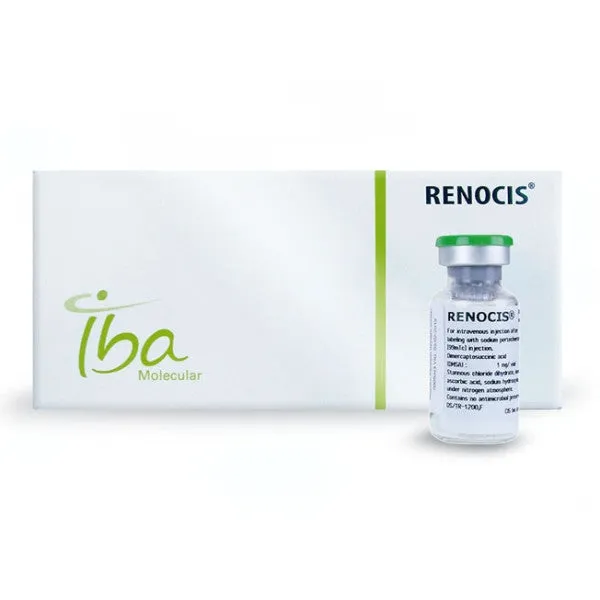
Table of Contents
Package leaflet: Information for the user
Introduction
Package leaflet: information for the patient
RENOCIS 1 mg reagent kit for radiopharmaceutical preparation
Succimer
Read the entire leaflet carefully before you are given this medicine, because it contains important information for you.
- Keep this leaflet, as you may need to read it again.
- If you have any questions, consult your nuclear medicine physician who supervises the procedure.
- If you experience any adverse reactions, consult your nuclear medicine physician, even if they are adverse reactions not listed in this leaflet. See Section 4.
Leaflet contents
- What RENOCIS is and what it is used for
- What you need to know before being given RENOCIS
- How to use RENOCIS
- Possible adverse reactions
- How to store RENOCIS
- Contents of the pack and other information
1. What RENOCIS is and what it is used for
This medicine is a radiopharmaceutical for diagnostic use only.
The active substance of Renocis is succimer. Renocis is used in combination with a radioactive technetium (99mTc) solution to form a technetium (99mTc) succimer solution for injection.
When injected, technetium (99mTc) succimer temporarily accumulates in the kidneys. Due to its radioactivity, it can be detected from outside the body using a special camera, allowing images—known as scintigraphies—to be obtained. These scans provide valuable information about the structure or function of the kidneys.
The use of Renocis involves exposure to a certain amount of radiation. Your doctor and the nuclear medicine physician have determined that the clinical benefit you will obtain from this radiopharmaceutical procedure outweighs the risk associated with radiation exposure.
2. What you need to know before using RENOCIS
RENOCIS must not be used
- If you are allergic to succimer or any of the other ingredients of this medicine (listed in section 6).
Warnings and precautions
Take special care with RENOCIS:
- If you suffer from an allergic disease, as allergic-type reactions have been reported with this type of examination.
- If you are pregnant or think you might be pregnant.
- If you are breastfeeding.
- If you have a kidney disease.
Consult your nuclear medicine specialist if you are in any of the situations mentioned above. RENOCIS may not be suitable for you. Your nuclear medicine specialist will provide you with appropriate instructions.
Before administration of Renocis you must:
Drink plenty of water before starting the examination to ensure you urinate as frequently as possible during the first hours after the examination.
Children and adolescents:
Inform your nuclear medicine specialist if you are under 18 years of age.
Use of RENOCIS with other medicines:
Inform your nuclear medicine specialist if you are taking, have recently taken, or might need to take any other medicines, including those obtained without a prescription, as some medicines may interfere with the interpretation of the images.
Your doctor or nuclear medicine specialist may recommend that you stop taking the following medicines before the Renocis procedure:
- Ammonium chloride (used in the treatment of recurrent urinary tract infections)
- Sodium bicarbonate (a medicine that reduces blood or urine acidity)
- Mannitol (used to reduce intracranial pressure)
- Certain antihypertensive medicines (so-called angiotensin-converting enzyme inhibitors [ACE inhibitors], such as captopril)
- Anticancer medicines, such as methotrexate, cyclophosphamide, and vincristine
Pregnancy and breastfeeding
If you are pregnant or breastfeeding, think you might be pregnant, or plan to become pregnant, consult your nuclear medicine specialist before using this medicine.
You must inform your nuclear medicine specialist before administration of Renocis if there is any possibility you are pregnant, if you have missed a period, or if you are breastfeeding.
If in doubt, it is important to consult your nuclear medicine specialist, who will supervise the procedure.
If you are pregnant
Examination with technetium (99mTc) is recommended to be avoided during pregnancy because it may pose risks to the fetus. The nuclear medicine specialist will administer this product during pregnancy only if the expected benefit outweighs the potential risks.
If you are breastfeeding
If you are breastfeeding, inform your nuclear medicine specialist, as they may delay the examination until after breastfeeding is completed or may ask you to interrupt breastfeeding for a period of time.
Your doctor will advise you when you can resume breastfeeding, which is usually 4 hours after injection. Breast milk expressed during this period should be discarded.
Driving and use of machines
It is considered unlikely that RENOCIS will affect your ability to drive or operate machinery.
RENOCIS contains sodium
This medicine contains less than 1 mmol of sodium (23 mg) per vial; i.e., essentially “sodium-free”.
3. How to use RENOCIS
There are strict regulations regarding the use, handling, and disposal of radiopharmaceuticals. Renocis will only be used in specially controlled areas. This medicine will only be handled and administered by trained and qualified personnel who are experienced in its safe use. These individuals will take special safety measures for the safe use of this medicine and will inform you about their actions.
The nuclear medicine physician supervising the procedure will determine the amount of technetium (99mTc) succimer to be used in your case, which will be the minimum quantity necessary to obtain the required information.
The amount generally recommended for administration in an adult normally ranges between 30 and 120 MBq (MBq: megabecquerel, the unit used to express radioactivity).
Use in children and adolescents
In children and adolescents, the administered amount will be adjusted according to body weight.
Administration of Renocis and performance of the procedure
Renocis is administered by injection into a vein in the arm.
One injection is sufficient to perform the procedure required by your physician.
Duration of the procedure
Your nuclear medicine physician will inform you about the usual duration of the procedure.
Scans may take from one to three hours after the injection. Occasionally, additional scans may be necessary up to 24 hours after the injection.
After administration of Renocis, you will be asked to drink as much as possible and to urinate frequently to help eliminate the product from your body.
The nuclear medicine physician will advise you whether you need to take special precautions after receiving this medicine. If you have any doubts, consult your nuclear medicine physician.
If you have been given more RENOCIS than you should
An overdose is unlikely, as you will receive a single dose of Renocis precisely controlled by the nuclear medicine physician supervising the procedure. However, in the event of an overdose, appropriate treatment will be given.
If you have any questions about the use of Renocis, ask the nuclear medicine physician supervising the procedure.
4. Possible adverse effects
Like all medicines, this medicinal product can produce adverse effects, although not everyone will experience them.
Administration of a radiopharmaceutical involves exposure to a small amount of ionizing radiation, with a very low risk of developing cancer and hereditary defects.
Cases of allergic reactions have been reported, with frequency not known.
Reporting of adverse effects
If you experience any type of adverse effect, consult the nuclear medicine specialist, even if they are possible adverse effects not listed in this leaflet. You may also report them directly through the Spanish Pharmacovigilance System for Human Medicinal Products: www.notificaRAM.es.
By reporting adverse effects, you can help provide more information on the safety of this medicinal product.
5. Storage of RENOCIS
You will not be required to store this medicine. This medicine is stored under the responsibility of the specialist in appropriate facilities.
Storage of radiopharmaceuticals must be carried out in accordance with national regulations concerning radioactive materials.
The following information is intended for specialists only.
Do not use Renocis after the expiry date stated on the label following EXP
6. Contents of the pack and other information
Composition of RENOCIS
- The active substance is succimer (dimercaptosuccinic acid).
- The other components are: tin chloride (II) dihydrate (E-512), inositol, ascorbic acid (E-300), sodium hydroxide (E-524), and nitrogen (E-941).
Appearance of the product and contents of the pack
Renocis is a kit of reagents for the preparation of a radiopharmaceutical, intended for use only by healthcare professionals. This medicine is presented as a white powder. It is supplied in multi-dose vials made of colourless, drawn glass type I according to Ph.Eur., with a chlorobutyl rubber stopper and sealed with an aluminum cap.
One pack contains 5 vials, each containing 1 mg.
Presentations: kit of 5 multi-dose vials.
Marketing Authorization Holder and Manufacturer:
CIS bio international
RN 306 - Saclay
B.P. 32
F-91192 Gif sur Yvette Cedex
France.
Further information on this medicinal product is available upon request to the local representative of the Marketing Authorization Holder:
Curium Pharma Spain, S.A.
Avda. Dr. Severo Ochoa, 29
28100-Alcobendas
Tel.: 91 4841989
Date of the most recent review of this summary: October 2018
This information is intended only for medical or healthcare professionals:
The full Summary of Product Characteristics for RENOCIS is included as a detachable section at the end of this package leaflet, in order to provide healthcare professionals with additional scientific and practical information on the administration and use of this radiopharmaceutical.
Please consult the Summary of Product Characteristics.