Reminyl 24 mg prolonged-release hard capsules
Spain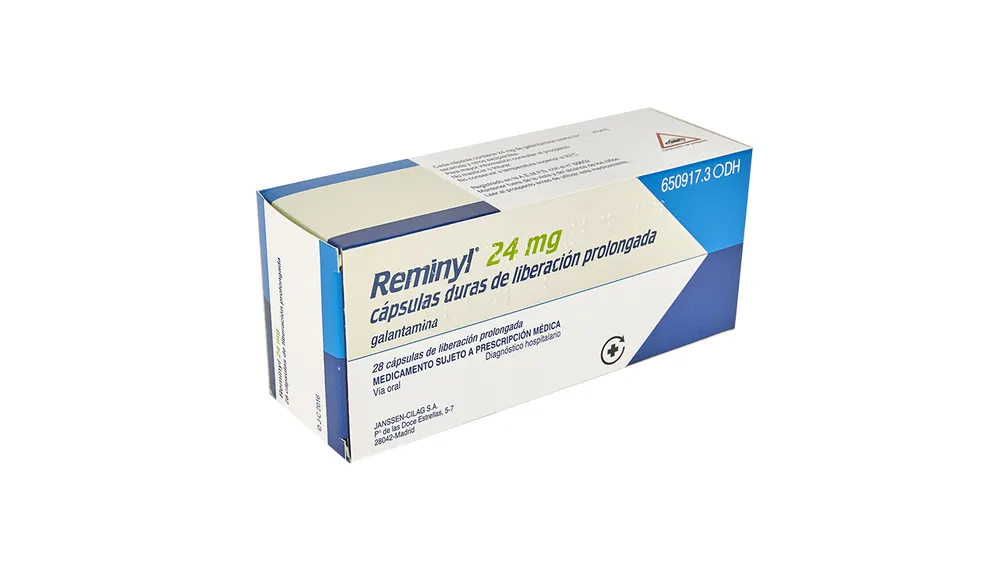
Table of Contents
- Package leaflet: Information for the user
- Introduction
- **Package leaflet:**
- 1. What Reminyl is and what it is used for
- 2. What you need to know before starting Reminyl
- **Other medicines and Reminyl**
- **Pregnancy and lactation**
- **Driving and operating machinery**
- **Reminyl contains sucrose**
- 3. How to take Reminyl capsules
- 4. Possible adverse effects
- 5. Reminyl Storage
- 6. Contents of the pack and other information
- Austria Reminyl 24mg Retardkapseln
- Portugal Reminyl 24mg prolonged-release capsules
- Spain Reminyl 24 mg prolonged release hard capsules
Package leaflet: Information for the user
Introduction
Package leaflet: Information for the user
Reminyl 24mg prolonged-release capsules
galantamine
Read the entire leaflet carefully before you start taking this medicine, as it contains important information for you.
- Keep this leaflet, as you may need to read it again.
- If you have any questions, consult your doctor or pharmacist.
- This medicine has been prescribed for you only; do not pass it on to other people, even if they have the same symptoms as you, because it may harm them.
- If you experience any adverse effects, consult your doctor or pharmacist, even if these are adverse effects not listed in this leaflet. See section 4.
Package leaflet:
- What Reminyl is and what it is used for
- What you need to know before taking Reminyl
- How to take Reminyl
- Possible side effects
- How to store Reminyl
- Contents of the pack and other information
1. What Reminyl is and what it is used for
Reminyl contains the active substance “galantamine”, an antidementia medicine. It is used in adults to treat the symptoms of mild to moderately severe Alzheimer's disease, a type of dementia that impairs brain function.
Alzheimer's disease causes increasing memory loss, confusion, and behavioral changes, making it progressively more difficult to carry out routine daily activities.
These effects are thought to be caused by a lack of “acetylcholine”, a substance responsible for transmitting messages between brain cells. Reminyl increases the amount of acetylcholine in the brain and thereby treats the symptoms of the disease.
The capsules are in the form of “prolonged release”. This means they release the medicine gradually.
2. What you need to know before starting Reminyl
Do not take Reminyl
- if you are allergic to galantamine or to any of the other components of this medicine (listed in section 6).
- if you have severe liver or kidney disease.
Warnings and precautions
Consult your doctor or pharmacist before starting Reminyl. This medicine should only be used for Alzheimer's disease and is not recommended for other types of memory loss or confusion.
Serious adverse effects
Reminyl may cause serious skin reactions, heart problems, and seizures. You should be alert to these adverse effects while taking Reminyl. See section 4, “Be alert to serious adverse effects”.
Before starting treatment with Reminyl, your doctor should know if you have or have had any of the following conditions:
- liver or kidney problems
- a heart disorder (such as chest pain usually caused by physical activity, heart attack, heart failure, slow or irregular heartbeat, prolonged QTc interval)
- changes in electrolyte levels (natural chemicals in the blood, such as potassium)
- peptic ulcer (stomach)
- obstruction in the stomach or intestine
- a nervous system disorder (such as epilepsy or problems controlling body or limb movements (extrapyramidal disorder))
- a respiratory disease or infection affecting breathing (such as asthma, obstructive lung disease, or pneumonia)
- problems with urine output.
Your doctor will decide whether Reminyl is suitable for you or whether the dose needs to be adjusted.
Also discuss with your doctor if you have recently had surgery on the stomach, intestine, or bladder. Your doctor will decide whether Reminyl is suitable for you.
Reminyl may cause weight loss. Your doctor will regularly monitor your weight while you are taking Reminyl.
Children and adolescents
The use of Reminyl is not recommended in children or adolescents.
Other medicines and Reminyl
Inform your doctor or pharmacist if you are taking, have recently taken, or might need to take any other medicines.
Reminyl should not be taken together with medicines that work in the same way. These include:
- donepezil or rivastigmine (for Alzheimer's disease)
- ambenonium, neostigmine, or pyridostigmine (for severe muscle weakness)
- pilocarpine (when taken by mouth for dry eyes or dry mouth).
Some medicines may be more likely to cause adverse effects in people taking Reminyl. These include:
-
medicines that affect the QTc interval
-
paroxetine or fluoxetine (antidepressants)
-
quinidine (for irregular heartbeat)
-
ketoconazole (an antifungal)
-
erythromycin (an antibiotic)
-
ritonavir (for human immunodeficiency virus or “HIV”)
-
non-steroidal anti-inflammatory analgesics (such as ibuprofen), which may increase the risk of ulcers
-
medicines for certain heart disorders or for high blood pressure (such as digoxin, amiodarone, atropine, beta-blockers, or calcium channel blockers). If you are taking medicines for an irregular heartbeat, your doctor may examine your heart using an “electrocardiogram” (ECG).
If you are taking any of these medicines, your doctor may prescribe a lower dose of Reminyl.
Reminyl may affect certain anaesthetics. If you are going to have surgery under general anaesthesia, inform your doctor well in advance that you are taking Reminyl.
Consult your doctor or pharmacist if you have any questions.
Pregnancy and lactation
If you are pregnant or breastfeeding, think you may be pregnant, or are planning to become pregnant, consult your doctor or pharmacist before using this medicine.
You must not breastfeed while taking Reminyl.
Driving and operating machinery
Reminyl may cause dizziness or drowsiness, especially during the first weeks of treatment. If Reminyl affects you in this way, do not drive or operate tools or machinery.
Reminyl contains sucrose
If your doctor has advised you that you have an intolerance to certain sugars, consult with him before taking this medicine.
3. How to take Reminyl capsules
Follow exactly the instructions given by your doctor or pharmacist for taking this medicine. If in doubt, consult your doctor or pharmacist again.
If you are currently taking Reminyl tablets or oral solution and your doctor has told you that you will be switching to Reminyl prolonged-release capsules, please read carefully the instructions under "Switching from Reminyl tablets or oral solution to Reminyl capsules" in this section.
How much to take
You will start treatment with Reminyl at a low dose. The usual starting dose is 8 mg taken once daily. Your doctor will gradually increase your dose every 4 weeks or longer until the most appropriate dose for you is reached. The maximum dose is 24 mg taken once daily.
Your doctor will explain to you which dose to start with and when to increase it.
If you are unsure what to do or find that the effect of Reminyl is too strong or too weak, inform your doctor or pharmacist.
Your doctor needs to see you regularly to check that this medicine is working and to discuss with you how you are feeling.
If you have liver or kidney problems, your doctor may prescribe you a reduced dose of Reminyl or may decide whether this medicine is suitable for you.
Switching from Reminyl tablets or oral solution to Reminyl capsules
If you are currently taking Reminyl tablets or oral solution, your doctor may decide to switch you to Reminyl prolonged-release capsules. If this applies to you:
- Take your last dose of Reminyl tablets or oral solution in the evening.
- The following morning, take your first dose of Reminyl prolonged-release capsules.
DO NOT take more than one capsule in a day. While taking one daily capsule of Reminyl capsules, DO NOT take Reminyl tablets or oral solution.
How to take it
Reminyl capsules should be swallowed whole and must NOT be chewed or crushed. Take your dose of Reminyl once daily in the morning, with water or other liquid. Try to take Reminyl with food.
Drink plenty of fluids while taking Reminyl to stay hydrated.
If you take more Reminyl than you should
In case of overdose or accidental ingestion, contact your doctor or pharmacist immediately or call the Toxicology Information Service at 91 562 04 20, indicating the medicine and the amount taken. Bring the packaging along with any remaining capsules. Signs of overdose may include:
- severe nausea and vomiting
- muscle weakness, slow heartbeat, seizures, and loss of consciousness.
If you forget to take Reminyl
If you forget to take a dose, skip that dose and continue your treatment as usual with the next scheduled dose. Do not take a double dose to make up for forgotten doses.
If you miss more than one dose, consult your doctor.
If you stop taking Reminyl
Consult your doctor before stopping treatment with Reminyl. It is important to continue taking this medicine to treat your condition.
If you have any further questions about the use of this medicine, ask your doctor or pharmacist.
4. Possible adverse effects
Like all medicines, this medicine may cause adverse effects, although not everyone gets them.
Be alert for serious adverse effects
Stop taking Reminyl and consult a doctor or go immediately to the nearest emergency service if you experience any of the following adverse effects:
Skin reactions, including:
- Severe rash with blisters and peeling of the skin, especially around the mouth, nose, eyes, and genitals (Stevens-Johnson syndrome).
- Red rash covered with small pus-filled bumps that may spread across the body, sometimes with fever (acute generalized exanthematous pustulosis).
- Rash that may cause blisters, with spots resembling small targets.
These skin reactions are rare in people taking Reminyl (may affect up to 1 in 1,000 people).
Heart problems, including changes in heartbeat (such as slow heartbeat or extra beats) or palpitations (feeling a fast or irregular heartbeat). Heart problems may appear as an abnormal tracing on an "electrocardiogram" (ECG), and may be common in people taking Reminyl (may affect up to 1 in 10 people).
Seizures. This is uncommon in people taking Reminyl (may affect up to 1 in 100 people).
You must stop taking Reminyl and seek immediate medical help if you notice any of the adverse effects listed above.
Other adverse effects
Very common adverse effects (may affect more than 1 in 10 people):
- Nausea and vomiting. These adverse effects are more likely to occur during the first weeks of treatment or when the dose is increased. They usually gradually disappear as the body adapts to the medicine and typically last only a few days. If you experience these effects, your doctor may recommend drinking more fluids and may prescribe a medicine to help prevent nausea.
Common adverse effects (may affect up to 1 in 10 people):
- Decreased appetite, weight loss
- Seeing, feeling, or hearing things that are not there (hallucinations)
- Depression
- Feeling dizzy or faint
- Tremors or muscle spasms
- Headache
- Feeling very tired, weak, or generally unwell
- Feeling very sleepy and lacking energy
- Increased blood pressure
- Abdominal pain or discomfort
- Diarrhea
- Indigestion
- Falls
- Injuries
Uncommon adverse effects (may affect up to 1 in 100 people):
- Allergic reaction
- Lack of body fluids (dehydration)
- Tingling or numbness of the skin
- Change in taste sensation
- Daytime sleepiness
- Problems controlling body movements or limbs (extrapyramidal disorder)
- Blurred vision
- Persistent ringing in the ears (tinnitus)
- Low blood pressure
- Flushing
- Feeling the need to vomit (nausea)
- Excessive sweating
- Muscle weakness
- Increased levels of liver enzymes in the blood.
Rare adverse effects (may affect up to 1 in 1,000 people):
- Inflamed liver (hepatitis).
Reporting of adverse effects
If you experience any type of adverse effect, talk to your doctor or pharmacist, even if it is a possible adverse effect not listed in this leaflet. You can also report them directly via the Spanish Pharmacovigilance System for Human Medicines: https://www.notificaram.es/. By reporting adverse effects, you can help provide more information on the safety of this medicine.
5. Reminyl Storage
Keep this medicine out of sight and reach of children.
Do not use this medicine after the expiry date stated on the label after EXP. The expiry date is the last day of the month indicated.
Do not store above 30°C.
Medicines must not be disposed of via wastewater or household waste. Dispose of unused medicines and their containers at the SIGRE collection point at your pharmacy. Ask your pharmacist how to properly dispose of medicines and containers you no longer need. This will help protect the environment.
6. Contents of the pack and other information
Composition of Reminyl
- The active substance is galantamine. Each prolonged-release capsule contains 24 mg of galantamine (as hydrobromide).
- The other components are:
Diethyl phthalate, ethylcellulose, hypromellose, macrogol 400, corn starch, sucrose, gelatin, titanium dioxide (E171), black iron oxide (E172), shellac and propylene glycol (E1520). Red iron oxide (E172), yellow iron oxide (E172).
Appearance of the product and contents of the pack
Reminyl 24 mg capsules are caramel-coloured with the imprint “G24”. Each pack contains blisters of 7, 28, 56 or 84 capsules, or bottles of 300 capsules.
Only certain pack sizes may be marketed.
Marketing Authorisation Holder and Manufacturer
Marketing Authorisation Holder
Essential Pharma Limited,
Vision Exchange Building,
Triq it-Territorjals, Zone 1,
Central Business District,
Birkirkara, CBD 1070,
Malta
Manufacturer
Janssen-Cilag, SpA Via C. Janssen
04100 Borgo San Michele
Latina (Italy)
This medicinal product is authorised in the Member States of the European Union under the following names:
Austria Reminyl 24mg Retardkapseln
Belgium Reminyl 24 mg hard capsules with prolonged release
Denmark Reminyl 24 mg depot capsules, hard
Finland Reminyl 24 mg depot capsules, hard
Greece Reminyl 24 mg prolonged release capsules, hard
Ireland Reminyl XL 24 mg prolonged release capsules
Italy Reminyl 24 mg prolonged release hard capsules
Luxembourg Reminyl 24 mg, hard capsules with prolonged release
Norway Reminyl 24 mg depot capsules, hard
Portugal Reminyl 24mg prolonged-release capsules
Spain Reminyl 24 mg prolonged release hard capsules
Sweden Reminyl 24 mg depot capsules, hard
United Kingdom (Northern Ireland) Reminyl XL 24 mg prolonged release capsules
This leaflet was approved in: October 2021.
Detailed and up-to-date information on this medicine is available on the website of the Spanish Agency for Medicines and Health Products (AEMPS) (http://www.aemps.gob.es/).