Positon 2.5 mg/g + 1 mg/g + 100,000 IU/g cream
Spain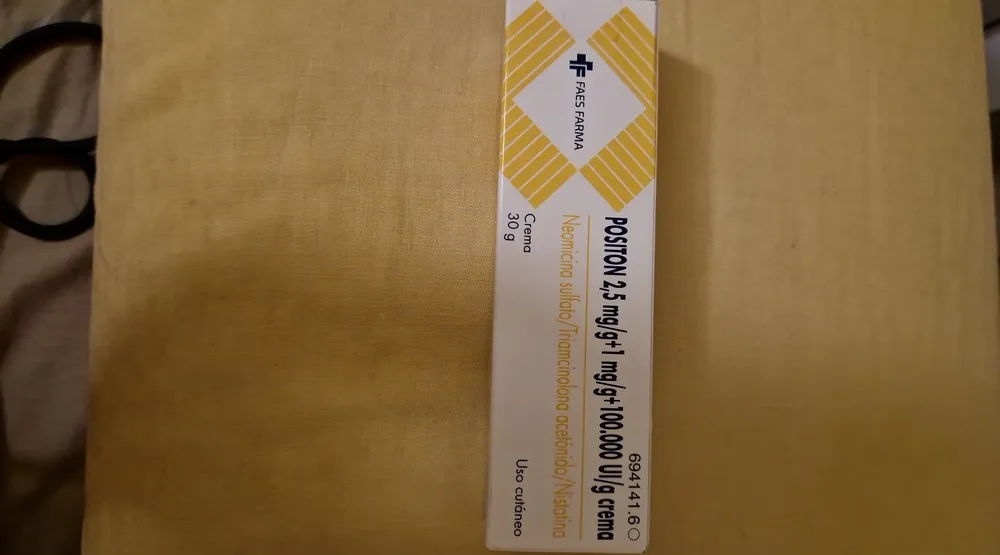
Table of Contents
Package leaflet: Information for the user
Introduction
Package leaflet: information for the user
Positon 2.5 mg/g + 1 mg/g + 100,000 IU/g cream
Neomycin / Triamcinolone / Nystatin
Read the entire leaflet carefully before you start using this medicine, because it contains important information for you.
- Keep this leaflet, as you may need to read it again.
- If you have any questions, ask your doctor or pharmacist.
- This medicine has been prescribed for you only, and you should not give it to others, even if they have the same symptoms as you, because it could harm them.
- If you experience any adverse effects, consult your doctor or pharmacist, even if they are adverse effects not listed in this leaflet. See section 4.
Leaflet contents
- What Positon cream is and what it is used for
- What you need to know before using Positon cream
- How to use Positon cream
- Possible side effects
- How to store Positon cream
- Contents of the pack and other information
1. What Positon cream is and what it is used for
It is a combination of an aminoglycoside antibiotic, an anti-inflammatory (corticosteroid), and an antifungal agent for topical administration on the skin.
Positon cream belongs to a group of medicines called topical corticosteroids. The term "topical" means that it is applied to the skin.
Positon cream also contains neomycin, an antibiotic used to prevent or treat certain bacterial skin infections, and nystatin, an antifungal agent used to treat fungal skin infections.
Antibiotics are used to treat bacterial infections and are not effective against viral infections.
It is important that you follow your doctor's instructions regarding dose, dosing interval, and duration of treatment.
Do not store or reuse this medicine. If you have any antibiotic left over after completing treatment, return it to the pharmacy for proper disposal. Do not dispose of medicines by flushing them down the sink or in household waste.
Positon cream is used to treat dermatological conditions responsive to corticosteroids when there is, or is at risk of, bacterial or fungal infection.
You should consult a doctor if your condition worsens or does not improve after 7 days.
2. What you need to know before using Positon cream
Do not use Positon cream
- If you are allergic to Neomycin, Triamcinolone, or Nystatin, or to any of the other ingredients of this medicine (listed in section 6).
- If you have rosacea (a skin condition causing facial redness), perioral inflammation (perioral dermatitis), acne, genital or perianal pruritus (itching), inflammatory skin reactions following vaccination (cutaneous vaccine reactions), or atrophic skin diseases.
- If you have skin infections caused by tuberculosis or viral infections such as herpes simplex or chickenpox.
- It should not be used in dermatoses in children under 1 year of age, due to an increased risk of enhanced absorption.
Warnings and precautions
Consult your doctor or pharmacist before starting to use Positon cream.
- Use this medicine only on your skin.
- Avoid contact with your eyes, mucous membranes, and open wounds, as it may cause irritation.
- Avoid covering the treated area with bandages, diapers, or dressings.
- Do not use Positon cream over large areas of skin unless specifically instructed by your doctor.
- Do not use on the face, or in areas of skin friction such as the groin, or other body areas (such as skin folds of arms and legs). Do not use Positon cream on ulcers, wounds, or stretch marks.
- If irritation or severe dryness occurs, consult your doctor.
- Its use is not recommended in pustular psoriasis or guttate psoriasis.
- Contact your doctor if you experience blurred vision or other visual disturbances.
Children and adolescents
The safety and efficacy of Positon cream in children have not been established.
The use of this medicine in children and adolescents should only occur when, in the physician’s judgment, its use is clearly necessary.
Treatment in children must be carefully monitored by a physician, especially when applied to large skin areas or when using occlusive dressings or tight diapers.
Prolonged and continuous topical treatment should always be avoided whenever possible, particularly in children, as it may lead to suppression of the hypothalamic-pituitary-adrenal axis, with or without development of Cushing's syndrome. If this occurs, consult your doctor, as the medicine must be withdrawn gradually and under medical supervision due to the risk of adrenal insufficiency.
Using Positon cream with other medicines
Inform your doctor or pharmacist if you are taking, have recently taken, or might need to take any other medicines, including those obtained without a prescription. Also consider any medicines applied to the skin.
If you are taking antibiotics of the same family as neomycin by mouth or by injection, toxicity may accumulate.
Pregnancy, breastfeeding, and fertility
Consult your doctor or pharmacist before using any medicine.
If you are pregnant or breastfeeding, think you may be pregnant, or are planning to become pregnant, consult your doctor or pharmacist before using this medicine.
Pregnancy
The use of Positon cream should be avoided during pregnancy. If you become pregnant while being treated with this medicine, consult your doctor immediately.
Breastfeeding
The use of Positon cream during breastfeeding is not recommended unless strictly necessary.
Driving and using machines
This medicine does not affect the ability to drive or operate machinery.
Important information about some of the components of Positon cream
Positon cream may cause local skin reactions (such as contact dermatitis) or skin irritation, as it contains cetyl alcohol, stearyl alcohol, propylene glycol, and sorbic acid (E 200).
It may also cause allergic reactions (possibly delayed), as it contains methylparahydroxybenzoate (E 218) and propylparahydroxybenzoate (E 216).
3. How to use Positon cream
Follow exactly the instructions for administration of this medicine given by your doctor or pharmacist. If in doubt, consult your doctor or pharmacist again.
Adults
Gently apply a thin layer of Positon cream to the affected area of skin two or three times a day. Applying a larger amount will not improve results. Apply the cream with your fingers to the affected area of skin. Be sure to wash your hands thoroughly with water and soap after applying the medicine to prevent accidental contact with your eyes or nose, as this may cause irritation.
To use the cream, unscrew the cap from the tube and, using the tip included on the outer end, pierce the metal seal.
Your doctor will determine the duration of treatment. Do not use Positon cream for longer than prescribed.
Use in children and adolescents
This medicine should only be used in children and adolescents when, in the doctor's judgment, its use is clearly necessary. In such cases, apply a thin layer once daily, and treatment should not exceed 7 days.
If used in children, treatment must be carefully monitored by the doctor. This is particularly important if the medicine is applied to more than 5 to 10% of the body surface area or if occlusive dressings or a tightly fitted diaper are used.
If you use more Positon cream than you should
If you apply too much Positon cream or use it for a prolonged period, some of the medicine may be absorbed into the body and cause unwanted effects.
Inform your doctor if you experience any adverse effect such as unusual tiredness or any other changes.
In case of overdose or accidental ingestion, contact your doctor or pharmacist immediately or call the Toxicology Information Service at telephone number 915620420, indicating the medicine and the amount used.
If you forget to use Positon cream
Apply the medicine as soon as possible, then continue with your normal dosing schedule.
Do not use a double dose to make up for a missed dose.
If you stop treatment with Positon cream
If used as normally prescribed, withdrawal effects should not occur when stopping treatment with Positon cream.
If you have been using large amounts of Positon cream for a prolonged period, your doctor will advise you on how to gradually reduce the dose so your body can adapt.
If you have any questions about the use of this medicine, ask your doctor or pharmacist.
4. Possible adverse effects
Like all medicines, this medicine may cause adverse effects, although not everyone will experience them.
The frequency with which adverse effects may occur is classified as follows:
Very common (may affect more than 1 in 10 people).
Common (may affect up to 1 in 10 people).
Uncommon (may affect up to 1 in 100 people).
Rare (may affect up to 1 in 1,000 people).
Adverse effects with frequency not known (cannot be estimated from the available data).
Very common adverse reactions | Hypersensitivity reactions (especially if used for prolonged periods), including: contact dermatitis, burning, erythema, rash, and urticaria. |
Common adverse reactions | Mild to moderate burning sensation at the application site, pruritus (itching), local cutaneous atrophy, pain, stinging, irritation, inflammation or erythema of the skin at the application site, which usually does not require discontinuation of treatment. |
Uncommon adverse reactions | Striae, secondary infection, papular facial rosacea, ecchymosis (appearance of small hemorrhages in the skin), folliculitis, erythema, pruritus (itching), burning sensation. |
Rare adverse reactions | Hypertrichosis, sensitization, hyper/hypopigmentation (changes in skin coloration), telangiectasias (dilation of small blood vessels in the skin), hypercorticism, adrenal suppression, anaphylactic reactions, contact dermatitis, perioral dermatitis, systemic activity. In rare cases, corticosteroid treatment of psoriasis may have led to the development of the pustular form of the disease. |
Adverse reactions of unknown frequency | Blurred vision. |
Other adverse effects include: purpura, acne (especially with prolonged treatment).
Contact your doctor immediately if you experience any of the following symptoms: appearance of a rash or skin eruption, difficulty breathing or swallowing, wheezing, or skin infection (redness, swelling, or pus).
Reporting of adverse effects
If you experience any type of adverse effect, consult your doctor or pharmacist, even if they are possible adverse effects not listed in this leaflet. You may also report them directly through the Spanish Pharmacovigilance System for Human Medicinal Products: www.notificaRAM.es. By reporting adverse effects, you can help provide more information on the safety of this medicine.
5. Storage of Positon cream
Keep this medicine out of sight and reach of children.
This medicine does not require any special storage conditions.
Do not use this medicine after the expiry date stated on the packaging after EXP. The expiry date refers to the last day of the month indicated.
Do not use Positon cream if you notice any visible signs of deterioration. Inform your doctor or pharmacist if you observe any changes in the appearance of Positon cream.
Medicines must not be disposed of via wastewater or household waste. Dispose of empty containers and unused medicines at the SIGRE point in your pharmacy. If in doubt, ask your pharmacist how to dispose of containers and unused medicines. This will help protect the environment.
6. Contents of the container and other information
Composition of Positon cream
- The active substances are: neomycin sulfate, triamcinolone acetonide and nystatin. Each gram of cream contains 2.5 mg of neomycin sulfate, 1 mg of triamcinolone acetonide and 100,000 IU of nystatin.
- The other components are: polyoxyl 40 stearate, glyceryl monostearate, white petrolatum, cetyl stearyl alcohol, aluminum hydroxide, titanium dioxide (E 171), sorbitol solution, propylene glycol, ethylenediamine dihydrochloride, methylparaben (E 218), propylparaben (E 216), sorbic acid (E 200), dimethicone, sodium hydroxide and water.
Appearance of the product and contents of the container
Positon cream is available in aluminum tubes containing 30 g or 60 g of cream.
Marketing Authorization Holder
Faes Farma, S.A.
Autonomia Etorbidea, 10
48940 Leioa (Bizkaia)
Spain
Manufacturer
Faes Farma Portugal, S.A.
Rua Elías García 28
2700-327 Amadora
Portugal
Date of the most recent revision of this leaflet: February 2018
Detailed and up-to-date information on this medicinal product is available on the website of the Spanish Agency for Medicines and Health Products (AEMPS) http://www.aemps.gob.es./