Plantaben 3.5 g effervescent powder
Spain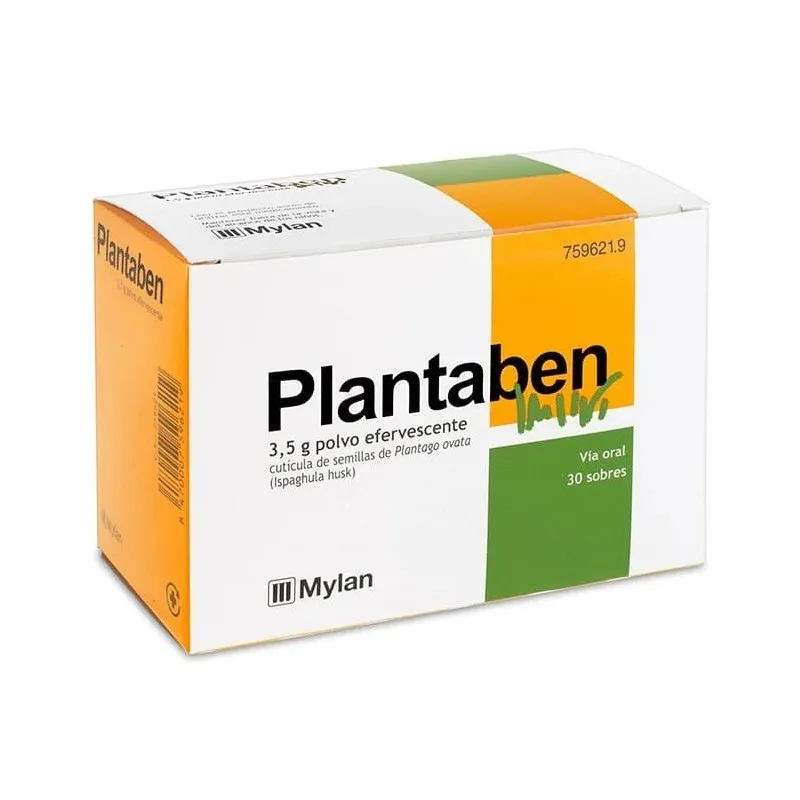
Table of Contents
Package leaflet: Information for the user
Introduction
PACKAGE LEAFLET: INFORMATION FOR THE USER
Plantaben 3.5 g effervescent powder
psyllium seed husk (Plantago ovata)
Read the entire leaflet carefully before starting to take this medicine, as it contains important information for you.
Follow exactly the instructions for use provided in this leaflet or those given by your doctor, pharmacist, or nurse.
-
Keep this leaflet, as you may need to read it again.
-
If you need advice or further information, consult your pharmacist.
-
If you experience any adverse effects, consult your doctor, pharmacist, or nurse, even if they are adverse effects not listed in this leaflet. See section 4.
- You should consult a doctor if your condition worsens or does not improve after 3 days.
Leaflet contents:
- What Plantaben is and what it is used for
- What you need to know before taking Plantaben
- How to take Plantaben
- Possible adverse effects
- How to store Plantaben
Contents of the pack and other information
1. What Plantaben is and what it is used for
Plantaben belongs to a group of medicines called: bulk-forming laxatives. The active ingredient is the husks of seeds from a plant known as Plantago ovata. These husks have a high capacity for retaining liquid, increasing the volume of stool and giving it an appropriate consistency to regulate intestinal transit.
Plantaben is used:
- For the symptomatic treatment of constipation.
- In situations where it would be desirable to facilitate defecation, for example in cases of painful bowel movements following rectal or anal surgery, anal fissures, and hemorrhoids.
You should consult a doctor if your condition worsens or does not improve after 3 days.
2. What you need to know before taking Plantaben
Do not take Plantaben
- If you are allergic to Plantago ovata seeds or to any of the other components of this medicine, listed in section 6 (see section “Warnings and precautions”).
- If you have intestinal obstruction, stenosis (narrowing) of the digestive tract, fecal impaction (accumulation of hardened stools), colonic atony (lack of tone and weakness), or ileus (paralysis of the colon).
- If you have abdominal pain, nausea, or vomiting.
- If you have difficulty swallowing.
- If you have poorly controlled diabetes mellitus.
- If you have undiagnosed rectal bleeding.
- If you are unable to defecate after using a laxative.
- If you have diseases of the esophagus or cardia (junction between esophagus and stomach).
- If you have intestinal paralysis or megacolon.
Warnings and precautions
Talk to your doctor, pharmacist, or nurse before starting to take Plantaben.
If you are a healthcare professional or caregiver who has handled products containing Plantago ovata seed powder for a prolonged period, you may have become allergic to these products due to continuous inhalation. If it is confirmed that the symptoms (listed in section 4) are due to an allergic reaction, do not use this product (see section “Do not take Plantaben”).
During treatment, you should drink 1 to 2 liters of water per day. Taking this product without sufficient liquid may cause blockage in the throat or esophagus.
Do not lie down immediately after taking this preparation.
If abdominal pain, nausea, or vomiting occur, stop treatment and consult a doctor.
Children and adolescents
Its use is not recommended in children under 6 years of age.
Other medicines and Plantaben
Inform your doctor or pharmacist if you are taking, have recently taken, or might need to take any other medicines.
- If you are taking other medicines such as minerals (calcium, iron, lithium, zinc), vitamins (vitamin B12), anticoagulants (so-called coumarin derivatives), or medications for heart conditions known as cardiac glycosides, take Plantaben 1 hour before or after taking your medication, as fiber may interfere with their absorption.
- Do not take Plantaben if you are taking anti-diarrheal drugs or drugs that reduce intestinal motility (such as difenoxilato, loperamide, or opioids), as intestinal obstruction may occur.
- In diabetic patients treated with insulin, it may be necessary to reduce the insulin dose when this medicine is taken with meals.
- Concomitant use with thyroid hormones requires medical supervision, as a dose adjustment of these hormones may be necessary.
Taking Plantaben with food and drink, and alcohol
Fiber can be taken before or after meals. If taken half an hour before meals, it may reduce appetite.
Pregnancy and breastfeeding and fertility
If you are pregnant or breastfeeding, think you may be pregnant, or are planning to become pregnant, consult your doctor or pharmacist before using this medicine.
Soluble fiber absorbs organic, inorganic, and mineral substances; therefore, to avoid the risk of excessive elimination of these substances during pregnancy, it is advised not to exceed the doses recommended in this leaflet or prescribed by your doctor.
Driving and using machines
No effects affecting the ability to drive or operate machinery have been reported.
Plantaben contains sodium saccharin, sodium bicarbonate, and the colouring agent Orange Yellow S (E-110)
This medicine contains 178.36 mg of sodium (the main component of table/cooking salt) per sachet. This corresponds to 26.7% of the maximum daily sodium intake recommended for an adult.
Consult your doctor or pharmacist if you need to take Plantaben daily or for a prolonged period, especially if you have been advised to follow a low-salt (low-sodium) diet.
This medicine may cause allergic reactions because it contains the colouring agent Orange Yellow S (E-110). It may cause asthma, particularly in patients allergic to acetylsalicylic acid.
3. How to take Plantaben
Follow exactly the instructions for use provided in this leaflet or those given by your doctor, pharmacist, or nurse. If in doubt, consult your doctor, pharmacist, or nurse.
Plantaben is administered orally.
Recommended dose:
Use in adults, elderly patients, and children over 12 years of age:
2 to 3 sachets per day (equivalent to 7 – 11 g of Ispaghula husk per day), depending on need and response.
Use in children aged 6 to 12 years:
1 to 2 sachets per day (equivalent to 3 – 8 g of Ispaghula husk per day), depending on need and response.
For proper administration, it is recommended to empty the contents of the sachet into a glass of cold water or any other liquid (200 cc), stir the mixture until uniform, and drink immediately. It is advisable to drink another glass of liquid afterwards. Additionally, it is recommended to drink 1 to 2 liters of water per day during treatment.
The medication should be taken in an upright position.
Do not lie down immediately after taking the preparation.
During preparation of the product for administration, avoid inhaling the powder.
Remember to take your medicine.
Use in children and adolescents
Its use is not recommended in children under 6 years of age.
If you take more Plantaben than you should
In case of overdose or accidental ingestion, contact your doctor or pharmacist immediately or call the Toxicology Information Service at telephone number 91 562 04 20, indicating the medication and the amount ingested.
No intoxication symptoms due to overdose have been described, as the active components of this preparation are not absorbed.
However, in case of massive ingestion, symptomatic treatment should be administered. Overdose with Ispaghula may cause abdominal discomfort, flatulence, and even intestinal obstruction. Adequate fluid intake should be maintained.
If you forget to take Plantaben
Do not take a double dose to make up for missed doses.
If you have any further questions about the use of this medicine, consult your doctor, pharmacist, or nurse.
4. Possible adverse effects
Like all medicines, Plantaben may cause adverse effects, although not everyone experiences them.
Plantago ovata seeds contain substances that may cause allergic reactions after oral administration of the medicine, upon contact with the skin, or, in the case of powder formulations, by inhalation.
Allergic symptoms may include nasal congestion, eye redness, difficulty breathing, skin reactions, itching, and in some cases anaphylaxis (a sudden and generalized allergic reaction that may cause life-threatening shock). Individuals who frequently handle powder formulations of the product are more likely to experience these reactions (see section 2).
At the beginning of treatment, and depending on the dose, some discomforts such as flatulence (gas) and a sensation of fullness may occur. These usually disappear within a few days without the need to discontinue the medication.
In some cases, abdominal distension may occur.
If taken without sufficient liquid, there is a risk of intestinal or esophageal obstruction or fecal impaction (accumulation of hardened stools).
Reporting of adverse effects
If you experience any type of adverse effect, consult your doctor, pharmacist, or nurse, even if it is a possible adverse effect not listed in this leaflet. You may also report them directly through the Spanish Pharmacovigilance System for Human Medicinal Products: https://www.notificaram.es. By reporting adverse effects, you can help provide more information on the safety of this medicine.
5. Storage of Plantaben
Keep this medicine out of the sight and reach of children.
Do not use this medicine after the expiry date stated on the packaging after CAD or EXP. The expiry date refers to the last day of the month indicated.
Medicines must not be disposed of via wastewater drains or household waste. Dispose of packaging and medicines you no longer need at the SIGRE collection point* at your pharmacy. If in doubt, ask your pharmacist how to properly dispose of packaging and medicines you no longer need. This way, you will help protect the environment.
6. Contents of the pack and other information
Composition of Plantaben
The active substance is the seed husk of Plantago ovata. Each sachet contains 3.5 g of Plantago ovata seed husk.
The other components are: sodium saccharin, sodium bicarbonate, tartaric acid, orange flavour, orange-yellow S colouring (E-110).
Appearance of the product and contents of the pack
Plantaben is presented in packs containing 30 effervescent powder sachets of 5 g each, beige in colour and orange-flavoured, for oral administration after dispersion in water.
Marketing Authorisation Holder
Cooper Consumer Health B.V.
Verrijn Stuartweg 60,
1112 AX Diemen,
The Netherlands
Manufacturer responsible for the medicinal product
Rottapharm Ltd.
Damastown, Ind. Park, Mulhuddart, Dublin 15, Ireland.
For further information on this medicinal product, please contact the local representative of the Marketing Authorisation Holder:
Vemedia Pharma Hispania, S.A.
C/ Aragón, 182, 5th floor
08011 - Barcelona
Spain
Date of the most recent review of this leaflet: April 2023
Detailed information on this medicinal product is available on the website of the Spanish Agency for Medicines and Health Products (AEMPS) https://www.aemps.gob.es/