Pigmentasa 40 mg/g cream
Spain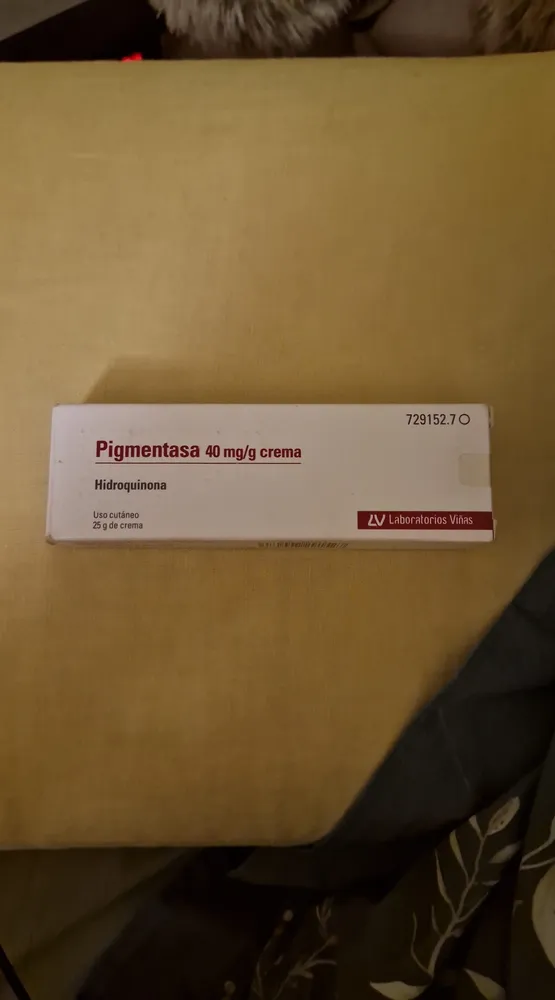
Instructions for Use
Table of Contents
- Introduction
- **Package leaflet:**
- 1. What Pigmentasa is and what it is used for
- 2. What you need to know before starting to use Pigmentasa
- **Warnings and precautions**
- **Use of Pigmentasa with other medicines**
- **Driving and use of machines**
- 3. How to use Pigmentasa
- 4. Possible adverse effects
- 5. Storage of Pigmentasa
- 6. Contents of the pack and other information
- **Composition of Pigmentasa**
Patient Information Leaflet
Introduction
Patient Information Leaflet
PIGMENTASA 40 MG/G CREAM
Read the entire leaflet carefully before you start using this medicine, as it contains important information for you.
|
Package leaflet:
- What Pigmentasa is and what it is used for
- What you need to know before using Pigmentasa
- How to use Pigmentasa
- Possible side effects
- How to store Pigmentasa
- Contents of the pack and other information
1. What Pigmentasa is and what it is used for
Pigmentasa contains hydroquinone, which is a locally-acting depigmenting active ingredient.
Pigmentasa works through a dual mechanism. On one hand, hydroquinone is capable of depigmenting the skin by gradually reducing the overproduction of melanin that causes dark skin spots. On the other hand, the medicine includes a combination of sun filters that prevent darkening (repigmentation) induced by sunlight.
This medicine is indicated in adults and children over 12 years of age for lightening small dark spots on the skin (cutaneous hyperpigmentation), such as melasma and chloasma, senile lentigo, and freckles.
2. What you need to know before starting to use Pigmentasa
Do not use Pigmentasa
- If you are allergic to hydroquinone or to any of the other ingredients of this medicine (listed in section 6).
- In cases of chemical hyperpigmentations such as ochronosis and colloidal degeneration (colloidal milium), whether of occupational or cosmetic origin.
- On open wounds, mucous membranes, eczematous or irritated skin, or sunburns.
Warnings and precautions
Consult your doctor or pharmacist before starting to use Pigmentasa.
- Avoid contact with eyes and mucous membranes. In case of accidental contact with the eyes, wash thoroughly with plenty of water to prevent possible formation of opaque spots on the cornea. In case of contact with the lips, you may notice a bitter taste and a slight anesthetic effect in the area.
- If the pigmented area is very extensive, treatment should be carried out in separate cycles.
- Protect the treated area from sunlight during treatment with hydroquinone, as even minimal sun exposure may reactivate melanin production. It is advisable to use a high-protection sunscreen during the day.
- This product must not be used to prevent sunburn.
- If you have very dark skin, the effects of hydroquinone may be less noticeable.
- If you have sensitive skin, hypersensitivity reactions may occur. To prevent this, it is advisable to apply a small amount of the product to the inner forearm for at least 24 hours. If severe irritation occurs, discontinue use of this product.
- In some cases, temporary darkening or irritation of the skin may occur; if this persists, treatment should be discontinued.
Depigmentation is not immediate, as hydroquinone only interferes with the formation of new melanin, and is temporary, since melanin production resumes when treatment is stopped. Depigmentation may last between 2 and 6 months after treatment ends. The darker the lesions, the sooner repigmentation occurs.
Children and adolescents
Do not use in children under 12 years of age.
Use of Pigmentasa with other medicines
Inform your doctor or pharmacist if you are using or have recently used any other medicines, including those obtained without a prescription.
You should not use topical preparations containing peroxides (for example: hydrogen peroxide, benzoyl peroxide, etc.) simultaneously on the same area of skin where Pigmentasa is being applied, as this may cause temporary skin discoloration due to oxidation of hydroquinone. This temporary discoloration resolves by discontinuing one of these medicines and washing the affected area with mild soap.
Pregnancy, breastfeeding and fertility
If you are pregnant or breastfeeding, think you may be pregnant, or are planning to become pregnant, consult your doctor or pharmacist before using this medicine.
The safety of Pigmentasa in human pregnancy has not been established. Therefore, this medicine should only be used during pregnancy and breastfeeding when strictly necessary, as determined by a physician.
Driving and use of machines
No effects on the ability to drive and use machines have been reported.
Pigmentasa contains cetearyl alcohol, cetyl alcohol, methylparaben (E-218), propylparaben (E-216), and propylene glycol.
This medicinal product may cause local skin reactions (such as contact dermatitis) because it contains cetearyl alcohol and cetyl alcohol.
It may cause allergic reactions (possibly delayed) because it contains methylparaben (E-218) and propylparaben (E-216).
This medicinal product contains 10 mg of propylene glycol per gram of cream.
3. How to use Pigmentasa
Follow exactly the administration instructions for this medicine given by your doctor or pharmacist.
If in doubt, consult your doctor or pharmacist again.
Pigmentasa is a topical medication (for use on the skin only).
Use in children
Do not use in children under 12 years of age.
Adults and children over 12 years of age
Before using the tube for the first time, unscrew the brown cap, remove and discard the white ring, and then screw the cap back on.
Apply a thin layer of the cream only to small hyperpigmented areas, always avoiding contact with eyes and mucous membranes.
Begin with one application per day for 10 to 15 days exclusively on the spot, and then continue treatment with two daily applications, one in the morning and one at night. You must wash your hands thoroughly with soap after applying the product, as hydroquinone may cause brown stains on the nails, which disappear over time.
If you do not observe improvement after 2 months of treatment, you should discontinue use and consult your doctor.
The recommended duration of treatment is 60 to 90 days.
This medicine must not be used for more than 6 months under any circumstances.
Your doctor will determine the duration of your treatment with Pigmentasa. Do not stop the treatment prematurely, as you will not achieve the desired effects.
If you feel that the effect of Pigmentasa is too strong or too weak, inform your doctor or pharmacist.
If you use more Pigmentasa than you should
Due to its topical use, cases of intoxication are unlikely.
In case of accidental ingestion, serious manifestations of systemic toxicity similar to those of phenol may occur. Oral ingestion of 5–15 g of hydroquinone may cause tremors, convulsions, and hemolytic anemia. Gastric lavage is recommended.
In case of overdose or accidental ingestion, contact your doctor or pharmacist immediately, or call the Toxicology Information Service at telephone number 91 562 04 20, indicating the medicine and the amount used.
If you forget to use Pigmentasa
Do not apply a double amount to make up for missed doses. Continue treatment with the recommended dosage.
If you stop treatment with Pigmentasa
Your doctor will determine the duration of your treatment with Pigmentasa. Do not stop the treatment prematurely, as you will not achieve the desired effects.
If you have any further questions about the use of this medicine, ask your doctor or pharmacist.
4. Possible adverse effects
Like all medicines, this medicine can cause adverse effects, although not everyone will experience them.
The adverse effects listed below are classified according to frequency and by organ and system. Frequency categories are defined by the following convention: very common (affects more than 1 in 10 patients); common (affects up to 1 in 100 patients); uncommon (affects up to 1 in 1,000 patients); rare (affects between 1 and 10 in 10,000 patients); very rare (affects less than 1 in 10,000 patients); frequency not known (cannot be estimated from available data).
Uncommon: skin inflammation and redness (erythema) and stinging.
Rare: increased skin sensitivity (increased cutaneous sensitization) and skin spots (cutaneous hyperpigmentation).
Very rare: bluish-black discoloration of cartilage, tendons, and certain areas of the face (ochronosis) and skin depigmentation (leucoderma).
If any adverse reactions occur, treatment should be discontinued.
Reporting of adverse effects
If you experience any type of adverse effect, consult your doctor or pharmacist, even if it is a possible adverse effect not listed in this leaflet. You may also report them directly through the national reporting system: www.notificaRAM.es.
By reporting adverse effects, you can help provide more information on the safety of this medicine.
5. Storage of Pigmentasa
Keep this medicinal product out of the sight and reach of children.
Keep the container tightly closed after each use to protect it from light.
Do not use this medicinal product after the expiry date stated on the container following EXP. The expiry date refers to the last day of the month indicated.
Do not use this medicinal product if you observe dark discoloration, even if it is within the validity period.
Medicines must not be disposed of via wastewater or household waste. Unused containers and medicines should be returned to the SIGRE point at your pharmacy. Ask your pharmacist how to properly dispose of containers and medicines you no longer need. This will help protect the environment.
6. Contents of the pack and other information
Composition of Pigmentasa
-
The active substance is hydroquinone. Each gram of cream contains 40 mg of hydroquinone.
-
The other components (excipients) are: emulsifying cetostearyl alcohol type B, ethylhexyl methoxycinnamate, cetostearyl alcohol, ceteareth ether of macrogol, isopropyl myristate, polysorbate 20, decyl oleate, butyl methoxydibenzoylmethane, propylene glycol, sodium metabisulfite (E-223), methyl parahydroxybenzoate (E-218), propyl parahydroxybenzoate (E-216), disodium edetate, and purified water.
Presentation of the product and contents of the container
Pigmentasa is presented as a white cream in 25-gram aluminium tubes.
Marketing Authorization Holder and Manufacturer
Marketing Authorization Holder
Laboratorios Viñas, S.A.
Provenza, 386
08025-Barcelona
Spain
Manufacturer
Laboratorios Viñas, S.A.
Torrente vidalet, 29
08012 Barcelona
Spain
Laboratorios Viñas, S.A.
Polígono Industrial Can Rosés, Avenida Can Rosés, s/n,
08191 Rubí
Spain
Date of the most recent revision of this leaflet: July 2025
Detailed information on this medicinal product is available on the website of the Spanish Agency of Medicines and Health Products (AEMPS) http://www.aemps.gob.es/
Similar Medications
-
Hquin 40 mg/g cream
Form: cream
Active substance Dosage HYDROQUINONE 1,20 g Manufacturer: Galenicum Derma S.L.U.
-
Melanase 20 mg/g cream
Form: cream
Active substance Dosage HYDROQUINONE 2000 mg Manufacturer: Laboratorios Vinas S.A.
This page has been machine-translated and may contain inaccuracies. The original data is available in the manufacturing country's language.
Last data check: May 18, 2026 · Data source: CIMA — AEMPS