Periactin 4 mg tablets
Spain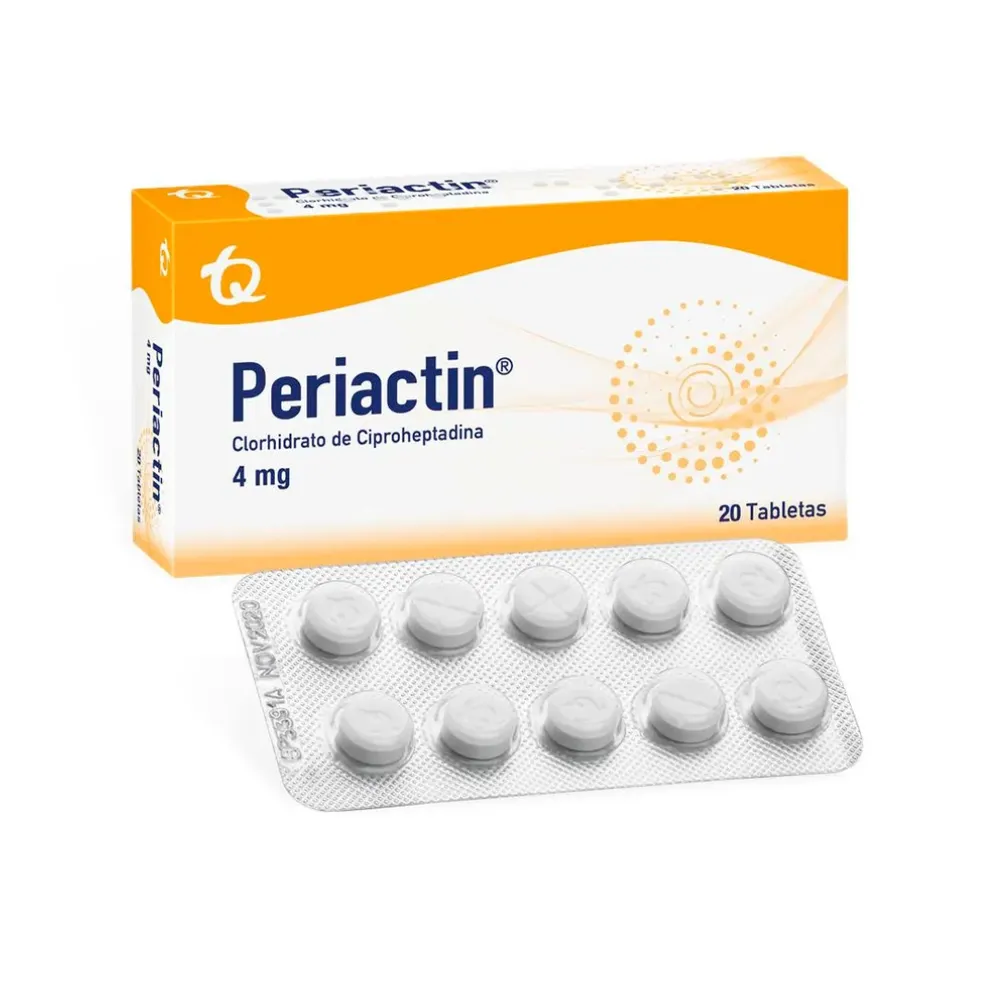
Table of Contents
Package leaflet: Information for the user
Introduction
Package leaflet: information for the patient
Periactin 4 mg tablets
ciproheptadine hydrochloride 1.5 hydrate
Read the entire leaflet carefully before you start taking this medicine, because it contains important information for you.
Follow exactly the instructions for use provided in this leaflet or as directed by your doctor or pharmacist.
- Keep this leaflet, as you may need to read it again.
- If you need advice or more information, consult your pharmacist.
- If you experience any adverse effects, consult your doctor or pharmacist, even if they are adverse effects not listed in this leaflet. See section 4.
- You should consult a doctor if you worsen or do not improve.
Leaflet contents
- What Periactin is and what it is used for
- What you need to know before taking Periactin
- How to take Periactin
- Possible side effects
- Storage of Periactin
- Contents of the pack and other information
1. What Periactin is and what it is used for
Periactin contains the active substance cyproheptadine hydrochloride 1.5 hydrate, an antihistamine used in adults and children from two years of age for:
- symptomatic treatment of allergies (rhinitis, conjunctivitis, urticaria).
- complementary treatment of severe allergic reactions (anaphylactic reactions) after acute symptoms have been controlled.
You should consult a doctor if your condition worsens or does not improve.
2. What you need to know before taking Periactin
Do not take Periactin
- If you are allergic to cyproheptadine hydrochloride 1.5 hydrate or to any of the other ingredients of this medicine (listed in section 6).
- If you are allergic to drugs with a chemical structure similar to cyproheptadine (piperidines, such as donepezil) or to other antihistamines.
- If you have closed-angle glaucoma.
- If you are experiencing an acute asthma attack.
- If you have intestinal ulcers leading to narrowing of the stomach, small intestine, or esophagus (stenosing peptic ulcer).
- If you have an enlarged prostate (prostatic hypertrophy).
- If you have a bladder neck obstruction or an obstruction of the valve connecting the stomach to the duodenum (pyloroduodenal obstruction).
- If you are being treated with monoamine oxidase inhibitors (see section 2 “Other medicines and Periactin”).
- If you are breastfeeding (see “Pregnancy and lactation”).
- Do not give this medicine to a newborn or premature infant.
- If you are elderly or in poor health, as you may be more prone to drowsiness and low blood pressure with this medicine.
Warnings and precautions
Talk to your doctor or pharmacist before taking this medicine:
- If you have a serious respiratory disease.
- If you have porphyria (a rare disorder, usually hereditary, in which large amounts of porphyrin are excreted in feces and urine).
- If you have a condition involving abnormally increased activity of the thyroid gland (hyperthyroidism), high intraocular pressure, heart disease, or high blood pressure.
- If you are taking any medicine that causes ear toxicity, as symptoms of such toxic effects (such as ringing in the ears, dizziness, or vertigo) may be masked.
- If you have any kidney disease or disorder.
Antihistamines may reduce alertness; conversely, they may occasionally cause excitation, especially in young children.
Rarely, prolonged treatment with antihistamines may cause changes in blood cell counts.
Treatment with antihistamines may mask the toxic effects of medicines that cause ear toxicity.
Children and adolescents
This medicine should not be used in newborns or premature infants (see “Do not take Periactin”).
The use of this medicine is not recommended in children under 2 years of age, as its efficacy and safety have not been established in this population.
Due to the high sensitivity of children to antihistamines, the dose of cyproheptadine should be determined with particular caution in this group.
Other medicines and Periactin
Tell your doctor or pharmacist if you are taking, have recently taken, or might need to take any other medicines.
Inform your doctor if you are taking:
- Monoamine oxidase inhibitors (MAOIs), such as moclobemide (used to treat depression) or selegiline, rasagiline (used to treat Parkinson’s disease). These medicines should not be taken at the same time as Periactin (see section 2 “Do not take Periactin”).
- Medicines that induce sleep and medicines that reduce the activity of the central nervous system (hypnotics, sedatives, tranquilizers, anxiolytics). This medicine may enhance their effects.
- Selective serotonin reuptake inhibitors (SSRIs), such as fluoxetine, paroxetine, sertraline, citalopram, escitalopram (medicines used for depression), as Periactin may cause a possible recurrence of depression and associated symptoms.
Taking Periactin with food, drinks and alcohol
Alcohol intake should be avoided during treatment. Alcohol increases the effects of this medicine.
Interference with diagnostic tests
If you are undergoing a pituitary function test, inform your doctor that you are taking this medicine, as it may alter the test result.
If you are undergoing a test to detect tricyclic antidepressants in blood or urine, inform your doctor that you are taking this medicine, as it may alter the test result.
Pregnancy and lactation
If you are pregnant or breastfeeding, think you may be pregnant, or plan to become pregnant, consult your doctor or pharmacist before using this medicine.
Cyproheptadine should be used during pregnancy only if strictly necessary and under close medical supervision.
If you take this medicine during the last three months of pregnancy, your baby may experience adverse effects.
This medicine is contraindicated in breastfeeding mothers (see “Do not take Periactin”). It is unknown whether cyproheptadine passes into breast milk. Due to the possibility of serious adverse effects in infants, your doctor will decide with you whether it is necessary to discontinue breastfeeding or discontinue treatment.
Driving and using machines
This medicine may cause drowsiness and could therefore affect your ability to drive and/or operate machinery. Patients should avoid operating dangerous machinery, including automobiles, until they know how they tolerate the medicine.
This medicine contains lactose
If your doctor has informed you that you have an intolerance to certain sugars, consult with him before taking this medicine.
3. How to take Periactin
Follow exactly the instructions for administering this medicine as stated in this leaflet or as directed by your doctor or pharmacist. If in doubt, consult your doctor or pharmacist.
Adults
The recommended initial dose is 4 mg (1 tablet) three times daily; thereafter the dose should be adjusted according to the patient's response. The recommended maintenance dose is 12 mg to 16 mg daily, divided into three doses. The dose should not exceed 32 mg daily, divided into three doses.
Use in children
Children 2 to 6 years of age: The recommended dose is 2 mg (half a tablet) two or three times daily, according to the patient's response. The total daily dose must not exceed 12 mg, divided into three doses.
Children 7 to 14 years of age: The recommended dose is 4 mg (1 tablet) two or three times daily, according to the patient's response. The total daily dose must not exceed 16 mg, divided into three doses.
Adolescents from 15 years of age: The recommended initial dose is 4 mg (1 tablet) three times daily; thereafter the dose should be adjusted according to the patient's response. The recommended maintenance dose is 12 mg to 16 mg daily, divided into three doses. The dose should not exceed 32 mg daily, divided into three doses.
The tablet may be divided into equal doses.
If you take more Periactin than you should
If you take more Periactin than recommended, you may experience hallucinations, depression or stimulation of central nervous system functions, seizures, respiratory and cardiac arrest, and death—especially in children.
Gastrointestinal symptoms and other effects such as dry mouth, flushing, and pupil dilation may also occur.
In case of overdose or accidental ingestion, contact your doctor or pharmacist immediately, or call the Toxicology Information Service at telephone number 91-562 04 20, stating the name of the medicine and the amount ingested.
If you forget to take Periactin
Do not take a double dose to make up for forgotten doses.
If you have any further questions about the use of this medicine, ask your doctor or pharmacist.
4. Possible adverse effects
Like all medicines, this medicine may cause adverse effects, although not everyone experiences them.
The adverse effects that occur frequently are drowsiness and increased tendency to sleep. Many patients who experience drowsiness at the beginning of treatment return to normal after 3 or 4 days of treatment.
During the period of ciproheptadine use, the following adverse reactions have been reported, although their frequency cannot be accurately determined:
- haemolytic anaemia, decreased white blood cells, decreased granulocytes, decreased platelets
- allergic oedema (swelling of the face, lips, mouth, tongue or throat), anaphylactic shock (severe allergic reaction)
- increased appetite, decreased appetite
- agitation, confusion, feeling detached from oneself, one's thoughts, feelings and surroundings, euphoria, hallucinations, insomnia, irritability, nervousness, restlessness
- sedation, somnolence, dizziness, coordination disorders, tremor, numbness, tingling or pins and needles (paraesthesia), nerve inflammation, seizures, syncope, headache
- inner ear inflammation (labyrinthitis), blurred vision, double vision, dizziness, ringing in the ears (tinnitus)
- palpitations, tachycardia (rapid heartbeat), extrasystoles (heartbeats occurring earlier than the normal cardiac contraction)
- low blood pressure
- dry nose, dry throat, thickening of bronchial secretions, chest tightness, wheezing (audible whistling breathing), sneezing, nasal congestion
- dry mouth, stomach discomfort, nausea, vomiting, diarrhoea, constipation
- jaundice (yellowing of the skin and mucous membranes), increased transaminases in blood
- allergic dermatitis, excessive sweating, urticaria, increased sensitivity of the skin to sunlight and ultraviolet light (photosensitivity)
- frequent urination, difficult urination, urinary retention
- early onset of menstruation
- fatigue, chills, tiredness
- weight gain
Reporting of adverse effects
If you experience any type of adverse effect, consult your doctor or pharmacist, even if it is a possible adverse effect not listed in this leaflet. You may also report them directly via the Spanish Pharmacovigilance System for Human Medicines: www.notificaram.es. By reporting adverse effects, you can help provide more information on the safety of this medicine.
5. Storage of Periactin
Keep this medicine out of the sight and reach of children.
Do not use this medicine after the expiry date stated on the packaging after EXP. The expiry date refers to the last day of the month indicated.
No special storage conditions are required.
Medicines must not be disposed of via wastewater or household waste. Ask your pharmacist how to dispose of medicines and packaging no longer required. Dispose of unused containers and medicines at the SIGRE collection point at your pharmacy. This helps protect the environment.
6. Contents of the container and additional information
Composition of Periactin
- The active substance is cyproheptadine hydrochloride 1.5 hydrate. Each tablet contains 4 mg of cyproheptadine hydrochloride 1.5 hydrate.
- The other components (excipients) are lactose monohydrate, sodium carboxymethyl starch (type A) (from potato), magnesium stearate, dicalcium phosphate dihydrate.
Appearance of the product and contents of the pack
Periactin are white, round tablets, scored on one side and engraved with the sigma symbol and the number 62 on the other.
They are available in packs of 30 tablets.
Marketing Authorization Holder
Alfasigma España, S.L.
C/ Aribau 195, 4º
08021 Barcelona. Spain
Manufacturer
Pharmaloop, S.L.
C/Bolivia, 15 - Polígono Industrial Azque
28806 Alcalá de Henares (Madrid). SPAIN
or
Alfasigma S.p.A.
Via Pontina Km 30,400
00071 Pomezia, Rome. ITALY
Date of the most recent revision of this leaflet: February 2023.
Other sources of information
Detailed information on this medicinal product is available on the website of the Spanish Agency for Medicines and Health Products (AEMPS) http://www.aemps.gob.es/.