Pecfent 100 micrograms/spray, solution for nasal spray
Spain
Table of Contents
Package leaflet: Information for the user
Introduction
Package leaflet: information for the user
PecFent 100 micrograms/spray, solution for nasal spray
PecFent 400 micrograms/spray, solution for nasal spray
fentanyl
Read all of this leaflet carefully before you start using this medicine, because it contains important information for you.
- Keep this leaflet, as you may need to read it again.
- If you have any questions, ask your doctor or pharmacist.
- This medicine has been prescribed for you only, and you should not give it to others, even if they have the same symptoms as you, because it may harm them.
- If you experience any adverse effects, consult your doctor or pharmacist, even if they are adverse effects not listed in this leaflet. See section 4.
Contents of this leaflet
- What PecFent is and what it is used for
- What you need to know before using PecFent
- How to use PecFent
- Possible side effects
- How to store PecFent
- Contents of the pack and other information
1. What PecFent is and what it is used for
What PecFent is
PecFent contains fentanyl, which is a potent pain-relieving medicine known as an opioid analgesic.
What PecFent is used for
PecFent is used in adults with cancer for a type of pain called "breakthrough" pain.
- This type of pain occurs suddenly.
- It occurs even when the usual opioid painkiller (for example, morphine, fentanyl, oxycodone or hydromorphone) has been taken to control constant background pain.
PecFent should only be used by adults who are already taking other opioids daily for constant pain caused by cancer.
How PecFent works
PecFent is a solution for nasal spray.
- When PecFent is sprayed into the nose, the tiny droplets of the spray form a thin gel.
- Fentanyl is rapidly absorbed through the nasal mucosa and passes directly into the bloodstream.
- This means that the medicine reaches your body quickly to relieve breakthrough pain.
2. What you need to know before using PecFent
Do not use PecFent:
- If you are allergic to fentanyl or any of the other components of this medicine (listed in section 6).
- If you are not already taking a prescribed opioid medicine (e.g., codeine, fentanyl, hydromorphone, morphine, oxycodone, meperidine) regularly, every day at the same time, for at least one week to manage persistent pain. If you have not been taking such medicines, do not use PecFent, as its use may increase the risk of your breathing becoming slower and/or shallower, or even stopping completely.
- If you have short-term pain that is not breakthrough pain.
- If you have a severe respiratory or lung condition.
- If you are being treated with medicines containing sodium oxybate.
Do not use PecFent if any of the above conditions apply to you. If you are unsure, consult your doctor or pharmacist before using PecFent.
Warnings and precautions
Keep this medicine in a safe and secure place, out of reach of others (see section 5, Storage of PecFent, for more information).
Keep PecFent out of the reach of children
- You must keep PecFent in its child-resistant storage container when not in use, even after you have used all eight sprays. This is because PecFent can be potentially fatal if accidentally taken by a child.
Consult your doctor or pharmacist before starting to use PecFent:
- If you have not been taking the same daily dose of your opioid for some time to manage your constant pain.
- If you have breathing problems, such as asthma, wheezing, or difficulty breathing.
- If you have suffered a severe head injury.
- If you have heart problems, especially a slow heart rate.
- If you have low blood pressure or low fluid volume in your circulation.
- If you have kidney or liver problems, as these may affect how your body breaks down the medicine.
- If you are taking antidepressants or antipsychotics, see the section “Other medicines and PecFent”.
If any of the above conditions apply to you (or you are unsure), consult your doctor or pharmacist before using PecFent.
- If you are an athlete, PecFent may lead to positive results in anti-doping tests.
Consult your doctor if, while using PecFent:
- You experience recurrent nosebleeds; your doctor may recommend an alternative treatment.
- You feel that PecFent is becoming less effective in treating your breakthrough pain episodes.
- You experience pain or increased sensitivity to pain (hyperalgesia) that does not respond to a higher dose of the medicine as prescribed by your doctor.
- You believe you are becoming addicted to PecFent.
- You develop a combination of the following symptoms: nausea, vomiting, loss of appetite, fatigue, weakness, dizziness, and low blood pressure. Together, these symptoms may indicate a potentially life-threatening condition called adrenal insufficiency, in which the adrenal glands do not produce enough hormones.
- You have previously experienced adrenal insufficiency or sex hormone deficiency (androgen deficiency) while using opioids.
Long-term use and tolerance
This medicine contains fentanyl, an opioid. Repeated use of opioid painkillers may cause the medicine to become less effective (your body becomes accustomed to it, known as pharmacological tolerance). You may also become more sensitive to pain when using PecFent. This is known as hyperalgesia. Increasing the dose of PecFent may continue to reduce pain for a time, but it may also be harmful. If you notice that the medicine is losing effectiveness, consult your doctor. Your doctor will decide whether it is better to increase the dose or gradually reduce the use of PecFent.
Dependence and addiction
Repeated use of PecFent may also lead to dependence, abuse, and addiction, which could result in a potentially fatal overdose. The risk of these adverse effects may be higher with higher doses and prolonged use. Dependence or addiction may cause you to feel a lack of control over how much medicine you take or how often you take it. You may feel the need to continue using the medicine even if it does not help relieve your pain.
The risk of dependence or addiction varies from person to person. The risk of becoming dependent on or addicted to PecFent may be higher if:
- You or any member of your family have abused or been dependent on alcohol, prescription medicines, or illegal drugs (“addiction”).
- You smoke.
- You have ever had mood disorders (depression, anxiety, or a personality disorder) or have received treatment from a psychiatrist for other mental illnesses.
If you notice any of the following symptoms while using PecFent, this could be a sign of dependence or addiction:
- You need to use the medicine for longer than prescribed by your doctor.
- You need to take a higher dose than recommended.
- You are using the medicine for reasons other than those prescribed, for example, “to stay calm” or “to help you sleep”.
- You have made repeated, unsuccessful attempts to stop using the medicine or control its use.
- You feel unwell when you stop using the medicine (e.g., nausea, vomiting, diarrhea, anxiety, chills, tremors, and sweating), and feel better once you take it again (“withdrawal effects”).
If you notice any of these signs, consult your doctor to determine the best treatment approach for you, when it is appropriate to stop the medicine, and how to do so safely.
Sleep-related breathing disorders
PecFent may cause sleep-related breathing disorders, such as sleep apnea (pauses in breathing during sleep) and sleep-related hypoxemia (low oxygen levels in the blood). Symptoms may include pauses in breathing during sleep, waking up at night due to breathlessness, difficulty maintaining sleep, or excessive daytime sleepiness. If you or someone else notices these symptoms, contact your doctor. Your doctor may consider reducing your dose.
Children and adolescents
PecFent has not been approved for use in children under 18 years of age.
Other medicines and PecFent
Inform your doctor or pharmacist if you are taking, have recently taken, or might need to take any other medicines.
Specifically, inform your doctor or pharmacist before using PecFent if you are taking or have recently taken any of the following medicines:
- Medicines that may cause drowsiness, such as sleeping pills, tranquilizers, muscle relaxants, medicines for anxiety such as benzodiazepines (e.g., diazepam), or medicines for allergies (antihistamines). Using PecFent together with medicines that cause drowsiness increases the risk of drowsiness, breathing difficulties (respiratory depression), and coma, and can be fatal. Contact your doctor if you experience any of these symptoms. For this reason, the use of PecFent together with sedatives should only be considered when no other therapeutic options are possible. However, if your doctor prescribes PecFent together with sedative medicines, you must limit the dose and duration of treatment. Inform your doctor about all sedative medicines you are taking and follow your doctor’s administration instructions strictly. It may be helpful to inform your friends or family members so they are aware of the signs and symptoms mentioned above.
- Medicines for depression called “monoamine oxidase inhibitors” (MAOIs). Inform your doctor or pharmacist if you have taken an MAOI within the previous two weeks before using PecFent.
The risk of adverse effects increases if you are taking medicines such as certain antidepressants or antipsychotics. PecFent may interact with these medicines, and you may experience changes in mental status (e.g., agitation, hallucinations, coma) and other effects such as body temperature above 38°C, increased heart rate, unstable blood pressure, exaggerated reflexes, muscle rigidity, lack of coordination, and/or gastrointestinal symptoms (e.g., nausea, vomiting, diarrhea). Your doctor will advise you whether PecFent is suitable for you.
- Nasal sprays used to treat a blocked nose (containing a decongestant such as oxymetazoline).
- Medicines that may affect how your body breaks down PecFent, including:
- Medicines for HIV infection (e.g., ritonavir, nelfinavir, amprenavir, or fosamprenavir).
- Medicines for fungal infections (e.g., ketoconazole, itraconazole, or fluconazole).
- Medicines for bacterial infections (e.g., troleandomycin, clarithromycin, or erythromycin).
- “Aprepitant,” used to relieve nausea.
- “Diltiazem” and “verapamil,” used for high blood pressure or heart problems.
- Other pain medicines called partial agonists/antagonists, such as buprenorphine, nalbuphine, and pentazocine. You may experience withdrawal symptoms (nausea, vomiting, diarrhea, anxiety, chills, tremors, and sweating) while using these medicines.
- Some neuropathic pain medicines (gabapentin and pregabalin).
If any of the above conditions apply to you (or you are unsure), consult your doctor or pharmacist before using PecFent.
Do not use any other type of nasal spray for at least 15 minutes after using PecFent.
Use of PecFent with food, drinks, and alcohol
- Do not drink alcohol while using PecFent, as it may increase the risk of serious adverse effects.
- Do not drink grapefruit juice while using PecFent, as it may affect how your body breaks down the medicine.
Pregnancy, breastfeeding, and fertility
If you are pregnant or breastfeeding, think you may be pregnant, or plan to become pregnant, consult your doctor or pharmacist before using this medicine.
- Do not use PecFent if you are pregnant or could become pregnant, unless your doctor has instructed you to do so.
- Do not use PecFent during childbirth, as it may cause breathing problems in your baby.
- Do not use PecFent during breastfeeding, as the medicine may pass into breast milk and cause adverse effects in the nursing infant.
- Do not start breastfeeding until at least 5 days have passed since your last dose of PecFent.
Driving and using machines
- Consult your doctor to determine whether it is safe to drive or operate machinery or tools while taking PecFent.
- You may feel drowsy, dizzy, or experience vision problems after using PecFent. If this happens, do not drive or operate tools or machinery.
- Do not drive or operate tools or machines until you know how this medicine affects you.
PecFent contains propylparahydroxybenzoate (E216)
It may cause allergic reactions (possibly delayed) and, very rarely, bronchospasm (if the nasal spray is not used correctly).
3. How to use PecFent
Before starting treatment and regularly during treatment, your doctor will also explain to you what to expect from using PecFent, when and for how long you should use it, when you should contact your doctor, and when you should stop using it (see also section 2).
Always follow exactly the instructions for using this medicine as given by your doctor or pharmacist. If in doubt, consult your doctor or pharmacist again.
PecFent is available in two different concentrations: a bottle of 100 micrograms per spray and a bottle of 400 micrograms per spray. Make sure you use the concentration prescribed by your doctor.
How much PecFent to use
- A dose to treat a breakthrough pain episode may consist of one or two sprays (one in each nostril). Your doctor will tell you how many sprays (one or two) you should use to treat the breakthrough pain episode.
- Do not use a higher dose than the one prescribed by your doctor for a single breakthrough pain episode.
- Do not use PecFent more than four times a day.
- Wait at least four hours before taking the next dose of PecFent.
Initial dose
- The initial dose is 100 micrograms.
- This consists of a single spray into one nostril from the 100 micrograms per spray bottle.
- See instructions on how to use a dose in “Using the PecFent bottle”.
Finding the correct dose
- Your doctor will help you find the correct dose to relieve your breakthrough pain. It is very important that you follow your doctor’s instructions.
- Inform your doctor about your pain and how PecFent affects you. Your doctor will decide whether the dose of PecFent needs to be changed.
- Do not change the dose yourself.
Once the correct dose has been found
- Inform your doctor if the dose of PecFent you are receiving does not relieve your breakthrough pain. Your doctor will decide whether the dose needs to be changed. Do not change the dose of PecFent or any other pain medication yourself.
- Inform your doctor immediately if you have more than four breakthrough pain episodes per day. Your doctor may change your medication for constant pain. Once constant pain is under control, your doctor may adjust your dose of PecFent.
If you are unsure about the correct dose or how much PecFent you should use, ask your doctor.
Using the PecFent bottle
Instructions on how to open and close the child-resistant container
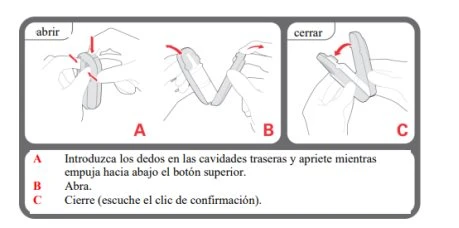
Preparing the PecFent bottle for use
Before using a new bottle of PecFent, you must prepare it for use. This is called “priming”.
To prime the bottle, follow these steps:
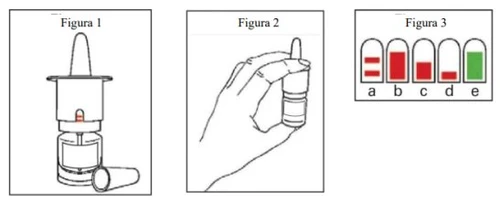
- A new PecFent bottle will show two red lines in the counter window on the white plastic top of the bottle (Figures 1 and 3a).
- Remove the clear plastic protective cap from the nozzle (Figure 1).
- Point the nasal spray away from yourself (and from other people).
- Hold the PecFent nasal spray upright, with your thumb on the bottom of the bottle and your index and middle fingers on the finger grips on either side of the nozzle (Figure 2).
- Firmly press down the finger grips until you hear a “click”; then release the grips. You will hear a second “click” and a single large red bar will appear in the counter window (Figure 3b).
- Repeat step 5 three times. Each time you repeat step 5, the red bar will become smaller, until you see a green bar in the counter window (Figures 3b-e). The green bar means the PecFent nasal spray is ready to use.
- Wipe the nozzle with a tissue and flush the tissue down the toilet.
- If you are not going to use the medicine immediately, replace the protective cap. Then place the PecFent bottle back into the child-resistant storage container. If PecFent is not used for five days, re-prime by spraying once.
Using PecFent
PecFent must only be used by spraying into the nostrils.
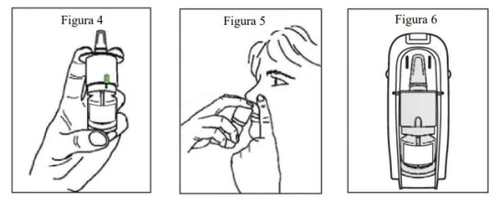
- Check that there is a green bar or a number in the counter window (Figure 4): this confirms that the PecFent bottle has been primed (see “Preparing the PecFent bottle for use” above).
- Blow your nose if needed.
- Sit with your head upright.
- Remove the protective cap from the nozzle.
- Hold the PecFent bottle with your thumb on the bottom and your index and middle fingers on the finger grips (Figure 4).
- Place the nozzle a short distance (approximately 1 cm) inside one nostril. Point it toward the nasal walls. This will tilt the bottle slightly (Figure 5).
- Close the other nostril with a finger from your other hand (Figure 5).
- Firmly press the finger grips to spray PecFent into the nostril. When you hear a click, release the grips. Note: You may not feel anything in your nose; do not assume this means the spray is not working; rely on the click and the numerical counter.
- Breathe in slowly through your nose and breathe out through your mouth.
- The numerical counter will advance after each use and show how many sprays have been used.
- If your doctor has prescribed a second spray, repeat steps 5 to 9, using the other nostril.
Do not use a higher dose than the one prescribed by your doctor to treat a single pain episode.
- After each use, return the bottle to the child-resistant container. Keep the medicine out of sight and reach of children (Figure 6).
- Remain seated for at least one minute after using the nasal spray.
Number of sprays in a PecFent bottle
Each PecFent bottle contains eight full sprays.
- After the first spray, the number 1 will appear in the counter window. The count will increase as you use the spray.
- When you see a red “8” in the counter window, the bottle is empty and no further full sprays can be delivered.
Disposal of unused PecFent
- If you can see a number other than “8” in the counter window, DO NOT assume that all eight sprays from the bottle have been used. There are still doses of PecFent remaining in the bottle.
- You must expel the remaining doses of PecFent from the bottle by pointing the nasal spray away from yourself (and from anyone else) and pressing and releasing the finger grips until the red “8” appears in the counter window.
When you see the number “8” in the counter window, there is still some medicine left in the bottle that must be expelled.
- You will need to press and release the finger grips four more times while pointing the nasal spray away from yourself (and from anyone else).
- You will feel increased resistance when pressing, and the finger grips will move only slightly.
- You will NOT hear a click when pressing.
- The dose counter will remain at “8”.
- Replace the protective cap on the spray bottle.
- Return the bottle to the child-resistant container.
- Ask your local pharmacy about disposal of empty bottles (see “Storage of PecFent”).
If the PecFent nasal spray is blocked or does not spray properly
- If the spray is blocked, point it away from yourself (and from anyone else) and firmly press down the pump to clear any blockage.
- If the nasal spray still does not work properly, discard the defective bottle and start a new one. Inform your doctor about what happened. Never try to repair the nasal spray yourself or attempt to take it apart, as this could result in an incorrect dose.
Discard the PecFent bottle and start a new one:
- If 60 days or more have passed since you first primed or used the bottle.
If you use more PecFent than you should
- You may feel drowsy, nauseous, dizzy, or you may have slow or shallow breathing. In severe cases, taking too much PecFent can lead to coma. If you feel very dizzy, very drowsy, or have slow or shallow breathing, call an ambulance or ask someone to do so immediately.
- An overdose may also cause a brain disorder known as toxic leukoencephalopathy.
If you stop treatment with PecFent
If you no longer experience breakthrough pain, consult your doctor before stopping treatment with PecFent and follow their instructions. However, you should continue taking another opioid for constant pain. Your doctor may need to review your dose.
You may experience withdrawal symptoms similar to the possible side effects of PecFent when you stop using PecFent. If you experience withdrawal symptoms, contact your doctor. Your doctor will assess whether you need any medication to reduce or eliminate withdrawal symptoms.
If you have any further questions about using this medicine, ask your doctor or pharmacist.
4. Possible adverse effects
Like all medicines, this medicine can cause adverse effects, although not everyone experiences them.
Call an ambulance or ask someone to do so immediately if any of the following occur:
- If you feel very dizzy or faint.
- If you feel very sleepy.
- If you have slow or shallow breathing.
- If you have cold and clammy skin, are pale, have a weak pulse, or other signs of shock.
If you or your caregiver notice any of the above effects, call an ambulance immediately.
Common adverse effects (may affect up to 1 in 10 people):
- Disorientation (not knowing where you are)
- Change in taste
- Dizziness
- Nausea or vomiting
- Drowsiness, headache
- Nosebleed, nasal discomfort (such as nasal burning), runny nose
- Constipation
- Itching of the skin
Uncommon adverse effects (may affect up to 1 in 100 people):
- Respiratory infection
- Pain, discomfort, or swelling of the throat or nose
- Cough, sneezing, nasal discharge, or cold symptoms, changes in nasal secretions
- Allergic reaction, skin rash
- Loss or increase in appetite, weight gain
- Dehydration, thirst
- Misuse of the medicine
- Seeing or hearing things that are not real (hallucinations or delirium), feeling confused
- Depression, anxiety, sluggishness, or restlessness
- Loss of concentration or increased activity
- Memory loss
- Feeling "high"
- Reduced awareness or unresponsiveness, loss of consciousness
- Seizure (epileptic fit)
- Seizures or muscle tremors
- Loss of taste, loss or change in smell
- Difficulty speaking
- Bluish skin discoloration
- Dizziness, falls, general malaise
- Impaired heat regulation and circulation, feeling hot or feverish, chills, excessive sweating
- Swelling of soft tissues
- Low blood pressure
- Airway obstruction
- Breathing difficulties
- Vaginal bleeding
- Intestinal perforation or inflammation of the stomach lining
- Numbness or tingling in the mouth, tongue, or nose, or other tongue problems, mouth ulcers, dry mouth
- Diarrhea
- Retching, stomach pain, indigestion
- Joint discomfort or pain
- Difficulty or inability to drink water
- Chest pain
- Feeling tired or weak, problems with movement
- Changes in blood cells (detected by laboratory tests)
- Increased blood sugar
- Protein in the urine
Other adverse effects (frequency not known [cannot be estimated from available data]):
- Severe breathing problems
- Flushing
- Insomnia
- Withdrawal syndrome (may present with the onset of the following adverse effects: nausea, vomiting, diarrhea, anxiety, chills, tremors, and sweating)
- Pharmacological tolerance, drug dependence (addiction), drug abuse (see section 2)
Prolonged treatment with fentanyl during pregnancy may cause withdrawal symptoms in the newborn, which may be potentially fatal (see section 2).
Reporting of adverse effects
If you experience any adverse effect, talk to your doctor or pharmacist, even if it is a possible adverse effect not listed in this leaflet. You can also report them directly through the national reporting system detailed in Appendix V. By reporting adverse effects, you can help provide more information on the safety of this medicine.
5. Storage of PecFent
Keep this medicine out of sight and reach of children. PecFent could be potentially fatal if accidentally taken by a child.
Store this medicine in a safe and secure place, inaccessible to others. This medicine may cause serious harm or even death in individuals who accidentally or intentionally use it without being prescribed.
- Do not use this medicine after the expiry date stated on the carton and vial after “EXP”. The expiry date refers to the last day of the month indicated.
- Do not store PecFent above 25°C.
- Do not freeze.
- Store the vial in its child-resistant packaging to protect it from light.
- Always keep the PecFent vial within its child-resistant packaging, even when empty.
- Do not use for longer than 60 days after first use (whether priming or treating an episode of breakthrough pain).
- Expired or unused PecFent may still contain enough medicine to be harmful to others, especially children. PecFent must not be disposed of via sinks or household waste. Any unused or leftover PecFent must be discarded as soon as possible following the instructions provided in Disposal of Unused PecFent. Any empty vial must be returned to its child-resistant packaging and disposed of by taking it to a pharmacy or following local regulatory requirements.
6. Contents of the pack and other information
Composition of PecFent
The active substance is fentanyl.
- PecFent 100 micrograms/spray, solution for nasal spray
Each ml of solution contains 1000 micrograms of fentanyl (as citrate).
-
One spray (100 microliters) contains 100 micrograms of fentanyl (as citrate).
-
PecFent 400 micrograms/spray, solution for nasal spray
Each ml of solution contains 4000 micrograms of fentanyl (as citrate).
One spray (100 microliters) contains 400 micrograms of fentanyl (as citrate).
The other components (excipients) are pectin (E440), mannitol (E421), phenylethyl alcohol, propyl parahydroxybenzoate (E216), sucrose, purified water, and hydrochloric acid or sodium hydroxide for pH adjustment.
Nature of the product and contents of the pack
The medicine is a transparent to almost transparent, colourless nasal spray solution. It is contained in a clear glass bottle equipped with a metering pump. The pump has a spray counter with an audible "click" sound, so you can hear and see that the spray has been delivered, and a protective cap. After priming the PecFent bottle (preparing it for use), it delivers eight full sprays. Each PecFent bottle is supplied in a child-resistant package.
PecFent bottles in their child-resistant packaging are supplied in cartons containing 1, 4 or 12 bottles.
Only some pack sizes may be marketed.
Marketing Authorisation Holder
Grünenthal GmbH
Zieglerstraße 6
52078 Aachen
Germany
Manufacturer
- Molteni & C. dei F.lli Alitti Società di Esercizio S.p.A
Strada Statale 67 Tosco Romagnola,
Fraz. Granatieri – 50018 Scandicci (FI)
Italy
Date of the latest revision of this leaflet:
Other sources of information
Detailed information on this medicine is available on the European Medicines Agency website: http://www.ema.europa.eu/.