Orkambi 150 mg/188 mg granules in sachet
Spain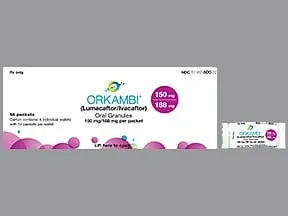
Instructions for Use
Package leaflet: Information for the user
Introduction
Package leaflet: information for the patient
Orkambi 100 mg/125 mg granules in sachet
Orkambi 150 mg/188 mg granules in sachet
lumacaftor/ivacaftor
Read the entire leaflet carefully before your child starts taking this medicine, because it contains important information for you.
- Keep this leaflet, as you may need to read it again.
- If you have any questions, consult your child's doctor or pharmacist.
- This medicine has been prescribed for your child only, and you should not give it to others, even if they have the same symptoms as your child, as it may harm them.
- If your child experiences any adverse effects, consult your child's doctor or pharmacist, even if they are effects not listed in this leaflet. See section 4.
Contents of the leaflet
- What Orkambi is and what it is used for
- What you need to know before your child takes Orkambi
- How to take Orkambi
- Possible side effects
- How to store Orkambi
- Contents of the pack and other information
1. What Orkambi is and what it is used for
Orkambi contains two active substances: lumacaftor and ivacaftor. It is a medicine used for the long-term treatment of cystic fibrosis (CF) in patients aged 1 year and older who have a specific mutation (called the F508del mutation) in the gene for a protein known as the cystic fibrosis transmembrane conductance regulator (CFTR), which plays an important role in regulating mucus flow in the lungs. Individuals with this mutation produce an abnormal CFTR protein. Cells contain two copies of the CFTR gene. Orkambi is used in patients in whom the F508del mutation is present in both copies (homozygous).
Lumacaftor and ivacaftor work together to improve the function of the abnormal CFTR protein.
Lumacaftor increases the amount of CFTR available, and ivacaftor helps the abnormal protein function more normally.
2. What you need to know before your child starts taking Orkambi
Do not use Orkambi
- if your child is allergic to the active substances or to any of the other components of this medicine (listed in section 6).
Warnings and precautions
Talk to your child’s doctor or pharmacist before starting Orkambi.
Orkambi must not be used in patients who do not have two copies of the F508del mutation in the CFTR gene.
Talk to your child’s doctor before starting Orkambi if your child has been diagnosed with liver or kidney disease, as the doctor may need to adjust the dose of Orkambi.
Abnormal liver function test results in blood tests have been frequently observed in some people taking Orkambi. Contact your child’s doctor immediately if your child experiences any of the following symptoms, which could indicate liver problems:
- Pain or discomfort in the upper right side of the stomach (abdomen)
- Yellowing of the skin or whites of the eyes
- Loss of appetite
- Nausea or vomiting
- Dark urine
- Confusion
Your child’s doctor should perform blood tests to monitor liver function before and during treatment with Orkambi, especially during the first year.
Depression (including suicidal thoughts and suicidal behavior) has been reported in patients taking Orkambi, usually within the first three months of treatment. Contact your doctor immediately if you (or someone taking this medicine) experience any of the following symptoms: sad or changed mood, anxiety, emotional discomfort, or thoughts of self-harm or suicide, as these may be signs of depression.
Respiratory events such as shortness of breath, chest tightness, or narrowing of the airways have been observed in patients starting treatment with Orkambi, particularly in those with impaired lung function. If your child has impaired lung function, the doctor may closely monitor your child when starting Orkambi treatment.
An increase in blood pressure has been observed in some patients treated with Orkambi. Your child’s doctor may monitor your child’s blood pressure during treatment with Orkambi.
In some children and adolescents treated with Orkambi and ivacaftor alone (one of the components of Orkambi), an eye lens abnormality (cataract) has been observed, without any effect on vision. Your child’s doctor may perform eye examinations before and during treatment with Orkambi.
Orkambi is not recommended in patients who have undergone an organ transplant.
Children under 1 year of age
It is unknown whether Orkambi is safe and effective in children under 1 year of age. Therefore, Orkambi should not be used in children under 1 year of age.
Other medicines and Orkambi
Tell your child’s doctor or pharmacist if your child is taking, has recently taken, or might need to take any other medicines.
In particular, inform the doctor if your child is taking any of the following medicines:
- Antibiotics (used to treat bacterial infections), for example:
- telithromycin, clarithromycin, rifampicin, rifabutin, rifapentine, erythromycin
- Anticonvulsants (used to treat seizures [epileptic fits]), for example:
- phenobarbital, carbamazepine, phenytoin
- Benzodiazepines (used to treat anxiety, insomnia, agitation, etc.), for example:
- midazolam, triazolam
- Antifungals (used to treat fungal infections), for example:
- fluconazole, ketoconazole, itraconazole, posaconazole, voriconazole
- Immunosuppressants (used after organ transplant), for example:
- ciclosporin, everolimus, sirolimus, tacrolimus
- Herbal medicines, for example:
- St. John’s wort (Hypericum perforatum)
- Antihistamines (used to treat allergies and/or asthma), for example:
- montelukast, fexofenadine
- Antidepressants (used to treat depression), for example:
- citalopram, escitalopram, sertraline, bupropion
- Anti-inflammatory medicines (used to treat inflammation), for example:
- ibuprofen
- H2 antagonists (used to reduce stomach acid), for example: ranitidine
- Cardiac glycosides (used to treat mild to moderate congestive heart failure and abnormal heart rhythm called atrial fibrillation), for example:
- digoxin
- Anticoagulants (used to prevent blood clots from forming or growing larger in the blood and blood vessels), for example:
- warfarin, dabigatran
- Contraceptives (used to prevent pregnancy):
- oral, injectable, and implantable contraceptives, as well as contraceptive patches; these may contain ethinylestradiol, norethindrone, and other progestogens. These should not be considered a reliable and effective contraceptive method when taken with Orkambi.
- Corticosteroids (used to treat inflammation):
- methylprednisolone, prednisone
- Proton pump inhibitors (used to treat acid reflux disease and ulcers):
- omeprazole, esomeprazole, lansoprazole
- Oral hypoglycemics (used to treat type 2 diabetes):
- repaglinide
False positive results in urine screening tests for tetrahydrocannabinol (THC, an active component of cannabis) have been reported in patients receiving Orkambi. Your child’s doctor may request additional testing to confirm the results.
Driving and using machines
Dizziness has been reported in patients receiving ivacaftor, a component of Orkambi, which could affect the ability to drive or operate machinery.
If a child experiences dizziness while taking Orkambi, it is advised that the child avoid riding a bicycle or performing any activity requiring full attention until symptoms resolve.
Orkambi contains sodium
This medicine contains less than 23 mg of sodium (1 mmol) per dose, which is essentially “sodium-free”.
3. How to take Orkambi
Follow exactly the instructions for administering this medicine as given by your child's doctor. If in doubt, consult the doctor again.
Your child's doctor will determine the correct dose for your child. Your child must continue taking all other medications unless the doctor specifically instructs otherwise.
Recommended dose
The recommended dose for patients aged 1 year or older is indicated in the table below.
Orkambi should be taken in the morning and at night (every 12 hours) with food containing fat.
There are different concentrations of Orkambi depending on the child's age and weight. Make sure the correct dose has been prescribed for you (see below).
Age | Weight | Product | Dosage | |
Morning | Evening | |||
1 to <2 years | 7 kg to <9 kg | Orkambi 75 mg/94 mg granules in sachet | 1 sachet | 1 sachet |
9 kg to <14 kg | Orkambi 100 mg/125 mg granules in sachet | 1 sachet | 1 sachet | |
≥14 kg | Orkambi 150 mg/188 mg granules in sachet | 1 sachet | 1 sachet | |
2 to 5 years | <14 kg | Orkambi 100 mg/125 mg granules in sachet | 1 sachet | 1 sachet |
≥14 kg | Orkambi 150 mg/188 mg granules in sachet | 1 sachet | 1 sachet |
If your child has moderate to severe liver function problems, the doctor may need to reduce the dose of Orkambi, as your child's liver will not eliminate Orkambi from the body as quickly as in children with normal liver function.
- Moderate liver problems: the dose may be reduced to one sachet in the morning and one sachet every 2 days in the evening.
- Severe liver problems: the dose may be reduced to one sachet per day or less frequently in the morning. No dose should be administered in the evening.
Instructions for administration
Orkambi is taken orally.
Each sachet is for single use only.
You may start giving Orkambi to your child on any day of the week.
Administration of Orkambi granules to your child:
- Hold the granule sachet with the cut line facing upwards.
- Gently shake the sachet so that the contents settle.
- Open the sachet by tearing or cutting along the cut line.
- Mix the entire contents of one sachet with a teaspoon (5 ml) of soft food or liquid appropriate for the child's age. The food or liquid should be at room temperature or cooler. Examples of age-appropriate soft foods or liquids include fruit or vegetable puree, flavored yogurt, applesauce, water, milk, breast milk, formula milk, or juice.
- Once mixed, give the medication to your child immediately. If this is not possible, administer it within one hour of mixing. Make sure your child takes the entire mixture immediately.
- Just before or just after administration, you must give your child a meal or snack containing fat (some examples are given below).
It is important to take Orkambi with food containing fat to achieve adequate levels of the medicine in the body. Meals and snacks recommended in cystic fibrosis (CF) guidelines or those recommended in standard nutritional guidelines contain adequate amounts of fat. Examples of meals or snacks containing fat include those prepared with butter or oils, or those containing eggs. Other examples of fat-containing foods include:
- Cheese, breast milk, formula milk, whole milk, whole milk dairy products
- Meats, oily fish
- Avocado, hummus (chickpea puree), soy-based products (tofu)
- Nutritional bars or drinks
If your child takes more Orkambi than they should
Consult your child's doctor or pharmacist for advice. If possible, show them the medicine and this leaflet. Your child may experience adverse effects, including those listed in section 4 below.
If you forget to give Orkambi to your child
Give the missed dose with food containing fat if less than 6 hours have passed since the time your child was supposed to take the granules. Otherwise, wait until your child's next scheduled dose and continue treatment as usual. Do not give your child a double dose to make up for a missed dose.
If you stop Orkambi treatment for your child
Give Orkambi to your child for as long as your child's doctor has recommended. Do not stop treatment unless instructed by your child's doctor. Continue giving the medicine as directed by the doctor, even if your child feels well.
If you have any further questions about the use of this medicine, ask your child's doctor or pharmacist.
4. Possible adverse effects
Like all medicines, this medicine can cause adverse effects, although not everyone experiences them. The adverse effects reported with Orkambi and with ivacaftor administered alone (one of the active substances in Orkambi) are listed below and may occur with the use of Orkambi.
Serious adverse effects of Orkambi include increased levels of liver enzymes in the blood, liver damage, and worsening of pre-existing severe liver disease. Worsening liver function may be fatal. These serious adverse effects are uncommon (may affect up to 1 in 100 people).
Tell your child’s doctor immediately if your child experiences:
- Pain or discomfort in the upper right part of the stomach (abdominal area)
- Yellowing of the skin or the whites of the eyes
- Loss of appetite
- Nausea or vomiting
- Confusion
- Dark-colored urine
Depression
Signs of depression include a sad or changed mood, anxiety, or a feeling of emotional discomfort.
Tell your doctor immediately if you experience any of these symptoms.
Other adverse effects
Very common (may affect more than 1 in 10 people):
- Cough with phlegm
- Nasal congestion
- Breathing difficulty
- Headache
- Abdominal pain (stomach ache)
- Diarrhea
- Increased amount of phlegm
- Nausea
- Common cold*
- Dizziness*
- Changes in the type of bacteria in mucus*
Common (may affect up to 1 in 10 people):
- Chest tightness
- Narrowing of the airways
- Sinus congestion*
- Nasal congestion or runny nose
- Upper respiratory tract infection
- Sore throat
- Redness of the throat*
- Skin rash
- Gas (flatulence)
- Vomiting
- Increase in an enzyme in the blood (creatine phosphokinase in blood)
- High levels of liver enzymes (detected in blood tests)
- Irregular periods (menstruation) or painful menstruation
- Ear pain, ear discomfort*
- Ringing in the ears (tinnitus)*
- Redness inside the ears*
- Inner ear disorder (sensation of dizziness or spinning)*
- Lump in the breast*
Uncommon (may affect up to 1 in 100 people):
- Abnormal periods including absence of menstruation, infrequent periods, or more frequent or heavier menstrual bleeding
- Increased blood pressure
- Ear blockage*
- Breast inflammation*
- Enlargement of the breasts in males*
- Changes or pain in the nipples*
*Adverse effects observed with ivacaftor alone.
Additional adverse effects in children
Adverse effects observed in children are similar to those observed in adults and adolescents.
However, increased liver enzymes in the blood are more common in young children than in adults.
Reporting of adverse effects
If your child experiences any type of adverse effect, consult your child’s doctor or pharmacist, even if it is a possible adverse effect not listed in this leaflet.
You may also report them directly through the national reporting system included in Appendix V. By reporting adverse effects, you can help provide more information on the safety of this medicine.
5. Storage of Orkambi
Keep this medicine out of the sight and reach of children.
Do not use this medicine after the expiry date stated on the carton/pouch after EXP. The expiry date refers to the last day of the month indicated.
This medicine does not require any special storage conditions.
Medicines must not be disposed of via wastewater or household waste. Ask your pharmacist how to dispose of any packaging and medicines your child no longer requires. This will help protect the environment.
6. Contents of the pack and other information
Composition of Orkambi
The active substances are lumacaftor and ivacaftor.
Orkambi 75 mg/94 mg granules in sachet:
Each sachet contains 75 mg of lumacaftor and 94 mg of ivacaftor.
Orkambi 100 mg/125 mg granules in sachet:
Each sachet contains 100 mg of lumacaftor and 125 mg of ivacaftor.
Orkambi 150 mg/188 mg granules in sachet:
Each sachet contains 150 mg of lumacaftor and 188 mg of ivacaftor.
The other components are: microcrystalline cellulose; sodium croscarmellose; hypromellose acetate succinate; povidone (K30); and sodium lauryl sulphate (see section 2 “Orkambi contains sodium”).
Nature of the product and pack size
Orkambi granules are white to off-white granules.
The granules are supplied in sachets.
Pack size: 56 sachets (contains 4 individual blisters with 14 sachets each)
Marketing Authorisation Holder
Vertex Pharmaceuticals (Ireland) Limited
Unit 49, Block 5, Northwood Court, Northwood Crescent,
Dublin 9, D09 T665,
Ireland
Tel.: +353 (0)1 761 7299
Manufacturer
Almac Pharma Services (Ireland) Limited
Finnabair Industrial Estate
Dundalk
Co. Louth
A91 P9KD
Ireland
Almac Pharma Services Limited
Seagoe Industrial Estate
Craigavon
BT63 5UA
United Kingdom
For further information about this medicine, please contact the local representative of the Marketing Authorisation Holder:
Vertex Pharmaceuticals (Ireland) Limited Tél/Tel/Te?/Tlf/Sími/Τηλ/Puh: +353 (0) 1 761 7299 | Spain Vertex Pharmaceuticals Spain, S.L. Tel: + 34 91 7892800 |
Greece Vertex Φαρμακευτικ? Μονοπρ?σωπη Αν?νυμη Εταιρ?α Τηλ: +30 (211) 2120535 | Italy Vertex Pharmaceuticals (Italy) S.r.l. Tel: +39 0697794000 |
Date of the most recent review of this leaflet:
Other sources of information
Detailed information on this medicine is available on the website of the European Medicines Agency: http://www.ema.europa.eu. There are also links to other websites about rare diseases and orphan medicinal products.
Similar Medications
-
Orkambi 100 mg/125 mg granules in sachet
Form: granules
Active substance Dosage LUMACAFTOR 100 mg IVACAFTOR 125 mg Manufacturer: Vertex Pharmaceuticals (Ireland) Limited
-
Orkambi 75 mg/94 mg granules in sachet
Form: granules
Active substance Dosage LUMACAFTOR 75 mg IVACAFTOR 94 mg Manufacturer: Vertex Pharmaceuticals (Ireland) Limited
This page has been machine-translated and may contain inaccuracies. The original data is available in the manufacturing country's language.
Last data check: May 18, 2026 · Data source: CIMA — AEMPS