Optovite B12 1.000 micrograms solution for injection
Spain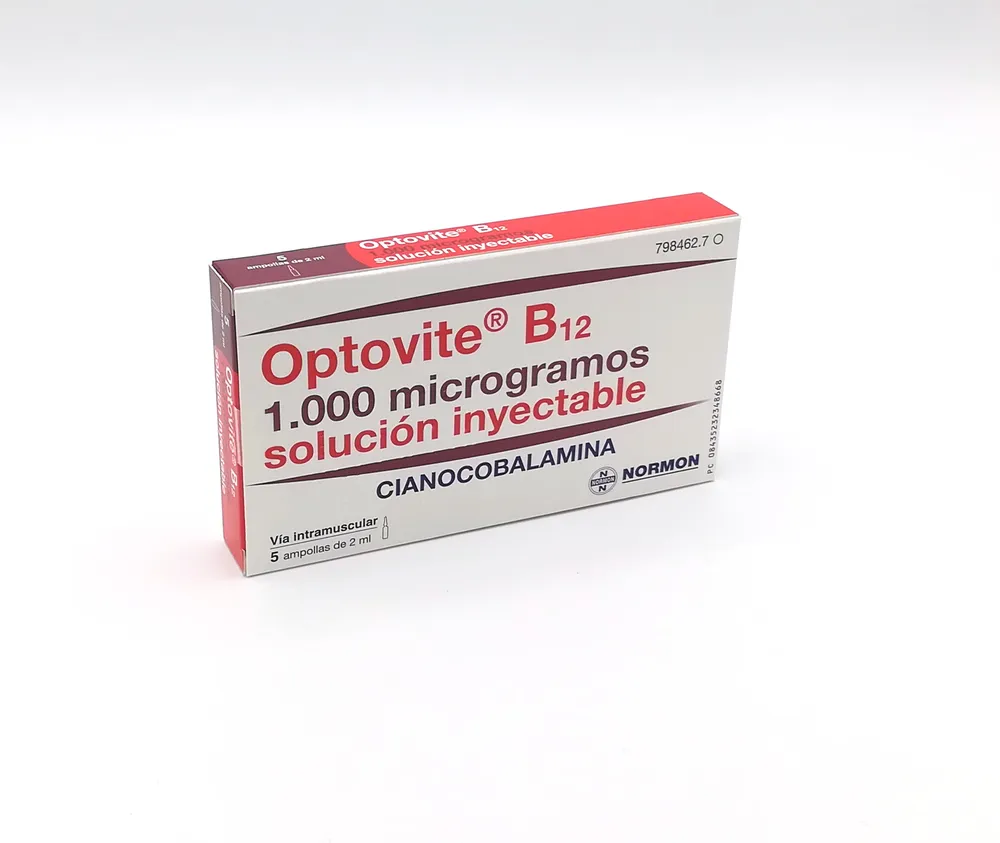
Table of Contents
- Package Leaflet: Information for the User
- Introduction
- 1. What Optovite B12 1,000 micrograms is and what it is used for
- 2. What you need to know before using Optovite B12 1,000 micrograms
- 3. How to use Optovite B12 1,000 micrograms
- 4. Possible adverse effects
- 5. Storage of Optovite B12 1,000 micrograms
- 6. Contents of the pack and other information
Package Leaflet: Information for the User
Introduction
Package Leaflet: Information for the User
Optovite B12 1,000 micrograms Injectable Solution
Cyanocobalamin
Read the entire leaflet carefully before you start using this medicine, because it contains important information for you.
- Keep this leaflet, as you may need to read it again. If you have any questions, consult your doctor or pharmacist.
- This medicine has been prescribed for you only, and you should not give it to other people, even if they have the same symptoms as you, because it could harm them.
- If you experience any adverse effects, consult your doctor or pharmacist, even if they are adverse effects not listed in this leaflet. See section 4.
Leaflet Contents
- What Optovite B12 1,000 micrograms is and what it is used for
- What you need to know before using Optovite B12 1,000 micrograms
- How to use Optovite B12 1,000 micrograms
- Possible adverse effects
- How to store Optovite B12 1,000 micrograms
- Contents of the pack and other information
1. What Optovite B12 1,000 micrograms is and what it is used for
Optovite B12 is a vitamin; its active ingredient is cyanocobalamin. It is a red, transparent injectable solution.
This medicine is indicated in vitamin B12 deficiency states such as: pernicious anemia (reduction in the number of red blood cells due to vitamin B12 deficiency), pregnancy, malabsorption syndrome (difficulty in digesting nutrients from food, which may be accompanied by diarrhea and colic), sprue (inflammation of the small intestine due to gluten intolerance and other grains, causing diarrhea), regional enteritis (chronic inflammation of the gastrointestinal tract, small intestine, and colon), intestinal or pancreatic neoplasms (tumors), total or partial gastrectomy (removal of all or part of the stomach), and other conditions in which there is a significant increase in the requirements for this vitamin. It is indicated in vegetarians. It is also indicated in diabetic polyneuritis (nervous system involvement due to diabetes mellitus) and alcoholic polyneuritis, trigeminal neuralgia (severe facial pain), or painful tics. Vitamin B12 is effective in allergic conditions (skin itching and scaling), and has also been used in certain arthritic conditions (joint degeneration) resistant to conventional medications.
2. What you need to know before using Optovite B12 1,000 micrograms
Do not use Optovite B12
If you are allergic (hypersensitive) to cobalt and/or vitamin B12.
Warnings and precautions
- If you are predisposed to gout (joint pain due to elevated uric acid), cyanocobalamin may precipitate a gout attack.
- If you have tobacco amblyopia (dim vision due to tobacco use) or hereditary optic nerve atrophy (Leber's disease), as these conditions may worsen with cyanocobalamin administration.
- If you have been treated for megaloblastic anemia (decreased number of red blood cells with increased cell size) and the condition is reversing, a drop in blood potassium levels may occur, which could be fatal. This may also occur during initial treatment of pernicious anemia.
- If you are sensitive to this vitamin, anaphylactic shock (acute allergic reaction) may occur after parenteral administration.
- If folic acid is taken instead of cyanocobalamin, the anemia will be corrected but not the neurological disorders.
Vitamin B12 deficiency should be confirmed before starting treatment, as it may mask symptoms of spinal cord degeneration.
Consult your doctor, even if any of the above conditions have occurred in the past.
Use of Optovite B12 with other medicines
Inform your doctor or pharmacist if you are using or have recently used any other medicines, including those obtained without a prescription. Some drugs may affect the action of others.
Administration is not recommended with the following medicines:
- Chloramphenicol and other bone marrow depressants: may reduce the effect of vitamin B12.
- Oral neomycin, colchicine, aminosalicylic acid, histamine H2-receptor antagonists: may reduce oral absorption of vitamin B12.
- Oral contraceptives: may decrease serum concentrations of vitamin B12.
- Most antibiotics, methotrexate, and primethamine may interfere with blood test results for folic acid and cyanocobalamin.
Pregnancy, breastfeeding, and fertility
Pregnancy
Consult your doctor or pharmacist before using any medicine. Vitamin B12 may be administered to pregnant women when necessary. A daily intake of 4 micrograms is recommended.
Breastfeeding
Consult your doctor or pharmacist before using any medicine. Vitamin B12 is excreted in breast milk, but its use is compatible with breastfeeding and may even be recommended when the amount transferred to the infant is insufficient. The recommended daily intake for infants is 0.5–3 micrograms/day.
Driving and use of machines
There is no evidence of effects on the ability to drive vehicles or operate machinery.
Optovite B12 contains sodium chloride: This medicine contains less than 23 mg (1 mmol) of sodium per dose and is therefore considered essentially “sodium-free”.
3. How to use Optovite B12 1,000 micrograms
Follow exactly the administration instructions for this medicine as indicated by your doctor. If in doubt, consult your doctor or pharmacist again. Your doctor will determine the appropriate dose and duration of your treatment with Optovite B12. Do not stop treatment prematurely.
If you feel that the effect of this medicine is too strong or too weak, inform your doctor or pharmacist.
Cyanocobalamin is administered intramuscularly and deep subcutaneously in gastrectomized patients. In both cases, the dosing regimen is 1,000 micrograms/day for the first week at the beginning of treatment, followed by 1,000 micrograms/week for the next 4–8 weeks, and then 1,000 micrograms/month as maintenance dose.
In patients who do not tolerate the intramuscular route (e.g., hemophiliacs), consult your doctor regarding oral administration. In these cases, the usual dose is 500 to 1,000 micrograms/day.
Intravenous administration is not recommended, although in exceptional cases (such as in the presence of extreme thrombocytopenia), cyanocobalamin may be administered via this route.
If you take more Optovite B12 than you should
Contact your doctor or pharmacist immediately.
In case of overdose or accidental ingestion, contact your doctor or pharmacist or call the Toxicology Information Service at telephone number 915 620 420, indicating the medicine and the amount taken.
If you forget to take Optovite B12
Do not administer a double dose to make up for missed doses.
If you have any further questions about the use of this product, ask your doctor or pharmacist.
4. Possible adverse effects
Like all medicines, Optovite B12 may cause adverse effects, although not everyone experiences them.
The following adverse effects have been observed in exceptional cases:
-
Blood and lymphatic system disorders: polycythaemia vera. Cases of peripheral vascular thrombosis have been reported at the beginning of treatment.
-
Immune system disorders: anaphylactic shock and death.
-
Metabolism and nutrition disorders: hypokalaemia.
-
Eye disorders: optic nerve atrophy.
-
Cardiac disorders: cases of congestive heart failure have occurred at the beginning of treatment.
-
Respiratory, thoracic and mediastinal disorders: cases of pulmonary edema have occurred at the beginning of treatment.
-
Gastrointestinal disorders: mild transient diarrhoea.
-
Skin and subcutaneous tissue disorders: pruritus, transient exanthema, urticaria.
-
General disorders and administration site conditions: pain at the injection site, sensation of swelling throughout the body.
Reporting of adverse effects:
If you experience any type of adverse effect, consult your doctor, pharmacist, or nurse, even if it is a possible adverse effect not listed in this leaflet. You may also report them directly through the Spanish Pharmacovigilance System for Human Medicines: https://www.notificaram.es. By reporting adverse effects, you can help provide more information on the safety of this medicine.
If any of these reactions occur, or any other reaction not described in this leaflet, consult your doctor or pharmacist.
5. Storage of Optovite B12 1,000 micrograms
Keep out of the sight and reach of children.
No special storage conditions are required.
Do not use Optovite B12 after the expiry date stated on the packaging after “Exp.:”. The expiry date refers to the last day of the month indicated.
Medicines must not be disposed of via wastewater drains or household waste. Dispose of unused medicines and their packaging at the SIGRE Point  at your pharmacy. If in doubt, ask your pharmacist how to properly dispose of unused medicines and their packaging. This will help protect the environment.
6. Contents of the pack and other information
Composition of Optovite B12 1,000 micrograms
The active substance is cyanocobalamin. Each ampoule contains 1,000 micrograms of cyanocobalamin.
The other components are: sodium chloride and water for injections.
Appearance of the medicinal product and contents of the pack
Red, transparent injectable solution, supplied in a pack containing 5 ampoules of 2 ml each.
Marketing Authorization Holder and Manufacturer
LABORATORIOS NORMON, S.A.
Ronda de Valdecarrizo, 6 – 28760 Tres Cantos – Madrid (SPAIN)
Date of the most recent review of this leaflet: December 2004
Detailed and up-to-date information on this medicinal product is available on the website of the Spanish Agency for Medicines and Health Products (AEMPS) http://www.aemps.gob.es
Information for healthcare professionals
Intramuscular injection should be administered into a large muscle mass.
Intravenous administration is exceptional and should be performed by diluting small amounts of cyanocobalamin in a parenteral administration solution. Administration of large amounts of cyanocobalamin would result in almost complete excretion via urine.