Nimenrix powder and solvent for solution for injection in pre-filled syringe
Spain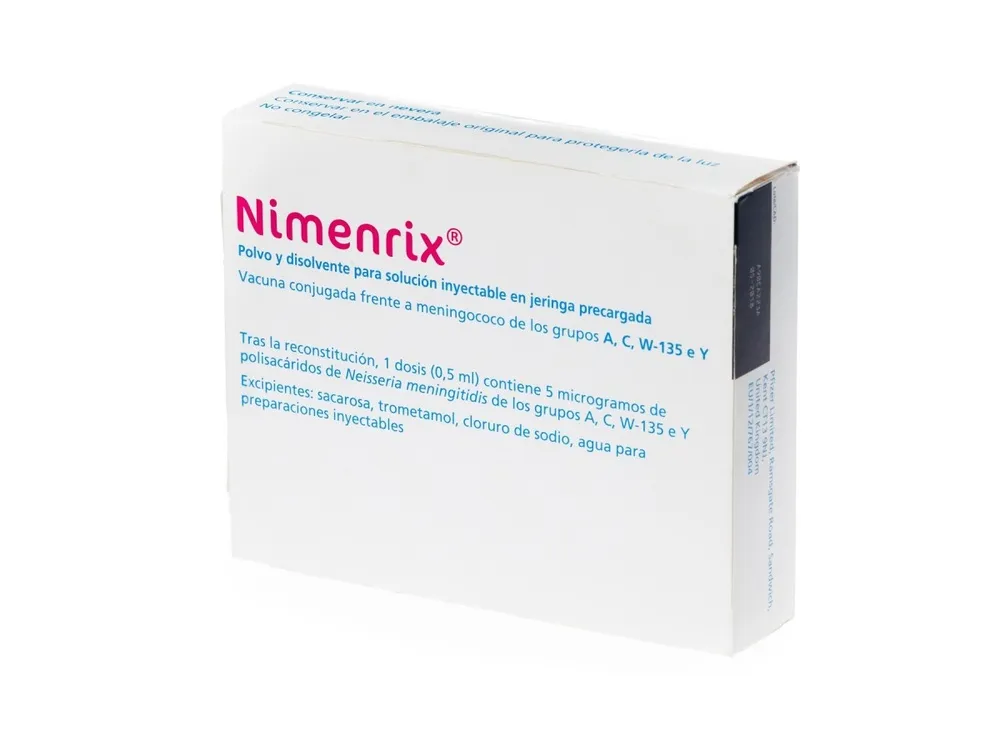
Table of Contents
Package leaflet: Information for the user
Introduction
Package leaflet: information for the user
Nimenrix powder and solvent for solution for injection in pre-filled syringe
Meningococcal serogroups A, C, W-135 and Y conjugate vaccine
Read all of this leaflet carefully before you or your child receives this vaccine because it contains important information for you.
-
Keep this leaflet. You may need to read it again.
-
If you have any further questions, ask your doctor or pharmacist.
-
This medicine has been prescribed for you or your child only and should not be passed on to others.
-
If you experience any side effects, talk to your doctor or pharmacist, even if they are not listed in this leaflet. See section 4.
This leaflet has been written assuming that the person receiving the vaccine is the one reading it. However, the vaccine may be administered to adults and children, so you may be reading it on behalf of your child.
Contents of the leaflet
- What Nimenrix is and what it is used for
- What you need to know before receiving Nimenrix
- How Nimenrix is given
- Possible side effects
- How to store Nimenrix
- Contents of the pack and other information
1. What Nimenrix is and what it is used for
What Nimenrix is and what it is used for
Nimenrix is a vaccine that helps protect against infections caused by the bacterium (germ) called “Neisseria meningitidis” of types A, C, W-135 and Y.
“Neisseria meningitidis” types A, C, W-135 and Y can cause serious diseases such as:
- meningitis – an infection of the membranes covering the brain and spinal cord.
- septicemia – a blood infection.
These infections spread easily from person to person and, if left untreated, can lead to death.
Nimenrix can be given to adults, adolescents, children and infants from 6 weeks of age.
How Nimenrix works
Nimenrix helps your body produce its own protection (antibodies) against the bacteria. These antibodies help protect you against disease.
Nimenrix will only protect you against infections caused by the bacterium “Neisseria meningitidis” of types A, C, W-135 and Y.
2. What you need to know before receiving Nimenrix
Do not receive Nimenrix if:
- you are allergic to the active substances or to any of the other components of this vaccine (listed in section 6).
Signs of an allergic reaction may include itchy rash, difficulty breathing, and swelling of the face or tongue. Seek immediate medical attention if you experience any of these signs.
If you are unsure, speak with your doctor or nurse before receiving Nimenrix.
Warnings and precautions
Talk to your doctor or nurse before receiving this vaccine if:
- you have an infection with high fever (over 38°C). If this applies to you, the vaccine should not be given until you recover. A minor infection, such as a cold, should not be a problem. However, consult your doctor or nurse first.
- you have a blood clotting disorder or bruise easily.
If you are in any of the above situations (or are unsure), consult your doctor or nurse before receiving Nimenrix.
Nimenrix may not fully protect all vaccinated individuals. If you have a weakened immune system (for example, due to HIV infection or medications affecting the immune system), you may not achieve maximum benefit from vaccination with Nimenrix.
Fainting (syncope) may occur before or after any injection (particularly in adolescents). Therefore, inform your doctor or nurse if you or your child has previously fainted following an injection.
Other medicines and Nimenrix
Inform your doctor or nurse if you are using or have recently used any other medicines, including other vaccines and over-the-counter medicines.
Nimenrix may be less effective if you are taking medicines that affect your immune system.
In infants, Nimenrix can be administered simultaneously with combined diphtheria-tetanus-acellular pertussis (DTPa) vaccines, including acellular pertussis (DTPa) with hepatitis B, inactivated poliovirus, or Haemophilus influenzae type b (HBV, IPV or Hib), such as the DTPa-HBV-IPV/Hib vaccine and the 10-valent pneumococcal conjugate vaccine.
From 1 year of age and older, Nimenrix can be administered at the same time as one of the following vaccines: hepatitis A (HAV) and hepatitis B (HBV), measles-mumps-rubella (MMR) vaccine, measles-mumps-rubella-varicella (MMRV) vaccine, 10-valent pneumococcal conjugate vaccine, or non-adjuvanted seasonal influenza vaccine.
During the second year of life, Nimenrix can also be administered simultaneously with diphtheria-tetanus-acellular pertussis (DTPa), including acellular pertussis (DTPa) with hepatitis B, inactivated poliovirus, or Haemophilus influenzae type b (HBV, IPV or Hib), such as the DTPa-HBV-IPV/Hib vaccine and the 13-valent pneumococcal conjugate vaccine.
In individuals aged 9 to 25 years, Nimenrix can be administered simultaneously with human papillomavirus vaccine [types 16 and 18] and a combined diphtheria (reduced antigen content)-tetanus-acellular pertussis vaccine.
Whenever possible, administration of Nimenrix and a vaccine containing tetanus toxoid, such as DTPa-HBV-IPV/Hib vaccine, should be given simultaneously or Nimenrix should be administered at least one month before the tetanus toxoid-containing vaccine.
Each vaccine should be administered at different injection sites.
Pregnancy and breastfeeding
If you are pregnant, think you may be pregnant, plan to become pregnant, or are breastfeeding, consult your doctor before receiving Nimenrix.
Driving and using machines
Nimenrix is unlikely to affect your ability to drive or use machines. However, do not drive or use machines if you do not feel well.
Nimenrix contains sodium
This medicine contains less than 23 mg (1 mmol) of sodium per dose: essentially “sodium-free”.
3. How Nimenrix is administered
Your doctor or nurse will administer Nimenrix to you.
Nimenrix is always injected into a muscle, usually in the upper arm or thigh.
Primary vaccination
Infants from 6 weeks to less than 6 months of age
Two injections given 2 months apart, for example at 2 and 4 months of age (the first injection can be given from 6 weeks of age).
Infants from 6 months of age, children, adolescents and adults
One injection.
Booster dose
Infants from 6 weeks to less than 12 months of age:
One booster dose at 12 months of age, at least 2 months after the last dose of Nimenrix.
Previously vaccinated individuals from 12 months of age and older:
Inform your doctor if you have previously received an injection of another meningococcal vaccine different from Nimenrix.
Your doctor will advise you whether you need an additional injection of Nimenrix and when it is needed, especially if you or your child:
- received the first dose at 6–14 months of age and may be at increased risk of infection caused by Neisseria meningitidis serogroups W-135 or Y
- received the dose approximately more than one year ago and may be at risk of infection caused by Neisseria meningitidis serogroup A
- received the first dose at 12–23 months of age and may be at increased risk of infection caused by Neisseria meningitidis serogroups A, C, W-135 or Y
You will be informed when you or your child should return for the next injection. If you or your child misses one of the scheduled injections, it is important to arrange another appointment.
Make sure that you or your child completes the full vaccination course.
If you have any further questions about the use of this medicine, ask your doctor or pharmacist.
4. Possible adverse effects
Like all medicines, this medicine may cause adverse effects, although not everyone experiences them. The following adverse effects may occur with this medicine:
Very common (may occur in more than 1 in 10 doses of the vaccine):
- fever
- tiredness (fatigue)
- headache
- feeling of numbness
- loss of appetite
- feeling irritable
- swelling, pain, and redness at the injection site
Common (may occur in up to 1 in 10 doses of the vaccine):
- bruising (hematomas) at the injection site
- stomach and digestive problems, such as diarrhea, vomiting, and nausea
- rash (infants)
Uncommon (may occur in up to 1 in 100 doses of the vaccine):
- rash
- hives
- itching
- unusual crying
- feeling dizzy
- sore muscles
- pain in arms or legs
- general malaise
- difficulty sleeping
- decreased sensation, especially in the skin
- reactions at the injection site, such as itching, warmth, or numbness, or development of a hard lump
- allergic reaction
Rare (may occur in up to 1 in 1,000 doses of the vaccine):
- seizures associated with high fever
Frequency not known (cannot be estimated from available data):
- swelling and redness at the injection site; this may affect a large area of the limb where the vaccine was administered
- swollen lymph node
- severe allergic reaction
Reporting of adverse effects
If you experience any type of adverse effect, consult your doctor, pharmacist, or nurse, even if it is a possible adverse effect not listed in this leaflet. You may also report them directly through the Spanish Pharmacovigilance System for Human Medicines: www.notificaRAM.es. By reporting adverse effects, you can help provide more information on the safety of this medicine.
5. Storage of Nimenrix
- Keep this medicine out of the sight and reach of children.
- Do not use this medicine after the expiry date stated on the container. The expiry date refers to the last day of the month indicated.
- Store in a refrigerator (between 2 °C and 8 °C).
- Keep in the original packaging to protect from light.
- Do not freeze.
- Medicines should not be disposed of via wastewater or household waste. Ask your pharmacist how to dispose of any unused medicine and its container. This will help protect the environment.
6. Contents of the container and additional information
Composition of Nimenrix
After reconstitution, 1 dose (0.5 ml) contains: Polysaccharide from Neisseria meningitidis group A1 Polysaccharide from Neisseria meningitidis group C1 Polysaccharide from Neisseria meningitidis group Y1 1conjugated to tetanus toxoid as carrier protein | 5 micrograms 5 micrograms 5 micrograms 5 micrograms 44 micrograms |
-
The other components are:
-
In the powder: sucrose and trometamol
-
In the solvent: sodium chloride (see section 2 “Nimenrix contains sodium”) and water for injections
Presentation of the medicinal product and content of the container
Nimenrix is a powder and solvent for injectable solution.
Nimenrix is supplied as a white powder or paste in a single-dose glass vial and a clear, colourless solvent in a pre-filled syringe.
Both components must be mixed before use. The mixed vaccine will appear as a clear, colourless solution.
Nimenrix is available in packs of 1 or 10, with or without needles.
Only certain pack sizes may be marketed.
Marketing Authorization Holder and Manufacturer
Marketing Authorization Holder: Pfizer Europe MA EEIG Boulevard de la Plaine 17 1050 Brussels Belgium | Manufacturer Responsible for Batch Release: Pfizer Manufacturing Belgium N.V. Rijksweg 12 2870 Puurs-Sint-Amands Belgium |
You can request further information about this medicinal product by contacting the local representative of the marketing authorization holder:
Belgium/Belgium/Belgium Luxembourg/Luxembourg Pfizer S.A./N.V. Tel/Tel: + 32 (0)2 554 62 11 | Lithuania Pfizer Luxembourg SARL branch in Lithuania Tel. + 370 52 51 4000 |
| Hungary Pfizer Ltd |
Czech Republic Pfizer, spol. s r.o. Tel: +420 283 004 111 | Malta Vivian Corporation Ltd. Tel: + 35621 344610 |
Denmark Pfizer ApS Tlf.: + 45 44 201 100 | Netherlands Pfizer BV Tel: +31 (0)800 63 34 636 |
Germany Pfizer Pharma GmbH Tel: + 49 (0)30 550055-51000 | Norway Pfizer AS Tlf: +47 67 526 100 |
Estonia Pfizer Luxembourg SARL Estonia branch Tel.: +372 666 7500 | Austria Pfizer Corporation Austria Ges.m.b.H Tel: + 43 (0)1 521 15-0 |
Greece Pfizer Hellas S.A. | Poland Pfizer Polska Sp. z o.o. Tel.: +48 22 335 61 00 |
Spain Pfizer, S.L. Tel: +34914909900 | Portugal Laboratórios Pfizer, Lda. Tel: +351 21 423 5500 |
France Pfizer Tel: +33 1 58 07 34 40 | Romania Tel: +40 (0) 21 207 28 00 |
Croatia Pfizer Croatia d.o.o. Tel: + 385 1 3908 777 | Slovenia Pfizer Luxembourg SARL Pfizer, advisory branch in the field of pharmaceutical activities, Ljubljana |
Ireland Pfizer Healthcare Ireland Unlimited Company Tel: 1800 633 363 (toll free) +44 (0)1304 616161 | Slovak Republic Pfizer Luxembourg SARL, Tel: + 421 2 3355 5500 |
Iceland Icepharma hf Tel: + 354 540 8000 | Finland/Finland Pfizer Oy Tel: +358 (0)9 430 040 |
Italy Pfizer S.r.l. Tel: +39 06 33 18 21 | Sweden Pfizer AB Tel: +46 (0)8 550 520 00 |
Cyprus Pfizer Hellas S.A. (Cyprus Branch) Tel: +357 22 817690 | |
Latvia Pfizer Luxembourg SARL branch in Latvia Tel.: + 371 670 35 775 |

Date of the latest review of this package leaflet: 01/2025.
Other sources of information
Detailed information on this medicinal product is available on the European Medicines Agency website: https://www.ema.europa.eu.
This information is intended for healthcare professionals only:
The vaccine must only be administered by intramuscular route. Do not administer by intravascular, intradermal or subcutaneous route.
If Nimenrix is administered simultaneously with other vaccines, separate injection sites must be used.
Nimenrix must not be mixed with other vaccines.
Instructions for reconstituting the vaccine with the solvent in the pre-filled syringe:
Nimenrix must be reconstituted by adding the entire contents of the pre-filled syringe to the vial containing the powder.
For instructions on how to insert the needle into the syringe, refer to the explanatory diagram. However, the syringe supplied with Nimenrix may be slightly different (without a screw thread) compared to the syringe shown in the diagram. In such a case, the needle should be inserted without screwing.
|
|
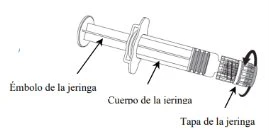
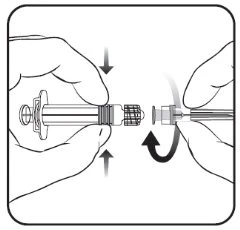
- Insert the needle into the syringe and then turn it clockwise until it locks into place (see illustration).
 Removing the needle cap may be slightly difficult at times.
- Add the solvent to the powder. After adding the solvent to the powder, shake the mixture well until the powder is completely dissolved in the solvent.
The reconstituted vaccine is a clear, colorless solution.
The reconstituted vaccine should be inspected visually for any foreign particles and/or alteration in physical appearance before administration. If any such conditions are observed, the vaccine must be discarded.
After reconstitution, the vaccine should be administered promptly.
A new needle must be used to administer the vaccine.
Any unused medicinal product and waste materials that have come into contact with it should be disposed of in accordance with local regulations.