Ngenla 60 mg solution for injection in pre-filled pen
Spain
Table of Contents
Package leaflet: Information for the user
Introduction
Package leaflet: information for the patient
Ngenla 60mg solution for injection in a prefilled pen
somatrogon
This medicine is subject to additional monitoring, which will allow rapid identification of new safety information. You can help by reporting any side effects you may experience. How to report side effects is explained at the end of section 4.
Read this leaflet carefully before you start using this medicine, because it contains important information for you.
- Keep this leaflet, as you may need to read it again.
- If you have any questions, ask your doctor, pharmacist, or nurse.
- This medicine has been prescribed for you or for the child under your care only. Do not give it to others, even if they have the same symptoms as you or the child under your care, as it may harm them.
- If you or the child under your care experience any side effects, consult your doctor, pharmacist, or nurse, even if they are side effects not listed in this leaflet. See section 4.
Leaflet contents
- What Ngenla is and what it is used for
- What you need to know before using Ngenla
- How to use Ngenla
- Possible side effects
- How to store Ngenla
- Contents of the pack and other information
1. What Ngenla is and what it is used for
Ngenla contains the active substance somatrogon, a modified pharmaceutical form of human growth hormone. Natural human growth hormone is necessary for bones and muscles to grow. It also helps fat and muscle tissues develop in the appropriate amounts. Ngenla is used to treat children and adolescents from the age of 3 years who do not have enough growth hormone and are not growing at a normal rate.
The active substance in Ngenla is produced using "recombinant DNA technology". This means it is created in cells that have been modified in the laboratory to enable them to produce it.
2. What you need to know before using Ngenla
Do not use Ngenla
- If you or the child under your care are allergic to somatrogon (see “Warnings and precautions”) or to any of the other components of this medicine (listed in section 6).
- If you or the child under your care have an active tumour (cancer). Inform your doctor if you or the child under your care have or have had an active tumour. Tumours must be inactive and you or the child under your care must have completed anti-tumour treatment before starting treatment with Ngenla.
- If you or the child under your care have stopped growing due to closure of the growth plates (closed epiphyses), meaning that your doctor has informed you or the child under your care that bone growth has ceased.
- If you or the child under your care are severely ill (for example, suffering complications after open-heart surgery, abdominal surgery, acute respiratory failure, multiple accidental traumas, or similar conditions). If you or the child under your care are about to undergo or have recently undergone major surgery, or are going to the hospital for any reason, inform your doctor and remind other healthcare providers that you or the child under your care are receiving growth hormone.
Warnings and precautions
Talk to your doctor, pharmacist, or nurse before starting to use Ngenla:
- If you or the child under your care experience a severe allergic reaction, stop using Ngenla and contact your doctor immediately. Severe allergic reactions such as hypersensitivity, including anaphylaxis or angioedema (difficulty breathing or swallowing, or swelling of the face, lips, throat, or tongue), have occasionally occurred. If you or the child under your care have any of the following symptoms of a severe allergic reaction:
- Breathing difficulties.
- Swelling of the face, mouth, and tongue.
- Hives (urticaria, raised lumps under the skin).
- Rash.
- Fever.
- If you or the child under your care are receiving corticosteroid (glucocorticoid) replacement therapy, you should consult your doctor regularly, as you or the child under your care may require an adjustment of your glucocorticoid dose.
- Your doctor should periodically check whether the thyroid gland is functioning properly in you or the child under your care, and if necessary, may prescribe treatment or adjust the dose of existing treatment, as this may be necessary for Ngenla to work effectively.
- If you or the child under your care have Prader-Willi syndrome, you or the child should not be treated with Ngenla unless you have growth hormone deficiency.
- Your doctor should monitor you or the child under your care for high blood sugar levels (hyperglycaemia) during treatment with Ngenla. If you or the child under your care are receiving insulin or other diabetes medications, your doctor may need to adjust the insulin dose. If you or the child under your care have diabetes and a serious or worsening eye condition related to diabetes, you should not receive treatment with Ngenla.
- If you or the child under your care have ever had any type of tumour (cancer).
- If you or the child under your care experience changes in vision, severe or frequent headaches associated with nausea or vomiting, or loss of muscle control or coordination of voluntary movements such as walking or grasping objects, difficulty speaking, eye movement problems, or difficulty swallowing, especially at the beginning of treatment, inform your doctor immediately. These could be signs of a temporary increase in pressure inside the brain (intracranial hypertension).
- If you or the child under your care are severely ill (for example, suffering complications after open-heart surgery, abdominal surgery, acute respiratory failure, multiple accidental traumas, or similar conditions). If you or the child under your care are about to undergo or have recently undergone major surgery, or are going to the hospital for any reason, inform your doctor and remind other healthcare providers that you or the child under your care are receiving growth hormone.
- If you or the child under your care experience severe stomach pain during treatment with Ngenla, as this could be a symptom of inflammation of the pancreas.
- If you or the child under your care notice a sideways curvature of the spine (scoliosis), you or the child should be examined regularly by your doctor.
- If during growth, you or the child under your care experience limping or pain in the hip or knee, you or the child should consult your doctor immediately. These could be symptoms of bone disorders in the hip, which may occur during periods of rapid growth.
- If you or the child under your care start or stop taking oral contraceptives or estrogen hormone replacement therapy, your doctor may recommend adjusting the dose of Ngenla.
Other medicines and Ngenla
Inform your doctor, pharmacist, or nurse if you or the child under your care are using, have recently used, or might need to use any other medicines.
- If you or the child under your care are receiving corticosteroid (glucocorticoid) replacement therapy, as these may reduce the effect of Ngenla on growth. You or the child under your care should consult your doctor regularly, as you or the child under your care may require an adjustment of your glucocorticoid dose.
- If you or the child under your care are receiving insulin or other diabetes medications, consult your doctor, as it may be necessary to adjust the dose.
- If you or the child under your care are receiving thyroid hormone treatment, your doctor may need to adjust the dose.
- If you or the child under your care are taking oral estrogens, consult your doctor, as you or the child may require an adjustment of the Ngenla dose.
- If you or the child under your care are receiving cyclosporine (a medicine that suppresses the immune system after transplantation), consult your doctor, as your doctor may need to adjust the dose.
- If you or the child under your care are taking medicines for epilepsy (anticonvulsants), consult your doctor, as your doctor may need to adjust the dose.
Pregnancy and breastfeeding
If you or the girl under your care are pregnant or breastfeeding, think you or the girl under your care might be pregnant, or plan to become pregnant, consult your doctor or pharmacist before using this medicine.
Ngenla has not been studied in pregnant women, and it is not known whether this medicine can harm the unborn baby. Therefore, Ngenla should be avoided during pregnancy. If you are able to become pregnant, you should not use Ngenla unless you are also using a reliable method of contraception.
It is unknown whether somatrogon passes into breast milk. Inform your doctor or the girl’s doctor if you or the girl under your care are breastfeeding or plan to breastfeed. Your doctor will help you decide whether you or the girl under your care should discontinue breastfeeding or stop receiving Ngenla, taking into account the benefits of breastfeeding for the baby and the benefits of Ngenla for you or the girl under your care.
Driving and using machines
Ngenla does not affect the ability to drive or operate machinery.
Ngenla contains sodium
This medicine contains less than 1 mmol of sodium (23 mg) per dose; thus, it is essentially “sodium-free”.
Ngenla contains metacresol
Ngenla contains a preservative called metacresol. In very rare cases, metacresol may cause inflammation (swelling) in the muscles. If you or the child under your care experience muscle pain or pain at the injection site, inform your doctor.
3. How to use Ngenla
This medicine will only be prescribed by a doctor experienced in growth hormone treatment who has confirmed your diagnosis or that of the child under your care.
Always follow exactly the instructions for use of this medicine as given by your doctor. If in doubt, consult your doctor, pharmacist, or nurse again.
Your doctor will determine the dose of Ngenla you should receive.
How much to use
Your doctor will calculate your dose of Ngenla based on your body weight in kilograms. The recommended dose is 0.66 mg per kg of body weight, administered once weekly. If you or the child under your care have previously been treated with daily growth hormone injections, your doctor will instruct you to wait until the day after your last daily injection before receiving your first dose of Ngenla, then continue with Ngenla once a week.
Do not change your dose unless your doctor tells you to do so.
How Ngenla is administered
- Ngenla is available as a pre-filled pen in two different sizes (Ngenla 24 mg and Ngenla 60 mg). Depending on the recommended dose, your doctor or the doctor of the child under your care will prescribe the most appropriate pen size (see section 6 “Contents of the pack and other information”).
- Before you or the child under your care use the pen for the first time, your doctor or nurse will show you how to use it. Ngenla is administered by injection under the skin (subcutaneous injection) using a pre-filled pen. Do not inject it into a vein or muscle.
- The best areas for administering Ngenla are the abdomen (stomach), thighs, buttocks, and upper arms. Injections in the upper arms and buttocks should be administered by a caregiver.
- Change the injection site on your body or the body of the child under your care each time a dose is given.
- If more than one injection is required to administer a complete dose, each injection should be given at a different injection site.
Detailed instructions for use of the pre-filled pen are located at the end of this leaflet.
When to use Ngenla
You or the child under your care should use this medicine once a week, on the same day each week.
You or the child under your care should record which day of the week you use Ngenla to help you remember to inject this medicine once a week.
If necessary, you or the child under your care may change the day of your weekly injection, provided at least 3 days have passed since the last injection was given. After selecting a new administration day, continue to administer the injection to yourself or the child under your care on that day every week.
If you use more Ngenla than you should
If you or the child under your care have injected more Ngenla than you should have, contact your doctor immediately, as monitoring of your blood sugar levels may be necessary.
If you forget to use Ngenla
If you or the child under your care forget to inject a dose and:
- 3 days or fewer have passed since you or the child under your care should have used Ngenla, use it as soon as you remember. Then inject your next dose on your usual injection day.
- More than 3 days have passed since you or the child under your care should have used Ngenla, skip the missed dose. Then inject your next dose as usual on the next scheduled day. A regular administration day should be maintained.
Do not use a double dose to make up for a missed dose.
If you stop using Ngenla
Do not stop using this medicine without consulting your doctor.
If you have any further questions about the use of this medicine, ask your doctor, pharmacist, or nurse.
4. Possible adverse effects
Like all medicines, this medicine may cause adverse effects, although not everybody gets them.
Very common: may affect more than 1 in 10 people
- Headache
- Bleeding, swelling, itching, pain, redness, discomfort, stinging, sensitivity, or warmth at the injection site (injection site reactions)
- Fever (pyrexia)
Common: may affect up to 1 in 10 people
- Decrease in the number of red blood cells in the blood (anaemia)
- Increase in the number of eosinophils in the blood (eosinophilia)
- Decreased blood level of thyroid hormone (hypothyroidism)
- Allergic inflammation of the conjunctiva, the transparent layer covering the outer part of the eye (allergic conjunctivitis)
- Joint pain (arthralgia)
- Pain in arms or legs
Uncommon: may affect up to 1 in 100 people
- Adrenal glands do not produce enough steroid hormones (adrenal insufficiency)
- Rash
Other possible adverse effects not observed with Ngenla but reported with other medicinal treatments containing growth hormone may include the following:
- Growth of tissues (non-cancerous or cancerous)
- Type 2 diabetes
- Increased intracranial pressure (causing symptoms such as severe headache, visual disturbances, or vomiting)
- Numbness or tingling
- Joint or muscle pain
- Breast enlargement in children and men
- Skin rash, redness, and itching
- Fluid retention (manifesting as swollen fingers or swollen ankles)
- Facial swelling
- Pancreatitis (causing symptoms of stomach pain, nausea, vomiting, or diarrhoea)
In very rare cases, the presence of metacresol may cause inflammation (swelling) in the muscles. If you or the child under your care experiences muscle pain or pain at the injection site, inform your doctor.
Reporting of adverse effects
If you experience any type of adverse effect, talk to your doctor, pharmacist, or nurse, even if it is a possible adverse effect not listed in this leaflet. You can also report them directly through the national reporting system included in Appendix V. By reporting adverse effects, you can help provide more information on the safety of this medicine.
5. Storage of Ngenla
Keep this medicine out of the sight and reach of children.
Do not use this medicine after the expiry date stated on the label of the pen or on the carton after “EXP”. The expiry date refers to the last day of the month indicated.
The prefilled pen must not be used for more than 28 days after first use.
Before first use of Ngenla
- Store in a refrigerator (between 2 °C and 8 °C).
- Keep Ngenla in the outer packaging to protect it from light.
- Remove Ngenla from the refrigerator before use. Ngenla may be kept at room temperature (up to a maximum of 32 °C) for up to 4 hours.
- Do not use this medicine if the solution appears cloudy or dark yellow. Do not use the medicine if it contains flakes or particles.
- Do not shake the pen. Shaking may damage the medicine.
After first use of Ngenla
-
Use within 28 days after first use. Store in a refrigerator (between 2 °C and 8 °C). Do not freeze.
-
Keep Ngenla with the pen cap on to protect it from light.
-
Do not store the prefilled pen with the needle attached.
-
Dispose of the pen after the last dose, even if there is unused medicine remaining.
-
Ngenla may be kept at room temperature (up to a maximum of 32 °C) for up to 4 hours with each injection, up to a maximum of 5 times. Return Ngenla to the refrigerator after each use.
-
Do not leave the pen at room temperature for more than 4 hours with each use.
-
Do not place the pen in any location where the temperature exceeds 32 °C.
-
If more than 28 days have passed since first use of the pen, dispose of it even if unused medicine remains. If your pen or the pen of the child under your care has been exposed to temperatures above 32 °C, has been out of the refrigerator for more than 4 hours with each use, or has been used a total of 5 times, dispose of it even if unused medicine remains.
To help you remember when to dispose of your pen, you may write the date of first use on the label of the pen.
A small amount of medicine may remain in the pen after all doses have been correctly administered. Do not attempt to use the remaining medicine. After administering the last dose, the pen should be properly disposed of.
Medicines must not be disposed of via wastewater or household waste. Ask your pharmacist how to dispose of containers and medicines you no longer need. This will help protect the environment.
6. Contents of the pack and other information
Composition of Ngenla
- The active substance is somatrogon.
Ngenla 24 mg solution for injection in a pre-filled pen
One ml of solution contains 20 mg of somatrogon.
Each pre-filled pen contains 24 mg of somatrogon in 1.2 ml of solution. Each pre-filled pen delivers doses from 0.2 mg to 12 mg in a single injection, in increments of 0.2 mg.
Ngenla 60 mg solution for injection in a pre-filled pen
One ml of solution contains 50 mg of somatrogon.
Each pre-filled pen contains 60 mg of somatrogon in 1.2 ml of solution. Each pre-filled pen delivers doses from 0.5 mg to 30 mg in a single injection, in increments of 0.5 mg.
- The other components are: trisodium citrate dihydrate, citric acid monohydrate, L-histidine, sodium chloride (see section 2 “Ngenla contains sodium”), poloxamer 188, m-cresol, and water for injections.
Nature of the product and contents of the pack
Ngenla is a transparent, colourless to slightly yellowish injectable solution in a pre-filled pen.
Ngenla 24 mg solution for injection is available in a pack size containing 1 pre-filled pen. The pen cap, dose button, and pen label are lilac in colour.
Ngenla 60 mg solution for injection is available in a pack size containing 1 pre-filled pen. The pen cap, dose button, and pen label are blue in colour.
Marketing Authorization Holder Pfizer Europe MA EEIG Boulevard de la Plaine 17 1050 Bruxelles Belgium |
Manufacturer Responsible Pfizer Manufacturing Belgium NV Rijksweg 12 2870 Puurs-Sint-Amands Belgium |
You can request further information about this medicinal product by contacting the local representative of the marketing authorization holder:
Belgium/Belgium/Belgium Luxembourg/Luxembourg Pfizer NV/SA Tel/Tel: +32 (0)2 554 62 11 | Lithuania Pfizer Luxembourg SARL branch in Lithuania Tel: +370 5 251 4000 |
Bulgaria Pfizer Bulgaria EOOD, Sofia Tel: +359 2 970 4333 | Hungary Pfizer Kft. Tel.: + 36 1 488 37 00 |
Czech Republic Pfizer, spol. s r.o. Tel: +420 283 004 111 | Malta Vivian Corporation Ltd. Tel: +356 21344610 |
Denmark Pfizer ApS Tlf.: +45 44 20 11 00 | Netherlands Pfizer bv Tel: +31 (0)800 63 34 636 |
Germany PFIZER PHARMA GmbH Tel: +49 (0)30 550055-51000 | Norway Pfizer AS Tlf: +47 67 52 61 00 |
Estonia Pfizer Luxembourg SARL Estonia branch Tel: +372 666 7500 | Austria Pfizer Corporation Austria Ges.m.b.H. Tel: +43 (0)1 521 15-0 |
Greece Pfizer Hellas S.A. Tel: +30 210 6785800 | Poland Pfizer Polska Sp. z o.o. Tel.: +48 22 335 61 00 |
Spain Pfizer S.L. Tel: +34 91 490 99 00 | Portugal Laboratórios Pfizer, Lda. Tel: +351 21 423 5500 |
France Pfizer Tél: +33 (0)1 58 07 34 40 | Romania Pfizer Romania S.R.L. Tel: +40 (0) 21 207 28 00 |
Croatia Pfizer Croatia d.o.o. Tel: +385 1 3908 777 | Slovenia Pfizer Luxembourg SARL Pfizer, advisory branch for pharmaceutical activities, Ljubljana Tel: + 386 (0)1 52 11 400 |
Ireland Pfizer Healthcare Ireland Unlimited Company Tel: 1800 633 363 (toll free) Tel: +44 (0)1304 616161 | Slovakia Pfizer Luxembourg SARL, organizational unit Tel: + 421 2 3355 5500 |
Iceland Icepharma hf. Tel: +354 540 8000 | Finland Pfizer Oy Tel: +358 (0)9 430 040 |
Italy Pfizer S.r.l. Tel: +39 06 33 18 21 | Sweden Pfizer AB Tel: +46 (0)8 550 520 00 |
Cyprus Pfizer Hellas S.A. (Cyprus Branch) Tel: +357 22817690 | |
Latvia Pfizer Luxembourg SARL branch in Latvia Tel: +371 670 35 775 |
Date of last review of this leaflet: 04/2025.
Other sources of information
Detailed information on this medicine is available on the European Medicines Agency website: https://www.ema.europa.eu.
Instructions for use
Ngenla 60 mg Pen
Injection for subcutaneous use only (under the skin)
Keep this leaflet. These instructions provide step-by-step guidance
on how to prepare and administer an injection of Ngenla.
Important information about the Ngenla pen
- Injectable Ngenla is a prefilled multidose pen containing 60 mg of medicine.
- Injectable Ngenla may be administered by a patient, caregiver, physician, nurse, or pharmacist. Do not attempt to self-inject Ngenla until you have been shown the correct way to administer the injections and have read and understood these instructions for use. If your doctor, nurse, or pharmacist determines that you or a caregiver may administer Ngenla injections at home, you must receive training on the proper way to prepare and inject Ngenla. It is important to consult with your doctor, nurse, or pharmacist to ensure you understand the administration instructions for Ngenla.
- To help you remember when to inject Ngenla, you may mark your calendar in advance. Contact your doctor, nurse, or pharmacist if you or your caregiver have any questions about the correct way to inject Ngenla.
- Each turn (click) of the dose knob increases the dose by 0.5 mg of medicine. You may administer between 0.5 mg and 30 mg in a single injection. If your dose exceeds 30 mg, you will need to administer more than one injection.
- A small amount of medicine may remain in the pen after all doses have been correctly administered. This is normal. Patients must not attempt to use the remaining solution but must dispose of the pen properly.
- Do not share your pen with other people, even if the needle has been changed. You may transmit serious infections to others or contract serious infections from them.
- Always use a new sterile needle for each injection. This reduces the risk of contamination, infection, medicine leakage, and blocked needles that may lead to an incorrect dose.
- Do not shake the pen. Shaking the pen may damage the medicine.
- Use of the pen is not recommended for blind or visually impaired individuals without assistance from a person trained in the proper use of the product.
Materials you will need each time you inject
Included in the package:
- 1 Ngenla 60 mg pen.
Not included in the package:
- 1 new sterile needle for each injection.
- Alcohol-impregnated wipes.
- Cotton balls or gauze pads.
- Adhesive bandage.
- A sharps container suitable for the disposal of pen needles and pens.
Ngenla 60 mg Pen:
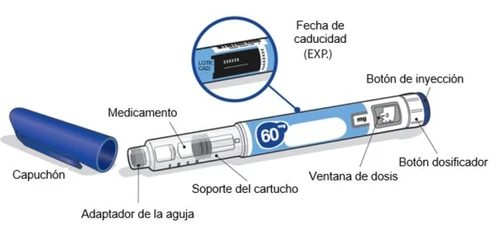
Needles that can be used
Pen needles are not included with the Ngenla pen. You may use pen needles from 4 mm to 8 mm in length and between 30G and 32G.
- The following needles have been shown to be compatible with the Ngenla pen:
- 32G (Novo Nordisk®, NovoFine® Plus)
- 31G (Novo Nordisk®, NovoFine®)
- 31G (Becton Dickinson and Company, BD Ultra-Fine™ or BD Micro-Fine™)
- The following safety needles have been shown to be compatible with the Ngenla pen:
- 30G (Becton Dickinson and Company, AutoShield Duo™)
- 30G (Novo Nordisk®, NovoFine® AutoCover®)
- Consult your doctor, nurse, or pharmacist about the appropriate needle for you.
Sterile needle (example) not included:
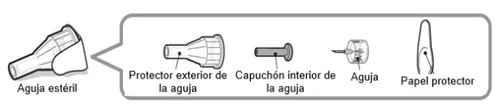
Note: Safety needles do not have an inner needle cap. Steps 5, 6, and 11 of these instructions relating to the inner needle cap may not apply when using a safety needle. Refer to the manufacturer's instructions for use of the needle for further information.
Caution: Never use a bent or damaged needle. Always handle pen needles carefully to avoid accidentally puncturing yourself (or others) with the needle. Do not attach a new needle to the pen until you are ready for injection.
Preparation for injection
Step 1: Preparation
-
Wash and dry your hands.
-
You may use your pen directly from the refrigerator. For a more comfortable injection, allow your pen to reach room temperature for up to 30 minutes. (See section 5 “Storage of Ngenla” in the Ngenla 60 mg prefilled pen leaflet).
-
Check the name, concentration, and label on the pen to ensure it is the medicine prescribed by your doctor.
-
Check the expiration date on the pen label. Do not use if the expiration date has passed.
-
Do not use the pen if:
- It has been frozen or exposed to heat (above 32°C), or more than 28 days have passed since first use of the pen. (See section 5 “Storage of Ngenla” in the Ngenla 60 mg prefilled pen leaflet).
- It has been dropped.
- It appears broken or damaged.
-
Do not remove the pen cap until you are ready for injection.
Step 2: Choose and clean the injection site
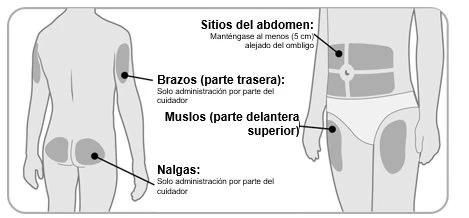
-
Ngenla can be administered in the abdomen (stomach), thighs, buttocks, or upper arms.
-
Select the best injection site as recommended by your doctor, nurse, or pharmacist.
-
If more than one injection is needed to complete your dose, each injection should be given at a different injection site.
-
Do not inject into bony areas, bruised, red, painful, or hard areas, or areas with scars or skin conditions.
-
Clean the injection site with an alcohol-impregnated wipe.
-
Allow the injection site to dry.
-
Do not touch the injection site after cleaning.
Step 3: Check the medicine
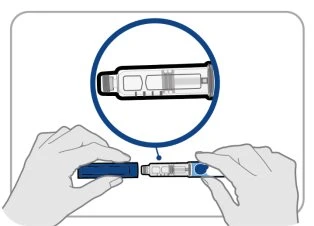
- Remove the pen cap and keep it for after the injection.
- Inspect the medicine inside the cartridge holder.
- Ensure the medicine is clear and colorless to slightly yellowish. Do not inject the medicine if it is cloudy or dark yellow.
- Ensure the medicine is free of flakes or particles. Do not inject the medicine if flakes or particles are present.
Note: It is normal to see one or more bubbles in the medicine.
Step 4: Attach the needle
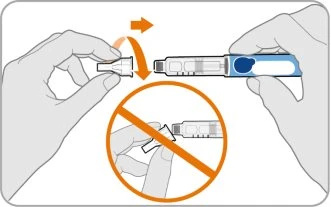
- Take a new needle and remove the protective paper.
- Align the needle with your pen, keeping both straight.
- Gently push and then screw the needle onto your pen.
Do not overtighten.
Note: Be careful not to attach the needle at an angle. This may cause the pen to leak.
Caution: Needles have sharp tips on both ends. Be cautious to avoid accidentally puncturing yourself (or others) with the needle.
Step 5: Remove the outer needle cap
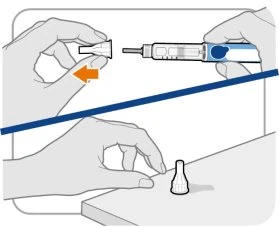
- Remove the outer needle cap.
- Keep the outer needle cap. You will need it later to remove the needle.
Note: You should see an inner needle cap after removing the outer cap. If you do not, try reattaching the needle.
Note: If using a safety needle, refer to the manufacturer's instructions for use.
Step 6: Remove the inner needle cap
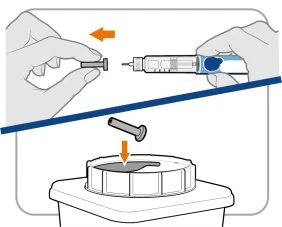
- Carefully remove the inner needle cap to expose the needle.
- Dispose of the inner needle cap in a sharps container. It is no longer needed.
Note: If using a safety needle, refer to the manufacturer's instructions for use.
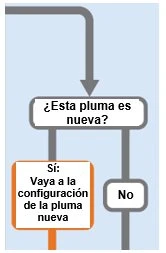
(“Yes: Go to new pen setup” has an arrow pointing to “New pen setup (priming)” and “No” has an arrow pointing to “Set your prescribed dose”)
New pen setup (priming): only for first use of a new pen
-
You must perform a new pen setup (priming) before first use of each new pen.
-
The new pen setup is performed before each new pen is used for the first time.
-
The purpose of the new pen setup is to remove air bubbles and ensure you receive the correct dose.
Important: Skip from Step A to Step C if you have already performed the pen setup.
Step A: Set the knob to 1.0
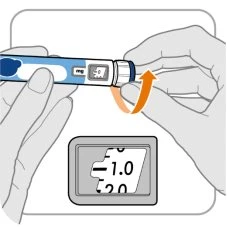
- Turn the dose knob to 1.0.
Note: If you turn the dose knob too far, you may turn it back.
Step B: Tap the cartridge holder
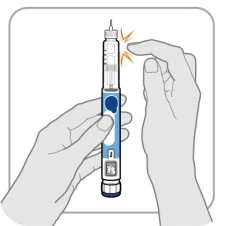
- Hold the pen with the needle pointing upward so that air bubbles can rise.
- Gently tap the cartridge holder to move air bubbles to the top.
Important: Continue with Step B even if you do not see air bubbles.
Step C: Press the button and check for liquid
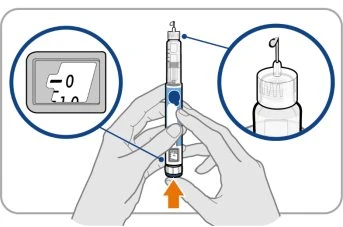
- Press the injection button until it cannot go further and “0” appears in the dose window.
- Check for liquid at the needle tip. If liquid appears, your pen is primed.
- Always ensure a drop of liquid appears before injection. If no liquid appears, repeat Steps A to C.
- If no liquid appears after repeating Steps A to C five (5) times, attach a new needle and try once (1) more.
Do not use the pen if a drop of liquid still does not appear. Contact your doctor, nurse, or pharmacist and use a new pen.
Set your prescribed dose
Step 7: Set your dose
| Example A:
21.5 mg displayed in the dose window Example B:
30.0 mg displayed in the dose window |
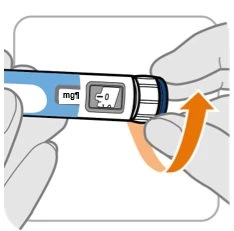
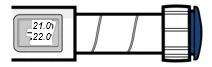
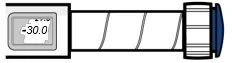
- Turn the dose selector to set your dose.
- The dose can be increased or decreased by turning the dose selector in either direction.
- The dose selector turns in increments of 0.5 mg.
- Your pen contains 60 mg of medicine, but you can only set a dose of up to 30 mg for a single injection.
- The dose window displays the dose in mg. See examples A and B.
- Always check the dose window to make sure you have set the correct dose.
Important: Do not press the injection button while setting your dose.
What should I do if I cannot set the dose I need?
- If your dose is greater than 30 mg, you will need more than one injection.
- You can administer from 0.5 mg to 30 mg in a single injection.
- If you need help dividing your dose correctly, consult your doctor, nurse, or pharmacist.
- Use a new needle for each injection (see Step 4: Attach the needle).
- If you normally need to give 2 injections for your full dose, make sure to administer your second dose.
What should I do if there is not enough medicine left in my pen?
- If your pen contains less than 30 mg of medicine, the dose selector will stop at the remaining amount of medicine shown in the dose window.
- If there is not enough medicine left in your pen for your full dose, you may:
- Inject the remaining amount in your pen and then prepare a new pen to complete your dose.
Remember to subtract the dose you have already received. For example, if your dose is 21.5 mg and you can only set the dose selector to 17 mg, you must inject the remaining 4.5 mg using a new pen.
- Or obtain a new pen and inject the full dose.
Inject your dose
Step 8 Insert the needle
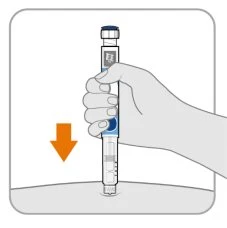
- Hold the pen so you can see the numbers in the dose window.
- Insert the needle straight into the skin.
Step 9 Inject your medicine
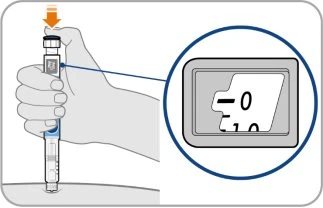
- Keep holding the needle in the same position on your skin.
- Press the injection button until it cannot be pressed further and “0” appears in the dose window.
Step 10 Count to 10
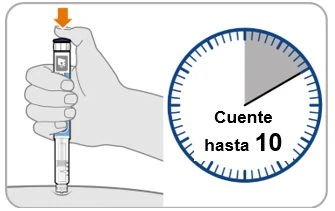
- Continue pressing the injection button while counting to 10. Counting to 10 ensures the full dose of medicine is delivered.
- After counting to 10, release the injection button and slowly remove the pen from the injection site by pulling the needle outward.
Note: You may see a drop of medicine at the tip of the needle. This is normal and does not affect the dose you have just received.
Step 11 Replace the outer needle cap
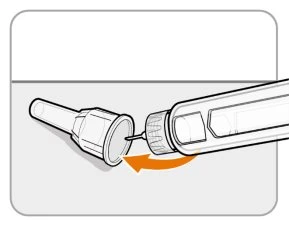
- Carefully replace the outer needle cap over the needle.
- Press the outer needle cap until it is securely in place.
Caution: Never attempt to reinsert the inner needle cap onto the needle. You may accidentally prick yourself with the needle.
Note: If you are using a safety needle, refer to the manufacturer's instructions for use.
Step 12 Remove the needle
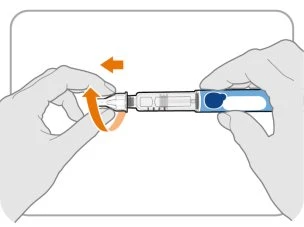
- Unscrew the needle from the pen.
- Gently pull until the needle comes off.
Note: If the needle is still attached, replace the outer needle cap and try again. Make sure to apply pressure while unscrewing the needle.
- Dispose of used pen needles in a sharps container according to your doctor’s, nurse’s, or pharmacist’s instructions and in accordance with local health and safety regulations. Keep the sharps container out of the reach of children. Do not reuse needles.
Step 13 Replace the pen cap
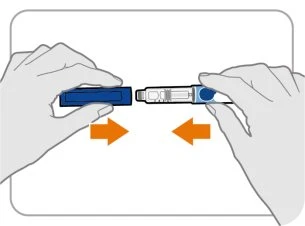
- Replace the pen cap on the pen.
- Do not recap the pen with a needle attached.
- If there is any medicine left in your pen, store it in the refrigerator between uses. (See section 5 “Storage of Ngenla” in the Ngenla 60 mg pre-filled pen package leaflet).
Step 14 After injection
-
Gently press a cotton ball or gauze pad against the injection site and hold it for a few seconds.
-
Do not rub the injection site. You may have slight bleeding. This is normal.
-
You may cover the injection site with a small adhesive bandage, if needed.
-
If the pen is empty or more than 28 days have passed since first use, dispose of it even if there is unused medicine remaining. Dispose of the pen in a sharps container.
-
To help you remember when to dispose of the pen, you may write the date of first use on the pen label and then:
Date of first use ______ / ______ / ______