Nerlynx 40 mg film-coated tablets
Spain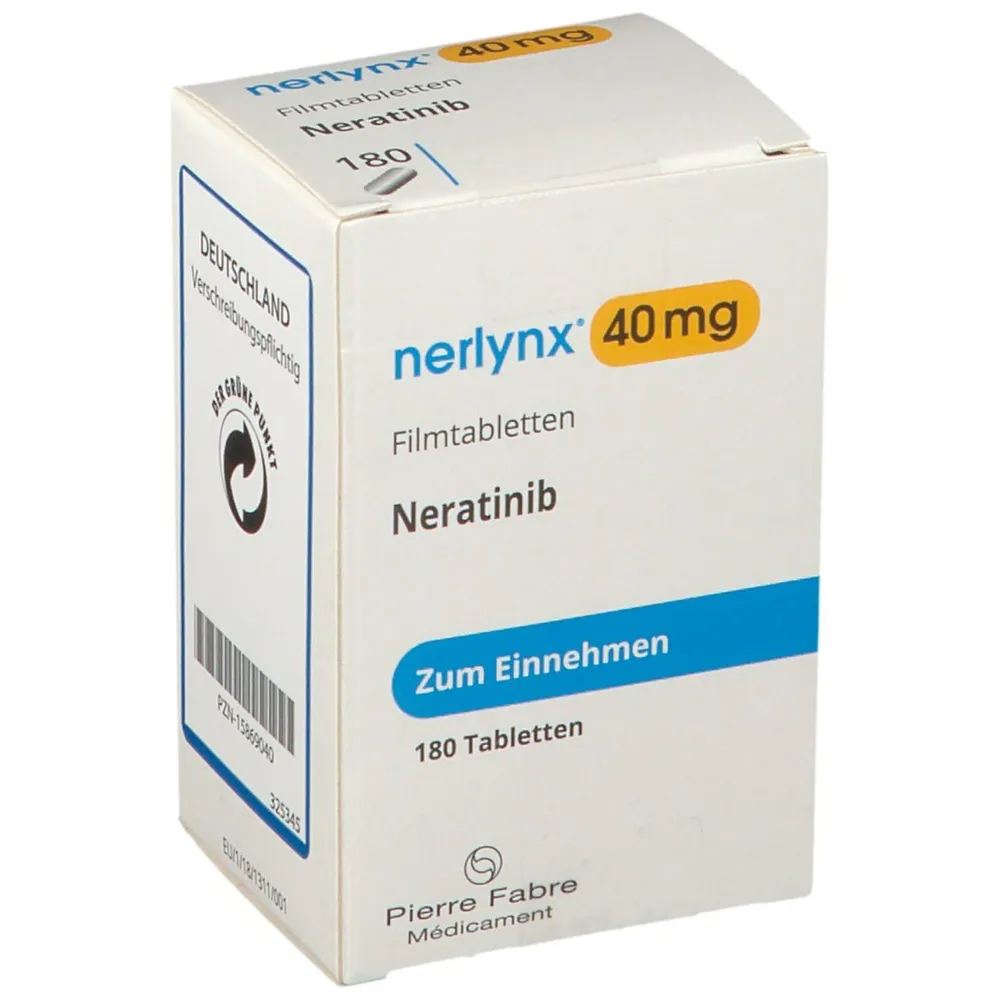
Table of Contents
Package leaflet: Information for the user
Introduction
Package leaflet: information for the patient
Nerlynx 40 mg film-coated tablets
neratinib
Read the entire leaflet carefully before you start taking this medicine because it contains important information for you.
- Keep this leaflet as you may need to read it again.
- If you have any questions, ask your doctor or pharmacist.
- This medicine has been prescribed for you only, and you should not give it to other people, even if they have the same symptoms as you, because it may harm them.
- If you experience any adverse effects, consult your doctor or pharmacist, even if such effects are not listed in this leaflet. See section 4.
Contents of the leaflet
- What Nerlynx is and what it is used for
- What you need to know before taking Nerlynx
- How to take Nerlynx
- Possible side effects
- How to store Nerlynx
- Contents of the pack and other information
1. What Nerlynx is and what it is used for
What Nerlynx is
Nerlynx contains the active substance neratinib. It belongs to a group of medicines called tyrosine kinase inhibitors, which are used to block cancer cells and treat breast cancer.
What Nerlynx is used for
Nerlynx is used in patients with early-stage breast cancer who:
-
are hormone receptor-positive (HR-positive) and have human epidermal growth factor receptor 2 overexpression/amplification (HER2-positive), and
-
have previously been treated with trastuzumab-based therapy completed less than one year ago.
The HER2 receptor is a protein found on the surface of cells in the body that helps regulate the growth of normal breast cells. In HER2-positive breast cancer, cancer cells have an increased number of HER2 receptors on their surface, causing cancer cells to divide and grow more rapidly.
Hormone receptors are also proteins expressed within cells of certain specific tissues. Estrogen and progesterone bind to these proteins and regulate cellular activity. In HR-positive breast cancer, estrogen and/or progesterone can promote the division and growth of tumor cells.
Before using Nerlynx, your cancer must be tested to confirm it is HR-positive and HER2-positive (overexpression/amplification). In addition, you must have received prior treatment with trastuzumab-based therapy.
How Nerlynx works
Nerlynx works by blocking the HER2 receptors on cancer cells. This prevents the cells from dividing and growing.
2. What you need to know before taking Nerlynx
Do not take Nerlynx
- if you are allergic to neratinib or to any of the other ingredients of this medicine (listed in section 6),
- if you have severe liver problems (classified as Child-Pugh class C),
- if you are taking a medicine that strongly induces liver enzymes (CYP3A4) and/or the drug transporter (P-gp), such as:
- rifampicin (a medicine for tuberculosis (TB)),
- carbamazepine or phenytoin (medicines for seizures),
- St. John’s wort (Hypericum perforatum) (a herbal medicine for depression).
Warnings and precautions
Talk to your doctor or pharmacist before starting to take Nerlynx.
When you start treatment with Nerlynx, you will need to take a diarrhoea medicine
Nerlynx may cause diarrhoea at the beginning of treatment. It may occur more than once. You must take a diarrhoea medicine as recommended by your doctor to prevent diarrhoea from worsening and to avoid dehydration during treatment with Nerlynx. Dietary changes (including appropriate fluid intake) and appropriate dose modifications of Nerlynx may be needed to manage diarrhoea.
Tests and monitoring for liver problems
Nerlynx may cause changes in liver function, which are detected in blood tests. Your doctor will carry out blood tests before and during treatment with Nerlynx and will interrupt treatment with Nerlynx if liver tests show serious problems.
Your doctor should monitor you closely if you have:
- Reduced kidney function
- Chronic gastrointestinal disorder
- Heart disorders or history of heart disease
- Skin and subcutaneous tissue disorders
Elderly patients
If you are 65 years of age or older, your doctor should monitor you closely.
Children and adolescents
Nerlynx must not be used in children and adolescents under 18 years of age. The safety and efficacy of Nerlynx have not been studied in this age group.
Other medicines and Nerlynx
Tell your doctor or pharmacist if you are taking, have recently taken, or might need to take any other medicines. The effectiveness and/or safety of Nerlynx and/or other medicines may be altered when taken together. This is because Nerlynx may affect how other medicines work. In addition, some medicines may affect how Nerlynx works.
In some cases, your doctor may make dose adjustments or carry out close monitoring.
In particular, tell your doctor or pharmacist if you are taking any of the following medicines:
- rifampicin, a medicine for tuberculosis (TB)
- carbamazepine, phenobarbital, phenytoin or primidone, medicines for seizures
- St. John’s wort (Hypericum perforatum), a herbal medicine for depression
- ketoconazole, voriconazole, itraconazole or fluconazole, medicines for fungal infections
- erythromycin, clarithromycin, troleandomycin or ciprofloxacin, medicines for bacterial infections
- protease inhibitors (such as ritonavir, lopinavir, saquinavir, nelfinavir, atazanavir, indinavir, efavirenz, etravirine) or medicines used in combination with antiretroviral therapy in HIV (cobicistat), antiviral medicines
- nefazodone, a medicine used to treat depression
- diltiazem or verapamil, medicines for high blood pressure and chest pain
- bosentan, a medicine for high blood pressure in the pulmonary artery
- dabigatran or digoxin, medicines for heart problems
- statin medicines (such as rosuvastatin), a medicine for high cholesterol
- dexamethasone, an anti-inflammatory medicine (corticosteroid)
- colchicine, an anti-inflammatory medicine used for gout
- irinotecan, a medicine used in colorectal cancer
- sulfasalazine, an intestinal anti-inflammatory medicine
- cyclosporine, everolimus, sirolimus and tacrolimus: immunosuppressant medicines
- fluvoxamine, a medicine used to treat depression and obsessive-compulsive disorders
- medicines for stomach problems:
- proton pump inhibitors (PPIs) whose use is not recommended (such as lansoprazole, omeprazole)
- "H2-receptor antagonists" (such as ranitidine). Neratinib should be taken at least 2 hours before or 10 hours after taking an H2-receptor antagonist.
- antacids; the administration of these medicines and Nerlynx should be separated by at least 3 hours.
If any of the above situations apply to you (or if you have any doubts), consult your doctor or pharmacist before taking Nerlynx.
Taking Nerlynx with food and drink
Do not consume grapefruit or pomegranate while taking Nerlynx; this includes eating the fruit, drinking its juice, or taking supplements that may contain it. The reason is that these fruits may interact with Nerlynx and affect its action.
Pregnancy
If you are pregnant, your doctor will evaluate the potential benefits for you and the risks to the fetus before prescribing this medicine. If you become pregnant while taking this medicine, your doctor will evaluate the potential benefits for you and the risks to the fetus associated with continuing treatment with this medicine.
Contraception
Women who could become pregnant must use an effective contraceptive method, including a barrier method:
- while taking Nerlynx and
- for one month after stopping treatment.
Men must use an effective barrier contraceptive method, such as a condom:
- while taking Nerlynx and
- for three months after stopping treatment.
Breast-feeding
Consult your doctor before taking Nerlynx if you are breast-feeding or plan to breast-feed, as it is unknown whether small amounts of this medicine may pass into breast milk. Your doctor will explain the benefits and risks of taking Nerlynx during this period.
Driving and using machines
The effect of Nerlynx on the ability to drive and use machines is minor. The side effects of Nerlynx (e.g., dehydration and dizziness due to diarrhoea, fatigue and fainting) may affect performance of tasks requiring judgment and motor or cognitive skills.
3. How to take Nerlynx
Follow exactly the administration instructions for this medicine given by your doctor. If in doubt, consult your doctor or pharmacist again.
What dose of Nerlynx should you take
The recommended dose of Nerlynx is 6 tablets once daily (a total of 240 mg).
- Take the tablets with food. Do not crush or dissolve the tablets.
- Take all tablets with water, at approximately the same time each day, preferably in the morning.
The duration of treatment is one year.
If you experience adverse effects, your doctor may adjust the dose or temporarily or permanently discontinue treatment.
When starting treatment with Nerlynx, you will need to take an anti-diarrhoeal medicine
Nerlynx can cause diarrhoea at the beginning of treatment unless an anti-diarrhoeal medicine is used to prevent or reduce diarrhoea. Diarrhoea usually occurs early in treatment with Nerlynx and may be severe and recurrent, leading to dehydration. Your doctor will advise you on how to adjust your diet and fluid intake.
- Start taking the anti-diarrhoeal medicine prescribed by your doctor with the first dose of Nerlynx.
- Your doctor will instruct you on how to take the anti-diarrhoeal medicine.
- Continue taking the anti-diarrhoeal for the first month or first two months of treatment with Nerlynx. Your doctor will tell you whether you need to continue taking it after the first two months.
- Your doctor will also tell you if you need to adjust the dose of Nerlynx due to diarrhoea.
If you take more Nerlynx than you should, contact a doctor or hospital immediately. Take the medicine packaging with you.
Some adverse effects that may occur if you take more Nerlynx than you should are: diarrhoea, nausea, vomiting and dehydration.
If you forget to take Nerlynx
- If you miss a dose, wait until the next day before taking the next dose.
- Do not take a double dose to make up for missed doses.
If you stop taking Nerlynx
- You must not stop treatment with Nerlynx without first talking to your doctor.
If you have any further questions about the use of this medicine, ask your doctor or pharmacist.
4. Possible adverse effects
Like all medicines, this medicine can cause adverse effects, although not everyone will experience them. The following adverse effects may occur with this medicine:
Diarrhea
Nerlynx may cause diarrhea (an increase in the number per day and/or a change in the consistency of stools) at the beginning of treatment unless anti-diarrheal medications are used to prevent or reduce diarrhea. Diarrhea may be severe and lead to dehydration. See section 3 for more information about the anti-diarrheal treatment you must take at the same time as Nerlynx.
Contact your doctor if:
- diarrhea does not go away; they may provide advice on how to manage diarrhea.
- you feel weak or dizzy due to diarrhea; if your doctor is not available, you may go to the hospital immediately.
Liver problems
Nerlynx may cause changes in liver function, which are detected in blood tests. You may or may not have signs or symptoms of liver problems (e.g., yellowing of the skin or eyes, dark urine, or pale stools). Your doctor will perform blood tests before and during treatment with Nerlynx and will interrupt treatment with Nerlynx if liver tests show serious problems.
Other adverse effects
Inform your doctor or pharmacist if you notice any of the following adverse effects:
Very common (may affect more than 1 in 10 people)
- diarrhea
- stomach pain, nausea, vomiting, decreased appetite
- inflammation of the mouth lining, with blisters or sores in the mouth
- rash
- muscle spasms or cramps
- severe fatigue
Common (may affect up to 1 in 10 people)
- burning sensation when urinating, frequent and urgent need to urinate (may be symptoms of urinary tract infection)
- dehydration
- fainting
- nosebleeds
- mild stomach discomfort (bloating, indigestion)
- dry mouth
- changes in blood test results measuring liver function (the enzymes called alanine aminotransferase and aspartate aminotransferase increase)
- nail problems, such as cracked nails or nail discoloration
- dry skin, including cracked skin
- changes in kidney function tests
- weight loss
Uncommon (may affect up to 1 in 100 people)
- kidney failure
- changes in blood test results measuring liver function (i.e., elevated blood bilirubin levels)
Inform your doctor or pharmacist if you experience any of the adverse effects listed above.
Reporting of adverse effects
If you experience any type of adverse effect, consult your doctor or pharmacist, even if it is a possible adverse effect not listed in this leaflet. You may also report them directly through the national reporting system included in Appendix V. By reporting adverse effects, you can help provide more information on the safety of this medicine.
5. Storage of Nerlynx
Keep this medicine out of the sight and reach of children.
Do not use this medicine after the expiry date stated on the bottle and carton following CAD (EXP). The expiry date refers to the last day of the month indicated.
This medicine does not require any special storage temperature.
Keep the bottle tightly closed to protect it from moisture.
Do not use Nerlynx if you notice signs of damage to the packaging or signs of tampering (e.g., if the inner seal is broken).
Medicines should not be disposed of via wastewater or household waste. Ask your pharmacist how to dispose of medicines and packaging that you no longer need. This will help protect the environment.
6. Contents of the pack and other information
Composition of Nerlynx
- The active substance is neratinib. Each film-coated tablet contains neratinib maleate equivalent to 40 mg of neratinib.
- The other components are:
- Tablet core: mannitol (E421), microcrystalline cellulose, crospovidone, povidone, colloidal anhydrous silica, magnesium stearate
- Tablet coating: polyvinyl alcohol, titanium dioxide (E171), macrogol, talc, iron oxide red (E172)
Appearance of the product and contents of the pack
The film-coated tablets are red, oval-shaped, with "W104" engraved on one side and smooth on the other side.
Nerlynx film-coated tablets are supplied in a white, round, high-density polyethylene (HDPE) bottle with a child-resistant polypropylene closure and an aluminum induction-sealed tamper-evident inner seal. Each bottle contains 180 film-coated tablets.
Inside each bottle, together with the tablets, is an HDPE desiccant bag containing 1 g of silica gel. Do not ingest the desiccant. Keep it inside the bottle.
Marketing Authorization Holder
PIERRE FABRE MEDICAMENT
Les Cauquillous
81500 Lavaur
France
Manufacturer
Pierre Fabre Médicament Production – Cahors
Site de Cahors
Le Payrat
46000 Cahors
France
Date of the most recent revision of this leaflet: MM/YYYY
Other sources of information
Detailed information on this medicine is available on the website of the European Medicines Agency: https://www.ema.europa.eu.