Neotigason 25 mg hard capsules
Spain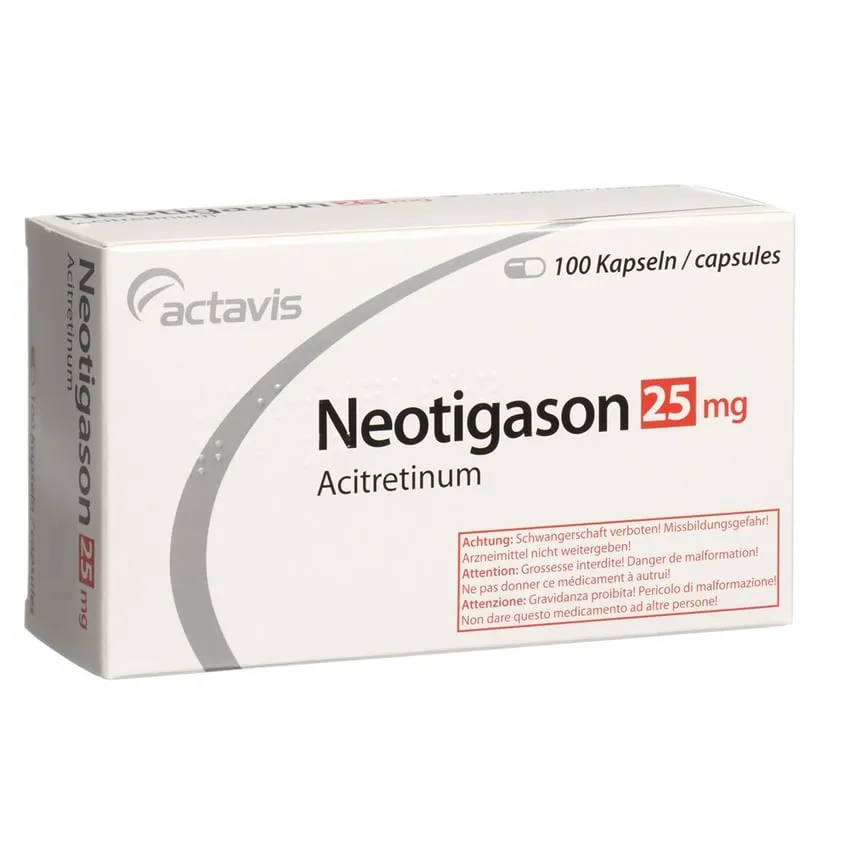
Table of Contents
- Package leaflet: Information for the user
- Introduction
- 1. What Neotigason is and what it is used for
- 2. What you need to know before starting to take Neotigason
- **Do not take Neotigason**
- 3. How to take Neotigason
- 4. Possible adverse effects
- 5. Storage of Neotigason
- 6. Contents of the pack and other information
Package leaflet: Information for the user
Introduction
Package leaflet: information for the user
Neotigason 25 mg hard capsules
Acitretin
WARNING
THIS MEDICINE CAN SERIOUSLY HARM AN UNBORN BABY IF TAKEN DURING PREGNANCY.
Women must use effective contraception throughout treatment.
Do not take this medicine if you are pregnant or think you might be pregnant.
Read this entire leaflet carefully before you start taking this medicine, because it contains important information for you.
- Keep this leaflet, as you may need to read it again.
- If you have any questions, ask your doctor or pharmacist.
- This medicine has been prescribed for you only and must not be given to others, even if they have the same symptoms as you, because it could harm them.
- If you experience any side effects, talk to your doctor or pharmacist, even if they are side effects not listed in this leaflet. See section 4.
Contents of the leaflet
- What Neotigason is and what it is used for
- What you need to know before taking Neotigason
- How to take Neotigason
- Possible side effects
- How to store Neotigason
- Contents of the pack and other information
1. What Neotigason is and what it is used for
Acitretin belongs to a group of medicines known as retinoids. Retinoids are derivatives of vitamin A.
This medicine is used to treat severe skin disorders in which the skin has become thickened, may appear scaly, and does not respond satisfactorily to other conventional treatments.
Neotigason is indicated for the treatment of skin disorders such as psoriasis, ichthyosis (a skin condition characterised by dryness and the formation of scale-like masses), and Darier's disease (a hereditary skin disorder affecting the skin, nails, and mucous membranes, manifested by the appearance of brown-coloured patches on the face, chest, abdomen, and skin folds).
Acitretin should only be prescribed by physicians, preferably dermatologists, who have experience in systemic retinoid therapy and who are able to properly assess the risk associated with acitretin during pregnancy and the required monitoring.
2. What you need to know before starting to take Neotigason
Do not take Neotigason
-
If you are pregnant or breastfeeding.
-
If there is any possibility you could become pregnant, you must follow the precautions outlined in the “Pregnancy Prevention Programme”; see the section “Warnings and precautions”.
-
If you are allergic to acitretin or to any of the other ingredients of this medicine (listed in section 6), or if you are taking other “retinoid” medicines such as isotretinoin or tazarotene.
-
If you have severe liver or kidney problems.
-
If you have high levels of fats (lipids) in your blood.
-
If you are taking vitamin A; see section “Other medicines and Neotigason”.
-
If you are taking medicines called tetracyclines (a type of antibiotic used to treat infections) or methotrexate (used for skin conditions, arthritis or cancer); see section “Other medicines and Neotigason”.
- Acitretin is contraindicated in children.
Warnings and precautions
Treatment with acitretin must be supervised by a doctor specialized in treating the skin conditions for which it is indicated.
Acitretin should only be used as a last-resort treatment, i.e. when other treatments have failed.
Acitretin commonly increases levels of fats in the blood, such as cholesterol and triglycerides, which has been associated with pancreatitis.
Inform your doctor if you experience severe abdominal or back pain (these may be signs of inflammation of the pancreas).
Due to the risk of fetal malformations, this medicine must not be given to anyone else. Any unused or expired medicine must be returned to the pharmacy for safe disposal.
Pregnancy Prevention Programme
Pregnant women must not take Neotigason.
This medicine can seriously harm the unborn baby (the medicine is considered "teratogenic") – it may cause serious abnormalities in the baby’s brain, face, ears, eyes, heart, and certain glands (thymus and parathyroid). It also increases the risk of miscarriage. This can occur even if Neotigason is taken for only a short time during pregnancy.
- Do not take this medicine if you are pregnant or think you might be pregnant.
- Do not take Neotigason if you are breastfeeding. The medicine is likely to pass into your milk and could harm your baby.
- Do not take Neotigason if you could become pregnant during treatment.
- Do not become pregnant within 3 years after stopping treatment, because the medicine may still remain in your body.
Women who could become pregnant must take Neotigason under strict rules due to the risk of serious harm to the unborn baby.
These are the rules:
- Your doctor must explain to you the risk of harm to the unborn baby – you must understand why you must not become pregnant and what you need to do to avoid pregnancy.
- You must have discussed contraception (birth control) with your doctor. Your doctor will provide information on how to avoid pregnancy. Your doctor may refer you to a specialist for contraceptive advice.
- Before starting treatment, your doctor will require you to take a pregnancy test. The test must confirm that you are not pregnant when starting Neotigason treatment.
Women must use effective contraception before, during, and after taking Neotigason
- You must agree to use at least one highly reliable contraceptive method (e.g. an intrauterine device or contraceptive implant) or two effective methods that work in different ways (e.g. a hormonal contraceptive pill and a condom). Discuss with your doctor which methods are suitable for you.
- You must use contraception for one month before starting Neotigason, throughout treatment, and for 3 years after stopping treatment.
- You must use contraception even if you are not having periods or are not sexually active (unless your doctor decides it is not necessary).
Women must agree to undergo pregnancy testing before, during, and after taking Neotigason
- You must agree to regular follow-up visits, ideally every month.
- You must agree to regular pregnancy testing, ideally every month during treatment and, because the medicine may still remain in your body, every 1–3 months for 3 years after stopping Neotigason (unless your doctor decides otherwise).
- You must agree to additional pregnancy tests if requested by your doctor.
- You must not become pregnant during treatment or within 3 years after stopping treatment, because the medicine may still remain in your body.
- Your doctor will discuss all these points with you using a checklist and will ask you (or a parent/guardian) to sign it. This checklist confirms that you have been informed of the risks and that you will follow the above rules.
If you become pregnant while taking Neotigason, stop taking the medicine immediately and consult your doctor. Your doctor may refer you to a specialist for advice.
Additionally, if you become pregnant within 3 years after stopping Neotigason, you must consult your doctor. Your doctor may refer you to a specialist for advice.
Advice for men
The levels of oral retinoids in the semen of men taking Neotigason are too low to harm a partner’s unborn baby. However, you must never share your medicine with anyone.
Additional precautions
Never give this medicine to another person. Please return any unused capsules to your pharmacist at the end of treatment.
You must not donate blood during treatment with this medicine or for 3 years after stopping Neotigason, because an unborn baby could be harmed if a pregnant woman receives your blood.
Consult your doctor before starting Neotigason:
- If you have diabetes. You may need to monitor your blood sugar levels more frequently when starting Neotigason.
- If you have high levels of fats in your blood or if you are obese. Your doctor may need to perform blood tests while you are taking Neotigason to monitor your blood lipid levels.
- If you have cardiovascular problems. Your doctor may monitor you more closely, e.g. your blood pressure.
- If you drink large amounts of alcohol.
- If you have liver problems.
- If you notice a decrease in night vision.
- If you experience severe headache, nausea, vomiting and/or vision problems. These may be symptoms of increased pressure in your head (intracranial hypertension), which must be evaluated by your doctor as soon as possible.
- If you plan to have significant sun exposure or use a sunbed. Neotigason may increase the effects of UV light on the skin. Before sun exposure, apply sunscreen (with a protection factor of at least SPF 15) to exposed skin areas. Uncontrolled use of sunlamps should be avoided.
- If you have ever had mental health problems, such as depression, aggressive tendencies, mood changes, or signs of psychosis (altered perception of reality, such as hearing voices or seeing things that are not there). This is because taking Neotigason may affect your mood and mental health.
Mental health problems
You may not notice certain changes in your mood or behaviour, so it is very important to inform your friends and family that this medicine may affect your mood and behaviour. They may notice these changes and help you identify any problems that need to be discussed with your doctor.
Your liver function and blood fat (lipid) levels should be checked before starting treatment and regularly during treatment. Your doctor may also monitor your bones periodically, as Neotigason may cause bone changes, especially in children and elderly patients receiving long-term treatment.
Patients treated with Neotigason may experience hair loss.
Children and adolescents
The use of this medicine is not recommended in children and adolescents. If, for exceptional reasons, it must be used, careful monitoring for any possible abnormalities in muscle and bone development is essential.
Other medicines and Neotigason
Inform your doctor or pharmacist if you are taking, have recently taken, or might need to take any other medicines.
Tetracyclines (a type of antibiotic): Concomitant treatment with antibiotics such as tetracyclines is contraindicated (see section “Do not take Neotigason”) because it may lead to increased pressure inside the skull (benign intracranial hypertension).
Vitamin A: While taking Neotigason, you must not take medicines containing high doses of vitamin A (see section “Do not take Neotigason”). It is not recommended to exceed the daily recommended dose of 4000–5000 IU of vitamin A.
Methotrexate (a medicine used to treat psoriasis or certain types of cancer): The combined use of methotrexate and Neotigason must be avoided due to the risk of hepatitis (liver inflammation) (see section “Do not take Neotigason”).
Phenytoin (a medicine for epilepsy): Neotigason partially reduces the binding of phenytoin to plasma proteins. The clinical significance of this is not fully known, but it should be considered when both medicines are used together.
Oral contraceptives (medicines used to prevent unwanted pregnancy): The contraceptive effect of low-dose progestogen-only preparations may be reduced by interaction with Neotigason. Therefore, microdose progestogen preparations or “mini-pills” should not be used, as retinoids may interfere with their contraceptive effect.
To date, no interactions have been observed between Neotigason and other substances (e.g. digoxin, cimetidine).
Taking Neotigason with food, drinks and alcohol
Women of childbearing potential must not consume alcohol (in beverages, food or medicines) during treatment with Neotigason or for 2 months after stopping treatment. The intake of acitretin and alcohol may lead to the formation of a compound (etretinate), which may be harmful to the fetus and which, once formed, takes a long time to be completely eliminated from the body.
The capsules should be taken with food or milk.
Pregnancy, breastfeeding and fertility
Neotigason causes severe fetal malformations and increases the incidence of spontaneous abortion. Do not take Neotigason if you are pregnant. If you become pregnant or think you may be pregnant while taking Neotigason, stop taking this medication immediately and contact your doctor. You must not become pregnant during the 3 years following the end of treatment with Neotigason. In this case, contact your doctor. Do not take Neotigason if you are breastfeeding. |
For more information on pregnancy and contraception, see the section “Pregnancy Prevention Plan” in the “Warnings and precautions” section.
Driving and operating machinery
Neotigason may, in some cases, cause reduced night vision, which resolves upon discontinuation of treatment. Therefore, caution must be exercised when driving vehicles or operating dangerous machinery during treatment.
Neotigason contains glucose
If your doctor has informed you of an intolerance to certain sugars, consult him before taking this medicine.
Neotigason contains sodium
This medicine contains less than 23 mg of sodium (1 mmol) per capsule; thus, it is essentially “sodium-free”.
3. How to take Neotigason
Follow exactly the instructions for using this medicine as given by your doctor. If in doubt, consult your doctor or pharmacist again.
The capsules should be swallowed whole once daily, taken with food or milk.
The required dose of Neotigason varies from person to person, so your doctor will prescribe a dose appropriate for you. This medicine is administered orally.
Use in adults and elderly
For psoriasis, the recommended starting dose is 25 mg (1 capsule of 25 mg) or 30 mg (3 capsules of 10 mg).
After 2–4 weeks, your doctor may increase or decrease the dose, depending on the treatment's effectiveness and how it affects you.
The maximum dose is 75 mg (3 capsules of 25 mg) per day. This maximum dose must not be exceeded. The capsule should be taken preferably once daily with food.
Most patients take acitretin for up to a maximum of 3 months. However, your doctor may decide that you should take it for a longer period. Long-term treatment is not recommended in patients with psoriasis.
In patients with Darier’s disease, the usual starting dose is 10 mg, which your doctor may increase if necessary.
Use in children and adolescents
The use of this medicine is not recommended in children and adolescents unless, in the opinion of the doctor, the benefits clearly outweigh the risks.
The dose will be determined according to body weight.
Before starting treatment with this medicine, consult the section “Pregnancy Prevention Programme” in “Warnings and precautions”.
If you take more Neotigason than you should
If you take more acitretin than you should, you may experience severe headache, dizziness, nausea or vomiting, drowsiness, irritability, and itching. Stop taking the medicine and contact your doctor immediately.
In case of overdose or accidental ingestion, contact your doctor or pharmacist immediately or call the Toxicology Information Service at 91 562 04 20, indicating the medicine and the amount ingested.
If you forget to take Neotigason
Do not take a double dose to make up for a missed dose. If you forget to take a dose, take it as soon as you remember and continue with your regular dosing schedule. However, if it is almost time for your next dose, do not take the missed dose.
If you stop taking Neotigason
Your doctor is best qualified to decide whether treatment with acitretin should be stopped and how this should be done. If you wish to discontinue the medicine, consult your doctor first.
If you have any further questions about the use of this medicine, ask your doctor or pharmacist.
4. Possible adverse effects
Like all medicines, this medicine can cause adverse effects, although not everyone will experience them.
Most of the adverse effects of Neotigason are dose-dependent, which is why most patients experience some adverse effects during the initial period while the dose is being adjusted. These effects are generally well tolerated at the recommended doses and usually disappear when the dose is reduced or treatment is stopped.
The skin and mucous membranes are most commonly affected, with dryness—sometimes with erosion—observed in the lips, mouth, nasal mucosa, or conjunctiva. Rarely, sensitivity to sunlight may increase.
Stop taking Neotigason and contact your doctor immediately if you experience the following adverse effects at the same time:
- severe headache;
- nausea or vomiting;
- vision problems.
The following adverse effects have been observed during treatment with Neotigason:
Very common (may affect more than 1 in 10 people):
- dry, irritated, or swollen eyes, which may cause intolerance to contact lenses;
- dry, irritated nose, runny nose, nosebleeds;
- dry mouth, thirst;
- dryness or inflammation of the lips, which can be relieved by applying a greasy ointment. Itching, hair loss, skin peeling on the palms of the hands or soles of the feet, or even elsewhere on the body;
- changes in liver function (detected in a blood test);
- increased blood lipid levels (detected in a blood test);
- elevated uric acid levels (detected in a blood test).
Common (may affect up to 1 in 10 people):
- headache;
- inflammation of the mouth mucosa, abdominal pain, diarrhea, nausea, vomiting;
- fragile skin, sticky sensation on the skin, rash, skin inflammation, changes in hair texture, brittle nails, nail bed infection, skin redness, hair weakening;
- joint pain, muscle pain;
- swelling of hands, ankles, and feet.
Uncommon (may affect up to 1 in 100 people):
- dizziness;
- blurred vision;
- gum inflammation;
- liver inflammation;
- skin fissures, cracks, or fine scarring, e.g., around the mouth (cheilitis), blisters and skin inflammation (bullous dermatitis), increased skin sensitivity to sunlight (photosensitivity reaction).
Rare (may affect up to 1 in 1,000 people):
- peripheral nervous system damage, which may include symptoms such as muscle weakness, numbness, and tingling in the hands and feet, or burning, stabbing pain.
Very rare (may affect up to 1 in 10,000 people):
- increased intracranial pressure;
- night blindness, eye cornea inflammation (ulcerative keratitis);
- yellowish skin, yellow coloration of the whites of the eyes (jaundice);
- bone pain, changes in bone growth.
Frequency not known (cannot be estimated from available data):
- vaginal infection (also known as Candida or thrush);
- hearing problems, ringing in the ears (tinnitus);
- redness, decreased resistance of blood vessel walls, retinoic acid syndrome;
- changes in taste;
- rectal bleeding;
- small red bumps on the skin that may bleed easily (pyogenic granuloma), thinner skin, skin peeling (exfoliative dermatitis), cutaneous atrophy, angioedema, partial or complete loss of eyelashes or eyebrows (madarosis);
- improvement or worsening of glucose tolerance in diabetic patients;
- changes in voice tone, dysphonia;
- allergic reaction;
- mood disturbances;
- signs of psychosis: altered perception of reality, such as hearing voices or seeing things that are not there.
Reporting of adverse effects:
If you experience any adverse effect, consult your doctor or pharmacist, even if it is a possible adverse effect not listed in this leaflet. You may also report them directly via the Spanish Pharmacovigilance System for Human Medicines: http://www.notificaram.es. By reporting adverse effects, you can help provide more information on the safety of this medicine.
5. Storage of Neotigason
Keep this medicine out of the sight and reach of children.
Do not store above 25°C. Store in the original packaging to protect from moisture.
Do not use this medicine after the expiry date stated on the packaging after EXP. The expiry date is the last day of the month indicated.
Return any unused capsules to your pharmacist. Keep them only if your doctor instructs you to do so.
Medicines must not be disposed of via wastewater or household waste. Dispose of unused medicines and their containers at the SIGRE collection point at your pharmacy. If you are in doubt, ask your pharmacist how to dispose of medicines and containers you no longer need. This will help protect the environment.
6. Contents of the pack and other information
Composition of Neotigason
- The active substance is acitretin. Each capsule contains 25 mg of acitretin.
- The other components are:
Capsule contents: glucose, sodium ascorbate (E-301), microcrystalline cellulose (E-460i), gelatin.
Capsule shell: black iron oxide (E-172), yellow iron oxide (E-172), red iron oxide (E-172), titanium dioxide (E-171), and gelatin.
Printing ink components: shellac, isopropyl alcohol, n-butyl alcohol, propylene glycol, ammonium hydroxide, black iron oxide (E-172).
Appearance of Neotigason and contents of the pack
It is presented as hard capsules with a yellow body and brown cap, marked with the inscription “25” on the body, packed in blisters, in packs of 30 capsules.
Other presentations:
Neotigason 10 mg hard capsules: Pack of 30 capsules.
Marketing Authorization Holder
Aurovitas Spain, S.A.U.
Avda. de Burgos, 16-D
28036 Madrid
Spain
Manufacturer
Cenexi
52, Rue Marcel et Jacques Gaucher
94120 Fontenay-Sous-Bois
France
Or
Cenexi
17, Rue de Pontoise
95520 Osny
France
Date of the most recent revision of this leaflet: January 2025
Detailed and up-to-date information on this product is available by scanning the QR code included in the leaflet using a smartphone. The same information is also available at the following link: https://cima.aemps.es/info/60302 and on the website http://www.aemps.gob.es/.