Neosayomol 20 mg/g cream
Spain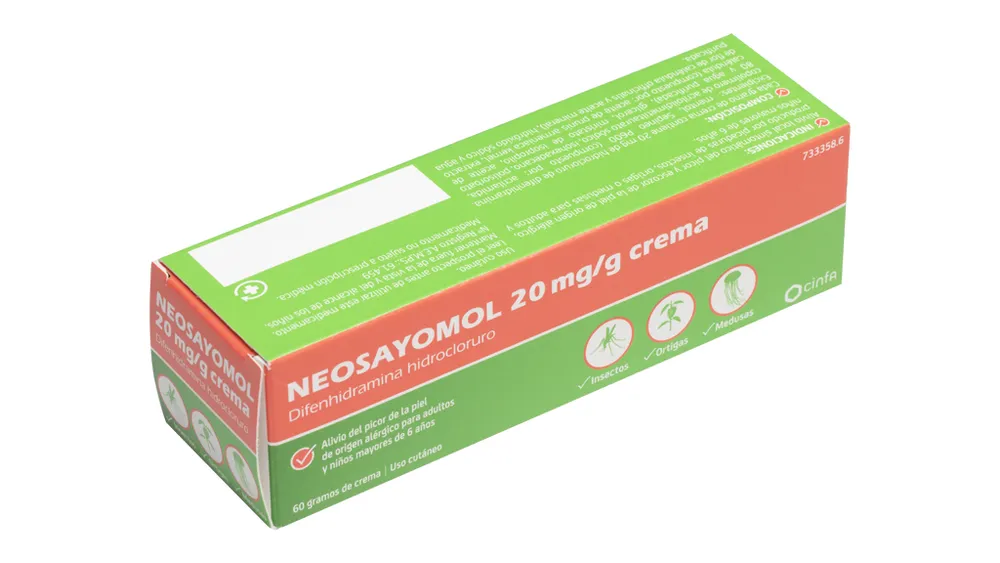
Table of Contents
Package leaflet: Information for the user
Introduction
Package leaflet: information for the user
Neosayomol 20 mg/g cream
Diphenhydramine hydrochloride
Read the entire leaflet carefully before you start using this medicine, because it contains important information for you.
Follow exactly the instructions for use provided in this leaflet or those given by your doctor or pharmacist.
- Keep this leaflet, as you may need to read it again.
- If you need advice or further information, consult your pharmacist.
- If you experience any adverse effects, consult your doctor or pharmacist, even if they are adverse effects not listed in this leaflet. See section 4.
- You should consult a doctor if your condition worsens or does not improve after 5 days of treatment.
Contents of the leaflet
- What Neosayomol is and what it is used for
- What you need to know before using Neosayomol
- How to use Neosayomol
- Possible side effects
- How to store Neosayomol
- Contents of the pack and other information
1. What Neosayomol is and what it is used for
Neosayomol is a cream containing the antihistamine diphenhydramine, which, due to its mechanism of action, is effective in relieving itching in allergic conditions.
This medicine is indicated in adults and children over 6 years of age for the local symptomatic relief of itching and stinging of the skin of allergic origin, caused by insect bites, nettles, or jellyfish stings.
2. What you need to know before using Neosayomol
Do not use Neosayomol
- If you are allergic to diphenhydramine or to any of the other ingredients of this medicine (listed in section 6).
- If you are using another medicine containing diphenhydramine or another medicine for allergic conditions (antihistamines).
- On open wounds or infected skin.
- In children under 2 years of age.
Warnings and precautions
Consult your doctor or pharmacist before starting to use this medicine.
- Do not apply on areas of broken, eroded, bleeding skin, or skin with blisters, or on extensive areas of skin.
- Avoid contact with eyes or other mucous membranes. Discontinue use if burning sensation, skin rash, or persistent symptoms occur. If necessary, remove by washing with water and soap.
- To avoid possible photosensitivity reactions, protect the treated area from exposure to sunlight.
Children
Use in children under 6 years of age should be carefully considered, as although systemic absorption is minimal, it may cause dry skin and mouth, pupil dilation, urinary retention, increased heart rate, tremor, speech disturbances, psychomotor hyperactivity, and drowsiness.
Elderly patients (over 65 years of age)
Use in individuals over 65 years of age should be carefully considered, as they are more sensitive to the adverse effects of this medicine.
Use of Neosayomol with other medicines
Inform your doctor or pharmacist if you are using, have recently used, or might need to use any other medicines.
Do not use together with other topical medicines on the same skin area, or with substances known to cause skin allergic reactions (photosensitivity and phototoxic reactions), without consulting your doctor.
Although significant systemic absorption is not expected, some of this medicine may enter the bloodstream; therefore, simultaneous use with ototoxic medicines (such as certain antibiotics) could mask symptoms of dizziness and vertigo.
Do not consume alcoholic beverages during treatment, as concomitant use may increase the sedative effect.
Use of this medicine together with anticholinergic medicines (such as antiparkinson agents, some antidepressants, neuroleptics, and belladonna) and with the medicine called metoprolol (used for lowering blood pressure and heart conditions) could increase adverse effects.
Use of this medicine with sedative medicines (opioid analgesics, barbiturates, benzodiazepines, antipsychotics) may cause drowsiness.
Interference with diagnostic tests
If you are due to have any diagnostic tests (including blood and urine analyses, skin tests using allergens, etc.), inform your doctor that you are using this medicine, as it may alter test results.
Pregnancy, breastfeeding and fertility
If you are pregnant or breastfeeding, think you may be pregnant, or are planning to become pregnant, consult your doctor or pharmacist before using this medicine.
Although systemic absorption and transfer into breast milk are unlikely, pregnant and breastfeeding women should consult their doctor before using this medicine.
Driving and use of machines
Under the approved conditions of use, this medicine is not expected to affect the ability to drive or operate machinery.
3. How to use Neosayomol
Follow exactly the instructions for administering this medicine as described in this leaflet or as directed by your doctor or pharmacist. If in doubt, consult your doctor or pharmacist.
The recommended dose is:
Adults and children over 6 years of age
Apply a small amount of the medicine to the affected area up to a maximum of 3–4 times daily.
If symptoms persist for more than 5 days or worsen, discontinue treatment and consult your doctor.
Use in children
Children aged 2 to 6 years:
Children are more susceptible to adverse effects; therefore, you should consult your doctor before using this medicine in children aged 2 to 6 years.
Children under 2 years of age
Do not use this medicine in children under 2 years of age.
If you use more Neosayomol than you should
Poisoning from this medicine is very unlikely, given its formulation and dosage. However, excessive or prolonged application may cause: dryness of the skin and mouth, pupil dilation, urinary retention, increased heart rate, tremor, speech disturbances, psychomotor hyperactivity, sedation, and drowsiness. At high doses, coma, ataxia (coordination problems), increased muscle reflexes, and seizures may occur.
In case of overdose or accidental ingestion, contact your doctor or pharmacist immediately or call the Toxicology Information Service at 91.5620420, indicating the medicine and the amount ingested.
If you forget to use Neosayomol
Do not use a double dose to make up for a missed dose.
Use the missed dose as soon as possible. If it is almost time for the next dose, skip the missed dose and take the next one at the regular time, continuing the treatment as usual.
If you have any further questions about the use of this medicine, ask your doctor or pharmacist.
4. Possible adverse effects
Like all medicines, this medicine may cause adverse effects, although not everyone experiences them.
If you consider any of the adverse effects you experience to be severe, or if you notice any adverse effect not mentioned in this leaflet, inform your doctor or pharmacist.
The following adverse effects have been observed during the period of diphenhydramine use for cutaneous application, the frequency of which cannot be precisely established:
- Adverse reactions may be of an allergic nature, such as hypersensitivity reactions as well as skin reactions (photosensitivity and phototoxicity), including contact dermatitis, pruritus, exanthematous eruptions (skin redness), and erythema (skin inflammation) following intense exposure to sunlight.
Reporting of adverse effects
If you experience any type of adverse effect, consult your doctor or pharmacist, even if it is a possible adverse effect not listed in this leaflet. You may also report them directly via the Spanish Pharmacovigilance System for Human Medicinal Products: https://www.notificaram.es. By reporting adverse effects, you can help provide more information on the safety of this medicine.
5. Storage of Neosayomol
Keep this medicine out of the sight and reach of children.
Do not use this medicine after the expiry date stated on the packaging after EXP. The expiry date is the last day of the month indicated.
This medicine does not require any special storage conditions.
Medicines must not be disposed of via wastewater or household waste. Dispose of containers and unused medicines at the SIGRE Point at your pharmacy. If you are in doubt, ask your pharmacist how to dispose of containers and medicines you no longer need. This way, you will help protect the environment.
6. Contents of the pack and other information
Composition of Neosayomol
- The active substance is diphenhydramine hydrochloride.
- The other components are: menthol, Sepineo P600 (composed of: acrylamide/sodium acryloyldimethyltaurate copolymer, isohexadecane, polysorbate 80 and purified water), glycerol, isopropyl myristate, calendula oil (composed of: Prunus armeniaca kernel oil, Calendula officinalis flower extract and mineral oil), sodium hydroxide and purified water.
Appearance of the product and contents of the pack
Neosayomol is a bright white cream with a mentholated odour.
This medicinal product is presented in tubes containing 30 grams or 60 grams of cream.
Only certain pack sizes may be marketed.
Marketing Authorization Holder and Manufacturer
Marketing Authorization Holder
Laboratorios Cinfa, S.A.
Carretera Olaz-Chipi, 10. Polígono Industrial Areta
31620 Huarte (Navarra) – Spain
Manufacturer
Laboratorios Cinfa, S.A.
Carretera Olaz-Chipi, 10. Polígono Industrial Areta
31620 Huarte (Navarra) – Spain
or
BOHM, S.A.
Molinaseca, 23. Pol. Ind. Cobo
28947 Fuenlabrada (Madrid) - Spain
Date of the most recent revision of this leaflet: February 2022
Detailed information on this medicinal product is available on the website of the Spanish Agency for Medicines and Health Products (AEMPS) www.aemps.gob.es/