Natifar 200/400/2 micrograms tablets
Spain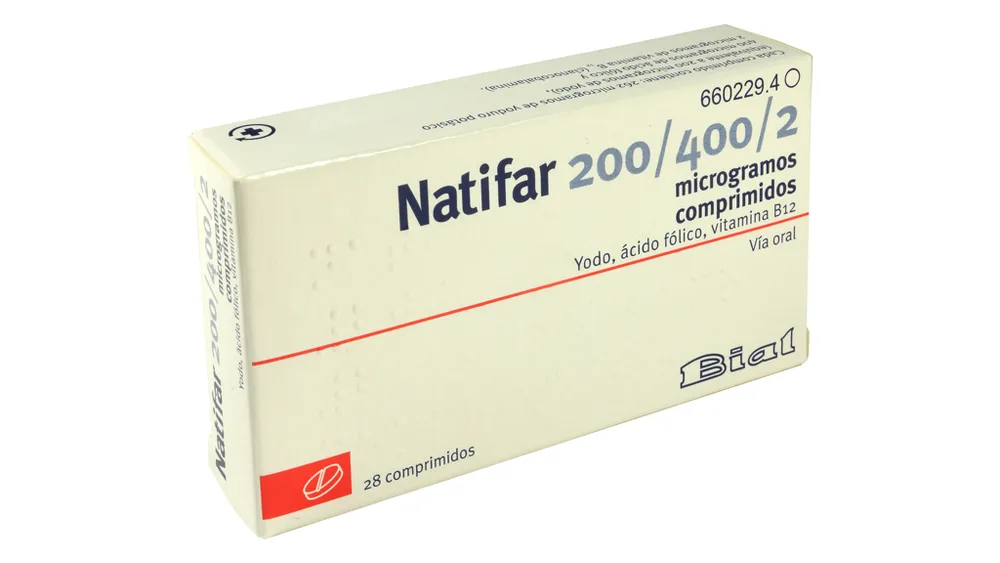
Table of Contents
Package leaflet: Information for the user
Introduction
Package leaflet: information for the user
NATIFAR 200/400/2 micrograms tablets
Iodine / folic acid / vitamin B12
Read the entire leaflet carefully before you start taking this medicine, as it contains important information for you.
- Keep this leaflet, as you may need to read it again.
- If you have any questions, ask your doctor or pharmacist.
- This medicine has been prescribed for you only, and you should not give it to other people, even if they have the same symptoms as you, because it could harm them.
- If you experience any adverse effects, consult your doctor or pharmacist, even if they are adverse effects not listed in this leaflet. See section 4.
Leaflet contents
- What NATIFAR is and what it is used for
- What you need to know before taking NATIFAR
- How to take NATIFAR
- Possible side effects
- How to store NATIFAR
- Contents of the pack and other information
1. What NATIFAR is and what it is used for
It contains as active ingredients iodine (as potassium iodide) and two substances belonging to the vitamin B complex group, folic acid and cyanocobalamin (vitamin B12).
Natifar is indicated for the prevention of disorders due to deficiency of iodine, folic acid, and vitamin B12 in women who are planning pregnancy, during one month prior to conception and, at the physician's discretion, during the first trimester of pregnancy, as prophylaxis against developmental disorders of the fetal nervous system (neural tube defects and neurological disorders).
2. What you need to know before taking NATIFAR
Do not take NATIFAR
- if you are allergic to iodine (or potassium iodide), folic acid, vitamin B12, cobalt, or any of the other components of this medicine (listed in section 6).
- if you have goiter (enlargement of the thyroid gland).
Warnings and precautions
Talk to your doctor or pharmacist before starting to take Natifar.
Since this medicine contains potassium iodide and some individuals are particularly sensitive to iodine, treatment should be started with caution.
Use caution if you have acute bronchitis, overt or latent hyperthyroidism, Addison's disease (hormonal deficiency caused by adrenal gland damage), dehydration, or autoimmune thyroid disease.
If you suffer from any of the following conditions—chronic urticaria (a skin disease causing rashes or hives), systemic lupus erythematosus (an autoimmune disease that may affect many organs), or hypocomplementemic vasculitis (skin lesions similar to urticaria caused by inflammation of blood vessels)—inform your doctor before taking this medicine, as it may cause significant adverse effects.
Treatment with Natifar in patients with epilepsy should be carried out under strict medical supervision.
Special caution is required when initiating treatment in patients with kidney disease, hyperkalemia (elevated potassium levels), or active tuberculosis.
Iodinated disinfectants must not be used for disinfection of the newborn or pregnant mother.
Interference with diagnostic tests
If you are scheduled to undergo any diagnostic tests (including blood and urine tests, skin tests using allergens, etc.), inform your doctor that you are taking this medicine, as it may alter test results. This medicine may affect thyroid function tests.
Children and adolescents
This medicine is not indicated for children under 14 years of age.
Taking NATIFAR with other medicines
Inform your doctor or pharmacist if you are currently using, have recently used, or might need to use any other medicines.
Certain medicines may interfere with Natifar. In such cases, it may be necessary to adjust the dose, interrupt treatment with one of the medicines, or wait at least 3 hours between administrations.
It is important to inform your doctor if you are taking or have recently taken any of the following medicines:
- Antiulcer agents such as omeprazole (medicines for gastric acidity)
- Chloramphenicol (antibiotic)
- Phenytoin, phenobarbital, barbiturates (medicines for seizures)
- Methotrexate (medicine for cancer or autoimmune diseases)
- Nitrofurantoin (medicine for urinary tract infections)
- Primidone (medicine for epilepsy)
- Pyrimethamine (medicine for parasitic diseases)
- Potassium-sparing diuretics (medicines for hypertension)
- Lithium salts (medicines for psychiatric conditions)
- Antithyroid drugs (medicines used in hyperthyroidism)
Taking NATIFAR with food, drinks, and alcohol
Do not consume alcohol with this medicine, as it may reduce blood levels of folic acid.
Do not drink green or black tea with this medicine, as they may reduce blood levels of folic acid.
Pregnancy, breastfeeding, and fertility
If you are pregnant or breastfeeding, think you might be pregnant, or are planning to become pregnant, consult your doctor or pharmacist before using this medicine.
Pregnancy
Natifar is indicated before and during pregnancy, but the recommended dose must not be exceeded.
Since iodine crosses the placental barrier and the fetus is sensitive to pharmacologically active doses of iodine, iodine doses at the milligram level should not be administered.
Breastfeeding
Potassium iodide passes into breast milk. Natifar is not indicated for use during breastfeeding.
Driving and use of machines
The effect of Natifar on driving or operating machinery is negligible or none.
3. How to take NATIFAR
Follow exactly the instructions given by your doctor for taking this medicine. If in doubt, consult your doctor or pharmacist again.
The recommended dose is 1 tablet per day, preferably taken before a meal.
Administer orally with sufficient water.
The recommended treatment duration is one month before conception (or when pregnancy is planned) and, at the physician's discretion, during the first trimester of pregnancy.
Use in children and adolescents
Natifar is not indicated in children and adolescents under 14 years of age.
If you take more NATIFAR than you should
Deliberate or accidental poisoning is unlikely. Administration of high doses (milligram range) or over long periods of time may cause symptoms of iodism such as metallic taste, burning sensation in mouth and throat, painful sensitivity in teeth and gums, increased salivation, irritation of nasal mucosa and eyes. It may also cause severe headache, productive cough, pulmonary edema (fluid accumulation in the lungs), swelling, and discomfort in the salivary glands. The pharynx, larynx, and tonsils may become inflamed.
In seborrheic areas, moderate eruptions (rashes) may appear, and rarely severe eruptions.
Gastric irritation is common whenever very high doses are ingested and diarrhea may occur.
Signs and symptoms of iodism usually resolve spontaneously within a few days after discontinuing treatment.
The use of large doses of potassium iodide or for prolonged periods may lead to hyperplasia (enlargement) of the thyroid gland, thyroid adenoma (benign tumor), goiter, or severe hypothyroidism.
In case of overdose or accidental ingestion, contact your doctor or pharmacist immediately or call the Toxicology Information Service at telephone number 91 562 04 20, indicating the medicine and the amount ingested.
If you forget to take NATIFAR
Do not take a double dose to make up for forgotten doses.
Simply take the missed dose as soon as you remember, and take the following doses at the prescribed intervals (24 hours apart).
If you stop taking NATIFAR
Your doctor will determine the duration of treatment with Natifar. Do not discontinue or prolong it on your own.
If you have any further questions about the use of this medicine, ask your doctor or pharmacist.
4. Possible adverse effects
Like all medicines, this medicine can cause adverse effects, although not everyone will experience them.
Uncommon adverse effects (may affect up to 1 in 100 people) are:
- Hypersensitivity reactions, with skin rashes accompanied by itching, redness, and symptoms such as edema (swelling), including facial and glottal edema, and serum-sickness-like symptoms (fever, arthralgia (joint pain), lymphadenopathy (swollen lymph nodes), eosinophilia (increased levels of a type of white blood cells, eosinophils), urticaria (itchy rash with hives), thrombotic thrombocytopenic purpura (a blood disorder characterized by low platelet and red blood cell counts), fatal periarteritis (a vascular disease in which small and medium-sized arteries become inflamed and damaged).
- Goiter (enlargement of the thyroid gland).
- Hyperthyroidism (very high levels of thyroid hormones) and hypothyroidism (very low levels of thyroid hormones).
- Irregular heartbeats.
Adverse effects with unknown frequency are:
- Severe allergic reaction (anaphylactic reaction).
Reporting of adverse effects
If you experience any type of adverse effect, consult your doctor or pharmacist, even if it is a possible adverse effect not listed in this leaflet. You may also report them directly through the Spanish Pharmacovigilance System for Human Medicines: https://www.notificaRAM.es. By reporting adverse effects, you can help provide more information on the safety of this medicine.
5. Storage of NATIFAR
No special storage conditions are required.
Keep this medicine out of the sight and reach of children.
Do not use this medicine after the expiry date stated on the packaging after EXP. The expiry date refers to the last day of the month indicated.
Medicines must not be disposed of via wastewater or household waste. Dispose of unused medicines and their containers at the SIGRE Point at your pharmacy. If in doubt, ask your pharmacist how to dispose of medicines and containers you no longer need. This will help protect the environment.
6. Contents of the pack and other information
Composition of NATIFAR
-
The active substances are: potassium iodide, folic acid and vitamin B12 (cyanocobalamin). Each tablet contains: potassium iodide, 262 micrograms (equivalent to 200 micrograms of iodine); folic acid, 400 micrograms; and vitamin B12 (cyanocobalamin), 2 micrograms.
-
The other components (excipients) are: mannitol (E-421), microcrystalline cellulose, sodium starch glycolate, anhydrous colloidal silica, magnesium stearate and maltodextrin.
Appearance of the medicinal product and contents of the pack
Tablets, round and yellow in colour.
Each pack contains 28 tablets.
Marketing Authorisation Holder and Manufacturer
Marketing Authorisation Holder:
DESMA Laboratorio Farmacéutico SL
Paseo de la Castellana 121, Escalera Izquierda 3ºB
28046 Madrid
Spain
Manufacturer:
FINE FOODS AND PHARMACEUTICALS N.T.M., S.P.A.
Via Grignano, 43
24041 Brembate (BG)
Italy
Date of the most recent review of this leaflet: May 2024.
Detailed and up-to-date information on this medicinal product is available on the website of the Spanish Agency for Medicines and Health Products (AEMPS) http://www.aemps.gob.es/