Mosegor 0.5 mg/10 ml oral solution
Spain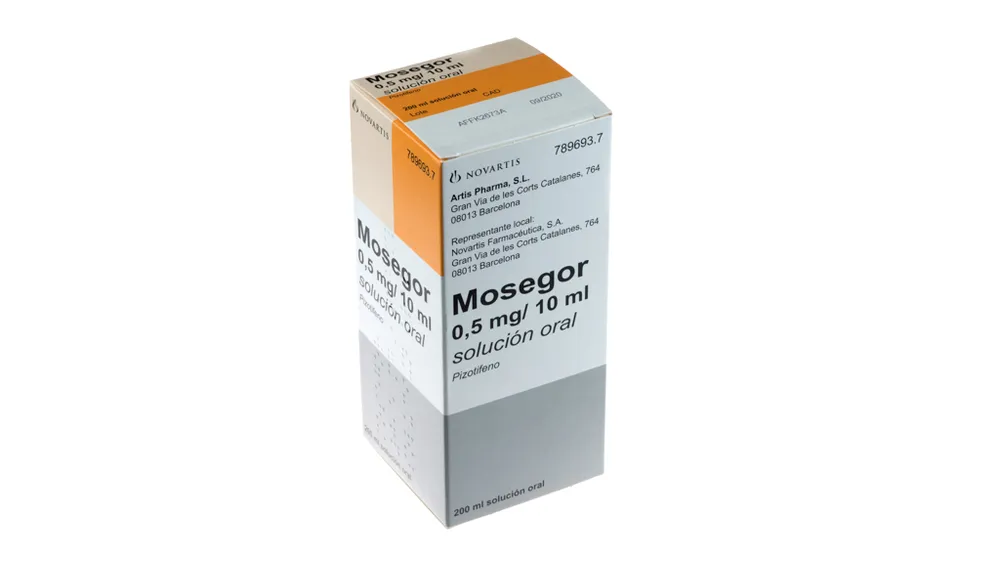
Table of Contents
Package leaflet: Information for the user
Introduction
Package leaflet: information for the user
Mosegor 0.5 mg/10 ml oral solution
pizotifen
Read the entire leaflet carefully before you start taking this medicine because it contains important information for you.
- Keep this leaflet, as you may need to read it again.
- If you have any questions, consult your doctor or pharmacist.
- This medicine has been prescribed for you only and must not be given to other people, even if they have the same symptoms as you, since it could harm them.
- If you experience any adverse effects, consult your doctor or pharmacist, even if they are adverse effects not listed in this leaflet. See section 4.
Leaflet contents
- What Mosegor is and what it is used for
- What you need to know before taking Mosegor
- How to take Mosegor
- Possible side effects
- How to store Mosegor
- Contents of the pack and other information
1. What Mosegor is and what it is used for
The active substance in Mosegor is cyproheptadine, which has an appetite-stimulating effect that promotes weight gain in patients with low body weight (whose appetite has decreased or been lost).
Mosegor is used for the treatment of appetite loss in patients with low body weight, as an adjunct to the treatment of the disease causing the weight reduction.
2. What you need to know before starting to take Mosegor
Carefully follow your doctor's instructions. These may differ from the general information included in this leaflet.
Do not take Mosegor
- if you are allergic (hypersensitive) to pizotifen or to any of the other ingredients of this medicine (listed in section 6).
Warnings and precautions
Inform your doctor if you have or have had any of the following conditions:
- if you have liver problems. This medicine has been associated with some cases of abnormal liver function test results. You may not notice any symptoms, but if you observe that your skin or the whites of your eyes turn yellow, your urine darkens, or you experience nausea, vomiting, and fatigue, inform your doctor immediately. Your doctor may request a blood test to check and monitor your liver function and may instruct you to stop treatment if the problem is serious.
If any of the symptoms described above occur while you are taking Mosegor, inform your doctor immediately.
- if you have visual disturbances due to increased pressure in the eye (signs of narrow-angle glaucoma), unless you have undergone successful surgery.
- if you suffer from urinary retention (difficulty urinating, as in the case of prostate enlargement).
- if you have seizures.
If you are in any of the situations described, inform your doctor before taking this medicine.
Children and adolescents
Mosegor must not be administered to children under 2 years of age.
Interaction of Mosegor with other medicines
Inform your doctor or pharmacist if you are taking, have recently taken, or might need to take any other medicines.
It is important that your doctor knows if you are taking:
- Sedatives or hypnotics (tranquilizers, sleeping medicines, or medicines for anxiety), as they may increase the sedative effects of Mosegor.
- Antihistamines (medicines used for allergies or the common cold), as they may increase the sedative effects of Mosegor.
- Cisapride (a medicine used to treat heartburn).
Mosegor with food, drink, and alcohol
Alcohol consumption may increase the sedative effects of this medicine.
Pregnancy and breastfeeding
Pregnancy
Inform your doctor if you are pregnant or planning to become pregnant.
Experience with Mosegor during pregnancy is limited; therefore, it should only be used in special circumstances, which your doctor will discuss with you.
Breastfeeding
You must not take this medicine while breastfeeding.
Driving and using machines
This medicine may cause drowsiness, dizziness, and other effects on the brain. Therefore, you should drive and operate machinery with caution. If you feel sleepy, do not drive or perform any activity requiring alertness (for example, using tools or machinery) until you feel well again, to avoid any risk to yourself and others.
Mosegor contains ethanol
- This medicine contains 2% ethanol (alcohol), corresponding to 200 mg per 10 ml, equivalent to 4 ml of beer or 1.7 ml of wine. This medicine is harmful for individuals suffering from alcoholism. The alcohol content should be taken into account in pregnant or breastfeeding women, children, and high-risk populations, such as patients with liver disease or epilepsy.
Mosegor contains sucrose
- If your doctor has informed you that you have an intolerance to certain sugars, consult with your doctor before taking this medicine. It may cause tooth decay.
Mosegor contains propyl parahydroxybenzoate and methyl parahydroxybenzoate
- May cause allergic reactions (possibly delayed).
Mosegor contains sorbitol
This medicine contains 10 g of sorbitol per 20 ml dose. Sorbitol is a source of fructose. If your doctor has informed you (or your child) that you have an intolerance to certain sugars, or if you (or your child) have been diagnosed with hereditary fructose intolerance (HFI), a rare genetic disorder in which the patient cannot break down fructose, consult your doctor before taking this medicine. Sorbitol may cause gastrointestinal discomfort and a mild laxative effect.
3. How to take Mosegor
Follow exactly the instructions for using Mosegor provided by your doctor. If in doubt, consult your doctor or pharmacist again. Do not take a higher dose than the one prescribed by your doctor.
The initial dose in adults is 0.5 mg (10 ml of the solution) daily, which may be gradually increased up to 0.5 mg (10 ml of the solution) three times a day.
Use in children (from 2 to 12 years of age)
Low initial doses will be gradually increased until reaching a maintenance dose of 0.025 mg/kg per day. The total daily dose may be divided into 2 or 3 doses per day, as prescribed by your doctor.
The following are approximate daily doses:
- Children from 2 to 6 years: 5 to 10 ml of solution (0.25 mg to 0.5 mg) in divided doses (administered in 2 or 3 doses per day, as directed by the physician). For example: for children aged 2 years or weighing 14 kg, 7 ml; for children aged 3 years or weighing 16 kg, 8 ml; for children aged 4 years or weighing 18 kg, 9 ml; for children aged 5 years or weighing 20 kg, 10 ml; for children aged 6 years and weighing less than 23 kg, 10 ml.
- Children from 6 to 12 years: 10 to 20 ml of solution (0.5 mg to 1 mg) in divided doses. For example: for children aged 6 years or weighing more than 23 kg, 11 ml; for children aged 7 years or weighing 26 kg, 13 ml; for children aged 8 years or weighing 30 kg, 15 ml; for children aged 9 years or weighing 35 kg, 17 ml; for children aged 10 to 12 years or weighing approximately 40 kg, 20 ml.
In adolescents over 13 years of age with a body weight above 40 kg, the same dose as in adults may be administered, i.e., starting with 0.5 mg daily and progressively increasing the dose to reach 0.5 mg three times daily.
If you take more Mosegor than you should
If you accidentally take too much Mosegor solution, contact your doctor immediately, as medical care may be necessary. You may also call the Toxicology Information Service at telephone number 91 562 04 20, indicating the name of the medicine and the amount taken.
If you forget to take Mosegor
If you forget to take a dose of Mosegor, take it as soon as possible. However, if there are 4 hours or less until your next scheduled dose, wait until the next scheduled time and take the medicine according to your original dosing schedule. Do not take a double dose to make up for a missed dose. If you have any doubts, consult your doctor.
If you stop taking Mosegor
Do not change or stop your treatment without consulting your doctor. Your doctor may recommend gradually reducing the dose before stopping treatment. This is done to prevent worsening of your medical condition and to reduce the risk of withdrawal symptoms such as depression, tremors, nausea, anxiety, malaise, dizziness, sleep disturbances, and weight loss.
If you have any questions about the use of this medicine, ask your doctor or pharmacist.
4. Possible adverse effects
Like all medicines, Mosegor may cause adverse effects, although not everyone will experience them.
These adverse effects may occur with certain frequencies, which are described below:
Very common | Affect more than 1 in 10 patients |
Common | Affect between 1 and 10 in 100 patients |
Uncommon | Affect between 1 and 10 in 1,000 patients |
Rare | Affect between 1 and 10 in 10,000 patients |
Very rare | Affect less than 1 in 10,000 patients |
Frequency not known | Frequency cannot be estimated from the available data |
Some adverse effects may be serious. If you notice any of these, inform your doctor immediately:
Rare:
- Signs of allergy such as itching, skin rash or blisters; swelling of the face.
Very rare:
- Seizures.
Frequency not known:
- Yellowing of the skin or whites of the eyes, darkening of the urine, nausea, vomiting, and fatigue (signs of jaundice or hepatitis).
Other adverse effects:
Very common:
- Increased appetite, weight gain.
Common:
- Drowsiness, fatigue, dizziness, dry mouth, nausea.
Uncommon:
- Constipation.
Rare:
- Depression, excitability, hallucinations (hearing, seeing, or sensing things that are not real), difficulty sleeping, anxiety, tingling and numbness sensations in the hands and feet, muscle pain.
Frequency not known:
- Muscle cramps.
If you experience any adverse effects, consult your doctor or pharmacist, even if they are adverse effects not listed in this leaflet.
5. Storage of Mosegor
- Keep out of the reach and sight of children.
- Do not use this medicine after the expiry date stated on the packaging. The expiry date refers to the last day of the month indicated.
- No special storage conditions are required.
- Do not use this medicine if you notice any visible signs of deterioration.
- Medicines must not be disposed of via wastewater or household waste. Dispose of unused medicines and their containers at the SIGRE Point at your pharmacy. If in doubt, ask your pharmacist how to properly dispose of unused medicines and their packaging. This will help protect the environment.
6. Contents of the container and additional information
Composition of Mosegor
- The active substance is pizotifen. Each 10 ml of solution contains 0.5 mg of pizotifen.
- The other components are: propyl parahydroxybenzoate (E216), methyl parahydroxybenzoate (E218), citric acid, disodium hydrogen phosphate, 96% ethanol, sucrose, 70% sorbitol, raspberry flavor, maraschino flavor, and purified water.
Appearance of the product and contents of the container
Bottle containing 200 ml with dosing cup.
Marketing Authorization Holder
ETHYX PHARMACEUTICALS
19 rue Duquesne
69006 Lyon
France
Manufacturer
DELPHARM ORLEANS
5 avenue de Concy
45071 Orleans
France
This patient information leaflet was approved in
May 2022
Detailed and up-to-date information on this medicine is available on the website of the Spanish Agency for Medicines and Health Products (AEMPS) http:/www.aemps.es/