Minurin 4 micrograms/ml solution for injection
Spain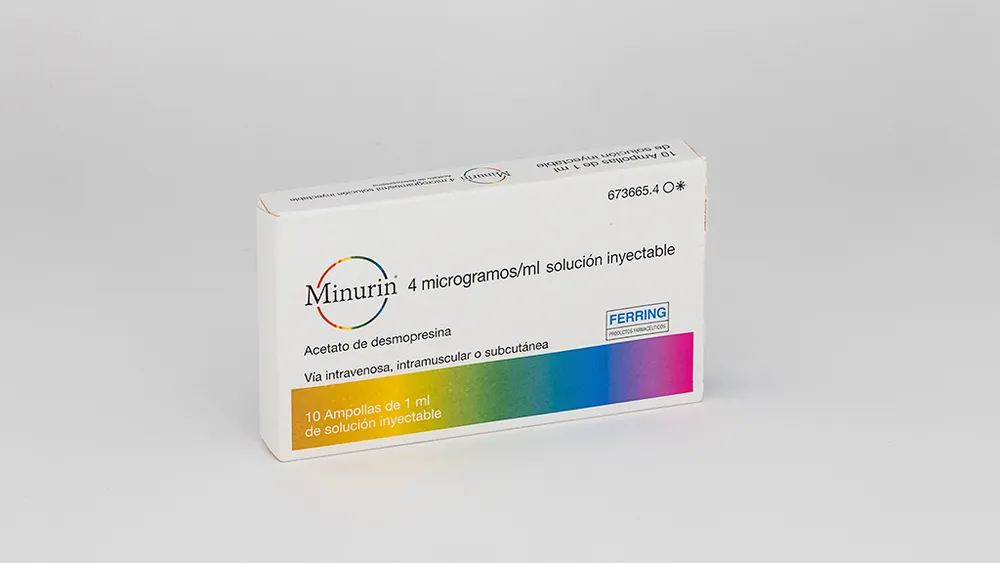
Table of Contents
Package leaflet: Information for the user
Introduction
Package leaflet: Information for the user
Minurin 4 micrograms/ml injection solution
Desmopressin acetate
Read all of this leaflet carefully before you start using this medicine because it contains important information for you.
- Keep this leaflet as you may need to read it again.
- If you have any questions, ask your doctor or pharmacist.
- This medicine has been prescribed for you only and you should not give it to other people, even if they have the same symptoms as you, because it could harm them.
- If you experience any adverse effects, consult your doctor or pharmacist, including any adverse effects not listed in this leaflet. See section 4.
Contents of the leaflet:
- What MINURIN is and what it is used for.
- What you need to know before using MINURIN.
- How to use MINURIN.
- Possible side effects.
- How to store MINURIN.
- Contents of the pack and other information.
1. What Minurin is and what it is used for
The active ingredient that makes Minurin work is desmopressin. Minurin belongs to a group of medicines called vasopressin and analogues. Desmopressin is a structural analogue of the natural hormone arginine-vasopressin, which temporarily reduces the amount of urine produced by the body, with a rapid onset of action and prolonged duration.
It is used for the treatment of:
- Central Diabetes Insipidus.
- Diagnostic test for renal concentrating capacity.
- Corrective and preventive treatment of bleeding episodes observed in the following cases:
- Haemophilia A and Von Willebrand's Disease (Type I, with factor VIII coagulant activity above 5%).
- Maintenance of haemostasis prior to surgical intervention.
2. What you need to know before using Minurin
Do not use Minurin:
- if you are allergic to desmopressin or to any of the other components of Minurin (listed in section 6).
- if you have habitual prolonged excessive thirst or excessive thirst due to alcohol abuse.
- if you have heart problems or other conditions requiring treatment with diuretic agents.
- if you suffer from unstable angina or decompensated heart failure.
- if you have von Willebrand disease type IIB, haemophilia A, or von Willebrand disease type I with factor VIII coagulant activity below 5%.
- in haemophilia B and in haemophiliacs with anti-factor VIII antibodies.
Warnings and precautions
Consult your doctor or pharmacist before starting to use this medicine.
Special care should be taken to avoid water retention in the body and low sodium levels in the blood in the following cases:
- Very young or elderly patients,
- Medical conditions causing fluid and/or electrolyte imbalance,
- Patients at risk of intracranial hypertension.
Particular attention must be paid to the risk of fluid retention. Fluid intake should be restricted as much as possible and body weight should be monitored regularly. If used for diagnostic purposes, fluid intake should not exceed 0.5 L from 1 hour before administration of the product until 8 hours after administration.
If a gradual increase in body weight, a decrease in serum sodium to a level below 130 mmol/L, or a decrease in plasma osmolality below 270 mOsm/kg body weight is observed, fluid intake must be drastically reduced and administration of the drug discontinued.
The renal concentration capacity test should only be performed in children under 2 years of age under strict hospital medical supervision.
In the treatment of bleeding episodes, due to individual variations in response, an efficacy test should be performed to confirm correction of bleeding time and, in the case of haemophilia, elevation of factor VIII levels.
Special measures should be taken to prevent fluid overload in patients receiving treatment with diuretic agents.
Blood pressure should be monitored regularly.
Minurin does not reduce prolonged bleeding time in thrombocytopenia.
Interaction of Minurin with other medicines
Inform your doctor or pharmacist if you are using or have recently used any other medicines, especially antidepressants, antidiabetic agents, or antiepileptic drugs.
Pregnancy, breastfeeding, and fertility
If you are pregnant or breastfeeding, think you may be pregnant, or are planning to become pregnant, consult your doctor or pharmacist before using this medicine.
Your doctor will carefully assess the benefit-risk balance if you become pregnant.
Breastfeeding
Desmopressin passes into breast milk, although in small amounts; therefore, if this medicine must be administered to a woman who is breastfeeding, replacement of natural breastfeeding with artificial feeding is recommended.
Driving and use of machines
Minurin does not affect the ability to drive or use machines.
3. How to use Minurin
Follow exactly the administration instructions for Minurin 4 microgram/ml solution for injection as given by your doctor. If you have any doubts, consult your doctor or pharmacist again.
Central diabetes insipidus:
When nasal administration (nasal drops) is considered inappropriate, the injectable solution is recommended. The dose should be individually adjusted for each patient depending on urinary volume and serum sodium levels.
The recommended dose of the injectable solution is 0.25 ml to 1 ml (1–4 micrograms) once or twice daily in adults.
It should not be administered to children under 12 years of age, as safety and efficacy have not been established.
In patients who were initially treated with the intranasal form and subsequently switched to the injectable form due to inadequate nasal absorption or surgical intervention, the approximately equivalent antidiuretic dose of the injectable form is about 10% of the intranasal dose.
Renal concentration capacity test:
The following administration schedule is recommended. The product should be injected intramuscularly or subcutaneously:
0.1 microgram (0.025 ml) (weight < 10 kg)
0.2 micrograms (0.05 ml) (weight between 10 and 20 kg)
1 microgram (0.25 ml) (weight between 20 and 30 kg)
2 micrograms (0.5 ml) (weight between 30 and 50 kg)
4 micrograms (1 ml) (weight > 50 kg)
In children, nasal drops are recommended as the first option.
Haemophilia A and von Willebrand's disease (Type I, with factor VIII coagulant activity above 5%) – Maintenance of haemostasis prior to surgical intervention:
Slow intravenous infusion of 0.3 micrograms/kg body weight is recommended in adults and children weighing more than 10 kg, diluted in 50–100 ml of physiological saline, administered over 15–30 minutes. If a positive effect is achieved, the initial dose may be repeated 1 or 2 times at intervals of 6–12 hours. However, further dose repetition may result in reduced efficacy.
Use in children requires special care to prevent the development of hyponatraemia. It is not recommended for use in children under 3 months of age.
If you use more Minurin than you should
In case of overdose or accidental ingestion, contact your doctor or pharmacist immediately or call the Toxicology Information Service immediately at telephone number 915 620 420, indicating the medication and the amount ingested.
Overdose increases the risk of water retention and hyponatraemia. Although treatment of hyponatraemia should be individualized, the following recommendations may be followed:
in asymptomatic hyponatraemia, discontinue desmopressin treatment and restrict fluid intake. In symptomatic hyponatraemia, administer isotonic or hypertonic sodium chloride solution (physiological saline). In cases of severe water retention (seizures or loss of consciousness), induce diuresis with furosemide.
If you have any further questions about the use of this medicine, ask your doctor or pharmacist.
4. Possible adverse effects
Like all medicines, Minurin may produce adverse effects, although not everyone experiences them.
The following adverse effects are common (may affect up to 1 in 10 patients):
-
headache,
-
stomach pain,
-
nausea.
-
At high doses the following were observed:
-
fatigue,
-
transient decrease in blood pressure, with reflex bradycardia and facial flushing at the time of administration.
The following adverse effects are uncommon (may affect up to 1 in 100 patients):
- At high doses: dizziness.
Unrestricted treatment without limiting water intake may lead to water retention accompanied by signs and symptoms (reduction in serum sodium, weight gain, and, in severe cases, seizures).
Reporting of adverse effects:
If you experience any type of adverse effect, consult your doctor or pharmacist, even if it is a possible adverse effect not listed in this leaflet. You may also report them directly through the Spanish Pharmacovigilance System for Human Medicines: https://www.notificaRAM.es. By reporting adverse effects, you can help provide more information on the safety of this medicine.
5. Storage of Minurin
Keep this medicine out of sight and reach of children.
Store in a refrigerator (between 2°C and 8°C).
Do not use Minurin after the expiry date stated on the packaging after "EXP". The expiry date refers to the last day of the month indicated.
Medicines must not be disposed of via wastewater or household waste. Dispose of empty containers and unused medicines at the SIGRE point in your pharmacy. If you have any doubts, ask your pharmacist how to properly dispose of containers and medicines you no longer need. This will help protect the environment.
6. Contents of the pack and other information
Composition of Minurin 4 micrograms/ml injection solution
- The active substance is desmopressin acetate. Each ml of Minurin 4 micrograms/ml injection solution contains 4 micrograms.
- The other components are: sodium chloride, hydrochloric acid and water for injections.
Appearance of the medicinal product and contents of the pack
Minurin 4 micrograms/ml injection solution is supplied in ampoules containing 1 ml of sterile solution with 4 micrograms of desmopressin acetate at a concentration of 4 micrograms/ml in water for injections.
Packs contain 10 ampoules.
Marketing Authorisation Holder and Manufacturer
Marketing Authorisation Holder:
FERRING S.A.U
C/ del Arquitecto Sánchez Arcas nº3, 1º
28040 Madrid, Spain
Manufacturer:
FERRING GmbH
Wittland 11,
D-24109 Kiel
Germany
The last revision of this leaflet was in November 2017
Detailed and up-to-date information on this medicinal product is available on the website of the Spanish Agency for Medicines and Medical Devices (AEMPS) http://www.aemps.gob.es/