Minitran 5 mg/24 h transdermal patches
Spain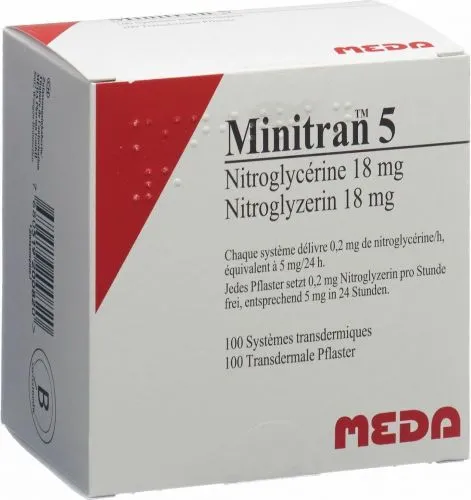
Table of Contents
- Package leaflet: Information for the user
- Introduction
- 1. What MINITRAN is and what it is used for
- 2. What you need to know before using MINITRAN
- **Use of MINITRAN with other medicines**
- **Pregnancy, breastfeeding and fertility**
- **Driving and operating machinery**
- 3. How to use MINITRAN
- **Instructions for Correct Administration**
- **If you use more MINITRAN than you should**
- 4. Possible adverse effects
- 5. Storage of MINITRAN
- 6. Contents of the pack and other information
Package leaflet: Information for the user
Introduction
PACKAGE LEAFLET: INFORMATION FOR THE USER
MINITRAN 5 mg/24 h transdermal patches
Glyceryl trinitrate
Read the entire leaflet carefully before you start using this medicine, because it contains important information for you.
- Keep this leaflet, as you may need to read it again.
- If you have any questions, ask your doctor or pharmacist.
- This medicine has been prescribed for you only, and you should not give it to others, even if they have the same symptoms as you, because it could harm them.
- If you experience any adverse effects, consult your doctor or pharmacist, even if they are adverse effects not listed in this leaflet. See section 4.
Leaflet contents:
- What MINITRAN is and what it is used for
- What you need to know before using MINITRAN
- How to use MINITRAN
- Possible adverse effects
- How to store MINITRAN
- Contents of the pack and other information
1. What MINITRAN is and what it is used for
MINITRAN patches are transdermal systems consisting of a thin, transparent film of low-density polyethylene, covered by an adhesive matrix containing glyceryl trinitrate. The matrix controls the rate of release of the active ingredient, allowing for sustained release of glyceryl trinitrate in sufficient quantity to ensure constant levels for 24 hours. The patch is covered by a protective polyester film which is peeled off and discarded before use.
MINITRAN is indicated for the prevention of exertional and rest angina associated with or resulting from coronary insufficiency.
2. What you need to know before using MINITRAN
Do not use MINITRAN
- If you are allergic to glyceryl trinitrate or other organic nitrates, or to any of the other ingredients of this medicine (listed in section 6).
- If you have heart failure due to valvular obstruction (narrowing of the heart valves) or pericarditis compressing the heart.
- If you have conditions associated with increased intracranial pressure (such as cerebral hemorrhage or head trauma) or increased intraocular pressure (glaucoma).
- In cases of reduced blood flow associated with very low blood pressure (such as in shock).
- If you have very low blood pressure (below 90 mm Hg).
- In cases of severe hypovolemia (if you have recently lost a large amount of blood).
- If you are taking medicines in the group of phosphodiesterase type 5 inhibitors, such as sildenafil, tadalafil, vardenafil (medicines used to treat impotence or pulmonary hypertension). These medicines must never be taken together with Minitran.
- If you are taking medicines containing riociguat, a soluble guanylate cyclase stimulator.
For further information, please consult your doctor or pharmacist.
Warnings and precautions
Talk to your doctor or pharmacist before using MINITRAN.
- MINITRAN should be used under strict medical supervision in cases of recent myocardial infarction or congestive heart failure (the heart's inability to pump sufficient blood to the rest of the body).
- Inform your doctor if you have or have had:
- any heart disease or blood vessel disorders other than angina,
- any lung disease. In patients with angina pectoris, myocardial infarction, or cerebral ischemia, disturbances in the small airways may occur,
- anemia.
- In patients with angina pectoris caused by thickening of the heart muscle (hypertrophic cardiomyopathy), treatment with Minitran may worsen the condition.
- MINITRAN is not indicated for the treatment of acute angina attacks (chest pain), which require the use of fast-acting nitrate derivatives administered sublingually.
- If treatment is to be discontinued, the dose and frequency of application of the MINITRAN patch should be gradually reduced over a period of 4–6 weeks to avoid withdrawal reactions associated with this class of vasodilator drugs. If starting another treatment for angina pectoris, you may need to use both medicines for a period of time.
- This product may cause postural hypotension, especially in anxious patients; therefore, patients should be warned of this risk to prevent sudden changes in posture.
- Tolerance to the medicine or to other nitroderivatives may develop. For this reason, your doctor may recommend applying MINITRAN daily with a patch-free interval of 8 to 12 hours per day.
Use of MINITRAN with other medicines
Inform your doctor or pharmacist if you are taking, have recently taken, or might need to take any other medicines.
Patients being treated with Minitran must never take phosphodiesterase-5 (PDE5) inhibitors, such as those containing sildenafil, vardenafil, or tadalafil (medicines used to treat impotence and pulmonary arterial hypertension), even if the patch has been removed. For further information, consult your doctor or pharmacist.
Concomitant treatment with riociguat, a soluble guanylate cyclase stimulator, should be avoided, as simultaneous use may cause hypotension (see "Do not use Minitran").
Your doctor should be aware if you are taking any other medicines, as they may increase or decrease the blood pressure-lowering effect of MINITRAN.
Caution is advised when administering MINITRAN together with other vasodilators, such as alcohol and certain medicines (calcium antagonists, beta-blockers, diuretics, antihypertensives, tricyclic antidepressants, major tranquilizers), in order to avoid additive effects.
Non-steroidal anti-inflammatory drugs (NSAIDs), except acetylsalicylic acid (aspirin), may reduce the effectiveness of Minitran.
Concomitant use of Minitran with dihydroergotamine (a medicine used to treat migraine) may increase blood levels of dihydroergotamine. This is particularly important in patients with coronary artery disease, as dihydroergotamine counteracts the effect of Minitran.
Concomitant administration of Minitran with amifostine and acetylsalicylic acid may enhance the hypotensive effects of MINITRAN.
Interference with diagnostic tests
Glycerol trinitrate may interfere with the measurement of certain clinical laboratory tests (catecholamines and vanillylmandelic acid in urine, increasing their excretion).
Use of MINITRAN with food and drink
The consumption of alcoholic beverages is not recommended during treatment.
Pregnancy, breastfeeding and fertility
If you are pregnant or breastfeeding, think you may be pregnant or are planning to become pregnant, consult your doctor or pharmacist before using any medicine.
MINITRAN should be used with caution during pregnancy, especially during the first 3 months of pregnancy. Under these circumstances, the medicine is only suitable if clearly needed and under the direct supervision of a physician. If you are taking this medicine regularly and become pregnant, inform your doctor immediately.
If you are breastfeeding, you must inform your doctor, as he or she must decide whether breastfeeding should be discontinued or the treatment interrupted, taking into account the benefits of breastfeeding for the child and the benefits of treatment for the mother.
Driving and operating machinery
MINITRAN may cause hypotension and dizziness, particularly at the start of treatment. If you experience any of these effects, avoid driving vehicles or operating machinery.
3. How to use MINITRAN
Follow exactly the administration instructions for this medicine as indicated by your doctor. If in doubt, consult your doctor or pharmacist again before using this medicine.
The response to nitroderivatives varies from individual to individual, and the minimum effective dose should be prescribed for each case. Since the amount of glyceryl trinitrate released by the MINITRAN patch is constant, the administered dose depends solely on the contact area of the patch.
As a general rule, it is advisable to start treatment with one MINITRAN 5 mg/24 h patch per day. If necessary, and depending on demonstrated tolerance, treatment may be increased to one MINITRAN 10 mg/24 h patch, or even one MINITRAN 15 mg/24 h patch per day.
Application may be performed continuously for 24 hours, or intermittently, including a patch-free interval of 8 to 12 hours (usually during the night).
Use in children and adolescents: Safety and efficacy in individuals under 18 years of age have not been established. Therefore, use is not recommended.
Use in the elderly: Geriatric patients are generally more sensitive to hypotensive effects (decreases in blood pressure).
Instructions for Correct Administration
Each MINITRAN patch is contained in a small sealed protective pouch. The adhesive side is covered by a protective film, which must be removed immediately before applying the patch to the skin.
Apply the MINITRAN patch to a clean, dry, healthy area of skin (free of creams or ointments) and with minimal hair.
The correct application procedure is as follows:
- Open the pouch by tearing it along the perforation mark and remove the patch from inside.

- Slightly fold the patch with the dotted lines facing you, pull the tab, and discard the protective film.

- Apply the adhesive surface to the upper arm or chest. Carefully peel away the other section of the perforated protective film.

- Press firmly on the patch to ensure proper adhesion.

Remove the MINITRAN patch after 24 hours, unless otherwise directed by your doctor. MINITRAN patches are disposable. They must be kept out of the reach of children.
Apply a new MINITRAN patch following the method described above. This new patch should be placed on a different skin area than the previous one, for example, on the opposite side of the chest.
Do not apply the system to the same skin site on consecutive days. The MINITRAN patch adheres easily to the skin and will not detach during bathing, showering, or physical exercise.
If you use more MINITRAN than you should
High doses of glyceryl trinitrate may, in some cases, cause a rapid drop in blood pressure and lead to shock, tachycardia, methemoglobinemia, cyanosis, coma, and seizures.
Due to the controlled release of glyceryl trinitrate with MINITRAN, the risk of overdose is very rare.
The effect of Minitran nitrate can be rapidly reversed simply by removing the transdermal patch(es).
Any drop in blood pressure and symptoms of collapse can be treated by elevating the legs and, if necessary, bandaging them.
Severe methemoglobinemia (increased methemoglobin in the blood) may be treated with an injection of methylene blue or toluidine blue.
In case of overdose or accidental ingestion, seek immediate medical attention or contact the Toxicology Information Service at telephone number (91) 562 04 20, indicating the medication and the amount ingested.
If you forget to use MINITRAN
Do not use a double dose to make up for missed doses.
If you stop using MINITRAN
If treatment is to be discontinued, the dose and frequency of patch application should be gradually reduced over a period of 4–6 weeks to avoid withdrawal reactions associated with this class of vasodilator drugs.
If you have any further questions about the use of this product, ask your doctor or pharmacist.
4. Possible adverse effects
Like all medicines, MINITRAN may produce adverse effects, although not everyone experiences them.
Tolerance to glyceryl trinitrate is generally good. The following adverse effects may occur and may disappear during treatment.
Very common (may affect more than 1 in 10 people): nausea and vomiting.
Common (may affect up to 1 in 10 people): headache, which usually resolves within a few days and can be treated with mild analgesics. In particularly severe cases, it may be necessary to reduce the dose or interrupt treatment.
Uncommon (may affect up to 1 in 100 people): dermatitis (skin inflammation). Skin irritation (itching, stinging, and slight redness), which usually disappears a few hours after removing the patch. If you experience a generalized skin reaction affecting a large area, inform your doctor.
Rare (may affect up to 1 in 1000 people): facial flushing. Dizziness, especially when getting up quickly; therefore, it is recommended to rise slowly and, if you feel dizzy, to sit or lie down. Drop in blood pressure. Fainting. Increased heart rate.
Very rare (may affect up to 1 in 10,000 people): dizziness.
Not known (frequency cannot be estimated from the available data): palpitations (abnormal sensation of heart rhythm), skin rash, and syncope.
It is important that you inform your doctor, as your dose may need to be reduced or treatment suspended, at least temporarily.
Reporting of adverse effects
If you experience any type of adverse effect, consult your doctor or pharmacist, even if it is a possible adverse effect not listed in this leaflet. You may also report them directly via the Spanish Pharmacovigilance System for Human Medicines at www.notificaRAM.es
By reporting adverse effects, you can help provide more information on the safety of this medicine.
5. Storage of MINITRAN
Do not store above 25°C. Keep in a cool, dry place.
Keep out of the reach and sight of children.
Do not use this medicine after the expiry date stated on the packaging. The expiry date refers to the last day of the month indicated.
Medicines must not be disposed of via wastewater or household waste. Dispose of unused medicines and their containers at the SIGRE collection point at your pharmacy. If you have any doubts, ask your pharmacist how to properly dispose of unused medicines and their packaging. This will help protect the environment.
6. Contents of the pack and other information
Composition of MINITRAN 5 mg/24 h
- The active substance is glyceryl trinitrate, 18 mg per patch. The average amount released over 24 hours is 5 mg.
- The other components are:
Isooctyl acrylate/acrylamide copolymer; ethyl oleate; glyceryl monolaurate.
Backing: an oval film of low-density polyethylene; polyester film coated on one side with silicone.
Appearance of the medicinal product and contents of the pack
MINITRAN 5 mg are transdermal patches consisting of a thin, transparent film of low-density polyethylene, covered by an adhesive matrix containing glyceryl trinitrate. The matrix controls the rate of release of the active substance. The patch is covered by a protective polyester film which is removed and discarded before use.
Each patch has a surface area of 6.7 cm² and is supplied in boxes of 7 and 30 patches.
Marketing Authorization Holder and Manufacturer
Marketing Authorization Holder:
Viatris Healthcare Limited
Damastown Industrial Park
Mulhuddart, Dublin 15
Dublin
Ireland
Manufacturer:
Meda Pharma GmbH & Co. KG
Benzstrasse 1
61352 Bad Homburg
Germany
or
Mylan Hungary Kft.
Mylan utca 1
2900 Komárom
Hungary
Further information on this medicinal product is available upon request to the local representative of the Marketing Authorization Holder:
Viatris Pharmaceuticals, S.L.
C/ General Aranaz, 86
28027 - Madrid
Spain
Date of the most recent review of this leaflet: October 2017
Detailed and up-to-date information on this medicinal product is available on the website of the Spanish Agency for Medicines and Health Products (AEMPS) https://www.aemps.gob.es