Magnesia San Pellegrino 3,6 g powder for oral suspension
Spain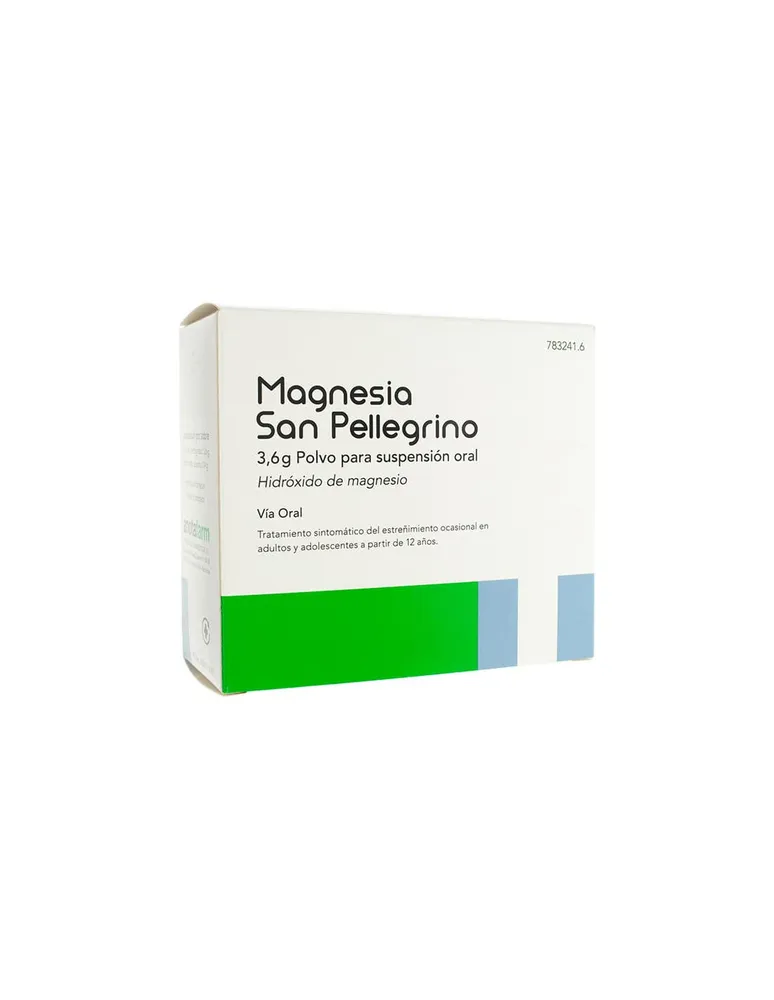
Table of Contents
- Package leaflet: Information for the user
- Introduction
- 1. What Magnesia San Pellegrino is and what it is used for
- 2. What you need to know before starting to take Magnesia San Pellegrino
- 3. How to take Magnesia San Pellegrino
- 4. Possible adverse effects
- 5. Storage of Magnesia San Pellegrino
- 6. Contents of the package and other information
Package leaflet: Information for the user
Introduction
Package leaflet: information for the user
Magnesia San Pellegrino 3.6 g Powder for oral suspension
Magnesium hydroxide
Read the entire leaflet carefully before you start taking this medicine, as it contains important information for you.
- Follow exactly the instructions for administration of the medicine contained in this leaflet or those indicated by your doctor, pharmacist, or nurse.
- Keep this leaflet, as you may need to read it again.
- If you need advice or further information, consult your pharmacist.
- If you experience adverse reactions, consult your doctor, pharmacist, or nurse, even if they are adverse reactions not listed in this leaflet. See section 4.
You should consult a doctor if you worsen or do not improve after 7 days of treatment.
Contents of the leaflet:
- What Magnesia San Pellegrino is and what it is used for.
- What you need to know before taking Magnesia San Pellegrino.
- How to take Magnesia San Pellegrino.
- Possible side effects.
- How to store Magnesia San Pellegrino.
- Contents of the pack and other information.
1. What Magnesia San Pellegrino is and what it is used for
Magnesia San Pellegrino is a medication with laxative activity.
It is indicated for the symptomatic treatment of occasional constipation in adults and adolescents aged 12 years and older.
You should consult a doctor if your condition worsens or does not improve after 7 days of treatment.
2. What you need to know before starting to take Magnesia San Pellegrino
Do not take Magnesia San Pellegrino:
- If you are allergic to magnesium hydroxide or to any of the other components of this medicine (listed in section 6).
- If you have:
- severe kidney disease
- any condition causing hydroelectrolytic imbalance (salts and water in the body)
- appendicitis, intestinal obstruction, undiagnosed gastrointestinal or rectal bleeding, ulcerative colitis (inflammatory bowel disease of the colon), colostomy (a surgical procedure in which the end of the large intestine is brought through the abdominal wall), diverticulitis (inflammation of the intestinal wall forming abnormal pouches), ileostomy (a surgical procedure in which the end of the small intestine is brought through the abdominal wall)
- chronic diarrhea.
Warnings and precautions
Consult your doctor or pharmacist before starting to take this medicine:
- If you have any kidney disease, even if not severe, or liver or heart disease
- If you are dehydrated
- If you are over 65 years of age
- If you are weakened.
If symptoms worsen or persist after 7 days of continuous treatment, consult your doctor.
Contact your doctor as soon as possible if you experience any symptoms such as abdominal pain of unknown origin, signs indicating bleeding (e.g. black stools or coffee-ground-like vomit), cramps, bloated or painful abdomen, nausea, vomiting, or diarrhea.
Children
In young children, the use of magnesium hydroxide may cause hypermagnesemia, especially in the presence of renal insufficiency or dehydration.
Taking Magnesia San Pellegrino with other medicines
Inform your doctor or pharmacist if you are taking, have recently taken, or might need to take any other medicines.
Concomitant administration of Magnesia San Pellegrino with other medicines may alter the absorption or action of other medicines used to treat:
- Diabetes: chlorpropamide, glibenclamide, glipizide, tolbutamide
- Infections: sulfonamides, quinolones (ciprofloxacin, ofloxacin, pefloxacin, enoxacin), tetracyclines (chlortetracycline, doxycycline, tetracycline), ketoconazole, methenamine
- Blood coagulation disorders: dicoumarol
- Anemia: iron salts, folic acid
- Parkinson's disease: levodopa
- Stomach, intestinal, and bladder spasms or contractions (anticholinergic medicines)
- Cardiovascular diseases: atenolol, digoxin, captopril, quinidine
- Psychiatric disorders: phenothiazines (especially oral chlorpromazine), chlordiazepoxide, amphetamines
- Epilepsy: phenytoin
- Digestive disorders: medicines used for acidity (cimetidine, etc.), misoprostol, pancreolipase, sucralfate
- Inflammation: indomethacin, penicillamine, salicylates, ibuprofen, flurbiprofen, mefenamic acid or flufenamic acid
- Metabolic disorders: oral phosphates, alendronate acid, tiludronate acid, sodium polystyrene sulfonate resin, vitamin D including calcifediol and calcitriol
- Smoking cessation: mecamylamine
- Others: enteric-coated medicines, urinary acidifying agents such as ammonium chloride, ascorbic acid, or potassium or sodium phosphates.
Interactions of magnesium hydroxide with other medicines
Some medicines may be affected by magnesium hydroxide or may affect the efficacy of magnesium hydroxide. If in doubt, consult your doctor or pharmacist – salicylates.
Separate the administration of Magnesia San Pellegrino from other medicines by 2 to 3 hours.
Interference with diagnostic tests
If you are scheduled for any diagnostic test (blood, urine, etc.), inform your doctor or pharmacist that you are taking Magnesia San Pellegrino, as it may alter test results.
Do not take this medicine within 24 hours prior to undergoing tests for gastric acid secretion, serum gastrin levels (a hormone regulating stomach acid secretion), serum potassium levels, or determination of serum and urinary pH.
Taking Magnesia San Pellegrino with food and drinks
This medicine may be taken with or without food and drinks.
Pregnancy and breastfeeding
If you are pregnant or breastfeeding, think you may be pregnant, or plan to become pregnant, consult your doctor or pharmacist before using this medicine.
Driving and use of machines
This medicine does not affect your ability to drive or operate machinery.
Magnesia San Pellegrino 3.6 g Powder for oral suspension in sachets contains sucrose. If your doctor has diagnosed you with an intolerance to certain sugars, consult him before taking this medicine.
3. How to take Magnesia San Pellegrino
Follow exactly the instructions for use provided in this leaflet or those indicated by your doctor or pharmacist. If in doubt, consult your doctor or pharmacist.
The recommended dose for adults and adolescents aged 12 years and over is 1 sachet per day.
How to take it
This medicine is taken orally.
Pour 200 ml of water into a glass and add the contents of the sachet. Stir with a spoon until no medicine remains at the bottom of the glass and drink immediately.
It is advisable to drink plenty of fluids throughout the day.
It is preferable to take it in the morning on an empty stomach.
If you do not improve or symptoms persist after 7 days of continuous treatment, you should consult a doctor.
If you take more Magnesia San Pellegrino than you should
Symptoms of overdose include: flushing, thirst, hypotension, nausea, vomiting, general fatigue, confusion, dizziness, blurred vision, lack of coordination, and muscle weakness.
In case of overdose or accidental ingestion, consult your doctor or pharmacist, or call the Toxicology Information Service at telephone number 915620420, indicating the medicine and the amount ingested.
4. Possible adverse effects
Like all medicines, Magnesia San Pellegrino may produce adverse effects, although not everyone experiences them.
During the period of use of magnesium hydroxide as a laxative and as an antacid, the following adverse effects have been observed, although their frequency could not be accurately determined:
- More frequent: diarrhea
- Frequency not known: abdominal pain
- Very rare frequency: Hypermagnesemia. Hypermagnesemia has been observed after prolonged administration in patients with renal insufficiency.
Reporting of adverse effects:
If you experience any type of adverse effect, consult your doctor, pharmacist, or nurse, even if it is a possible adverse effect not listed in this leaflet. You may also report them directly through the Spanish Pharmacovigilance System for Human Medicines: https://www.notificaram.es. By reporting adverse effects, you can help provide more information on the safety of this medicine.
5. Storage of Magnesia San Pellegrino
Keep this medicine out of sight and reach of children.
No special storage conditions are required.
Do not use this medicine after the expiry date stated on the container after EXP. The expiry date refers to the last day of the month indicated.
Medicines must not be disposed of via wastewater drains or in household waste. Dispose of unused containers and medicines at a SIGRE collection point at your pharmacy. If in doubt, ask your pharmacist how to properly dispose of unused containers and medicines. This will help protect the environment.
6. Contents of the package and other information
Composition of Magnesia San Pellegrino 3.6 g Powder for oral suspension in sachets
Each sachet contains 3.6 g of magnesium hydroxide as the active substance.
The other components (excipients) are: sucrose (0.4 g) and anise flavour.
Appearance of the medicine and contents of the pack
Magnesia San Pellegrino 3.6 g Powder for oral suspension is a fine white powder with anise flavour and odour, supplied in cartons containing 20 sachets.
Marketing Authorization Holder:
Anotaciones Farmacéuticas, S.L.
Calle Amposta, 14-18, planta 2 puerta 2B
08174 Sant Cugat del Vallès (Barcelona)
Manufacturer:
SINCROFARM, S.L.
C/ Mercurio, 10, Pol. Ind. Almeda
08940 Cornellà de Llobregat (Barcelona), Spain
or
LABIANA PHARMACEUTICALS, S.L.U.
Casanova 27-31
Corbera de Llobregat (Barcelona), Spain
Date of the most recent review of this leaflet: December 2013.
Other sources of information
Detailed and up-to-date information on this medicine is available on the website of the Spanish Agency of Medicines and Health Products (AEMPS) http://www.aemps.gob.es/