Lomper 100 mg tablets
Spain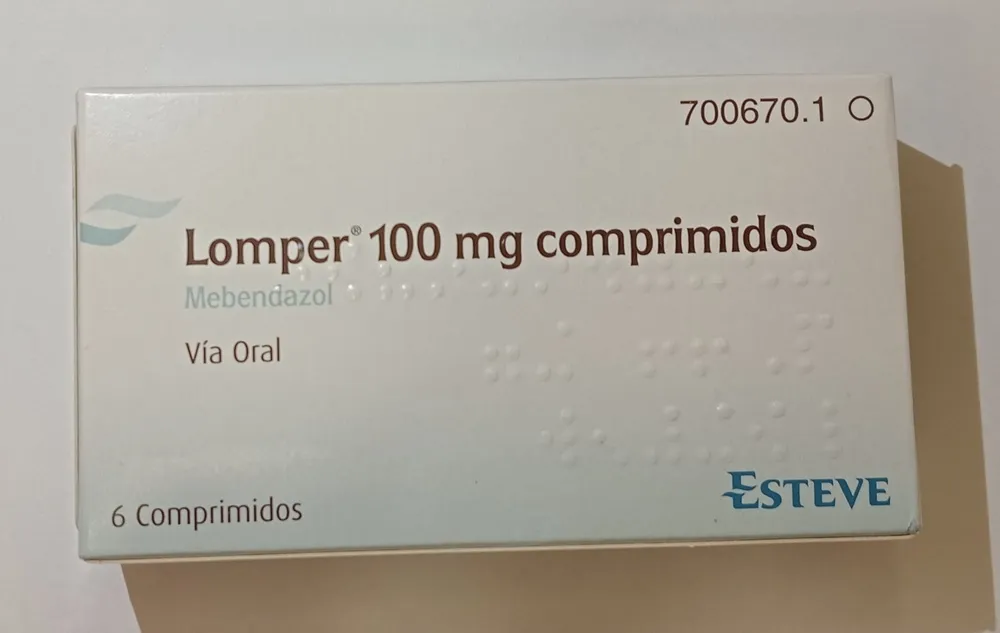
Table of Contents
Package leaflet: Information for the user
Introduction
Package leaflet: information for the patient
Lomper 100 mg tablets
Mebendazole
Read the entire leaflet carefully before you start taking this medicine, as it contains important information for you.
- Keep this leaflet as you may need to read it again.
- If you have any questions, ask your doctor or pharmacist.
- This medicine has been prescribed for you only, and you should not give it to other people, even if they have the same symptoms as you, because it could harm them.
- If you experience any adverse reactions, consult your doctor or pharmacist, even if they are adverse reactions not listed in this leaflet. See section 4.
Contents of the leaflet
- What Lomper tablets are and what they are used for
- What you need to know before taking Lomper tablets
- How to take Lomper tablets
- Possible side effects
- How to store Lomper tablets
- Contents of the pack and other information
1. What Lomper tablets are and what they are used for
Lomper is a medicine that belongs to a group of drugs called anthelmintics.
Lomper is indicated for the treatment of the following intestinal parasitoses, whether simple or mixed: Enterobiasis (Oxyuriasis), Ascariasis, Trichuriasis, Ancylostomiasis, Necatoriasis.
2. What you need to know before taking Lomper tablets
Do not take Lomper:
- if you are allergic to mebendazole or to any of the other ingredients of this medicine (listed in section 6).
Warnings and precautions
- A possible association has been reported between concomitant use of mebendazole and metronidazole (a medicine used to treat bacterial and protozoal infections) and the occurrence of serious reactions (Stevens-Johnson syndrome / toxic epidermal necrolysis (skin blistering or extensive peeling of the skin, or lesions in the mouth, eyes, or anogenital area, accompanied by fever)), which may be life-threatening (see section Possible side effects).
Children and adolescents
Lomper must not be used in children under 1 year of age, as the safety of mebendazole in these children has not been established. Seizures have been reported in children (very rarely), including in children under 1 year of age.
Its use is not recommended in children under 2 years of age, as mebendazole has not been sufficiently studied in this age group. Your doctor will assess whether administration to children under two years is appropriate and will only administer it if the expected benefit outweighs the potential risk.
Taking Lomper with other medicines
Inform your doctor or pharmacist if you are taking, have recently taken, or might take any other medicines, including those obtained without a prescription.
Concomitant use of this medicine with metronidazole should be avoided (see Warnings and precautions).
Simultaneous administration with cimetidine (a medicine used to treat stomach acidity) may inhibit the hepatic metabolism of mebendazole, thereby increasing plasma concentrations of the drug. Your doctor will carry out the necessary monitoring to adjust the dose of the medicine as needed.
Taking Lomper with food
Lomper may be taken with or without food.
Pregnancy, breastfeeding, and fertility
If you are pregnant or breastfeeding, think you may be pregnant, or are planning to become pregnant, consult your doctor or pharmacist before using this medicine.
Pregnancy
Your doctor will evaluate the potential risks versus the expected therapeutic benefits of administering Lomper during pregnancy, especially during the first trimester.
Breastfeeding
If you are breastfeeding, consult your doctor first, who will decide whether you can take Lomper.
Driving and using machines
The effect of this medicine on the ability to drive and operate machinery is negligible or none.
Lomper 100 mg tablets contain sunset yellow FCF (E110) and sulfites
This medicine can cause allergic-type reactions because it contains sunset yellow FCF (E110).
This medicine may rarely cause severe hypersensitivity reactions and bronchospasm because it contains sulfites.
This medicine contains less than 1 mmol of sodium (23 mg) per tablet; that is, essentially "sodium-free".
3. How to take Lomper tablets
Follow exactly the instructions given by your doctor or pharmacist for taking this medicine. If in doubt, consult your doctor or pharmacist again.
Your doctor will determine the appropriate dose for you and make any adjustments considered necessary.
If you think that the effect of Lomper is too strong or too weak, inform your doctor or pharmacist. Your doctor will advise you on the duration of treatment with Lomper.
The recommended dose is:
- Enterobiasis (pinworm infection):
One tablet (a single dose of 100 mg). Repeating the treatment after 2 and 4 weeks is recommended.
- Ascariasis, Trichuriasis, Ankylostomiasis, Necatoriasis, or Mixed Infections:
Two tablets daily, one in the morning and one in the evening, for three consecutive days.
Use in children and adolescents
Children from 2 years of age and adolescents:
- Enterobiasis (pinworm infection):
One tablet (a single dose of 100 mg). Repeating the treatment after 2 and 4 weeks is recommended.
- Ascariasis, Trichuriasis, Ankylostomiasis, Necatoriasis, or Mixed Infections:
Two tablets daily, one in the morning and one in the evening, for three consecutive days.
Consider using Lomper oral suspension for patients (children, adolescents, and adults) who cannot swallow tablets.
Remember to take your medicine.
If you take more Lomper than you should
If you have taken more Lomper than you should, contact your doctor or pharmacist immediately.
In case of accidental overdose, you may experience stomach cramps, nausea, vomiting, and diarrhea.
If you have taken more Lomper than recommended or for prolonged periods, be aware that you may develop blood, kidney, or liver disorders, some of which may be serious, as well as hair loss, which may be permanent in some cases.
In case of overdose or accidental ingestion, contact your doctor or pharmacist immediately or call the Toxicology Information Service at telephone number: 91 562 04 20, indicating the medicine and the amount ingested.
4. Possible adverse effects
Like all medicines, this medicine may cause adverse effects, although not everyone experiences them.
If you experience any of the following adverse effects, stop treatment immediately and consult your doctor:
-
Allergic reactions such as blistering rash on the skin, swelling of the face, or breathing difficulties.
-
Blistering or extensive skin peeling, or in the mouth, eyes, or anogenital area, accompanied by fever.
-
Seizures.
The following adverse effects have been reported. The assessment of adverse effects is based on the following frequency data:
Very common: may affect more than 1 in 10 people
Common: may affect up to 1 in 10 people
Uncommon: may affect up to 1 in 100 people
Rare: may affect up to 1 in 1,000 people
Very rare: may affect up to 1 in 10,000 people
Frequency not known: cannot be estimated from available data
Common: abdominal pain.
Uncommon: abdominal discomfort, diarrhoea and flatulence (gas), rash (redness), nausea and vomiting.
Rare: dizziness.
Very rare: neutropenia (severe decrease in the number of white blood cells), hypersensitivity reactions (allergic reactions), seizures, liver function abnormalities, hepatitis, toxic epidermal necrolysis and Stevens-Johnson syndrome (blistering or extensive peeling of the skin or in the mouth, eyes, or anogenital area, with fever), exanthema (redness), angioedema (swelling of the face), urticaria (red, itchy raised patches on the skin), and alopecia (hair loss, which in some cases may be permanent), inflammatory kidney disorders.
Reporting of adverse effects:
If you experience any type of adverse effect, consult your doctor or pharmacist, even if it is a possible adverse effect not listed in this leaflet. You may also report them directly via the Spanish Pharmacovigilance System for Human Medicinal Products: https://www.notificaram.es. By reporting adverse effects, you can help provide more information on the safety of this medicine.
5. Storage of Lomper tablets
Keep this medicine out of the sight and reach of children.
No special storage conditions are required. Store in the original packaging.
Do not use this medicine after the expiry date stated on the container. The expiry date refers to the last day of the month indicated.
Medicines must not be disposed of via wastewater drains or household waste. Dispose of unused medicines and their containers at the SIGRE point in your pharmacy. If you have any doubts, ask your pharmacist how to properly dispose of unused medicines and their containers. This will help protect the environment.
6. Contents of the pack and other information
Composition of Lomper tablets
- The active substance in this medicine is mebendazole. Each tablet contains 100 mg of mebendazole.
- The other components are: sodium saccharin, microcrystalline cellulose, sodium carboxymethylstarch type A (derived from potato starch), talc, magnesium stearate, maize starch, anhydrous colloidal silica, orange flavour (which contains sulfite among others), sodium lauryl sulfate and sunset yellow FCF (E-110).
Appearance of the product and contents of the pack
Presented in aluminum/PVC blisters. Each pack contains 6 tablets.
The tablets are orange-coloured, round, and scored on one side.
The score line is intended only to facilitate breaking the tablet and swallowing, but not for dividing the tablet into equal doses.
Marketing Authorization Holder and Manufacturer
Marketing Authorization Holder:
Esteve Pharmaceuticals, S.A.
Passeig de la Zona Franca, 109
08038 Barcelona
Spain
Manufacturer:
TOWA Pharmaceutical Europe, S.L.
C/ de Sant Martí, 75-97
08107 Martorelles (Barcelona)
Spain
Date of the most recent revision of this leaflet: 05/2022
Detailed and up-to-date information on this medicine is available on the website of the Spanish Agency of Medicines and Medical Devices (AEMPS) http://www.aemps.gob.es