Lebersal effervescent granules orange flavour
Spain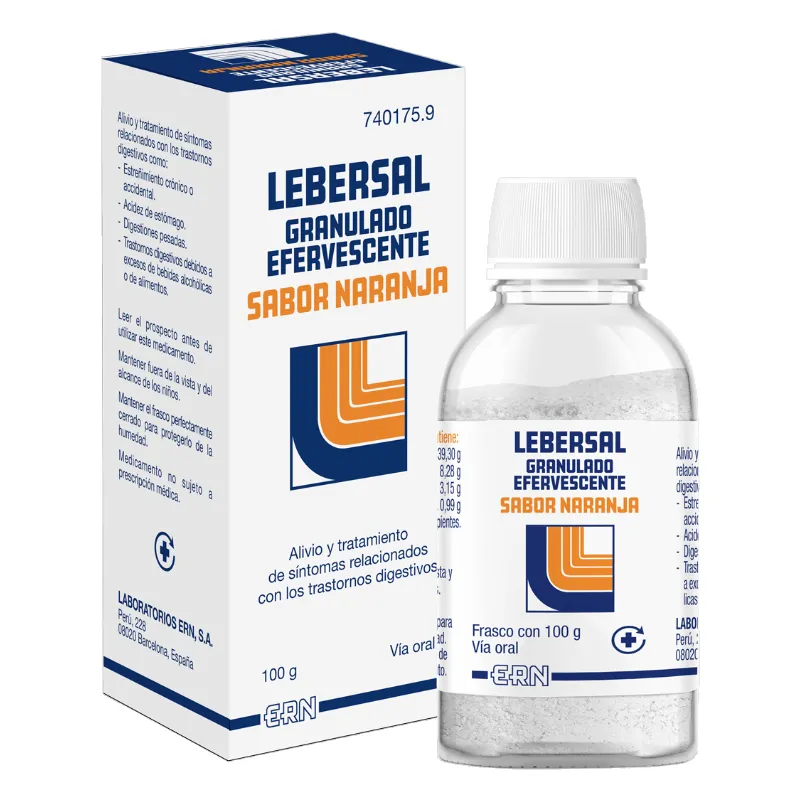
Table of Contents
Package leaflet: Information for the user
Introduction
Package leaflet: information for the user
Lebersal effervescent granules orange flavour
Sodium hydrogen carbonate (Sodium bicarbonate) / Anhydrous disodium phosphate
Anhydrous sodium sulphate / Anhydrous magnesium sulphate
Read the entire leaflet carefully before starting to take this medicine because it contains important information for you.
- Follow exactly the instructions for administration provided in this leaflet or those given by your doctor or pharmacist.
- Keep this leaflet, as you may need to read it again.
- If you need advice or more information, consult your pharmacist.
- If you experience any adverse effects, consult your doctor or pharmacist, even if they are adverse effects not listed in this leaflet. See section 4.
- You should consult a doctor if you worsen or do not improve after 7 days.
Contents of the leaflet
- What Lebersal is and what it is used for
- What you need to know before taking Lebersal
- How to take Lebersal
- Possible adverse effects
- How to store Lebersal
- Contents of the pack and other information
1. What Lebersal is and what it is used for
Lebersal is indicated for the relief and treatment of symptoms related to digestive disorders such as:
- Chronic or occasional constipation
- Stomach acidity
- Heavy digestion
- Digestive disturbances due to excess alcohol or food consumption.
2. What you need to know before taking Lebersal
Do not take Lebersal:
- If you are allergic to sodium bicarbonate, anhydrous disodium phosphate, anhydrous sodium sulfate, anhydrous magnesium sulfate, or any of the other components of this medicine (listed in section 6).
- If you have an electrolyte imbalance (altered water or electrolyte levels), hypernatremia (high sodium levels in blood), or suffer from diarrhoeal conditions.
Warnings and precautions
Consult your doctor or pharmacist before taking Lebersal:
- If you have heart failure.
- If you have renal insufficiency (kidney disease).
- If you are prone to fluid retention (oedema).
- If you are on a low-sodium diet (low-salt diet).
- If you have hypertension.
- During treatment with diuretics (medications that increase urine elimination).
- If you are pregnant or breastfeeding.
Taking Lebersal with other medicines:
Inform your doctor or pharmacist if you are taking, have recently taken, or might need to take any other medicines.
Lebersal should not be administered simultaneously with other orally administered medicines, as it may affect their absorption. This includes tetracyclines, ketoconazole, cimetidine, ranitidine, famotidine, mecamylamine, methenamine, bisphosphonates, digoxin, indomethacin, iron salts, lithium, salicylates, and naproxen.
Due to its content of sodium bicarbonate and magnesium sulfate, Lebersal may reduce the urinary excretion of amphetamines and quinidine.
Aluminum, calcium, or magnesium salts may reduce the absorption of Lebersal due to its phosphate content. On the other hand, vitamin D increases phosphate absorption and could therefore cause hyperphosphataemia (excess phosphate in blood).
Concomitant use of medicines affecting serum electrolytes (minerals in the blood), such as diuretics, calcium channel blockers, or lithium therapy, may lead to elevated blood levels of phosphate (hyperphosphataemia), sodium (hypernatraemia), magnesium (hypermagnesaemia), and low calcium levels (hypocalcaemia).
In addition, taking Lebersal together with calcium supplements may increase the risk of ectopic calcification (deposition of calcium salts in extraskeletal tissues).
In any case, if it is necessary to take these medicines, doses should be separated by at least two hours.
Taking Lebersal with food and drinks
Do not take Lebersal when the stomach is overly full of food or drink, as this may increase carbon dioxide production, leading to gastric distension and, rarely, perforation of the stomach wall.
Pregnancy, breastfeeding, and fertility
If you are pregnant or breastfeeding, think you may be pregnant, or are planning to become pregnant, consult your doctor or pharmacist before using this medicine.
Its use during pregnancy is not recommended. The presence of sodium bicarbonate in Lebersal may induce metabolic alkalosis (a disturbance in the balance of water and mineral salts in the blood), fluid retention, and weight gain in both mother and foetus.
Its use during breastfeeding is not recommended, as it is unknown whether Lebersal is excreted in breast milk.
Driving and using machines
No effects of Lebersal on the ability to drive vehicles or operate machinery have been reported.
Lebersal contains sodium
This medicine contains 470 mg of sodium (the main component of table/cooking salt) in 2.5 grams. This corresponds to 24% of the maximum recommended daily sodium intake for an adult.
Consult your doctor or pharmacist if you need to take one teaspoon or more per day for a prolonged period, especially if you have been advised to follow a low-salt (sodium) diet.
3. How to take Lebersal
Follow exactly the instructions for use provided in this leaflet or those given by your doctor or pharmacist. If in doubt, consult your doctor or pharmacist.
Lebersal is administered orally.
The recommended dose is 1 or 2 teaspoons (2.5 or 5 g) taken on an empty stomach or before main meals. Pour the granules into half a glass of water.
It may be taken before or after effervescence occurs.
It is advisable not to take more than 4 teaspoons per day.
If you take more Lebersal than you should
Contact your doctor or pharmacist immediately. Doses exceeding the recommended amounts of Lebersal may cause diarrhea, headache, nausea, vomiting, abdominal cramps, weakness, and loss of appetite. At very high doses and during prolonged treatment, metabolic alkalosis may occur.
Treatment administered will aim to relieve symptoms and restore the balance of water and electrolytes in the blood.
In case of overdose or accidental ingestion, contact your doctor or pharmacist immediately or call the Toxicology Information Service at telephone number 91 562 04 20, indicating the medication and the amount used/ingested.
If you forget to take Lebersal
Do not take a double dose to make up for missed doses.
4. Possible adverse effects
Like all medicines, this medicine can cause adverse effects, although not everybody will experience them.
When used at the recommended dosage, no adverse effects have been reported.
In case of renal insufficiency (kidney failure), elevated blood levels of phosphate (hyperphosphatemia), sodium (hypernatremia), magnesium (hypermagnesemia), and low levels of calcium (hypocalcemia) may occur. The frequency of these adverse effects is unknown.
Reporting of adverse effects
If you experience any type of adverse effect, consult your doctor or pharmacist, even if it is a possible adverse effect not listed in this leaflet. You may also report them directly through the Spanish Pharmacovigilance System for Human Medicinal Products: www.notificaRAM.es. By reporting adverse effects, you can help provide more information on the safety of this medicine.
5. Storage of Lebersal
Keep Lebersal out of sight and reach of children.
Keep the bottle tightly closed to protect it from moisture.
Do not use this medicine after the expiry date stated on the packaging after EXP. The expiry date is the last day of the month indicated.
Medicines must not be disposed of via wastewater drains or household waste. Dispose of unused medicines and their containers at the SIGRE collection point at your pharmacy. If you are in doubt, ask your pharmacist how to dispose of medicines and containers you no longer need. This will help protect the environment.
6. Contents of the pack and other information
Composition of Lebersal
- The active substances are: Sodium hydrogen carbonate (sodium bicarbonate) (39.30 g), anhydrous disodium phosphate (8.28 g), anhydrous sodium sulfate (3.15 g) and anhydrous magnesium sulfate (0.99 g).
- The other components are: Tartaric acid, sodium carbonate, orange flavour and saccharin.
Appearance of the medicine and contents of the pack
Lebersal is an effervescent granulate for oral use. It is supplied in a bottle containing 100 g of white effervescent granulate with an orange flavour.
Marketing Authorization Holder
LABORATORIOS ERN, S.A.
Perú, 228 - 08020 Barcelona, Spain.
Manufacturer
LABORATORIOS ERN, S.A.
Gorgs LLadó, 188 – 08210 Barberà del Vallès, Barcelona, Spain.
Date of the most recent review of this leaflet: June 2021
Detailed and up-to-date information on this medicine is available on the website of the Spanish Agency for Medicines and Health Products (AEMPS): http://www.aemps.gob.es/