Lactoferrin 40 mg oral solution
Spain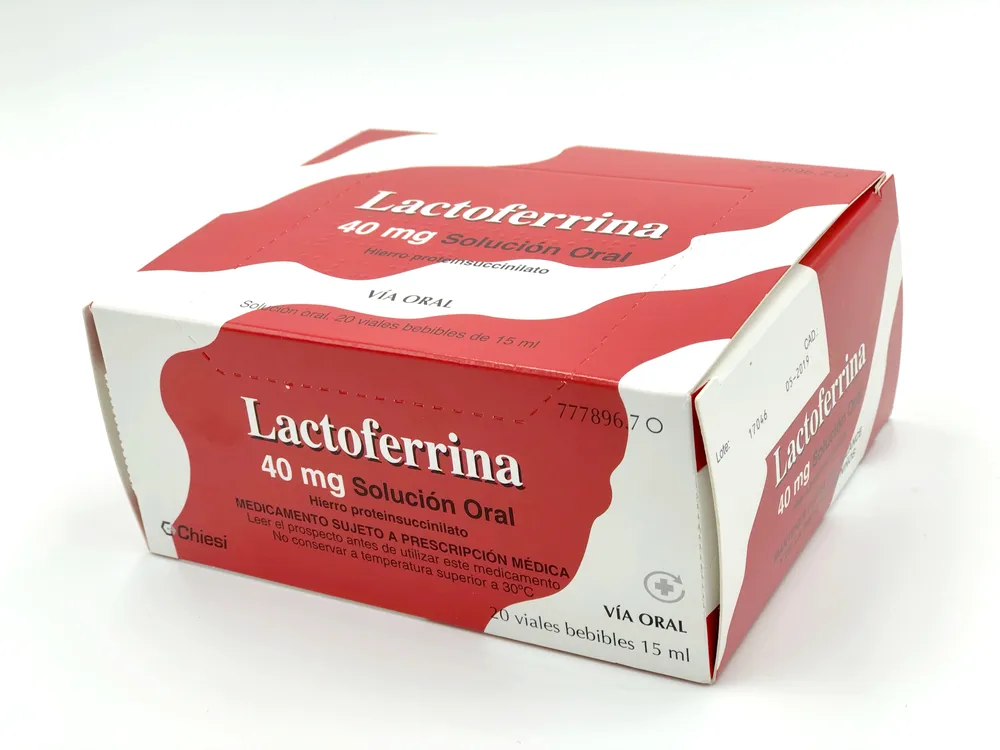
Table of Contents
Package leaflet: Information for the user
Introduction
Package leaflet: information for the user
LACTOFERRIN 40 mg ORAL SOLUTION
Iron Proteinsuccinylate (Fe3+)
Read all of this leaflet carefully before you start taking this medicine.
- Keep this leaflet. You may need to read it again.
- If you have any further questions, ask your doctor or pharmacist.
- This medicine has been prescribed for you only and must not be given to other people, even if they have the same symptoms, as it may harm them.
- If you consider any of the side effects you experience to be severe, or if you notice any side effects not listed in this leaflet, inform your doctor or pharmacist.
Contents of the leaflet:
- What Lactoferrin is and what it is used for
- Before you take Lactoferrin
- How to take Lactoferrin
- Possible side effects
- How to store Lactoferrin
- Further information
1. What Lactoferrin is and what it is used for
Lactoferrin is a medication that supplies iron to red blood cells, treating iron deficiency states and curing anemia (reduction in hemoglobin levels and in the number and size of red blood cells) caused by this iron deficiency.
2. Before taking Lactoferrin
Do not take Lactoferrin
- If you are allergic (hypersensitive) to iron protein succinylate or to any of the other ingredients of Lactoferrin.
- If you are allergic to milk proteins.
- If you have a disease causing iron accumulation in the body (hemochromatosis, hemosiderosis).
- If you have pancreatitis (inflammation of the pancreas) or hepatic cirrhosis (chronic liver disease characterized by the formation of fibrosis or "scarring" in liver tissue that alters its structure and normal function) due to iron accumulation.
- If you have anemia due to causes other than iron deficiency.
Take special care with Lactoferrin
- Before starting treatment with this medicine, if you have anemia or iron deficiency, you should consult your doctor.
Use of other medicines
Inform your doctor or pharmacist if you are taking, have recently taken, or might take any other medicines, even those not requiring a prescription.
Lactoferrin may reduce intestinal absorption and, therefore, the effect of certain medicines, such as:
- Antibiotics, such as quinolones and tetracyclines.
- Bisphosphonates, used in patients with osteoporosis (bone loss and weakening).
- Penicillamine, used for arthritis (joint inflammation).
- Alpha-methyldopa, used to treat arterial hypertension (high blood pressure).
- Thyroxine, used for the treatment of hypothyroidism (underactive thyroid gland).
- Levodopa and carbidopa, used for the treatment of Parkinson's disease.
- Mycophenolate mofetil, used to prevent transplant rejection.
The intestinal absorption of iron, and thus the effectiveness of Lactoferrin, may be reduced if taken together with the following medicines. Therefore, at least 2 hours should be left between taking any of these medicines and taking Lactoferrin:
- Antacids, commonly used in patients with gastric acidity.
- Chloramphenicol (antibiotic).
- Cholestyramine, used in patients with high cholesterol.
- Medicines for the treatment of stomach ulcer or gastroesophageal reflux such as omeprazole, lansoprazole, pantoprazole.
Interference with diagnostic tests:
This medicine may interfere with laboratory tests for the detection of occult blood in feces.
Taking Lactoferrin with food and drinks
Certain plant-based foods, milk, coffee, and tea reduce iron absorption. Therefore, it is recommended not to take Lactoferrin within two hours after consuming any of these foods.
Simultaneous intake of freshly squeezed citrus juices (orange, lemon, etc.) may enhance the absorption of iron compounds.
Pregnancy and breastfeeding
Consult your doctor or pharmacist before using any medicine.
Lactoferrin is particularly indicated in iron deficiency states occurring during pregnancy and breastfeeding; therefore, no special precautions are required.
Driving and using machines
No effects on the ability to drive and use machines have been observed.
Important information about some of the ingredients of Lactoferrin
This medicine contains 1400 mg of sorbitol per vial. Sorbitol is a source of fructose. If your doctor has informed you (or your child) that you have an intolerance to certain sugars, or if you (or your child) have been diagnosed with hereditary fructose intolerance (HFI), a rare genetic disorder in which the patient cannot break down fructose, consult your doctor before taking this medicine. Sorbitol may cause gastrointestinal discomfort and a mild laxative effect.
This medicine contains 61.1 mg of propylene glycol in each vial, equivalent to 4.1 mg/ml. If the infant is less than 4 weeks old, consult your doctor or pharmacist, especially if the infant has been administered other medicines containing propylene glycol or alcohol.
This medicine contains 38.4 mg of sodium (the main component of table/cooking salt) in each vial. This corresponds to 1.9% of the maximum daily recommended sodium intake for an adult.
Lactoferrin may cause allergic reactions (possibly delayed) because it contains sodium propyl parahydroxybenzoate (E-217) and sodium methyl parahydroxybenzoate (E-219).
3. How to take Lactoferrin
Follow exactly the instructions for administration of Lactoferrin provided by your doctor. Consult your doctor or pharmacist if you have any doubts. Remember to take your medication.
Your doctor will determine the duration of your treatment. Do not stop the treatment early, as the desired effect will not be achieved.
Take this medicine preferably a few hours before meals.
The contents of the vial can be taken directly or diluted in water.
The usual doses are as follows:
Adults:
1–2 vials per day, according to medical judgment (equivalent to 40–80 mg of Fe 3+), divided into two doses.
Children:
Administer 1.5 mL of solution/kg/day (equivalent to 4 mg of Fe 3+) or as directed by a physician, divided into two doses.
The duration of treatment depends on the nature and severity of iron deficiency. Treatment should continue until iron stores are replenished.
If you think that the effect of Lactoferrin is too strong or too weak, inform your doctor or pharmacist.
If you take more Lactoferrin than you should
If you take more Lactoferrin than prescribed, contact your doctor or pharmacist immediately or call the Toxicology Information Service at telephone number 91 562 04 20.
If you forget to take Lactoferrin
Do not take a double dose to make up for missed doses. If you forget to take a dose, take the next one as soon as possible and continue as before.
If you have any further questions about the use of this product, ask your doctor or pharmacist.
4. Possible adverse effects
Like all medicines, Lactoferrin may cause adverse effects, although not everyone experiences them.
The following adverse effects have been reported (frequency unknown):
Gastrointestinal disorders: stomach pain, nausea, constipation or diarrhoea, which usually resolve quickly after reducing the dose or, if necessary, after stopping treatment.
Skin and subcutaneous tissue disorders: allergic reactions.
Appearance of green or black stools, due to iron excretion. This adverse effect is harmless.
If you consider any of the adverse effects you experience to be severe, or if you notice any adverse effect not listed in this leaflet, inform your doctor or pharmacist.
5. Storage of Lactoferrin
No special storage conditions are required.
Keep out of the reach and sight of children.
Do not use Lactoferrin after the expiry date stated on the container. The expiry date is the last day of the month indicated.
Medicines must not be disposed of via wastewater or household waste. Dispose of containers and unused medicines at the SIGRE collection point at your pharmacy. If in doubt, ask your pharmacist how to properly dispose of containers and unused medicines. This way, you will help protect the environment.
6. Additional Information
Composition of Lactoferrin
The active substance is Iron Protein Succinylate (contains milk protein). Each 15 ml vial of oral solution contains 800 mg of Iron Protein Succinylate, equivalent to 40 mg of Fe3+.
The other components are: sorbitol (E-420), propylene glycol (E-1520), sodium propylparaben (E-217), sodium methylparaben (E-219), sodium saccharin, blackberry flavor, sodium hydroxide, and purified water.
Appearance of the product and contents of the container
LACTOFERRIN is presented as a transparent, brown-colored oral solution with a characteristic odor.
Each package contains 20 vials.
Marketing Authorization Holder
CHIESI ESPAÑA, S.A.U.
Plaça d’Europa, 41-43, 10th Floor
08908 L'Hospitalet de Llobregat - Barcelona (Spain)
Under license from Italfarmaco S.p.A. (Italy)
Manufacturer
Italfarmaco S.A.
San Rafael, 3
28108 Alcobendas (Madrid)
Spain
or
LACER, S.A.
Boters, 5
08290 Cerdanyola del Vallès (Barcelona)
Spain
This leaflet was approved in May 2022.
Detailed and up-to-date information on this medicinal product is available on the website of the Spanish Agency of Medicines and Health Products (AEMPS) http://www.aemps.es.