Kiovig 100 mg/ml solution for infusion
Spain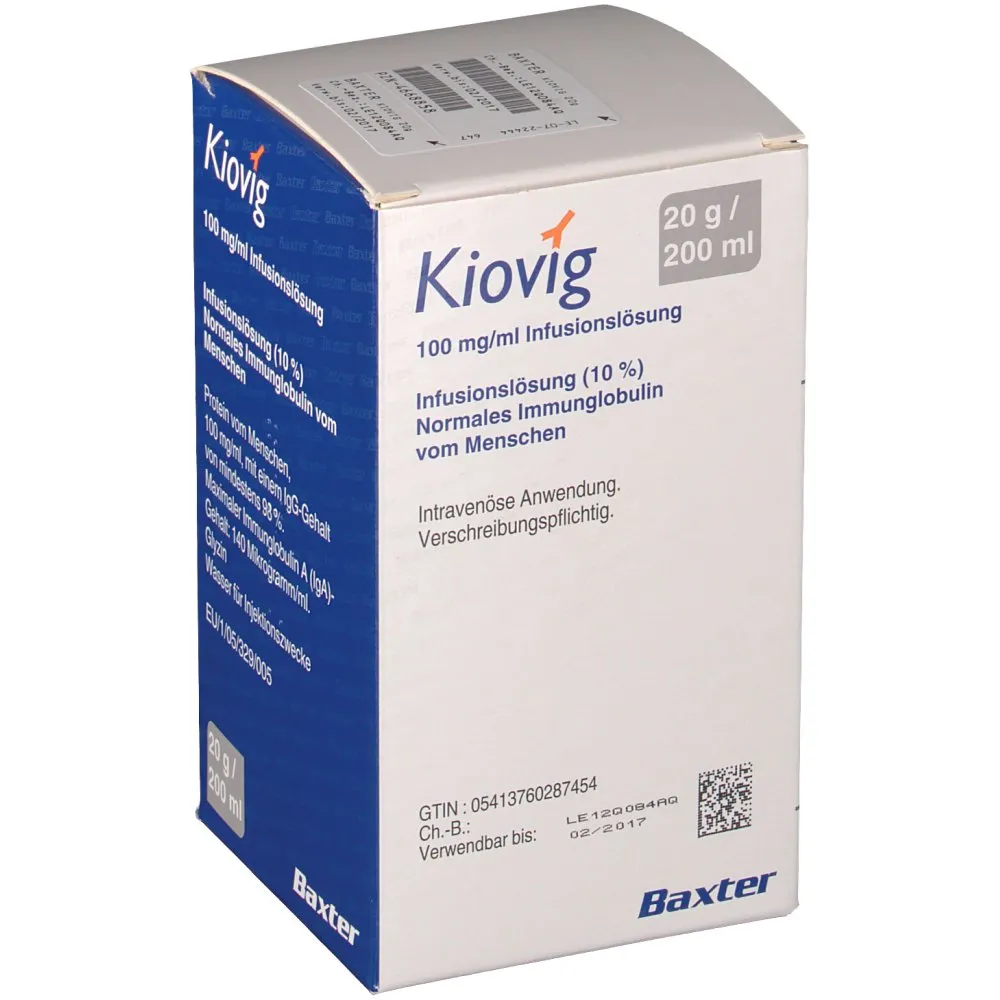
Table of Contents
Package leaflet: Information for the user
Introduction
Package leaflet: Information for the user
KIOVIG 100 mg/ml solution for infusion
human normal immunoglobulin
Read the entire leaflet carefully before you start using this medicine because it contains important information for you
- Keep this leaflet, as you may need to read it again.
- If you have any questions, ask your doctor, pharmacist or nurse.
- This medicine has been prescribed for you only and must not be given to other people, even if they have the same symptoms as you, since it could harm them.
- If you experience any adverse reactions, consult your doctor, pharmacist or nurse, even if they are adverse reactions not listed in this leaflet. See section 4.
Contents of the leaflet:
- What KIOVIG is and what it is used for
- What you need to know before using KIOVIG
- How to use KIOVIG
- Possible side effects
- How to store KIOVIG
- Contents of the pack and other information
1. What KIOVIG is and what it is used for
KIOVIG belongs to a class of medicines called immunoglobulins. These medicines contain human antibodies, which are also present in blood. Antibodies help fight infections. Medicines such as KIOVIG are used in patients who do not have sufficient antibodies in the blood and who frequently suffer from infections. These medicines can also be used in patients who require additional antibodies for the treatment of certain inflammatory disorders (autoimmune diseases).
KIOVIG is used for
Treatment of patients who lack sufficient antibodies (replacement therapy). There are five groups:
- Patients with a congenital deficiency in antibody production (primary immunodeficiency syndromes).
- Patients with secondary immunodeficiencies (SID) who suffer from severe or recurrent infections, ineffective antimicrobial treatment, and specific antibody deficiency (SAD, by its English acronym)* or serum IgG <4 g/l.
*SAD = inability to increase IgG antibody titres at least 2-fold in response to the polysaccharide pneumococcal vaccine and peptide antigen vaccines.
Treatment of patients with certain inflammatory disorders (immunomodulation).
There are five groups:
- Patients with low platelet counts in the blood (primary immune thrombocytopenia) and who are at high risk of bleeding or who are about to undergo surgery.
- Patients with a disease characterized by widespread inflammation of the nerves throughout the body (Guillain-Barré Syndrome).
- Patients with a disease causing widespread inflammation of various organs in the body (Kawasaki disease).
- Patients with a rare disease characterized by progressive, asymmetric weakness of the limbs without sensory loss (multifocal motor neuropathy, MMN).
- Patients with chronic inflammatory demyelinating polyradiculoneuropathy (CIDP).
2. What you need to know before starting to use KIOVIG
Do not use KIOVIG
If you are allergic to immunoglobulins or to any of the other components of this medicine (listed in section 6).
For example, if you have immunoglobulin A deficiency, in which case you may have anti-immunoglobulin A antibodies in your blood. Since KIOVIG contains trace amounts of immunoglobulin A (up to 0.14 mg/ml), you may develop an allergic reaction.
Warnings and precautions
Talk to your doctor, pharmacist, or nurse before starting to use KIOVIG.
Monitoring period required during infusion
- You will be closely monitored during the KIOVIG infusion period to prevent an allergic reaction. Your doctor will ensure that the infusion rate of KIOVIG is appropriate for your condition.
- If KIOVIG is administered at a high rate, if you have a disorder characterized by low levels of antibodies in the blood (hypo- or agammaglobulinemia), if you have not previously received this medicine, or if a long period (e.g., several weeks) has passed since your last dose, there may be an increased risk of adverse effects. In these cases, you will be closely monitored during the infusion and for one hour after the infusion.
- If you have previously received KIOVIG and your last treatment was recent, you will only be observed during the infusion and for at least 20 minutes after the infusion.
When to stop or reduce the infusion rate
In rare cases, your body may have previously reacted to certain antibodies and thus be sensitized to antibody-containing medicines. This may occur especially if you have immunoglobulin A deficiency. In these rare cases, you may experience allergic reactions such as a sudden drop in blood pressure or shock, even if you have previously received treatments with antibody-containing medicines.
If you experience an allergic reaction during KIOVIG infusion, inform your doctor immediately. Depending on the doctor's decision, the infusion rate may be reduced or the infusion stopped.
Special patient groups
- Your doctor will take special precautions if you are overweight, elderly, diabetic, or have high blood pressure, low blood volume (hypovolemia), or blood vessel problems (vascular diseases). In these cases, immunoglobulins may increase the risk of myocardial infarction, stroke, pulmonary embolism, or deep vein thrombosis, although this is very rare.
Inform your doctor if you are diabetic. Although KIOVIG does not contain sugar, it may be diluted with a special sugar solution (5% glucose), which could affect your blood sugar levels.
- Your doctor will also exercise special care if you have or have had kidney problems, or if you have received medications that may have damaged your kidneys (nephrotoxic drugs), as there is a very rare possibility of severe kidney failure.
Inform your doctor if you have or have had kidney problems. Your doctor will select the appropriate intravenous immunoglobulin for you.
Information about the source material of KIOVIG
KIOVIG is made from human plasma (the liquid part of blood). When medicines are made from human blood or plasma, certain measures must be taken to prevent infections from being passed to patients. These measures include careful selection of donors to exclude those at risk of carrying infectious diseases, testing for specific infection markers in individual donations and plasma pools, and inclusion of manufacturing steps designed to inactivate or remove viruses. Nevertheless, when medicines derived from human blood or plasma are administered, the possibility of transmitting infectious agents cannot be completely ruled out. This also applies to emerging or unknown viruses and other types of infections.
The measures taken in the manufacturing of KIOVIG are considered effective against enveloped viruses such as human immunodeficiency virus (HIV), hepatitis B virus, and hepatitis C virus, as well as non-enveloped viruses such as hepatitis A virus and parvovirus B19. KIOVIG also contains certain antibodies that may help prevent infection by hepatitis A virus and parvovirus B19.
Use of KIOVIG with other medicines
Inform your doctor or pharmacist if you are taking, have recently taken, or might need to take any other medicines.
If you have received a vaccine within the past six weeks up to three months, the infusion of immunoglobulins such as KIOVIG may affect the effectiveness of certain live virus vaccines such as measles, rubella, mumps, and varicella. Therefore, after receiving immunoglobulins, you may need to wait up to 3 months before receiving an attenuated live virus vaccine. You may need to wait up to 1 year after receiving immunoglobulins before receiving the measles vaccine.
Effects on blood tests
KIOVIG contains a wide variety of different antibodies, some of which may interfere with blood tests. If you have a blood test after receiving KIOVIG, please inform the laboratory staff or your doctor that you have received this medication.
Pregnancy, breastfeeding, and fertility
- If you are pregnant or breastfeeding, think you may be pregnant, or are planning to become pregnant, consult your doctor or pharmacist before using this medicine.
- Clinical studies with KIOVIG have not been conducted in pregnant or breastfeeding women. However, antibody-containing medicines have been used in pregnant and breastfeeding women, and no harmful effects on pregnancy or the baby are expected.
- If you are breastfeeding and receive KIOVIG, the antibodies in the medicine may also be present in breast milk. Therefore, your baby may be protected against certain infections.
Driving and use of machines
Patients may experience reactions (e.g., dizziness or nausea) during treatment with KIOVIG that could affect their ability to drive or operate machinery. If this occurs, wait until the symptoms have resolved before driving or using machines.
3. How to use KIOVIG
KIOVIG is for intravenous administration (infusion into a vein). It will be administered to you by your doctor or nurse. The dose and frequency of infusion may vary depending on your condition and body weight.
At the beginning of the infusion, you will receive KIOVIG at a low rate. Your doctor may gradually increase the infusion rate depending on how well you tolerate it.
Use in children and adolescents
In children and adolescents (0 to 18 years of age), the same indications, doses, and infusion frequencies are used as in adults.
If you use more KIOVIG than you should
If you receive more KIOVIG than you should, the blood may thicken (hyperviscosity). This may occur especially if you are a high-risk patient (for example, an elderly patient or a patient with kidney problems). Make sure you drink adequate fluids to avoid dehydration, and inform your doctor if you have any medical conditions.
4. Possible adverse effects
Like all medicines, this medicine can cause adverse effects, although not everyone will experience them. Some adverse effects, such as headache or flushing, can be avoided by reducing the infusion rate.
The list of adverse effects observed during treatment with KIOVIG is described below:
- Very common adverse effects (may affect more than 1 in 10 patients):
Headache, high blood pressure, nausea, rash, local reactions (e.g., pain, swelling, or other reactions at the infusion site), fever, fatigue.
- Common adverse effects (may affect up to 1 in 10 patients):
Bronchitis, common cold, low red blood cell count, swollen lymph nodes, decreased appetite, difficulty sleeping, anxiety, dizziness, migraine, numbness or tingling of the skin or a limb, decreased sense of touch, eye inflammation, increased heart rate, flushing, cough, runny nose, chronic cough or wheezing (asthma), nasal congestion, sore throat, difficulty breathing, diarrhea, vomiting, abdominal pain, indigestion, bruising, itching and hives, dermatitis, skin redness, back pain, joint pain, arm or leg pain, muscle pain, muscle cramps, loss of muscle strength, chills, fluid accumulation under the skin, flu-like illness, chest pain or discomfort, lack of strength or feeling weak, malaise, chills and shivering.
- Uncommon adverse effects (may affect up to 1 in 100 patients):
Chronic nasal infection, fungal infections, various infections (of the nose and throat, kidney or bladder), inflammation of the membranes covering the brain, severe allergic reactions, thyroid disorders, overreaction to stimuli, memory disturbance, difficulty speaking, bad taste in the mouth, impaired balance, involuntary tremor, eye pain or swelling, vertigo, fluid in the middle ear, peripheral coldness, inflammation of a vein, inflammation of nose and throat, abdominal distension, rapid skin swelling, acute skin inflammation, cold sweat, increased skin sensitivity to sunlight, excessive sweating even during sleep, muscle twitching, excess serum protein in urine, chest tightness, sensation of heat, burning sensation, swelling, increased respiratory rate, changes in blood test results.
- Frequency not known (cannot be estimated from available data):
Destruction of red blood cells, severe life-threatening allergic shock, transient ischaemic attack, stroke, low blood pressure, heart attack, blood clot in a major vein, blood clot in the main artery of the lung, fluid accumulation in the lung, positive Coombs test, decreased oxygen saturation in blood, transfusion-related acute lung injury.
Reporting of adverse effects
If you experience any type of adverse effect, consult your doctor, pharmacist, or nurse, even if it is a possible adverse effect not listed in this leaflet. You may also report them directly through the national reporting system included in Appendix V.
By reporting adverse effects, you can help provide more information on the safety of this medicine.
5. Storage of KIOVIG
- Keep this medicine out of the sight and reach of children.
- Do not use this medicine after the expiry date stated on the label and container after EXP. The expiry date is the last day of the month indicated.
- Do not use this medicine if particles or discoloration are observed.
- Do not store above 25°C.
- Do not freeze.
- Store the container in the original packaging to protect it from light.
6. Contents of the container and other information
Composition of KIOVIG
- The active substance in KIOVIG is human normal immunoglobulin.
- 1 ml of KIOVIG contains 100 mg of human protein, of which at least 98% is immunoglobulin G (IgG).
- The other components (excipients) are glycine and water for injections.
Appearance of the product and contents of the container
KIOVIG is an infusion solution available in vials of 10, 25, 50, 100, 200 or 300 ml. The solution is clear or slightly opalescent, colourless or pale yellow.
Not all pack sizes may be marketed.
Marketing Authorisation Holder:
Takeda Manufacturing Austria AG
Industriestrasse 67
A-1221 Vienna
Austria
Tel.: +800 66838470
E-mail: [email protected]
Manufacturer:
Baxalta Belgium Manufacturing SA
Boulevard René Branquart, 80
B-7860 Lessines
Belgium
Date of the most recent revision of this summary:
Other sources of information
Detailed information on this medicine is available on the European Medicines Agency website: http://www.ema.europa.eu.
This information is intended for healthcare professionals only:
Method of administration
- KIOVIG must only be administered intravenously. Other routes of administration have not been evaluated.
- KIOVIG should be infused intravenously at an initial rate of 0.5 ml/kg body weight/hour for 30 minutes. If well tolerated, the infusion rate may be gradually increased up to a maximum of 6 ml/kg body weight/hour. Clinical data from a limited number of patients also indicate that adult patients with PID may tolerate an infusion rate of up to 8 ml/kg body weight/hour.
- If dilution to lower concentrations is required prior to infusion, KIOVIG may be diluted with 5% glucose solution to a final concentration of 50 mg/ml (5% immunoglobulin).
- Any adverse reaction related to the infusion should be managed by reducing the infusion rate or stopping the infusion.
Special precautions
- Any adverse reaction related to the infusion should be managed by reducing the infusion rate or stopping the infusion.
- It is recommended to record the name and batch number of the product each time KIOVIG is administered.
Incompatibilities
This medicinal product must not be mixed with other medicinal products.
Special storage precautions
- Immediate use after dilution is recommended. In-use stability of KIOVIG after dilution with 5% glucose solution to a final concentration of 50 mg/ml (5% immunoglobulin) has been demonstrated for 21 days at 2°C to 8°C as well as at 28°C to 30°C; however, these studies did not include assessment of microbial contamination and safety.
Instructions for handling and disposal
- The product should reach room or body temperature before use.
- KIOVIG should be inspected visually before administration to confirm the absence of particles and discoloration. Only clear or slightly opalescent, colourless or pale yellow solutions should be used. Do not use if particles or discoloration are observed.
- If dilution is required, 5% glucose solution is recommended. To obtain a 50 mg/ml (5%) immunoglobulin solution, KIOVIG 100 mg/ml (10%) should be diluted with an equal volume of glucose solution. The risk of microbial contamination during dilution should be minimized.
- Disposal of unused medicine and all materials that have come into contact with it should be carried out in accordance with local regulations.
Dosage recommendations
Indication | Dosage | Infusion frequency |
Replacement therapy in primary immunodeficiency | ‑ Initial dose: 0.4–0.8 g/kg Maintenance dose: 0.2–0.8 g/kg | every 3–4 weeks to achieve a minimum (trough) IgG level of at least 5–6 g/L |
Replacement therapy in secondary immunodeficiency | 0.2–0.4 g/kg | every 3–4 weeks to achieve a minimum (trough) IgG level of at least 5–6 g/L |
Immunomodulation: | ||
Primary immune thrombocytopenia | 0.8–1 g/kg or 0.4 g/kg/day | on the first day, may be repeated once within the following three days for 2–5 days |
Guillain-Barré syndrome | 0.4 g/kg/day | for 5 days |
Kawasaki disease | 2 g/kg | as a single dose, in combination with acetylsalicylic acid |
Chronic inflammatory demyelinating polyradiculoneuropathy (CIDP) | Initial dose: 2 g/kg Maintenance dose: 1 g/kg | divided over 2–5 days every 3 weeks for 1–2 days |
Multifocal motor neuropathy (MMN) | Initial dose: 2 g/kg Maintenance dose: 1 g/kg or 2 g/kg | administered over 2–5 days every 2–4 weeks or every 4–8 weeks for 2–5 days |