Kevzara 150 mg solution for injection in pre-filled pen
Spain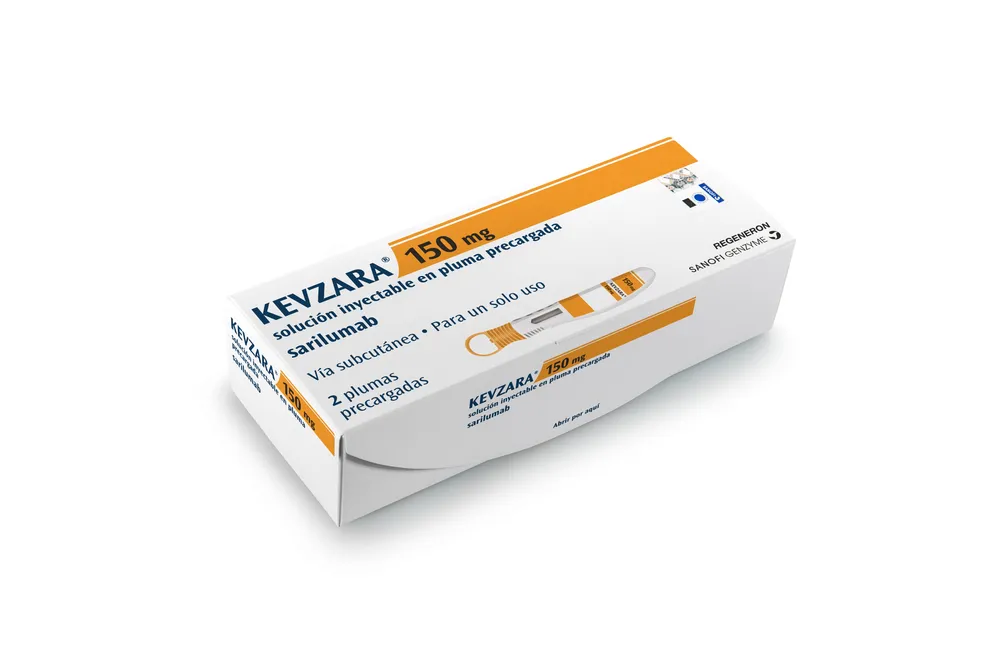
Table of Contents
Package leaflet: Information for the user
Introduction
Package leaflet: information for the patient
Kevzara 150 mg solution for injection in a pre-filled pen
Kevzara 200 mg solution for injection in a pre-filled pen
sarilumab
Read the entire leaflet carefully before you start using this medicine, because it contains important information for you.
- Keep this leaflet, as you may need to read it again.
- If you have any questions, ask your doctor, pharmacist, or nurse.
- This medicine has been prescribed for you only, and you should not give it to other people, even if they have the same symptoms as you, because it may harm them.
- If you experience any adverse reactions, consult your doctor, pharmacist, or nurse, even if they are adverse reactions not listed in this leaflet. See section 4.
In addition to this leaflet, you will be given a patient information card containing important safety information you need before and during treatment with Kevzara.
Contents of the leaflet
- What Kevzara is and what it is used for
- What you need to know before using Kevzara
- How to use Kevzara
- Possible side effects
- How to store Kevzara
- Contents of the pack and other information
1. What Kevzara is and what it is used for
What Kevzara is
Kevzara contains the active substance sarilumab. It is a type of protein called a "monoclonal antibody".
What Kevzara is used for
Kevzara is used to treat adults with moderate to severe active rheumatoid arthritis (RA) when previous treatment has not worked well or has not been tolerated. Kevzara may be used alone or together with a medicine called MTX.
It may help you by:
- slowing down joint damage
- improving your ability to carry out daily activities.
Kevzara is also used to treat adults with polymyalgia rheumatica after corticosteroids have been used and have not worked well, or if you experience a relapse while tapering off corticosteroid dose (gradual reduction). Kevzara may be used alone or together with a medicine called a corticosteroid.
How Kevzara works
- Kevzara binds to the receptor of another protein called interleukin-6 (IL-6) and blocks its action.
- IL-6 plays a key role in the symptoms of RA such as pain, joint inflammation, morning stiffness, and fatigue.
2. What you need to know before using Kevzara
Do not use Kevzara:
- if you are allergic to sarilumab or to any of the other ingredients of this medicine (listed in section 6).
- if you have a serious active infection.
Warnings and precautions
Talk to your doctor, pharmacist, or nurse if:
- you have any infection or if you get infections frequently. Kevzara may reduce your body’s ability to fight infections, meaning you may become more susceptible to infections or your existing infection may worsen.
- you have tuberculosis (TB), symptoms of TB (persistent cough, weight loss, fatigue, low-grade fever), or have been in close contact with someone who has TB. Before starting treatment with Kevzara, your doctor will test you for TB.
- you have had viral hepatitis or any other liver disease. Before using Kevzara, your doctor will perform a blood test to check your liver function.
- you have had diverticulitis (a disease of the colon) or ulcers in your stomach or intestines, or develop symptoms such as fever and stomach pain (abdominal pain) that do not go away.
- you have ever had any type of cancer.
- you have recently been vaccinated or are scheduled to be vaccinated.
If any of the above apply to you (or if you are unsure), consult your doctor, pharmacist, or nurse before using Kevzara.
Blood tests should be performed before you receive Kevzara and also during treatment. These tests are to monitor for low blood cell counts, liver problems, or changes in your cholesterol levels.
Each time you receive a new pack of Kevzara, it is important to record the medicine name, the date of administration, and the batch number (shown on the pack after “Lote”) and keep this information in a safe place.
Children and adolescents
The Kevzara pre-filled pen has not been studied in children aged 2 years and older with pJIA and is not indicated for use in children.
Kevzara is not recommended for use in children under 2 years of age. Kevzara must not be administered to children with pJIA weighing less than 10 kg.
Other medicines and Kevzara
Tell your doctor or pharmacist if you are taking, have recently taken, or might need to take any other medicines. This is because Kevzara may affect how other medicines work. Likewise, other medicines may affect how Kevzara works.
In particular, do not use Kevzara and inform your doctor or pharmacist if you are taking:
- a group of medicines called “Janus kinase (JAK) inhibitors” (used for conditions such as rheumatoid arthritis and cancer)
- other biological medicines used in the treatment of RA.
If any of the above apply to you (or if you are unsure), consult your doctor or pharmacist.
Kevzara may affect how certain medicines work: this means that the dose of other medicines may need to be adjusted. If you are taking any of the following medicines, inform your doctor or pharmacist before using Kevzara:
- statins, used to lower cholesterol levels
- oral contraceptives
- theophylline, used to treat asthma
- warfarin, used to prevent blood clots.
If any of the above apply to you (or if you are unsure), consult your doctor or pharmacist.
Pregnancy and breastfeeding
Talk to your doctor before using Kevzara if you are pregnant or breastfeeding, think you may be pregnant, or plan to become pregnant.
- Do not use Kevzara during pregnancy unless specifically recommended by your doctor.
- The effects of Kevzara on the unborn baby are unknown.
- Your doctor will decide, together with you, whether you should receive Kevzara if you are breastfeeding.
Driving and using machines
Kevzara is not expected to affect your ability to drive or operate machinery. However, if you feel tired or unwell after receiving Kevzara treatment, you should not drive or use machines.
KEVZARA contains polysorbate 20
This medicine contains 2.28 mg of polysorbate 20 in each 1.14 ml of injectable solution, equivalent to 2 mg/ml. Polysorbates may cause allergic reactions. Inform your doctor if you have any known allergies.
3. How to use Kevzara
Treatment should be initiated by a physician experienced in the diagnosis and treatment of RA or polymyalgia rheumatica. Follow exactly the administration instructions for this medicine as provided by your doctor or pharmacist. If in doubt, consult your doctor or pharmacist again.
Adult patients
The recommended dose is one 200 mg injection every two weeks.
- Your doctor may adjust your dose based on the results of your blood tests.
Kevzara is administered as an injection under the skin (called a "subcutaneous" injection).
Learn how to use the pre-filled pen
- Your doctor, pharmacist, or nurse will teach you how to inject Kevzara. Following these instructions, Kevzara may be self-injected or administered by a caregiver after receiving proper training.
- Carefully follow the "Instructions for Use" included in the package.
- Use the pre-filled pen exactly as described in the "Instructions for Use."
If you use more Kevzara than you should
If you have used more Kevzara than you should, inform your doctor, pharmacist, or nurse.
If you forget to use a dose of Kevzara
If 3 days or fewer have passed since the missed dose:
- inject the missed dose as soon as possible.
- then administer your next dose on the next scheduled day.
If 4 days or more have passed, inject the next dose on the next scheduled day. Do not inject a double dose to make up for the missed injection.
If you are unsure when your next dose should be injected, ask your doctor, pharmacist, or nurse for instructions.
If you stop using Kevzara
Do not stop treatment with Kevzara without discussing it with your doctor.
If you have any further questions about the use of this medicine, ask your doctor, pharmacist, or nurse.
4. Possible adverse effects
Like all medicines, this medicine can cause adverse effects, although not everyone experiences them.
Serious adverse effect
Tell your doctor immediately if you think you have an infection (which may affect up to 1 in 10 people). Symptoms may include fever, sweating, or chills.
Adults
Other adverse effects
Tell your doctor, pharmacist, or nurse if you notice any of the following adverse effects:
Very common (may affect more than 1 in 10 people):
- Low white blood cell counts as shown in blood tests
Common (may affect up to 1 in 10 people):
- Infections in the nasal sinuses or throat, nasal congestion or runny nose, and sore throat (“upper respiratory tract infection”)
- Urinary tract infection
- Fever blisters (“oral herpes”)
- Low platelet counts as shown in blood tests
- High cholesterol, high triglycerides as shown in blood tests
- Abnormal liver function tests
- Injection site reactions (including redness and itching)
- Inflammation of the deep layers of the skin
- Lung infection
Uncommon (may affect up to 1 in 100 people):
- Diverticulitis (a condition affecting the intestine, often with stomach (abdominal) pain, nausea and vomiting, fever, and constipation, or less frequently diarrhea)
Rare (may affect up to 1 in 1,000 people):
- Perforation of the stomach or intestines (a hole forming in the intestinal wall)
Reporting of adverse effects
If you experience any type of adverse effect, talk to your doctor, pharmacist, or nurse, even if it is a possible adverse effect not listed in this leaflet. You may also report them directly through the national reporting system included in Appendix V*. By reporting adverse effects, you can help provide more information on the safety of this medicine.
5. Storage of Kevzara
Keep this medicine out of the sight and reach of children.
Do not use this medicine after the expiry date stated on the label and on the carton after EXP. The expiry date refers to the last day of the month indicated.
Store in a refrigerator (between 2 °C and 8 °C).
- Do not freeze.
- Once removed from the refrigerator, do not store Kevzara at temperatures above 25 °C.
- Write the date you removed the pen from the refrigerator in the space provided on the outer carton.
- Use the pen within 14 days after removing it from the refrigerator or the insulated bag.
- Keep the pen in its original carton to protect it from light.
Do not use this medicine if the solution in the pen is cloudy, discolored, contains particles, or if any part of the pre-filled pen appears damaged.
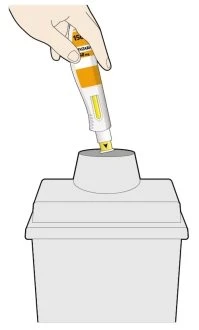
After use, place the pen in a sharps container. Always keep the container out of sight and reach of children. Ask your doctor, pharmacist, or nurse how to dispose of the container.
Medicines should not be disposed of via wastewater or household waste. Ask your pharmacist how to dispose of medicines you no longer need. This will help protect the environment.
6. Contents of the pack and other information
Composition of Kevzara
- The active substance is sarilumab. Each pre-filled pen contains 150 mg or 200 mg of sarilumab in 1.14 ml of solution.
- The other excipients are arginine, histidine, polysorbate 20 (E 432), sucrose, and water for injections.
Appearance of the product and contents of the pack
Kevzara is a clear, colourless to pale yellow injectable solution supplied in a pre-filled pen.
Each pre-filled pen contains 1.14 ml of solution providing a single dose. Kevzara is available in packs containing 1 or 2 pre-filled pens and multiple packs containing 3 packs, each with 2 pre-filled pens.
Only certain pack sizes may be marketed.
Kevzara is available as 150 mg or 200 mg pre-filled pens.
Marketing Authorization Holder
Sanofi Winthrop Industrie
82 avenue Raspail
94250 Gentilly
France
Manufacturer
Sanofi-Aventis Deutschland GmbH
Brüningstraße 50
Industriepark Höchst
65926 Frankfurt am Main
Germany
Genzyme Ireland Ltd.
IDA Industrial Park
Old Kilmeaden Road
Waterford
Ireland
For more information about this medicine, please contact the local representative of the Marketing Authorization Holder:
Belgium/Belgium/Belgium Sanofi Belgium Tel/Tel: +32 (0)2 710 54 00 | Lithuania Swixx Biopharma UAB Tel: +370 5 236 91 40 |
| Luxembourg/Luxembourg Sanofi Belgium Tel/Tel: +32 (0)2 710 54 00 (Belgium/Belgium) |
Czech Republic Sanofi s.r.o. Tel: +420 233 086 111 | Hungary SANOFI-AVENTIS Zrt. Tel.: +36 1 505 0050 |
Denmark Sanofi A/S Tlf: +45 45 16 70 00 | Malta Sanofi S.r.l. +39. 02 39394275 |
Germany Sanofi-Aventis Deutschland GmbH Telephone: 0800 04 36 996 Telephone from abroad: +49 69 305 70 13 | Netherlands Sanofi B.V. Tel: +31 20 245 4000 |
Estonia Swixx Biopharma OÜ Tel: +372 640 10 30 | Norway sanofi-aventis Norge AS Tlf: +47 67 10 71 00 |
Greece Sanofi-Aventis Μονοπρόσωπη AEBE Tel: +30 210 900 16 00 | Austria sanofi-aventis GmbH Tel: +43 1 80 185 – 0 |
Spain sanofi-aventis, S.A. Tel: +34 93 485 94 00 | Poland Sanofi Sp. z o.o. Tel.: +48 22 280 00 00 |
France Sanofi Winthrop Industrie Tel: 0 800 222 555 Call from abroad: +33 1 57 63 23 23 | Portugal Sanofi - Produtos Farmacêuticos, Lda Tel: +351 21 35 89 400 |
Croatia Swixx Biopharma d.o.o. Tel: +385 1 2078 500 | Romania Sanofi Romania SRL Tel: +40 (0) 21 317 31 36 |
Ireland sanofi-aventis Ireland Ltd. T/A SANOFI Tel: +353 (0) 1 403 56 00 | Slovenia Swixx Biopharma d.o.o. Tel: +386 1 235 51 00 |
Iceland Vistor ehf. Telephone: +354 535 7000 | Slovakia Swixx Biopharma s.r.o. Tel: +421 2 208 33 600 |
Italy Sanofi S.r.l. Tel: 800 536389 | Finland Sanofi Oy Tel: +358 (0) 201 200 300 |
Cyprus C.A. Papaellinas Ltd. Tel: +357 22 741741 | Sweden Sanofi AB Tel: +46 (0)8 634 50 00 |
Latvia Swixx Biopharma SIA Tel: +371 6 616 47 50 |
Date of the most recent review of this leaflet:
Detailed information on this medicine is available on the European Medicines Agency website: http://www.ema.europa.eu.
Kevzara 150 mg solution for injection in pre-filled pen
sarilumab
Instructions for use
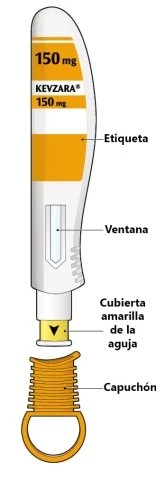
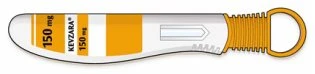
The parts of the Kevzara pre-filled pen are shown in this drawing.
Important information
This device is a single-dose pre-filled pen (referred to as “pen” in these instructions). It contains 150 mg of Kevzara for injection under the skin (subcutaneous injection) once every two weeks.
Ask your healthcare professional to show you how to correctly use the pen before your first injection.
What you should do
- Read all instructions carefully before using a pen.
- Check that you have the correct medicine and correct dose.
- Store unused pens in their original packaging and keep them in the refrigerator at a temperature between 2 °C and 8 °C.
- Store the pack in an insulated container with a cold pack when travelling.
- Allow the pen to reach room temperature for at least 60 minutes before using it.
- Use the pen within 14 days after removing it from the refrigerator or insulated container.
- Keep the pen out of sight and reach of children.
What you should not do
- Do not use the pen if it has been damaged or if the cap is missing or not securely attached.
- Do not remove the cap until you are ready for injection.
- Do not press or touch the yellow needle cover with your fingers.
- Do not attempt to re-cap the pen.
- Do not reuse the pen.
- Do not freeze or heat the pen.
- Once removed from the refrigerator, do not store the pen at temperatures above 25 °C.
- Do not expose the pen to direct sunlight.
- Do not inject through clothing.
If you have any further questions, consult your doctor, pharmacist, or nurse.
Step A: Preparation for injection
- Prepare all the equipment you will need on a clean, flat surface.
- You will need an alcohol swab, cotton ball or gauze, and a sharps container.
- Remove one pen from the pack by holding it in the middle of the pen body. Return any remaining pens to the pack and store them in the refrigerator.
- Check the label.
- Verify that you have the correct medicine and correct dose.
- Check the expiry date (EXP), which is shown on the side of the pens.
- Do not use the pen if it is expired.
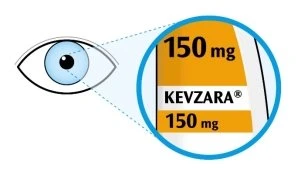
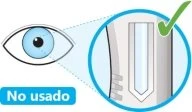
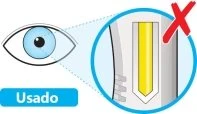
- Look at the viewing window.
- Check that the liquid is clear and colourless to pale yellow.
- You may see an air bubble, which is normal.
- Do not proceed with the injection if the liquid is cloudy, discoloured, or contains particles.
- Do not use the pen if the window appears solid yellow.
- Place the pen on a flat surface and allow it to reach room temperature (<25 °C) for at least 60 minutes.
- Using the pen at room temperature may make the injection more comfortable.
- Do not use the pen if it has been out of the refrigerator for more than 14 days.
- Do not heat the pen; allow it to warm naturally.
- Do not expose the pen to direct sunlight.

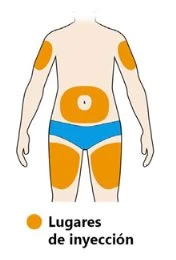
- Select the injection site.
- You may inject into your thigh or abdomen, except within 5 cm of your navel. If someone else is giving you the injection, the outer upper arm may also be used.
- Change the injection site each time you inject.
- Do not inject into sensitive, damaged, bruised, or scarred skin.
- Prepare the injection site.
- Wash your hands.
- Clean the skin with an alcohol swab.
- Do not touch the injection site again before injecting.
Step B: Perform the injection – Proceed to Step B only after completing Step A “Preparation for injection”
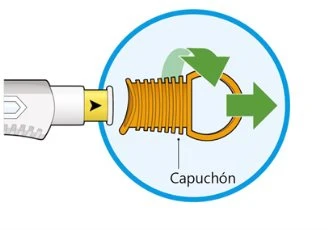
- Twist and remove the orange cap.
- Do not remove the cap until you are ready for injection.
- Do not press or touch the yellow needle cover with your fingers.
- Do not replace the cap.
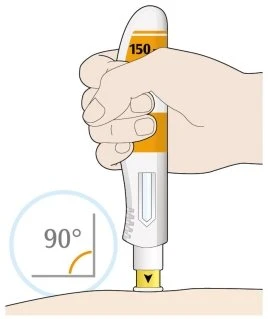
- Place the yellow needle cover against your skin at an angle of approximately 90 degrees.
- Make sure you can see the viewing window.
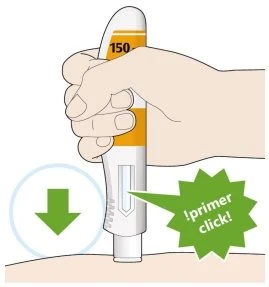
- Press down and hold the pen firmly against your skin.
- A “click” will be heard when the injection starts.
- Continue holding the pen firmly against your skin.
- The viewing window will begin to turn yellow.
- The injection may take up to 15 seconds (15 s).
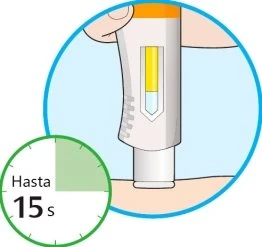
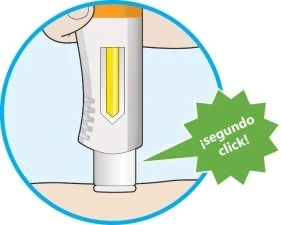
- A second “click” will be heard. Check that the entire viewing window has turned completely yellow before removing the pen.
- If you do not hear the second click, continue to observe whether the window turns completely yellow.
- If the window does not turn completely yellow, do not administer a second dose without speaking to your healthcare professional.
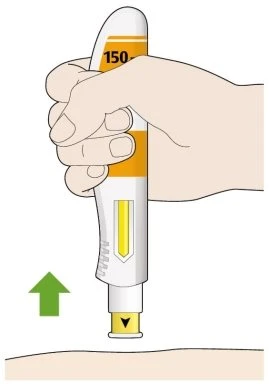
- Remove the pen from your skin.
- If you see any blood, press a cotton ball or gauze on the injection site.
- Do not rub the skin after the injection.
- Immediately place the used pen and cap into a sharps container.
- Always keep the container out of sight and reach of children.
- Do not re-cap the pen.
- Do not throw used pens into household waste.
- Do not dispose of the used sharps container in household waste unless permitted by local regulations. Ask your doctor, pharmacist, or nurse how to dispose of the container properly.