Kemadren 5 mg tablets
Spain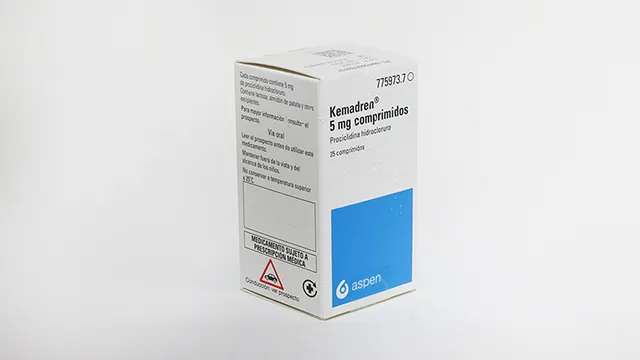
Table of Contents
Package leaflet: Information for the user
Introduction
Package leaflet: information for the patient
Kemadren 5 mg tablets
procyclidine hydrochloride
Read the entire leaflet carefully before you start taking this medicine, because it contains important information for you.
- Keep this leaflet, as you may need to read it again.
- If you have any questions, ask your doctor or pharmacist.
- This medicine has been prescribed only for you; do not give it to other people, even if they have the same symptoms as you, because it could harm them.
- If you experience any adverse effects, consult your doctor or pharmacist, even if they are adverse effects not listed in this leaflet. See section 4.
Contents of the leaflet
- What Kemadren is and what it is used for
- What you need to know before taking Kemadren
- How to take Kemadren
- Possible adverse effects
- How to store Kemadren
- Contents of the pack and other information
1. What Kemadren is and what it is used for
Kemadren contains an active substance called procyclidine hydrochloride. It belongs to a group of medicines known as anticholinergics.
This medicine works by counteracting a substance in the body called acetylcholine.
Kemadren is used for:
- Treating and relieving the symptoms of Parkinson's disease (such as muscle rigidity, paralysis, tremor, difficulty speaking, writing and walking, excessive saliva production and drooling, sweating, involuntary eye movements, and depression).
- Preventing side effects known as "extrapyramidal effects" caused by certain medicines. These may include symptoms similar to those produced by Parkinson's disease, as well as restlessness or unusual movements of the head and body.
2. What you need to know before starting to take Kemadren
Do not take Kemadren
- if you are allergic to procyclidine hydrochloride or to any of the other ingredients of this medicine (listed in section 6),
- if you have a condition caused by increased pressure in the eye called closed-angle glaucoma,
- if you have difficulty urinating (retention),
- if you suffer from constipation.
Do not take Kemadren if you have any of the above conditions. If you are unsure, consult your doctor before starting to take Kemadren.
Warnings and precautions
Talk to your doctor or pharmacist before taking Kemadren if:
- you have an enlarged prostate,
- you have a mental illness and are taking Kemadren to control side effects of other medicines. Occasionally, some people taking this medicine may experience a psychotic episode,
- if you are elderly, you should carefully monitor the dose to avoid side effects,
- if you have any liver or kidney disease,
- if you are at risk of developing glaucoma (a group of diseases that damage the optic nerve),
- if you are prone to conditions that obstruct the gastrointestinal tract (complete or partial obstruction of either the small or large intestine),
- some patients taking Kemadren to control side effects of other medicines may experience involuntary repetitive body movements. If this occurs, your doctor may decide to reduce the dose.
If you are unsure whether any of the above applies to you, consult your doctor or pharmacist before starting to take Kemadren.
Children
This medicine is not suitable for use in children.
Taking Kemadren with other medicines
Tell your doctor or pharmacist if you are taking, have recently taken, or might need to take any other medicines, including those obtained without a prescription and/or herbal remedies, before taking Kemadren.
In particular, inform your doctor if you are taking any of the following medicines:
- Medicines used to treat mental illnesses, for example monoamine oxidase inhibitors, tricyclic antidepressants, paroxetine, clozapine, or phenothiazines.
- Medicines used to treat dementia, including Alzheimer's disease (such as memantine or tacrine).
- Antihistamines used to treat hay fever and allergies.
- Disopyramide, quinine, and nitrate tablets (including sublingual tablets) used to treat heart problems.
- Levodopa and amantadine used in Parkinson's disease.
- Cisapride, domperidone, and metoclopramide used to treat nausea, vomiting, and indigestion.
- Nefopam, used to treat pain.
- Ketoconazole, used to treat fungal infections.
- If you are taking medicines to treat psychosis, such as chlorpromazine in combination with Kemadren, you should be aware that this medicine may cause fever if you travel to a tropical (hot and humid) climate.
Pregnancy and breastfeeding
If you are pregnant or breastfeeding, think you may be pregnant, or plan to become pregnant, consult your doctor or pharmacist before using this medicine.
Driving and using machines
Taking Kemadren may cause blurred vision, dizziness, confusion, or disorientation. If this occurs, do not drive, operate tools, or use machinery.
Kemadren contains lactose
If your doctor has informed you of an intolerance to certain sugars, consult with him before taking this medicine.
Kemadren contains sodium
This medicine contains less than 1 mmol of sodium (23 mg) per tablet; that is, essentially “sodium-free”.
3. How to take Kemadren
Follow exactly the instructions given by your doctor for taking this medicine. If in doubt, consult your doctor or pharmacist again.
- Take the tablets with a glass of water.
- You may take Kemadren at any time of day, with or without food. Some people feel less dizzy if they take it with meals.
- The tablet may be divided into equal doses.
In the treatment of Parkinson's disease
- The recommended starting dose is half a tablet three times a day.
- Your doctor may increase the dose by adding half or one tablet per day until an effect is achieved. This is known as the maintenance dose.
- The usual maintenance dose is 15–30 mg (3 to 6 tablets) per day.
- The maximum dose your doctor may prescribe is 60 mg (twelve tablets) per day.
- Although the dose is usually taken three times a day, your doctor may ask you to take a fourth dose before going to bed.
In the treatment of uncontrolled body movements (extrapyramidal symptoms) caused by taking other medications:
- The recommended starting dose is half a tablet three times a day.
- Your doctor may increase the dose by adding half a tablet per day until an effect is achieved. The usual daily maintenance dose is 10–30 mg (between 2 and 6 tablets).
- Your doctor may decide to stop your treatment with Kemadren after 3–4 months to see whether your side effects persist.
- If you need to take Kemadren for a longer period, your doctor may decide to interrupt treatment from time to time.
Elderly patients
Careful dose monitoring is necessary in elderly patients to avoid side effects.
Use in children
Kemadren tablets are generally not recommended for use in children.
If you take more Kemadren than you should
If you take more than you should, consult your doctor or go to a hospital immediately. Take the medicine pack with you.
In case of overdose or accidental ingestion, contact your doctor or pharmacist immediately or call the Toxicology Information Service at 91 562 04 20, indicating the medicine and the amount ingested.
If you forget to take Kemadren
If you forget to take a dose, take it as soon as possible. Do not take a double dose to make up for forgotten doses. Take the next dose at the usual time. If you have trouble remembering to take the tablets, inform your doctor or pharmacist.
If you stop taking Kemadren
Do not stop taking Kemadren without consulting your doctor.
If you have any further questions about the use of this medicine, ask your doctor or pharmacist.
4. Possible adverse effects
Like all medicines, this medicine can cause adverse effects, although not everyone will experience them. The following adverse effects may occur with this medicine.
If you are taking a medicine for a mental illness (called a neuroleptic) at the same time as Kemadren:
- You may develop uncontrollable movements of the face and tongue (called tardive dyskinesia). It may be necessary to adjust the dose of either of your medicines.
- Unusual body movements, especially in the hands, arms, and legs, that you already had while taking the medicine for your mental illness, and which may be worsened by taking Kemadren.
If any of these occur, inform your doctor immediately.
Frequent (may affect up to 1 in 10 patients):
- Urinary problems (urinary retention)
- Blurred vision
- Dry mouth
- Constipation
Uncommon (may affect up to 1 in 100 patients):
- Nausea or vomiting
- Swelling of the gums (gingivitis)
- Dizziness, nervousness, confusion, disorientation, decreased concentration or memory, hearing voices or seeing unexpected things (hallucinations), anxiety, agitation (irritability)
- Skin rashes
Rare (may affect up to 1 in 1,000 patients):
- "Psychotic disorder", which includes symptoms occurring together such as: dizziness, confusion, decreased concentration or memory, disorientation, hearing voices or seeing unexpected things (hallucinations), anxiety, agitation (irritability).
If you consider any of the adverse effects you experience to be severe, even if they are adverse effects not listed in this leaflet, inform your doctor or pharmacist.
Reporting of adverse effects
If you experience any type of adverse effect, consult your doctor, pharmacist, or nurse, even if they are possible adverse effects not listed in this leaflet. You may also report them directly through the Spanish Pharmacovigilance System for Human Medicinal Products: https://www.notificaram.es. By reporting adverse effects, you can help provide more information on the safety of this medicine.
5. Storage of Kemadren
- Keep this medicine out of the sight and reach of children.
- Do not store at temperatures above 25 °C.
- Do not use this medicine after the expiry date stated on the packaging after EXP. The expiry date refers to the last day of the month indicated.
- .
- Medicines must not be disposed of via wastewater or household waste. Dispose of unused medicines and their containers at the SIGRE Point in your pharmacy. If you are unsure, ask your pharmacist how to properly dispose of unused medicines and their packaging. This helps protect the environment.
6. Contents of the pack and other information
Composition of Kemadren
The active substance is procyclidine hydrochloride. Each tablet contains 5 mg of the active substance.
The other components are: monohydrate lactose, sodium starch glycolate from potato (type A), povidone, and magnesium stearate.
Appearance of the product and contents of the container
Kemadren 5 mg tablets are white, round, biconvex tablets with a break line on one side, engraved with "KT" above the break line and "05" below the break line, and a notch on the other side. They are supplied in amber glass bottles with a polyethylene press-seal cap containing 25 tablets.
Marketing Authorisation Holder and Manufacturer
Marketing Authorisation Holder
Aspen Pharma Trading Limited
3016 Lake Drive
Citywest Business Campus
Dublin 24, Ireland
Tel: +34 952010137
Manufacturer
Aspen Bad Oldesloe GmbH
Industriestrasse 32-36
23843 Bad Oldesloe
Germany
Local Representative
Aspen Pharmacare España S.L.
Avenida Diagonal, 512
Planta Interior 1, Oficina 4
08006 Barcelona
Spain
Date of the most recent revision of this summary: 02/2023
Detailed and up-to-date information on this medicine is available on the website of the Spanish Agency for Medicines and Health Products (AEMPS) http://www.aemps.gob.es