Kanova Niños 2,25 g rectal solution
Spain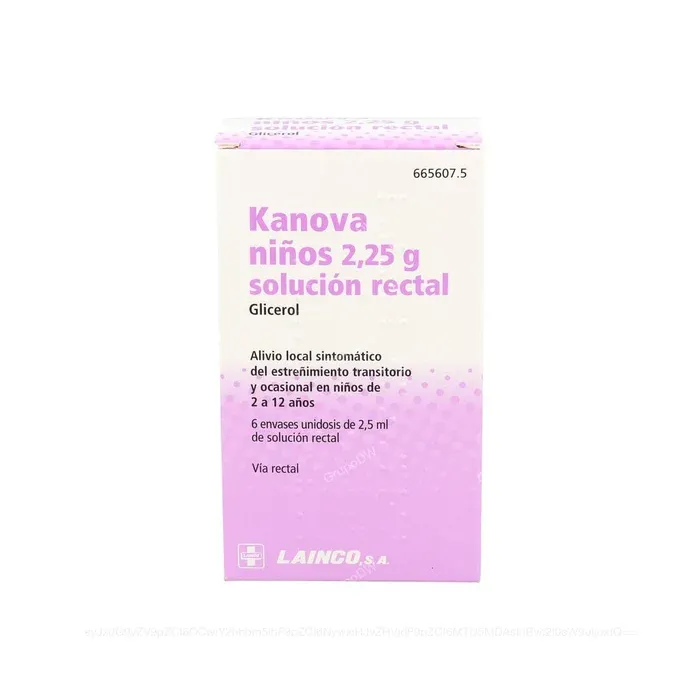
Table of Contents
Package leaflet: Information for the user
Introduction
Package leaflet: information for the user
Kanova niños 2.25 g rectal solution
Glycerol
Read the entire leaflet carefully before you start using this medicine, as it contains important information for you.
Follow exactly the instructions for administering this medicine as described in this leaflet or as indicated by your doctor or pharmacist.
- Keep this leaflet, as you may need to read it again.
- If you need advice or further information, consult your pharmacist.
- If you experience any adverse reactions, consult your doctor or pharmacist, even if they are adverse reactions not listed in this leaflet. See section 4.
- You should consult a doctor if your condition worsens or does not improve after 7 days of treatment.
Contents of the leaflet
- What Kanova niños is and what it is used for
- What you need to know before using Kanova niños
- How to use Kanova niños
- Possible adverse effects
- How to store Kanova niños
- Contents of the pack and other information
1. What Kanova niños is and what it is used for
Glycerol, the active ingredient in this medicine, is a laxative administered by rectal route. The laxative effect is achieved due to glycerol's ability to soften the stool, which, together with a mild local irritant action, stimulates intestinal movements.
It is indicated for the local symptomatic relief of transient and occasional constipation in children aged 2 to 12 years.
You should consult a doctor if symptoms worsen or do not improve after 7 days of treatment.
2. What you need to know before using Kanova niños
Do not use Kanova niños
- If you are allergic (hypersensitive) to glycerol or to any of the other components of this medicine (listed in section 6).
- If you have any anorectal disease, ulcerative colitis (a type of chronic intestinal inflammation), or inflamed hemorrhoids.
- If you have cramps, colic, nausea, vomiting, or other signs of appendicitis, intestinal obstruction, acute inflammatory bowel diseases, or, in general, any abdominal pain of unknown cause.
- In children under 2 years of age.
Warnings and precautions
Consult your doctor or pharmacist before starting to use Kanova niños.
- If blood appears in the stool, or if irritation, pain, or lack of improvement occurs, discontinue treatment and consult your doctor.
- Do not use this medicine for more than 7 consecutive days unless otherwise directed by your doctor.
- This medicine should be used only under strict medical supervision in patients with serious diseases, especially cardiovascular conditions (related to the heart or blood vessels).
Children
Kanova niños is contraindicated in children under 2 years of age.
Use of Kanova niños with other medicines
Inform your doctor or pharmacist if you are taking, have recently taken, or might need to take any other medicines.
Use of Kanova niños with food and drink
Food and drink do not affect the effectiveness of this medicine.
Pregnancy, breastfeeding, and fertility
If you are pregnant or breastfeeding, think you may be pregnant, or are planning to become pregnant, consult your doctor or pharmacist before using this medicine.
Driving and using machines
This medicine does not affect your ability to drive or operate machinery.
3. How to use Kanova niños
Follow exactly the administration instructions provided in this leaflet or those given by your doctor or pharmacist. If in doubt, consult your doctor or pharmacist.
Recommended dose:
Children aged 2 to 12 years: 1 single-dose container per day, as needed, or as prescribed by the doctor.
This medicine is for rectal use only; do not swallow it.
Instructions for correct administration:
At the time chosen for administration, after removing the cap covering the end of the container shaped like a cannula, place it vertically with the tip facing upwards and gently squeeze it so that a few drops of Kanova niños moisten the tip of the cannula, to facilitate its insertion into the rectum. Once inserted into the rectum, press the container until all its contents are completely emptied, then gently withdraw it without stopping pressure on its walls.
Delay evacuation, keeping the buttocks tightly clenched, for as long as possible to allow the medicine to exert its full effect.
Even if some residue remains in the container after administration, the recommended dose has been delivered. Each single-dose container must be used only once. It must be discarded after use.
If resistance is encountered during administration, stop the procedure, as it could be harmful, and consult your doctor.
If symptoms do not improve within 7 days, discontinue treatment and consult your doctor.
If you use more Kanova niños than you should
Cases of intoxication are unlikely due to the route of administration.
Abuse or prolonged use of this medicine may lead to a condition resembling irritable bowel syndrome (symptoms or discomfort such as alternating constipation and diarrhea, intestinal spasms, bloating, nausea, and gas).
In case of overdose or accidental ingestion, consult your doctor, pharmacist, or call the Toxicology Information Service immediately at telephone number 91.562.04.20, indicating the name of the medicine and the amount ingested.
4. Possible adverse effects
Like all medicines, this medicine may produce adverse effects, although not everyone will experience them.
During the period of use of glycerol in rectal solution as a laxative, the following adverse effects have been observed with unknown frequency (cannot be estimated from the available data): itching, pain, and irritation of the anus.
Very rare adverse reactions (may affect up to 1 in 10,000 patients):
Allergic reactions to chamomile (e.g. contact dermatitis). In patients allergic to plants of the same family, cross-reactions may occur. After internal use, these reactions could be severe and might include swelling of the face, lips, mouth, tongue, or throat, causing difficulty in swallowing or breathing.
Reporting of adverse effects:
If you experience any type of adverse effect, consult your doctor or pharmacist, even if it is a possible adverse effect not listed in this leaflet. You can also report them directly via the Spanish Pharmacovigilance System for Human Medicines: https://www.notificaram.es. By reporting adverse effects, you can help provide more information on the safety of this medicine.
5. Storage of Kanova niños
Keep this medicine out of the sight and reach of children.
No special storage conditions are required.
Do not use this medicine after the expiry date stated on the packaging after EXP. The expiry date is the last day of the month indicated.
Medicines should not be disposed of via wastewater or household waste. Dispose of empty containers and unused medicines at the SIGRE collection point at your pharmacy. If you are in doubt, ask your pharmacist how to dispose of medicines and containers you no longer need. This will help protect the environment.
6. Contents of the pack and other information
Composition of Kanova niños
- The active substance is glycerol. Each single-dose container contains 2.25 g of glycerol.
- The other components (excipients) are: Malva flower fluid extract, Matricaria chamomilla fluid extract, sodium carmellose, and purified water.
Appearance of the medicinal product and contents of the container
It is a clear, yellowish solution. It is supplied in single-dose 2.5 ml polyethylene containers with a cannula-shaped tip and closure cap, packed in cartons containing 6 or 12 single-dose containers. A clinical pack containing 200 single-dose containers is also available.
Only certain pack sizes may be marketed.
Other presentations
Kanova adultos 6.75 g rectal solution: Packaged in cartons containing 6 or 12 single-dose containers and clinical packs containing 200 single-dose containers.
Marketing Authorization Holder and Manufacturer:
LAINCO, S.A. Avda. Bizet, 8-12 08191 Rubí (Barcelona)
Date of the most recent review of this leaflet: July 2010
Other sources of information
Detailed and up-to-date information on this medicinal product is available on the website of the Spanish Agency for Medicines and Health Products (AEMPS) (http://www.aemps.gob.es/)