Kaloba film-coated tablets
Spain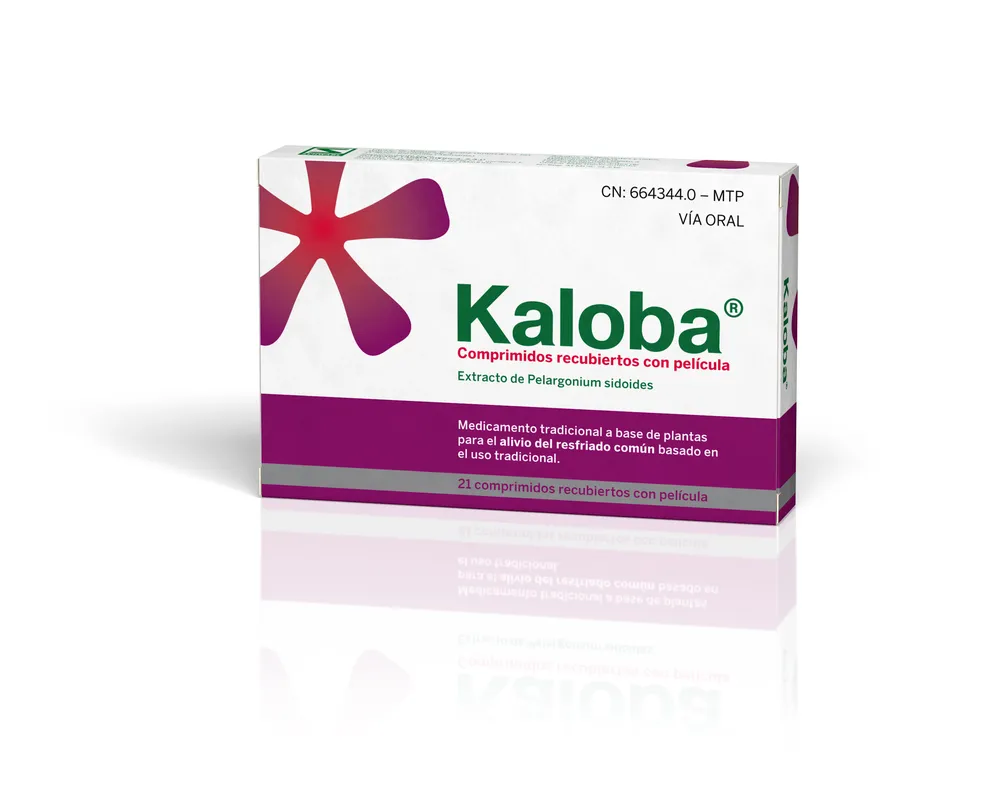
Table of Contents
- Package leaflet: Information for the user
- Introduction
- 1. What KALOBA tablets are and what they are used for
- 2. What you need to know before starting to take KALOBA tablets
- ***Do not take KALOBA tablets:***
- ***Warnings and precautions***
- 3. How to take KALOBA tablets
- 4. Possible adverse effects
- 5. Storage of KALOBA tablets
- 6. Contents of the pack and other information
Package leaflet: Information for the user
Introduction
Package leaflet: information for the patient
KALOBA?
Film-coated tablets
Pelargonium sidoides extract
Read the entire leaflet carefully before you start taking this medicine, because it contains important information for you.
Follow exactly the instructions for use of this medicine contained in this leaflet or as indicated by your doctor or pharmacist.
- Keep this leaflet, as you may need to read it again.
- If you need advice or more information, consult your pharmacist.
- If you experience any adverse effects, consult your doctor or pharmacist, even if they are adverse effects not listed in this leaflet. See section 4.
- You should consult a doctor if you worsen or do not improve after 7 days.
Contents of the leaflet
- What KALOBA tablets are and what they are used for
- What you need to know before taking KALOBA tablets
- How to take KALOBA tablets
- Possible adverse effects
- Storage of KALOBA tablets
- Contents of the pack and other information
1. What KALOBA tablets are and what they are used for
KALOBA tablets are film-coated tablets containing 20 mg of dried (liquid) extract from the root of Pelargonium sidoides DC (1:8-10) EPs® 7630. Extraction agent: Ethanol 11% (m/m).
Therapeutic indications:
KALOBA tablets are a traditional herbal medicinal product for the relief of the common cold, based on traditional use.
This medicine is intended for use in adults, adolescents, and children over 6 years of age.
It belongs to the pharmacotherapeutic group of medicines for the common cold.
2. What you need to know before starting to take KALOBA tablets
Do not take KALOBA tablets:
- If you are allergic (hypersensitive) to Pelargonium sidoides extract or to any of the ingredients of KALOBA tablets (see section 6).
- You should not take KALOBA coated tablets if you have severe liver disease.
Warnings and precautions
Consult your doctor or pharmacist before starting to take KALOBA tablets.
If symptoms do not improve or worsen after 1 week of treatment, or if you develop fever over several days, hepatic dysfunction of various origins, difficulty breathing, or bloody sputum, stop treatment and consult your doctor immediately.
Children
This medicine must not be given to children under 6 years of age.
Use of KALOBA tablets with other medicines
No interactions with other medicines are known.
Inform your doctor or pharmacist if you are taking, have recently taken, or might need to take any other medicines, including those obtained without a prescription.
Pregnancy and breastfeeding
KALOBA coated tablets must not be taken during pregnancy and breastfeeding due to insufficient data on the use of this medicine under these conditions.
Important for women |
If you are pregnant or breastfeeding, think you may be pregnant or are planning to become pregnant, consult your doctor or pharmacist before taking this medicine. |
Driving and using machines
It is unlikely that KALOBA tablets will affect your ability to drive or operate machinery.
KALOBA tablets contain monohydrate lactose.
If your doctor has informed you of an intolerance to certain sugars, consult your doctor before taking this medicine. Each tablet contains 20 mg of monohydrate lactose.
3. How to take KALOBA tablets
Follow exactly the instructions for use provided in this leaflet or those indicated by your doctor or pharmacist. If in doubt, ask your doctor or pharmacist.
KALOBA tablets are intended for oral use.
Unless otherwise prescribed by your doctor, the daily dosage is as follows:
- Adults and adolescents over 12 years of age: 1 tablet, 3 times daily (breakfast, lunch, and dinner).
- Children from 6 to 12 years of age: 1 tablet, 2 times daily (breakfast and dinner).
The tablets should be swallowed with liquid (preferably a glass of water). Do not take the tablets while lying down.
How long should you take KALOBA tablets
The recommended duration of treatment is 7 days. The treatment may be continued for an additional 2–3 days to prevent relapses. The treatment should not exceed a maximum of 2 weeks.
If you take more KALOBA tablets than you should
Symptoms of overdose have not been reported to date.
If you forget to take KALOBA tablets
Do not take a double dose to make up for missed doses, but continue treatment with KALOBA coated tablets as indicated in this leaflet or prescribed by your doctor.
If you have any questions about the use of this medicine, ask your doctor or pharmacist.
4. Possible adverse effects
Like all medicines, this medicine may have adverse effects, although not everyone experiences them.
The following list of adverse effects includes all reactions that have occurred during treatment with KALOBA tablets.
Uncommon side effects (affect more than 1 in 1,000 people treated but less than 1 in 100): Gastrointestinal problems such as stomach pain, burning sensation, nausea, or diarrhoea may occur. |
Rare side effects (affect more than 1 in 10,000 people treated but less than 1 in 1,000):
|
Very rare cases (affect one or fewer in 10,000 people treated): serious hypersensitivity reactions may occur, including facial swelling, difficulty breathing, and drop in blood pressure. |
Frequency unknown: Liver dysfunction of various origins. A causal relationship between this observation and the use of the product has not been established. |
Reporting of adverse reactions
If you experience any type of adverse reaction, consult your doctor or pharmacist, even if it is a possible adverse reaction not listed in this leaflet. You may also report them directly through the Spanish Pharmacovigilance System for Human Medicinal Products: http://www.notificaram.es. By reporting adverse reactions, you can help provide more information on the safety of this medicine.
5. Storage of KALOBA tablets
Keep this medicine out of sight and reach of children.
Do not use KALOBA tablets after the expiry date which is stated on the carton and on the blister after Exp.:. The expiry date corresponds to the last day of the month indicated.
No special storage conditions are required.
Medicines must not be disposed of via wastewater or household waste. Dispose of empty containers and unused medicines at the SIGRE collection point at your pharmacy. If in doubt, ask your pharmacist how to properly dispose of unused containers and medicines. This way, you will help protect the environment.
6. Contents of the pack and other information
Composition of KALOBA film-coated tablets:
The active substance is 20 mg of dried liquid extract from the root of Pelargonium sidoides DC (1:8-10) (EPs® 7630). The extraction agent is ethanol 11% (m/m).
The other components (excipients) are: microcrystalline cellulose; sodium croscarmellose; hypromellose; iron oxide red E 172; lactose monohydrate; macrogol 1500; magnesium stearate; maltodextrin; α-octadecyl-ω-hydroxypoly(ethylene oxide)-5; anhydrous colloidal silica; precipitated silica; dimethicone; sorbic acid; talc.
Appearance of the product and contents of the pack
KALOBA film-coated tablets are packaged in blisters and are available in boxes containing 21, 42, and 63 tablets. Not all pack sizes may be marketed.
Marketing Authorization Holder and Manufacturer
Dr. Willmar Schwabe GmbH & Co. KG
Willmar-Schwabe-Straße 4
76227 Karlsruhe / Germany
Further information on this medicinal product is available from the local representative of the Marketing Authorization Holder:
SCHWABE FARMA IBÉRICA, S.A.U.
Avenida de la Industria, 4. Building 2, staircase 1, 2nd floor.
28108 Alcobendas, Madrid
Date of the most recent review of this leaflet: May 2025.
Detailed and up-to-date information on this medicinal product is available on the website of the Spanish Agency of Medicines and Health Products (AEMPS) http://www.aemps.es/.