Kaftrio 37.5 mg/25 mg/50 mg film-coated tablets
Spain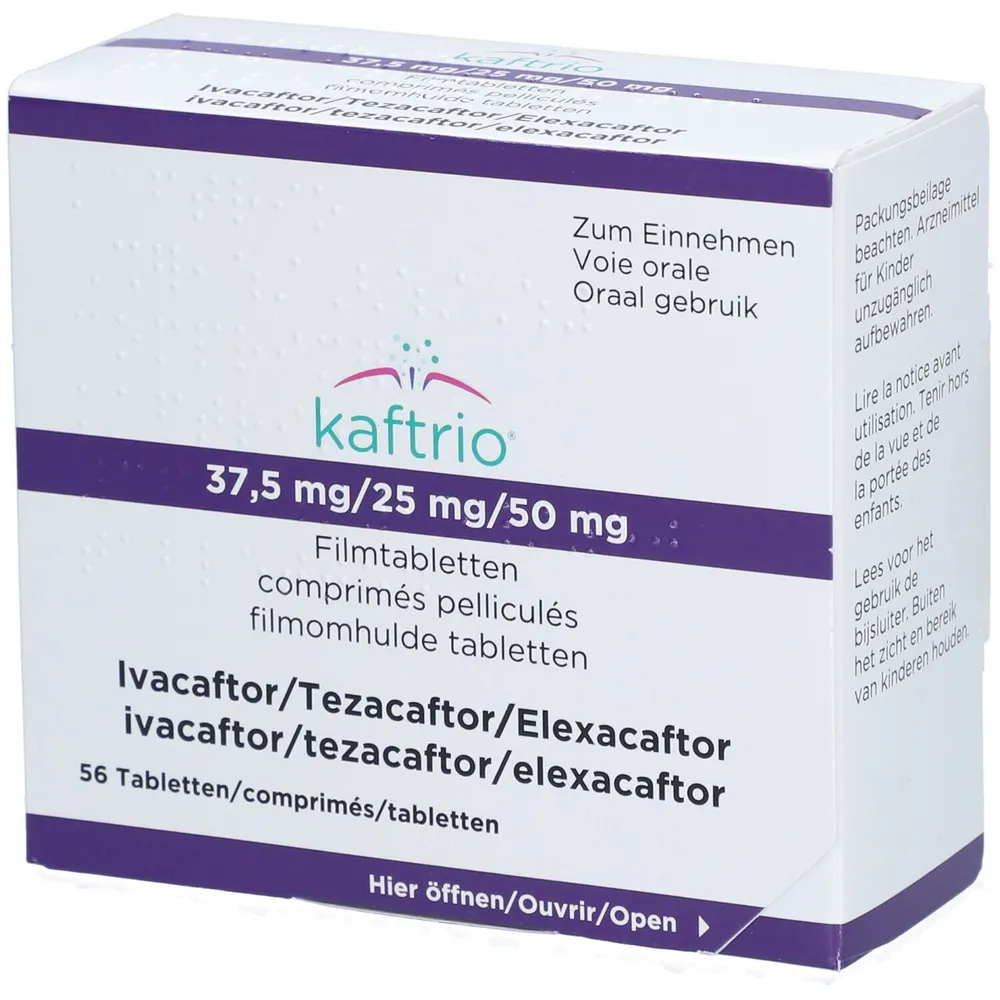
Table of Contents
Patient Information Leaflet
Introduction
Patient Information Leaflet
Kaftrio 37.5mg/25mg/50mg film-coated tablets
Kaftrio 75mg/50mg/100mg film-coated tablets
ivacaftor/tezacaftor/elexacaftor
Read the entire leaflet carefully before you start taking this medicine, as it contains important information for you.
- Keep this leaflet as you may need to read it again.
- If you have any questions, ask your doctor or pharmacist.
- This medicine has been prescribed for you only, and you should not give it to other people, even if they have the same symptoms as you, because it may harm them.
- If you experience any adverse reactions, consult your doctor or pharmacist, even if they are adverse reactions not listed in this leaflet. See section 4.
Leaflet Contents
- What Kaftrio is and what it is used for
- What you need to know before taking Kaftrio
- How to take Kaftrio
- Possible side effects
- How to store Kaftrio
- Contents of the pack and other information
1. What Kaftrio is and what it is used for
Kaftrio contains three active substances: ivacaftor, tezacaftor and elexacaftor. This medicine helps lung cells work better in some patients with cystic fibrosis (CF). CF is an inherited condition in which the lungs and digestive system can become clogged with thick, sticky mucus.
Kaftrio taken with ivacaftor is for patients aged 6 years and older who have CF with at least one mutation in the CFTR (cystic fibrosis transmembrane conductance regulator) gene that responds to Kaftrio. The medicine is intended as a long-term treatment.
Kaftrio acts on a protein called CFTR. This protein is defective in some people with CF if they have a mutation in the CFTR gene.
Kaftrio is usually taken with another medicine, ivacaftor. Ivacaftor improves the function of the protein, while tezacaftor and elexacaftor increase the amount of protein at the cell surface.
Kaftrio (taken together with ivacaftor) helps your breathing by improving your lung function. You may also notice that you do not get sick as often or that it is easier to gain weight.
2. What you need to know before taking Kaftrio
Do not take Kaftrio
- if you are allergic to ivacaftor, tezacaftor, elexacaftor or to any of the other components of this medicine (listed in section 6).
Consult your doctor and do not take the tablets if this applies to you.
Warnings and precautions
-
Consult your doctor if you have liver problems or have had them in the past. Your doctor may need to adjust your dose (see section 4).
-
Your doctor will carry out some blood tests to check your liver function before and during treatment with Kaftrio, especially if previous blood tests showed elevated liver enzymes. Liver enzymes in the blood may increase in patients receiving Kaftrio.
Tell your doctor immediately if you experience any symptoms indicating liver problems. These are listed in section 4.
- Depression (including suicidal thoughts, changes in behaviour, anxiety, and sleep disorders) has been reported in patients taking Kaftrio, usually beginning within the first three months of treatment. Contact your doctor immediately if you (or someone taking this medicine) experience any of the following symptoms, which may be signs of depression: sadness or mood changes, anxiety, feelings of emotional distress, or thoughts of self-harm or suicide, and/or difficulty sleeping (see section 4).
Consult your doctor if you notice changes in your child's behaviour during the first 2 months of treatment.
-
Consult your doctor if you have kidney problems or have had them in the past.
-
If you have two class I mutations (mutations known not to produce the CFTR protein), you should not take Kaftrio, as a response to this medicine is not expected.
-
Consult your doctor before starting treatment with Kaftrio if you have received an organ transplant.
-
Consult your doctor if you are using hormonal contraceptives, for example, women taking oral contraceptive pills. This may increase your likelihood of developing a skin rash while taking Kaftrio.
-
Your doctor may perform eye examinations before and during treatment with Kaftrio. In some children and adolescents taking this treatment, lens opacities (cataracts) have occurred without affecting vision.
Children under 6 years of age
Do not give this medicine to children under 6 years of age, as it is unknown whether Kaftrio tablets are safe and effective in this age group.
Other medicines and Kaftrio
Tell your doctor or pharmacist if you are taking, have recently taken, or might need to take any other medicines. Some medicines may affect how Kaftrio works or may increase the likelihood of experiencing side effects. In particular, consult your doctor if you are taking any of the medicines listed below. Your doctor may adjust the dose of one of the medicines if you are taking any of these.
- Antifungals (used to treat infections caused by fungi). These include fluconazole, itraconazole, ketoconazole, posaconazole and voriconazole.
- Antibiotics (used to treat infections caused by bacteria). These include clarithromycin, erythromycin, rifampicin, rifabutin and telithromycin.
- Medicines for epilepsy (used to treat seizures or epileptic fits). These include carbamazepine, phenobarbital and phenytoin.
- Herbal medicines. These include St John’s wort (Hypericum perforatum).
- Immunosuppressants (used after organ transplantation). These include ciclosporin, everolimus, sirolimus and tacrolimus.
- Cardiac glycosides (used to treat certain heart conditions). These include digoxin.
- Anticoagulants (used to prevent blood clots). These include warfarin.
- Medicines for diabetes. These include glimepiride, glipizide, glibenclamide, nateglinide and repaglinide.
- Medicines to lower blood cholesterol. These include pitavastatin and rosuvastatin.
- Medicines to lower blood pressure. These include verapamil.
Taking Kaftrio with food and drink
Avoid foods or drinks containing grapefruit during treatment, as they may increase the adverse effects of Kaftrio by increasing the amount of Kaftrio in the body.
Pregnancy and breastfeeding
- Consult your doctor before using this medicine if you are pregnant or breastfeeding, think you may be pregnant, or plan to become pregnant.
- Pregnancy: it may be preferable to avoid using this medicine during pregnancy. Your doctor will help you decide what is best for you and your baby.
- Breastfeeding: ivacaftor, tezacaftor and elexacaftor have been detected in breastfed infants. Your doctor will consider the benefits of breastfeeding for your baby and the benefits of treatment for you to help you decide whether to discontinue breastfeeding or discontinue treatment.
Driving and using machines
Kaftrio may cause dizziness. If you feel dizzy, do not drive, ride a bicycle, or use machines unless you are certain it does not affect you.
Kaftrio contains sodium
This medicine contains less than 23 mg of sodium (1 mmol) per dose unit; this is essentially “sodium-free”.
3. How to take Kaftrio
Follow exactly the instructions for administration of this medicine given by your doctor or pharmacist. If in doubt, consult your doctor or pharmacist again.
Your doctor will determine the correct dose for you.
Kaftrio is usually taken with ivacaftor.
Recommended dose for patients aged 6 years and older
Age | Weight | Morning dose | Evening dose |
6 years to <12 years | <30 kg | Two tablets of 37.5 mg ivacaftor/25 mg tezacaftor/50 mg elexacaftor | One tablet of 75 mg ivacaftor |
6 years to <12 years | ≥30 kg | Two tablets of 75 mg ivacaftor/50 mg tezacaftor/100 mg elexacaftor | One tablet of 150 mg ivacaftor |
12 years and older | - | Two tablets of 75 mg ivacaftor/50 mg tezacaftor/100 mg elexacaftor | One tablet of 150 mg ivacaftor |
Take the morning and evening tablets approximately 12 hours apart.
The tablets are taken orally.
Take Kaftrio and ivacaftor tablets with food containing fat. Meals or snacks containing fat include those prepared with butter or oils, or those containing eggs. Examples of other foods containing fat are:
- Cheese, whole milk, full-fat dairy products, yoghurt, chocolate
- Meats, fatty fish
- Avocado, hummus (chickpea purée), soy-based products (tofu)
- Nuts, nutritional bars or nutritional drinks containing fat
Avoid grapefruit-containing meals and beverages while taking Kaftrio. See Taking Kaftrio with food and drink in section 2 for more information.
Swallow the tablets whole. Do not chew, crush, or break the tablets before swallowing.
You must continue taking all other medications unless your doctor tells you to stop.
If you have liver problems, either moderate or severe, your doctor may reduce your tablet dose or decide to stop your Kaftrio treatment. See Warnings and precautions in section 2.
If you take more Kaftrio than you should
Consult your doctor or pharmacist. If possible, bring the medicine and this leaflet with you. You may experience adverse effects, including those listed in section 4 below.
If you forget to take Kaftrio
If you miss a dose, calculate how much time has passed since the time you were supposed to take it.
-
If less than 6 hours have passed since the time you should have taken the dose, either in the morning or evening, take the missed tablet(s) as soon as possible. Then continue with your regular schedule.
-
If more than 6 hours have passed:
- If you missed a morning dose of Kaftrio, take it as soon as you remember. Do not take the evening ivacaftor dose. Take the next morning dose at the usual time.
- If you forgot an evening dose of ivacaftor, do not take the missed dose. Wait until the next day and take the morning dose of Kaftrio at the usual time.
Do not take a double dose to make up for missed tablets.
If you stop taking Kaftrio
Your doctor will advise you on how long you need to take Kaftrio. It is important to take this medicine consistently. Do not make any changes unless instructed by your doctor.
If you have any further questions about the use of this medicine, ask your doctor or pharmacist.
4. Possible adverse effects
Like all medicines, this medicine can cause adverse effects, although not everyone will experience them.
Serious adverse effects:
Possible signs of liver problems
Liver damage and worsening of liver function in people with or without liver disease. Worsening of liver function can be severe and may require a liver transplant (see section 2).
Increased liver enzymes in the blood are very common in patients treated with Kaftrio. The following may be signs of liver problems:
- Pain or discomfort in the upper right part of the stomach (abdominal area).
- Yellowing of the skin or whites of the eyes.
- Loss of appetite.
- Nausea or vomiting.
- Dark-colored urine.
Depression. Signs include sadness or mood changes, anxiety, and emotional discomfort (see section 2).
Contact your doctor immediately if you experience any of these symptoms.
Very common adverse effects (may affect more than 1 in 10 people)
- Rash (more common in children and women than in men).
Contact your doctor immediately if you develop a rash.
Other adverse effects:
Very common (may affect more than 1 in 10 people)
- Headache.
- Dizziness.
- Upper respiratory tract infection (common cold).
- Oropharyngeal pain (sore throat).
- Nasal congestion.
- Stomach or abdominal pain.
- Diarrhea.
- Increased liver enzymes (signs of liver stress).
- Changes in the types of bacteria in mucus.
- Increased creatine phosphokinase (sign of muscle breakdown), observed in blood tests.
Common (may affect up to 1 in 10 people)
- Influenza (flu).
- Abnormal breathing (shortness of breath or difficulty breathing).
- Low blood sugar level (hypoglycemia).
- Runny nose.
- Sinus problems (sinus congestion).
- Redness or soreness of the throat.
- Ear problems: ear pain or discomfort, ringing in the ears, inflamed eardrum.
- Sensation of spinning (inner ear disorder).
- Flatulence.
- Acne.
- Itching of the skin.
- Lump in the breast.
- Nausea.
Uncommon (may affect up to 1 in 100 people)
- Breast or nipple problems: swelling, pain.
- Enlargement of the breasts in males.
- Increases in blood pressure.
- Wheezing.
- Ear blockage (ear congestion).
Frequency not known (cannot be estimated from available data)
- Allergic reactions (hypersensitivity).
- Liver damage (hepatic injury).
- Increased bilirubin (liver blood test).
- Changes in behavior.
Additional adverse effects in adolescents
Adverse effects observed in adolescents are similar to those observed in adults.
Additional adverse effects in children
Most cases of changes in behavior have been reported in young children aged 2 to 5 years.
Reporting of adverse effects
If you experience any type of adverse effect, consult your doctor or pharmacist, even if it is a possible adverse effect not listed in this leaflet. You may also report them directly through the national reporting system listed in Appendix V. By reporting adverse effects, you can help provide more information on the safety of this medicine.
5. Storage of Kaftrio
Keep this medicine out of the sight and reach of children.
Do not use this medicine after the expiry date stated on the carton and blister after EXP. The expiry date refers to the last day of the month indicated.
This medicine does not require any special storage conditions.
Medicines should not be disposed of via wastewater or household waste. Ask your pharmacist how to dispose of medicines and packaging you no longer need. This will help protect the environment.
6. Contents of the pack and other information
Composition of Kaftrio
- The active substances are ivacaftor, tezacaftor and elexacaftor.
Kaftrio 37.5 mg/25 mg/50 mg film-coated tablets
Each film-coated tablet contains 37.5 mg of ivacaftor, 25 mg of tezacaftor and 50 mg of elexacaftor.
Kaftrio 75 mg/50 mg/100 mg film-coated tablets
Each film-coated tablet contains 75 mg of ivacaftor, 50 mg of tezacaftor and 100 mg of elexacaftor.
-
The other components are:
-
Tablet core: hypromellose (E464), hydroxypropyl methylcellulose acetate succinate, sodium lauryl sulfate (E487), croscarmellose sodium (E468), microcrystalline cellulose (E460(i)) and magnesium stearate (E470b).
-
Tablet coating: hypromellose (E464), hydroxypropyl cellulose (E463), titanium dioxide (E171), talc (E553b), yellow iron oxide (E172) and red iron oxide (E172).
See the end of section 2 for important information on the contents of Kaftrio.
Appearance of the product and contents of the pack
Kaftrio 37.5 mg/25 mg/50 mg film-coated tablets are capsule-shaped, light orange tablets with the imprint “T50” on one side and smooth on the other.
Kaftrio 75 mg/50 mg/100 mg film-coated tablets are capsule-shaped, orange tablets with the imprint “T100” on one side and smooth on the other.
Kaftrio is available in pack sizes of 56 tablets (4 blister cards of 14 tablets each).
Marketing Authorisation Holder
Vertex Pharmaceuticals (Ireland) Limited
Unit 49, Block 5, Northwood Court, Northwood Crescent,
Dublin 9, D09 T665,
Ireland
Tel.: +353 (0)1 761 7299
Manufacturer
Almac Pharma Services (Ireland) Limited
Finnabair Industrial Estate
Dundalk
Co. Louth
A91 P9KD
Ireland
Almac Pharma Services Limited
Seagoe Industrial Estate
Craigavon
Northern Ireland
BT63 5UA
United Kingdom
Date of the most recent revision of this leaflet:
Other sources of information
Detailed information on this medicine is available on the website of the European Medicines Agency: https://www.ema.europa.eu. Links to other websites on rare diseases and orphan medicines are also provided.