Kadcyla 160 mg powder for concentrate for infusion solution
Spain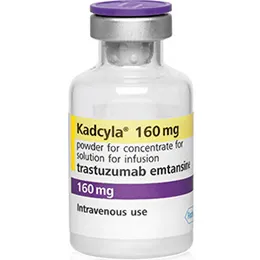
Instructions for Use
Package leaflet: Information for the user
Introduction
Package leaflet: Information for the user
Kadcyla 100 mg powder for concentrate for solution for infusion
Kadcyla 160 mg powder for concentrate for solution for infusion
trastuzumab emtansine
Read the entire leaflet carefully before you start using this medicine, as it contains important information for you.
- Keep this leaflet, as you may need to read it again.
- If you have any questions, consult your doctor, pharmacist, or nurse.
- If you experience any side effects, consult your doctor, pharmacist, or nurse, even if they are side effects not listed in this leaflet. See section 4.
Leaflet contents
- What Kadcyla is and what it is used for
- What you need to know before you are given Kadcyla
- How Kadcyla is administered
- Possible side effects
- How to store Kadcyla
- Contents of the pack and other information
1. What Kadcyla is and what it is used for
What Kadcyla is
Kadcyla contains the active substance trastuzumab emtansine, which consists of two parts linked together:
- trastuzumab – a monoclonal antibody that selectively binds to an antigen (a protein targeted by the medicine) called human epidermal growth factor receptor 2 (HER2). HER2 is present in large amounts on the surface of certain cancer cells, stimulating their growth. When trastuzumab binds to HER2, it can stop the growth of cancer cells and cause their death.
- DM1 – an anticancer agent that becomes activated once Kadcyla enters the cancer cell.
What Kadcyla is used for
Kadcyla is used to treat adult patients with breast cancer when:
- the cancer cells contain a large amount of the HER2 protein – your doctor will analyze your cancer cells to determine this.
- they have already been treated with the medicine trastuzumab and a medicine from a group called taxanes.
- the cancer has spread to areas near the breast or to other parts of the body (metastatic).
- the cancer has not spread to other parts of the body and treatment is to be given after surgery (treatment after surgery is called adjuvant therapy).
2. What you need to know before Kadcyla is administered to you
Do not receive Kadcyla
- if you are allergic to trastuzumab emtansine or to any of the other ingredients of this medicine (listed in section 6).
If the above applies to you, Kadcyla must not be administered. If you are unsure, consult your doctor or nurse before receiving Kadcyla.
Warnings and precautions
Talk to your doctor or nurse before receiving Kadcyla if:
- you have ever experienced a serious infusion-related reaction during treatment with trastuzumab, characterized by symptoms such as flushing, chills, fever, shortness of breath, difficulty breathing, rapid heartbeat, or low blood pressure.
- you are receiving treatment with blood-thinning medications (e.g., warfarin, heparin).
- you have any history of liver problems. Your doctor will perform blood tests to check your liver function before starting treatment and regularly during treatment.
If any of the above conditions apply to you (or if you are unsure), consult your doctor or pharmacist before receiving Kadcyla.
Monitoring for adverse effects
Kadcyla may worsen pre-existing conditions or cause adverse effects. See section 4 for more detailed information about adverse effects to monitor.
Immediately inform your doctor or nurse if you experience any of the following serious adverse effects while receiving Kadcyla:
-
Respiratory problems: Kadcyla may cause serious breathing problems, such as shortness of breath (at rest or during physical activity) and cough. These signs may indicate lung inflammation, which could be severe and even fatal. If you develop a lung disease, your doctor may discontinue treatment with this medicine.
-
Liver problems: Kadcyla may cause inflammation or damage to liver cells, which can impair normal liver function. When liver cells are inflamed or damaged, they may release higher-than-normal amounts of certain substances (liver enzymes) into the blood, leading to elevated liver enzymes in blood tests. In most cases, you may not have any symptoms. One possible symptom is yellowing of the skin and eyes (jaundice). Your doctor will perform blood tests to check your liver function before starting treatment and regularly during treatment.
Another rare liver abnormality is a condition known as nodular regenerative hyperplasia (NRH). This condition alters the liver's structure and may impair liver function. Patients with this condition develop multiple nodules in the liver that may affect liver function. Over time, symptoms such as a feeling of fullness or abdominal swelling due to fluid accumulation, or bleeding from abnormal blood vessels in the esophagus or rectum, may occur.
-
Heart problems: Kadcyla may weaken the heart muscle. When the heart muscle is weakened, symptoms such as shortness of breath at rest or while lying down, chest pain, swelling of the arms or legs, or a sensation of rapid or irregular heartbeat may occur. Your doctor will check your heart function before starting treatment and regularly during treatment. If you experience any of the symptoms listed above, inform your doctor immediately.
-
Infusion-related reactions or allergic reactions: Kadcyla may cause flushing, chills, fever, difficulty breathing, low blood pressure, rapid heartbeat, sudden swelling of the face or tongue, or difficulty swallowing during or after the infusion on the first day of treatment. Your doctor or nurse will monitor you for these adverse effects. If you develop a reaction, they may slow down or stop the infusion and may give you treatment to counteract the adverse effects. The infusion may resume once your symptoms improve.
-
Bleeding: Kadcyla may cause a decrease in the number of platelets in your blood. Platelets are involved in blood clotting, so bruising or spontaneous bleeding (such as nosebleeds or bleeding gums) may occur. Your doctor will perform regular blood tests to check if your platelet count is low. If you notice any bruising or spontaneous bleeding, inform your doctor immediately.
-
Neurological problems: Kadcyla may cause nerve damage. Symptoms you may experience include tingling, pain, numbness, itching, or a pins-and-needles sensation, and muscle cramps in the hands and feet. Your doctor will monitor you for signs and symptoms of neurological problems.
-
Injection site reaction: If you experience a burning sensation, pain, or tenderness at the injection site during the infusion, this may indicate that Kadcyla has leaked outside the blood vessel. Inform your doctor or nurse immediately. If Kadcyla leaks outside the blood vessel, increased pain, discoloration, blistering, and peeling of the skin (cutaneous necrosis) may occur in the days or weeks following the infusion.
Immediately inform your doctor or nurse if you experience any of the adverse effects mentioned above.
Children and adolescents
Kadcyla is not recommended for patients under 18 years of age, as there is no information available on its efficacy in this age group.
Other medicines and Kadcyla
Inform your doctor or nurse if you are taking, have recently taken, or might need to take any other medicines.
In particular, consult your doctor or pharmacist if you are taking the following:
- blood-thinning medications such as warfarin or medications that reduce the ability to form blood clots, such as aspirin
- antifungal medications, such as ketoconazole, itraconazole, or voriconazole
- antibiotics for infections, such as clarithromycin or telithromycin
- HIV medications, such as atazanavir, indinavir, nelfinavir, ritonavir, or saquinavir
- an antidepressant medicine called nefazodone
If any of the above conditions apply to you (or if you are unsure), consult your doctor or pharmacist before receiving Kadcyla.
Pregnancy
Kadcyla is not recommended if you are pregnant, as this medicine may harm the unborn baby.
- Before starting treatment with Kadcyla, inform your doctor if you are pregnant, think you may be pregnant, or plan to become pregnant.
- You must use an effective method of contraception to prevent pregnancy during treatment with Kadcyla. Consult your doctor to determine the most appropriate contraceptive method for you.
- You should continue using contraception for at least 7 months after your last dose of Kadcyla. Consult your doctor before stopping contraception.
- Male patients or their female partners should also use an effective method of contraception.
- Inform your doctor immediately if you become pregnant during treatment with Kadcyla.
Breast-feeding
You must not breast-feed during treatment with Kadcyla and for at least 7 months after your last infusion of Kadcyla. It is unknown whether the components of Kadcyla pass into breast milk. Discuss this with your doctor.
Driving and use of machines
Kadcyla is not expected to affect your ability to drive, ride a bicycle, or use tools or machinery. However, if you experience flushing, chills, fever, difficulty breathing, low blood pressure, rapid heartbeat (infusion-related reactions), blurred vision, fatigue, headache, or dizziness, you should not drive, ride a bicycle, or use tools or machinery until these symptoms resolve.
Important information about some of the ingredients of Kadcyla
This medicine contains less than 1 mmol of sodium (23 mg) per dose; this is essentially “sodium-free.”
Kadcyla 100 mg powder for concentrate for solution for infusion
This medicine contains 1.1 mg of polysorbate 20 in each vial, equivalent to 0.22 mg/ml.
Kadcyla 160 mg powder for concentrate for solution for infusion
This medicine contains 1.7 mg of polysorbate 20 in each vial, equivalent to 0.21 mg/ml.
Polysorbate may cause allergic reactions. Consult your doctor if you have known allergies.
3. How Kadcyla is administered
A doctor or nurse will administer Kadcyla to you in a hospital or clinic.
- It is given as an intravenous infusion (a drip into a vein).
- You will receive an infusion every 3 weeks.
What dose will be given to you
- You will receive 3.6 mg of Kadcyla per kilogram of body weight. Your doctor will calculate the correct dose for you.
- The first infusion will last 90 minutes. Your doctor or nurse will monitor you during the infusion and for at least 90 minutes afterward to check for adverse reactions.
- If the first infusion is well tolerated, the next infusion may be given over 30 minutes. You will be monitored by a doctor or nurse during the infusion and for at least 30 minutes afterward to check for adverse reactions.
- The number of infusions you receive will depend on how you respond to treatment and the indication being treated.
- If you experience adverse reactions, your doctor may decide to continue treating you, but may use a lower dose or delay or interrupt treatment.
If you forget to use Kadcyla
If you miss or do not attend your appointment to receive Kadcyla, schedule another appointment as soon as possible. Do not wait until your next planned appointment.
If you stop treatment with Kadcyla
Do not stop using this medicine without first consulting your doctor.
If you have any further questions about the use of this medicine, ask your doctor or nurse.
4. Possible adverse effects
Like all medicines, this medicine can cause adverse effects, although not everyone experiences them.
Tell your doctor or nurse immediately if you notice any of the following serious adverse effects:
Very common (may affect more than 1 in 10 people):
- Kadcyla may cause inflammation or damage to liver cells, resulting in elevated liver enzymes in blood tests. However, in most cases observed during treatment with Kadcyla, these elevations are mild and temporary, do not cause symptoms, and do not affect liver function.
- Bruising and spontaneous bleeding (such as nosebleeds).
- Tingling, pain, numbness, itching, prickling sensations, or muscle cramps in the hands and feet. These symptoms may indicate nerve damage.
Common (may affect up to 1 in 10 people):
- Flushing, chills, fever, difficulty breathing, decreased blood pressure, or rapid heartbeat during or within 24 hours after infusion. These are known as infusion-related reactions.
- Heart problems may occur. Most patients will not have symptoms of heart problems. If symptoms do occur, they may include cough, shortness of breath at rest or when lying flat, chest pain, swelling of the ankles or arms, or sensation of rapid or irregular heartbeat.
Uncommon (may affect up to 1 in 100 people):
- Inflammation of the lungs, which may cause breathing difficulties such as shortness of breath (at rest or during activity), cough, or dry coughing fits, which are signs of lung tissue inflammation.
- Allergic reactions may occur, and most patients will have mild symptoms such as itching or tightness in the chest. In more severe cases, swelling of the face or tongue, difficulty swallowing, or difficulty breathing may occur.
Rare (may affect up to 1 in 1,000 people):
- Yellowing of the skin and eyes (jaundice), which could be a sign of severe liver damage.
Frequency not known:
- If the Kadcyla infusion solution leaks into the area around the infusion site, it may cause pain, skin discoloration, blistering, and skin peeling (cutaneous necrosis) at the infusion site. Contact your doctor or nurse immediately.
Tell your doctor or nurse immediately if you notice any of the serious adverse effects listed above.
Other adverse effects
Very common: may affect more than 1 in 10 people
- decrease in red blood cell count (shown in blood test)
- nausea (vomiting)
- diarrhea
- dry mouth
- urinary tract infection
- constipation
- stomach pain
- cough
- difficulty breathing
- mouth inflammation
- difficulty sleeping
- muscle or joint pain
- fever
- headache
- fatigue
- weakness
Common: may affect up to 1 in 10 people
- chills or flu-like symptoms
- decreased potassium levels (shown in blood test)
- skin rash
- decrease in white blood cell count (shown in blood test)
- dry eyes, watery eyes, or blurred vision
- red eye or eye infection
- indigestion
- swelling of legs and/or arms
- bleeding gums
- increased blood pressure
- dizziness
- taste disturbances
- itching
- difficulty remembering
- hair loss
- skin reaction on hands and feet (hand-foot syndrome, also known as palmar-plantar erythrodysesthesia)
- nail changes
Uncommon: may affect up to 1 in 100 people
- Another abnormality that Kadcyla may cause is a disorder known as nodular regenerative hyperplasia of the liver. This condition causes changes in liver structure. Patients with this disorder develop multiple nodules in the liver that may impair liver function. Over time, symptoms such as a feeling of fullness or abdominal swelling due to fluid accumulation may appear, or bleeding may occur due to the formation of abnormal blood vessels in the esophagus or rectum.
- During Kadcyla infusion, leakage of the infused liquid into surrounding tissues may occur, causing tenderness, skin irritation, or swelling at the infusion site.
If you experience any of the above adverse effects after Kadcyla treatment has been stopped, you should consult your doctor or nurse and inform them that you have been treated with Kadcyla.
Reporting of adverse effects
If you experience any adverse effect, talk to your doctor or nurse, even if it is a possible adverse effect not listed in this leaflet. You can also report them directly through the national reporting system included in Appendix V. By reporting adverse effects, you can help provide more information on the safety of this medicine.
5. Storage of Kadcyla
Kadcyla will be stored by healthcare professionals at the hospital or clinic.
- Keep this medicine out of the sight and reach of children.
- Do not use this medicine after the expiry date stated on the packaging and vial after EXP. The expiry date refers to the last day of the month indicated.
- Store in a refrigerator (between 2 °C and 8 °C). Do not freeze.
- After reconstitution in the vial, Kadcyla is stable for up to 120 hours (5 days) at a temperature between 2 °C and 8 °C. After dilution into an infusion bag, the solution is stable for 24 hours at a temperature between 2 °C and 8 °C and must be discarded after this period.
- Medicines must not be disposed of via wastewater or household waste. Ask your pharmacist how to dispose of medicines and packaging you no longer need. This will help protect the environment.
6. Contents of the pack and other information
Composition of Kadcyla
- The active substance is trastuzumab emtansine.
- Kadcyla 100 mg: One vial of powder for concentrate for solution for infusion contains 100 mg of trastuzumab emtansine. After reconstitution, a 5 ml vial of solution contains 20 mg/ml of trastuzumab emtansine.
- Kadcyla 160 mg: One vial of powder for concentrate for solution for infusion contains 160 mg of trastuzumab emtansine. After reconstitution, an 8 ml vial of solution contains 20 mg/ml of trastuzumab emtansine.
- The other components are succinic acid, sodium hydroxide (see section 2 “Important information about some of the components of Kadcyla”), sucrose, and polysorbate 20.
Nature and contents of the container
- Kadcyla is a white to off-white lyophilized powder for concentrate for solution for infusion supplied in glass vials.
- Kadcyla is available in packs containing 1 vial.
Marketing Authorization Holder
Roche Registration GmbH
Emil-Barell-Strasse 1
79639 Grenzach-Wyhlen
Germany
Manufacturer
Roche Pharma AG
Emil-Barell-Strasse 1
D-79639 Grenzach-Wyhlen
Germany
Further information on this medicinal product is available upon request to the local representative of the Marketing Authorization Holder:
Belgium/Belgium/Belgium Luxembourg/Luxembourg N.V. Roche S.A. Belgium/Belgium/Belgium Tel/Tel: +32 (0) 2 525 82 11 | Latvia Roche Latvija SIA Tel: +371 - 6 7039831 |
| Lithuania UAB “Roche Lietuva” Tel: +370 5 2546799 |
Czech Republic Roche s. r. o. Tel: +420 - 2 20382111 | Hungary Roche (Hungary) Kft. Tel: +36 – 1 279 4500 |
Denmark Roche Pharmaceuticals A/S Tlf: +45 - 36 39 99 99 | Netherlands Roche Nederland B.V. Tel: +31 (0) 348 438000 |
Germany Roche Pharma AG Tel: +49 (0) 7624 140 | Norway Roche Norge AS Tlf: +47 - 22 78 90 00 |
Estonia Roche Eesti OÜ Tel: + 372 - 6 177 380 | Austria Roche Austria GmbH Tel: +43 (0) 1 27739 |
Greece, Cyprus Roche (Hellas) A.E. Greece Tel: +30 210 61 66 100 | Poland Roche Polska Sp.z o.o. Tel: +48 - 22 345 18 88 |
Spain Roche Farma S.A. Tel: +34 - 91 324 81 00 | Portugal Roche Farmacêutica Química, Lda Tel: +351 - 21 425 70 00 |
France Roche Tél: +33 (0)1 47 61 40 00 | Romania Roche România S.R.L. Tel: +40 21 206 47 01 |
Croatia Roche d.o.o Tel: +385 1 4722 333 | Slovenia Roche farmacevtska družba d.o.o. Tel: +386 - 1 360 26 00 |
Ireland, Malta Roche Products (Ireland) Ltd. Ireland/Ireland Tel: +353 (0) 1 469 0700 | Slovakia Roche Slovensko, s.r.o. Tel: +421 - 2 52638201 |
Iceland Roche Pharmaceuticals A/S c/o Icepharma hf Tel: +354 540 8000 | Finland/Finland Roche Oy Puh/Tel: +358 (0) 10 554 500 |
Italy Roche S.p.A. Tel: +39 - 039 2471 | Sweden Roche AB Tel: +46 (0) 8 726 1200 |
Date of the most recent review of this leaflet
Other sources of information
Detailed information on this medicine is available on the European Medicines Agency website: http://www.ema.europa.eu.
This information is intended for healthcare professionals only:
To avoid medication errors, it is important to check the vial labels to ensure that the medicine being prepared and administered is Kadcyla (trastuzumab emtansine) and not another trastuzumab-containing product (e.g., trastuzumab or trastuzumab deruxtecan).
Kadcyla must be reconstituted and diluted by a healthcare professional and administered as an intravenous infusion. It must not be administered as an intravenous push or bolus.
Always store this medicine in its original closed container at a temperature of 2°C – 8°C in a refrigerator. The Kadcyla vial reconstituted with water for injections or 4.5 mg/ml (0.45%) sodium chloride (not supplied) is stable for up to 120 hours (5 days) at 2°C – 8°C after reconstitution and must not be frozen.
Appropriate aseptic techniques must be used. Appropriate procedures for handling cytotoxic medicinal products should be followed.
The reconstituted Kadcyla solution must be diluted in polyvinyl chloride (PVC)-free and latex-free polyolefin infusion bags.
A 0.20 or 0.22 μm inline polyethersulfone (PES) filter must be used when the infusion concentrate is diluted in 9 mg/ml (0.9%) sodium chloride solution for infusion.
Reconstitution instructions
- Kadcyla 100 mg: Using a sterile syringe, slowly inject 5 ml of sterile water for injections or 4.5 mg/ml (0.45%) sodium chloride into the 100 mg vial of trastuzumab emtansine.
- Kadcyla 160 mg: Using a sterile syringe, slowly inject 8 ml of sterile water for injections or 4.5 mg/ml (0.45%) sodium chloride into the 160 mg vial of trastuzumab emtansine.
- Gently rotate the vial until the concentrate is completely dissolved. Do not shake.
The reconstituted solution should be visually inspected for the presence of particles and discoloration before administration. The reconstituted solution must be free of visible particles and should be clear to slightly opalescent, colorless to pale brown. Do not use if visible particles are present or if the solution is cloudy or has changed color.
Any unused portions must be discarded. The reconstituted solution contains no preservatives and is for single use only.
Dilution instructions
Determine the volume of solution required based on a trastuzumab emtansine dose of 3.6 mg/kg body weight:
Volume (ml) = | Total dose to be administered = (body weight (kg) x dose (mg/kg)) |
20 (mg/ml, concentration of the reconstituted solution) |
Withdraw the appropriate amount of solution from the vial and add it to a 250 ml infusion bag containing either 4.5 mg/ml (0.45%) or 9 mg/ml (0.9%) sodium chloride solution for infusion. Glucose (5%) solutions must not be used. When dilution is performed using 4.5 mg/ml (0.45%) sodium chloride solution for infusion, an in-line polyethersulfone (PES) filter of 0.20 or 0.22 μm is not required. However, the use of an in-line polyethersulfone (PES) filter of 0.20 or 0.22 μm is necessary when using 9 mg/ml (0.9%) sodium chloride solution for infusion. Once the infusion is prepared, it should be administered immediately. Do not freeze or shake the infusion during storage. If the dilution has been carried out under aseptic conditions, the solution may be stored for up to 24 hours at a temperature between 2 °C and 8 °C.
Similar Medications
-
Kadcyla 100 mg powder for concentrate for solution for infusion
Form: powder for concentrate for solution for infusion
Active substance Dosage TRASTUZUMAB EMTANSINE 20 mg Manufacturer: Roche Registration Gmbh
This page has been machine-translated and may contain inaccuracies. The original data is available in the manufacturing country's language.
Last data check: May 18, 2026 · Data source: CIMA — AEMPS