Janumet 50 mg/1000 mg film-coated tablets
Spain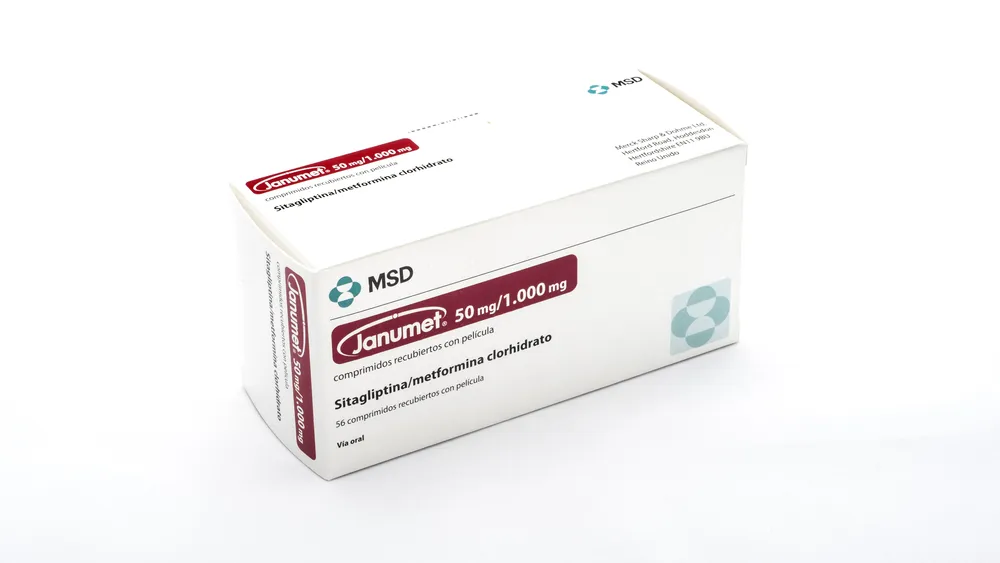
Table of Contents
Package leaflet: Information for the user
Introduction
Package leaflet: information for the user
Janumet 50 mg/850 mg film-coated tablets
Janumet 50 mg/1 000 mg film-coated tablets
sitagliptin/metformin hydrochloride
Read the entire leaflet carefully before you start taking this medicine, as it contains important information for you.
- Keep this leaflet, as you may need to read it again.
- If you have any questions, ask your doctor, pharmacist or nurse.
- This medicine has been prescribed for you only and must not be given to other people, even if they have the same symptoms as you, because it may harm them.
- If you experience any adverse effects, consult your doctor, pharmacist or nurse, even if they are adverse effects not listed in this leaflet. See section 4.
Contents of the leaflet
- What Janumet is and what it is used for
- What you need to know before taking Janumet
- How to take Janumet
- Possible side effects
- How to store Janumet
- Contents of the pack and other information
1. What Janumet is and what it is used for
Janumet contains two different medicines called sitagliptin and metformin.
- Sitagliptin belongs to a class of medicines known as DPP‑4 inhibitors (dipeptidyl peptidase‑4 inhibitors).
- Metformin belongs to a class of medicines known as biguanides.
Together, they work to control blood sugar levels in adult patients with a form of diabetes called "type 2 diabetes mellitus". This medicine helps increase insulin levels produced after a meal and reduces the amount of sugar produced by your body.
Along with diet and exercise, this medicine helps lower your blood sugar level. This medicine may be used alone or in combination with certain other diabetes medicines (insulin, sulfonylureas, or glitazones).
What is type 2 diabetes?
Type 2 diabetes is a condition in which your body does not produce enough insulin and the insulin your body does produce does not work as well as it should. Your body may also produce too much sugar. When this happens, sugar (glucose) builds up in the blood. This can lead to serious medical problems, such as heart (cardiovascular) disease, kidney (renal) disease, blindness, and amputations.
2. What you need to know before taking Janumet
Do not take Janumet
- if you are allergic to sitagliptin, metformin, or any of the other ingredients of this medicine (listed in section 6)
- if you have severely reduced kidney function
- if you have uncontrolled diabetes, for example, with severe hyperglycemia (high blood glucose), nausea, vomiting, diarrhea, rapid weight loss, lactic acidosis (see “Risk of lactic acidosis” below), or ketoacidosis. Ketoacidosis is a condition in which substances called “ketone bodies” build up in the blood, which may lead to diabetic pre-coma. Symptoms include stomach pain, rapid deep breathing, drowsiness, or fruity-smelling breath
- if you have a serious infection or are dehydrated
- if you are undergoing an X-ray procedure requiring injection of a contrast agent. You will need to stop taking Janumet at the time of the procedure and for 2 or more days afterwards, as directed by your doctor, depending on how well your kidneys are functioning
- if you recently had a heart attack or have severe circulatory problems, such as “shock” or difficulty breathing
- if you have liver problems (hepatic impairment)
- if you drink excessive amounts of alcohol (either daily or occasionally)
- if you are breastfeeding.
Do not take Janumet if any of the above apply to you, and consult your doctor about other ways to manage your diabetes. If you are unsure, speak with your doctor, pharmacist, or nurse before starting Janumet.
Warnings and precautions
Cases of inflammation of the pancreas (pancreatitis) have been reported in patients treated with Janumet (see section 4).
If you develop blisters on your skin, this may be a sign of a condition called bullous pemphigoid. Your doctor may ask you to stop taking Janumet.
Risk of lactic acidosis
Janumet may cause a very rare but serious adverse effect called lactic acidosis, especially if your kidneys are not functioning properly. The risk of developing lactic acidosis is also increased in uncontrolled diabetes, serious infections, prolonged fasting, alcohol consumption, dehydration (see further information below), liver problems, and any medical condition in which part of the body receives reduced oxygen supply (such as acute and severe heart conditions).
If any of the above apply to you, consult your doctor for further instructions.
Contact your doctor immediately for advice if:
- You are known to have a hereditary mitochondrial disease (components responsible for energy production within cells), such as MELAS syndrome (mitochondrial encephalopathy, myopathy, lactic acidosis, and stroke-like episodes) or maternally inherited diabetes and deafness (MIDD).
- You experience any of the following symptoms after starting treatment with metformin: seizures, cognitive decline, difficulty with body movements, symptoms indicating nerve damage (e.g., pain or numbness), migraine, or hearing loss.
Stop taking Janumet temporarily if you develop an illness that could lead to dehydration (significant loss of body fluids), such as severe vomiting, diarrhea, fever, heat exposure, or if you are drinking less fluid than usual. Consult your doctor for further instructions.
Stop taking Janumet and contact a doctor or go to the nearest hospital immediately if you experience any symptoms of lactic acidosis, as this condition may lead to coma.
Symptoms of lactic acidosis include:
- vomiting
- stomach pain (abdominal pain)
- muscle cramps
- general feeling of discomfort with profound fatigue
- difficulty breathing
- reduced body temperature and reduced heart rate
Lactic acidosis is a medical emergency and must be treated in a hospital.
Talk to your doctor or pharmacist before taking Janumet if:
- you have or have had a pancreatic disease (such as pancreatitis)
- you have or have had gallstones, alcohol addiction, or very high blood levels of triglycerides (a type of fat). These medical conditions may increase your risk of developing pancreatitis (see section 4)
- you have type 1 diabetes. This condition may also be called insulin-dependent diabetes
- you have had or have an allergic reaction to sitagliptin, metformin, or Janumet (see section 4)
- you are taking a sulfonylurea or insulin, or other diabetes medications along with Janumet, as you may experience low blood sugar levels (hypoglycemia).
- Your doctor may need to reduce the dose of your sulfonylurea or insulin
If you require major surgery, you must stop taking Janumet during the procedure and for a period afterwards. Your doctor will decide when to interrupt and when to restart treatment with Janumet.
If you are unsure whether any of the above apply to you, consult your doctor or pharmacist before starting Janumet.
During treatment with Janumet, your doctor will monitor your kidney function at least once a year, or more frequently if you are elderly and/or if your kidney function is deteriorating.
Children and adolescents
Children and adolescents under 18 years of age must not use this medicine. It is not effective in children and adolescents aged between 10 and 17 years. It is unknown whether this medicine is safe and effective in children under 10 years of age.
Other medicines and Janumet
If you need to receive an intravenous injection of an iodine-containing contrast agent, for example during an X-ray or scan, you must stop taking Janumet before or at the time of the injection. Your doctor will decide when to interrupt and when to restart treatment with Janumet.
Tell your doctor or pharmacist if you are taking, have recently taken, or might need to take any other medicines. You may require more frequent blood glucose and kidney function tests, or your doctor may need to adjust your Janumet dose. It is especially important to mention the following:
- medicines (taken orally, by inhalation, or injection) used to treat inflammatory conditions such as asthma and arthritis (corticosteroids)
- medicines that increase urine production (diuretics)
- medicines used to treat pain and inflammation (NSAIDs and COX-2 inhibitors, such as ibuprofen and celecoxib)
- certain medicines used to treat high blood pressure (ACE inhibitors and angiotensin II receptor antagonists)
- specific medicines for bronchial asthma (β-sympathomimetics)
- iodinated contrast agents or medicines containing alcohol
- certain medicines used to treat stomach problems such as cimetidine
- ranolazine, a medicine used to treat angina pectoris
- dolutegravir, a medicine used to treat HIV infection
- vandetanib, a medicine used to treat a specific type of thyroid cancer (medullary thyroid cancer)
- digoxin (to treat irregular heartbeat and other heart problems). Blood levels of digoxin may need to be monitored if you are taking Janumet.
Taking Janumet with alcohol
Avoid excessive alcohol consumption while taking Janumet, as this may increase the risk of lactic acidosis (see section “Warnings and precautions”).
Pregnancy and breastfeeding
If you are pregnant or breastfeeding, think you may be pregnant, or plan to become pregnant, consult your doctor or pharmacist before using this medicine. You must not take this medicine during pregnancy. Do not take this medicine if you are breastfeeding. See section 2, Do not take Janumet.
Driving and using machines
The effect of this medicine on the ability to drive and use machines is negligible or none. However, dizziness and drowsiness have been reported during treatment with sitagliptin, which may affect your ability to drive and use machines.
Taking this medicine together with medicines called sulfonylureas or with insulin may cause hypoglycemia, which could affect your ability to drive and use machines or work without secure support.
Janumet contains sodium
This medicine contains less than 23 mg of sodium (1 mmol) per tablet; this is essentially “sodium-free.”
3. How to take Janumet
Follow exactly the instructions for using this medicine as given by your doctor. If you are unsure, consult your doctor or pharmacist again.
-
Take one tablet:
-
twice daily by mouth
-
with food to reduce the likelihood of stomach discomfort
-
Your doctor may need to increase the dose to control blood sugar levels.
-
If you have reduced kidney function, your doctor may prescribe a lower dose.
You should continue the diet recommended by your doctor during treatment with this medicine and take care to distribute carbohydrate intake evenly throughout the day.
It is unlikely that treatment with this medicine alone will cause abnormally low blood sugar (hypoglycaemia). Low blood sugar may occur when this medicine is taken together with a medicine containing sulphonylurea or with insulin, so your doctor may consider it necessary to reduce the dose of your sulphonylurea or insulin.
If you take more Janumet than you should
If you take more than the prescribed dose of this medicine, contact your doctor immediately. Go to hospital if you have symptoms of lactic acidosis such as feeling cold or unwell, severe nausea or vomiting, stomach pain, unexplained weight loss, muscle cramps, or rapid breathing (see section “Warnings and precautions”).
If you forget to take Janumet
If you forget to take a dose, take it as soon as you remember. If you do not remember until it is time for your next dose, skip the missed dose and continue with your regular dosing schedule. Do not take a double dose of this medicine.
If you stop taking Janumet
Keep taking this medicine for as long as your doctor tells you to, so that it can help you control your blood sugar level. Do not stop taking this medicine without first consulting your doctor. If you stop treatment with Janumet, your blood sugar level may rise again.
If you have any further questions about the use of this medicine, ask your doctor or pharmacist.
4. Possible adverse effects
Like all medicines, this medicine can cause adverse effects, although not everybody gets them.
STOP taking Janumet and contact your doctor immediately if you notice any of the following serious adverse effects:
- Severe and persistent pain in the abdomen (stomach area) that may extend to the back, with or without nausea and vomiting, as these may be signs of inflammation of the pancreas (pancreatitis).
Janumet may cause a very rare (may affect up to 1 in 10,000 people), but very serious side effect called lactic acidosis (see section “Warnings and precautions”). If this occurs, you must stop taking Janumet and contact a doctor or the nearest hospital immediately, as lactic acidosis can lead to coma.
If you have a severe allergic reaction (frequency not known), including rash, hives, skin blisters/skin peeling, and swelling of the face, lips, tongue, and throat which may cause difficulty breathing or swallowing, stop taking this medicine and consult your doctor immediately. Your doctor will prescribe a medicine to treat the allergic reaction and will switch you to a different medicine for the treatment of diabetes.
Some patients taking metformin have experienced the following adverse effects after starting treatment with sitagliptin:
Frequent (may affect up to 1 in 10 people): low blood sugar levels, nausea, gas, vomiting
Uncommon (may affect up to 1 in 100 people): stomach pain, diarrhoea, constipation, drowsiness
Some patients have experienced diarrhoea, nausea, gas, constipation, stomach pain, or vomiting when starting treatment with the combination of sitagliptin and metformin (frequency classified as frequent).
Some patients have experienced the following adverse effects when taking this medicine together with a sulfonylurea such as glimepiride:
Very common (may affect more than 1 in 10 people): low blood sugar levels
Frequent: constipation
Some patients experienced the following adverse effects while taking this medicine in combination with pioglitazone:
Frequent: swelling of hands or legs
Some patients experienced the following adverse effects while taking this medicine in combination with insulin:
Very common: low blood sugar levels
Uncommon: dry mouth, headache
Some patients have experienced the following adverse effects during clinical studies while taking sitagliptin alone (one of the medicines contained in Janumet) or during use after approval of Janumet or sitagliptin alone or with other diabetes medicines:
Frequent: low blood sugar levels, headache, upper respiratory tract infection, nasal congestion or runny nose, sore throat, osteoarthritis, pain in arm or leg
Uncommon: dizziness, constipation, itching
Rare: reduction in the number of platelets
Frequency not known: kidney problems (which sometimes require dialysis), vomiting, joint pain, muscle pain, back pain, interstitial lung disease, bullous pemphigoid (a type of blistering skin condition)
Some patients have experienced the following adverse effects after taking metformin alone:
Very common: nausea, vomiting, diarrhoea, stomach pain, and loss of appetite. These symptoms may occur when you first start taking metformin and usually go away
Frequent: metallic taste, decreased or low levels of vitamin B12 in the blood (symptoms may include extreme tiredness (fatigue), pain and redness of the tongue (glossitis), tingling (paraesthesia), or pale or yellowish skin). Your doctor may order tests to determine the cause of your symptoms, as some of them may also be caused by diabetes or other unrelated health problems.
Very rare: hepatitis (a liver problem), hives, redness of the skin (rash), or itching
Reporting of adverse effects
If you experience any adverse effect, talk to your doctor, pharmacist, or nurse, even if it is a possible adverse effect not listed in this leaflet. You can also report them directly through the national reporting system included in Appendix V. By reporting adverse effects, you can help provide more information on the safety of this medicine.
5. Storage of Janumet
Keep this medicine out of the sight and reach of children.
Do not use this medicine after the expiry date stated on the blister and packaging after EXP. The expiry date refers to the last day of the month indicated.
Do not store above 25 °C.
Medicines should not be disposed of via wastewater or household waste. Ask your pharmacist how to properly dispose of any unused medicine and its packaging. This will help protect the environment.
6. Contents of the pack and other information
Composition of Janumet
-
The active substances are sitagliptin and metformin.
-
Each film-coated tablet of Janumet 50 mg/850 mg (tablet) contains sitagliptin phosphate monohydrate equivalent to 50 mg of sitagliptin and 850 mg of metformin hydrochloride.
-
Each film-coated tablet of Janumet 50 mg/1 000 mg (tablet) contains sitagliptin phosphate monohydrate equivalent to 50 mg of sitagliptin and 1 000 mg of metformin hydrochloride.
-
The other components are:
-
Tablet core: microcrystalline cellulose (E460), povidone K 29/32 (E1201), sodium lauryl sulfate and sodium stearyl fumarate.
-
Film coating: polyvinyl alcohol, macrogol 3350, talc (E553b), titanium dioxide (E171), iron oxide red (E172) and iron oxide black (E172).
Appearance of the product and pack contents
- The film-coated tablets of Janumet 50 mg/850 mg are oval-shaped, pink in colour, with the imprint “515” on one side.
- The film-coated tablets of Janumet 50 mg/1 000 mg are oval-shaped, red in colour, with the imprint “577” on one side.
Opaque blisters (PVC/PE/PVDC and aluminium). Packs containing 14, 28, 56, 60, 112, 168, 180, 196 film-coated tablets; multiple packs containing 196 (2 boxes of 98) and 168 (2 boxes of 84) film-coated tablets. Pack of 50 x 1 tablet in single-dose perforated blister strips.
Not all pack sizes may be marketed.
Marketing Authorization Holder and Manufacturer
Merck Sharp & Dohme B.V.
Waarderweg 39
2031 BN Haarlem
The Netherlands
More information about this medicine is available upon request by contacting the local representative of the Marketing Authorization Holder:
Belgium/Belgium/Belgium MSD Belgium Tel/Tel: +32(0)27766211 | Lithuania UAB Merck Sharp & Dohme Tel. +370 5 2780 247 |
| Luxembourg/Luxembourg MSD Belgium Tél/Tel: +32(0)27766211 |
Czech Republic Merck Sharp & Dohme s.r.o. Tel.: +420 277 050 000 | Hungary MSD Pharma Hungary Kft. Tel.: +36 1 888 5300 |
Denmark MSD Danmark ApS Tlf.: +45 4482 4000 | Malta Merck Sharp & Dohme Cyprus Limited Tel: 8007 4433 (+356 99917558) |
Germany MSD Sharp & Dohme GmbH Tel.: +49 (0) 89 20 300 4500 | Netherlands Merck Sharp & Dohme B.V. Tel: 0800 9999000 (+31 23 5153153) |
Estonia Merck Sharp & Dohme OÜ Tel: +372 614 4200 | Norway MSD (Norge) AS Tlf: +47 32 20 73 00 |
Greece MSD Α.Φ.Ε.Ε Tel: +30 210 98 97 300 | Austria Merck Sharp & Dohme Ges.m.b.H. Tel: +43 (0) 1 26 044 |
Spain Merck Sharp & Dohme de España, S.A. Tel: +34 91 321 06 00 | Poland MSD Polska Sp. z o.o. Tel.: +48 22 549 51 00 |
France MSD France Tél: +33 (0)1 80 46 40 40 | Portugal Merck Sharp & Dohme, Lda Tel.: +351 21 4465700 |
Croatia Merck Sharp & Dohme d.o.o. Tel: +385 1 6611 333 | Romania Merck Sharp & Dohme Romania S.R.L. Tel.: +40 21 529 29 00 |
Ireland Merck Sharp & Dohme Ireland (Human Health) Limited Tel: +353 (0)1 2998700 | Slovenia Merck Sharp & Dohme, inovativna zdravila d.o.o. Tel: +386 1 520 4201 |
Iceland Vistor ehf. Tel: +354 535 7000 | Slovakia Merck Sharp & Dohme, s. r. o. Tel.: +421 2 58282010 |
Italy MSD Italia S.r.l. Tel: 800 23 99 89 (+39 06 361911) | Finland/Sweden MSD Finland Oy Puh/Tel: +358 (0)9 804 650 |
Cyprus Merck Sharp & Dohme Cyprus Limited Tel: 800 00 673 (+357 22866700) | Sweden Merck Sharp & Dohme (Sweden) AB Tel: +46 77 5700488 |
Latvia SIA Merck Sharp & Dohme Latvija Tel.: +371 67025300 |

Date of the most recent review of this leaflet: {MM/YYYY}.
Detailed information on this medicine is available on the European Medicines Agency website: https://www.ema.europa.eu.