Itnogen 2% gel
Spain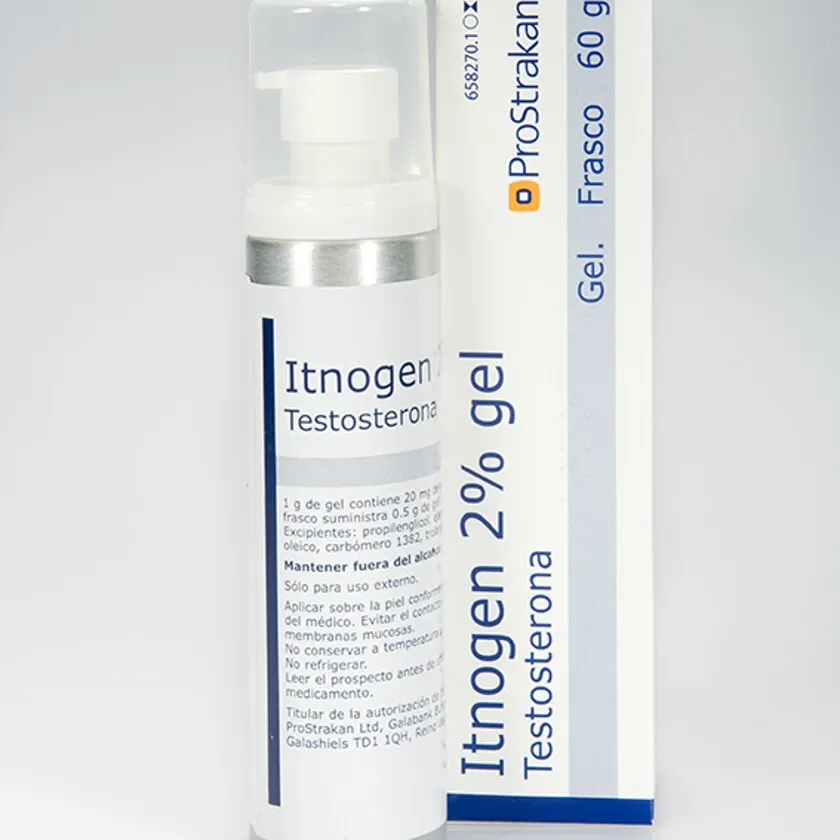
Table of Contents
Package leaflet: Information for the user
Introduction
PACKAGE LEAFLET: INFORMATION FOR THE USER
Itnogen 20mg/g transdermal gel
Testosterone
Read the entire leaflet carefully before you start using this medicine, because it contains important information for you.
- Keep this leaflet, as you may need to read it again.
- If you have any questions, ask your doctor or pharmacist.
- This medicine has been prescribed for you only and must not be given to other people, even if they have the same symptoms as you, because it may harm them.
- If you experience any adverse effects, consult your doctor or pharmacist, even if they are adverse effects not listed in this leaflet. See section 4.
Leaflet contents:
- What Itnogen is and what it is used for
- What you need to know before using Itnogen
- How to use Itnogen
- Possible side effects
- How to store Itnogen
- Contents of the pack and other information
1. What Itnogen is and what it is used for
The active substance, testosterone, is a male hormone and a type of androgen.
Itnogen is used in adult men as testosterone replacement therapy to treat various health problems caused by a lack of testosterone (male hypogonadism). This must be confirmed by two separate blood testosterone measurements and the presence of clinical symptoms such as:
- impotence
- infertility
- low sexual appetite
- fatigue
- depressive mood states
- bone loss caused by low hormone levels
2. What you need to know before using Itnogen
Itnogen should only be used if your doctor has confirmed, based on your symptoms and laboratory test results, that you have hypogonadism. Before starting treatment, your doctor should have ruled out other possible causes of your symptoms.
Only men should use Itnogen. Itnogen has not been studied in males under 18 years of age, and there is limited experience in treating men over 65 years of age.
Do not use Itnogen:
If you:
- are allergic to testosterone or any of the other ingredients of this medicine (listed in section 6).
- have or are suspected of having breast or prostate cancer.
If any of these situations apply to you, inform your doctor or pharmacist.
Warnings and precautions
A medical review is necessary before starting treatment and periodically during treatment (usually once or twice a year).
If you have a serious heart, liver, or kidney disease, treatment with Itnogen may cause serious complications in the form of fluid retention, which may occasionally be accompanied by heart failure (congestive).
Before starting and during treatment, your doctor will check the following parameters in your blood tests: testosterone levels and complete blood count.
Inform your doctor if you have high blood pressure or are being treated for high blood pressure, as testosterone may cause an increase in blood pressure.
Testosterone treatment may increase the risk of developing a disorder characterized by an enlarged prostate (benign prostatic hyperplasia) or prostate cancer. Testosterone treatment may also affect your red blood cell count, blood lipid profile, and liver function.
Inform your doctor before treatment if you:
- have swollen hands or feet
- are overweight or have chronic lung disease, as testosterone treatment may worsen sleep apnea (temporary interruption of breathing during sleep)
- have diabetes and use insulin to control blood sugar, as testosterone treatment may alter your response to insulin
- have or develop epilepsy or migraines, as these conditions may worsen during treatment
- have bone cancer, as your doctor will need to monitor your blood calcium levels during treatment
- have or have had blood clotting disorders
- thrombophilia (a blood clotting disorder that increases the risk of thrombosis – blood clots in blood vessels)
- factors that increase the risk of blood clots in a vein: previous blood clots in a vein; smoking; obesity; cancer; immobility; if a close family member has had a blood clot in the leg, lung, or another organ at an early age (e.g., under 50 years); or as you age.
How to recognize a blood clot: painful swelling of one leg or a sudden change in skin color, for example paleness, redness, or blueness; sudden shortness of breath; sudden and unexplained cough that may produce blood; or sudden chest pain, severe dizziness or lightheadedness, severe stomach pain, sudden loss of vision. Seek urgent medical attention if you experience any of these symptoms.
Contact your doctor if you:
- experience frequent or prolonged erections
- feel irritable or nervous or notice weight gain
- feel nauseous or vomit, notice changes in skin color, or develop swollen ankle joints
- notice any changes in your breathing patterns, including during sleep
These symptoms may indicate that your dose of Itnogen is too high, and your doctor may need to adjust it.
Contact your doctor if you notice any type of skin reaction at the application site, such as burning or stinging sensation, dryness, rash, redness, or itching. If the reaction is severe, your doctor should review your treatment and discontinue it if necessary.
Athletes should be aware that this medicine contains testosterone, which may result in a positive doping test.
Itnogen must not be used to treat male infertility or sexual impotence.
Women must not use Itnogen due to its potential virilizing effects (such as facial or body hair growth, voice changes to a deeper tone, or changes in menstrual cycle).
How to prevent transfer of Itnogen to other people:
During repeated or prolonged physical contact, this medicine may be transferred to another person. This could cause adverse effects such as facial or body hair growth, voice changes to a deeper tone, or changes in menstrual cycle in women, or accelerated growth, genital enlargement, and early puberty (including pubic hair development) in children. Wearing clothing that covers the application site or washing the area before contact may reduce this risk.
Patients using this medicine who may have close physical contact with children should take additional precautions, as testosterone can pass through clothing. Be sure to follow the application technique (see section 3 of this leaflet) when in physical contact with children, including covering the application site with clean clothing once the gel has dried. Additionally, wash the application site with soap after the recommended time (at least 2 hours) and cover it again with clean clothing before physical contact with children.
To ensure your partner's safety, you must wait at least four hours after applying Itnogen before having sexual intercourse, and either wear clothing that covers the application site at the time of contact or wash the application site with water and soap before sexual intercourse.
You should wear clothing covering the application site when in contact with children to avoid the risk of transferring the gel to the child’s skin.
If you transfer some of the testosterone gel to another person through skin contact or if someone is directly exposed to the gel, wash the contact area of the other person with water and soap as soon as possible.
If a healthcare professional or caregiver applies Itnogen to a patient, they must use appropriate disposable gloves. The gloves should be alcohol-resistant, as the gel contains ethanol and isopropyl alcohol.
Contact your doctor if you notice changes in body hair, a significant increase in acne, or other signs indicating the development of male characteristics in people not receiving treatment with Itnogen (i.e., female partners or children).
Other medicines and Itnogen
Tell your doctor or pharmacist if you are taking, have recently taken, or might need to take any other medicines, especially the following:
- anticoagulants
- corticosteroids
Also inform your doctor or pharmacist about any medicines you have purchased without a prescription.
Use of Itnogen with food and drink
Food and drink do not affect Itnogen.
Pregnancy and breastfeeding
- Itnogen should only be used in men.
- Pregnant or breastfeeding women must not use Itnogen.
- Pregnant women should avoid all contact with skin areas treated with Itnogen. Itnogen may cause harm or abnormalities in the fetus. If your partner becomes pregnant, you must follow the advice in this section on how to avoid transferring testosterone gel. In case of contact with a treated skin area, the area should be washed immediately with water and soap.
Driving and using machines
It is unlikely that Itnogen will affect your ability to drive or use machines.
Itnogen contains butylhydroxytoluene, propylene glycol, and ethanol
Butylhydroxytoluene may cause local skin reactions (e.g., contact dermatitis) or irritation of the eyes and mucous membranes.
Itnogen contains propylene glycol and ethanol
This medicine contains 175 mg of propylene glycol per pump actuation.
This medicine contains 75 mg of alcohol (ethanol) per pump actuation.
It may cause a burning sensation on damaged skin.
This product is flammable until dry.
3. How to use Itnogen
Follow exactly the administration instructions for this medicine given by your doctor. Consult your doctor or pharmacist if you have any doubts about how and when to apply the gel.
The usual starting dose is 3 g of gel (containing 60 mg of testosterone) per day. Your doctor may adjust your dose, and the maximum dose is 4 g of gel (80 mg of testosterone) per day.
Itnogen is supplied in a bottle with a pump mechanism that delivers half a gram of gel (10 mg of testosterone) each time the piston is pressed (when the pump mechanism is pushed down).
First use of the device:
Before using the pump dispenser for the first time, it is necessary to expel air from the pump. To do this, place the reservoir in an upright position and slowly and fully press the actuator several times until the gel appears. Press the actuator six more times. Discard the gel dispensed as a result of these six actuations. Expelling air from the pump is only necessary before the first dose.
Administration of Itnogen:
Your doctor will tell you how many times you should press the piston to administer the dose of gel you require after priming the pump. The following table includes further information on this.
Number of pumps | Amount of gel (g) | Amount of testosterone applied to the skin (mg) |
1 | 0.5 | 10 |
2 | 1 | 20 |
4 | 2 | 40 |
6 | 3 | 60 |
8 | 4 | 80 |
Apply the gel to an intact, clean, and dry area of skin once daily at the same time each day, for example, in the morning after a shower.
The gel should either be rubbed onto the skin of the abdomen (over an area of at least 10 by 30 cm), or divided into two equal parts and each part rubbed onto the inner region of each thigh (over an area of at least 10 by 15 cm). It is recommended to administer Itnogen on the abdomen and on the inner region of both thighs on alternate days.
Application to other areas should be avoided. Itnogen must not be applied to the genitals.
Gently rub the gel into the skin with one finger until it dries. Once the gel has dried, cover the application site with clean clothing (e.g., a T-shirt or shorts or long pants). After application, wash your hands thoroughly with water and soap. Before having close physical contact with another person (adult or child), wash the application site with water and soap after the recommended time has elapsed (at least 2 hours) and cover it again with clean clothing.
If you wish to take a bath or a shower, do so before applying Itnogen or wait at least two hours after application.
Two weeks after starting the medication, your doctor will take blood samples to check whether a dose adjustment is needed. While using Itnogen, you should expect to require regular medical monitoring.
If you are responsible for arranging blood tests during Itnogen use, ensure that all testosterone measurements are performed at the same laboratory due to variability in analytical values between different diagnostic laboratories.
If you use more Itnogen than you should
Contact a doctor, hospital, or pharmacist if you have applied an excessive amount of the medicine.
If you forget to use Itnogen
Do not use a double dose to make up for missed doses. Apply the next dose at the usual time.
If you stop using Itnogen
Always consult your doctor or pharmacist before stopping treatment with this medicine.
If you have any further questions about the use of this medicine, ask your doctor or pharmacist.
4. Possible adverse effects
Like all medicines, this medicine can cause adverse effects, although not everyone experiences them.
The adverse effects classified as very common (affecting more than 1 in every 10 users) are skin reactions at the application site such as burning or stinging sensation, dryness, skin rashes, redness, or itching. These are usually mild and transient adverse effects, but if they cause significant discomfort or last for more than a few days, inform your doctor or pharmacist as soon as possible.
The adverse effects classified as common (affecting between 1 and 10 users in every 100) are: swelling of hands or feet, increased blood pressure, prostate disorders (including an increase in blood concentrations of a protein called prostate-specific antigen, produced by the prostate), increased body hair growth, enlargement of the breasts, increased red blood cell count (which is measured in blood samples). Increase in red blood cell count, hematocrit (percentage of red blood cells in the blood), and hemoglobin (the part of red blood cells that carries oxygen), identified in periodic blood tests.
Other adverse effects known to be associated with testosterone treatment are: baldness, seborrhea, acne, jaundice (liver problems which may sometimes be associated with yellowing of the skin and whites of the eyes), abnormalities in liver function tests, nausea, changes in libido, increased frequency of erections, difficulty urinating, depression, nervousness, hostility, weight gain, muscle cramps or pain, fluid retention, swelling of the ankles, sleep apnea, and rare cases of painful and prolonged erections. A reduction in sperm production and testicular size may occur when the medicine is administered at high doses. Prolonged administration of testosterone may cause changes in the body's electrolyte levels.
There is no convincing evidence that testosterone replacement therapy in hypogonadal men induces prostate cancer. However, testosterone therapy should be avoided in men who are known or suspected to have prostate cancer.
Hyperglycemia (excess blood sugar) has been reported in 2 individuals with a history of diabetes mellitus.
Reporting of adverse effects
If you experience any type of adverse effect, consult your doctor, pharmacist, or nurse, even if it is a possible adverse effect not listed in this leaflet. You may also report them directly via:
Spanish Pharmacovigilance System for Human Medicines: www.notificaRAM.es.
By reporting adverse effects, you can help provide more information on the safety of this medicine.
5. Storage of Itnogen
Keep this medicine out of sight and reach of children.
Do not use this medicine after the expiry date stated on the vial after EXP. The expiry date is the last day of the month indicated.
Do not store above 25°C.
Do not refrigerate or freeze.
After opening, keep the vial in an upright position.
Medicines must not be disposed of via wastewater or household waste. Dispose of containers and unused medicines at the SIGRE collection point at your pharmacy. Ask your pharmacist how to dispose of containers and medicines you no longer need. This will help protect the environment.
6. Contents of the pack and other information
Composition of Itnogen
- The active substance is testosterone. One gram of gel contains 20 mg of testosterone.
- The other components are propylene glycol; anhydrous ethanol; isopropyl alcohol; oleic acid; carbomer 1382; tromethamine; butylhydroxytoluene (E321); purified water; and hydrochloric acid (for pH adjustment).
Appearance of Itnogen and contents of the container
A transparent gel, ranging in appearance from colourless to slightly yellowish.
It is supplied in bottles, each containing 60 grams of gel. The bottles are equipped with a pump mechanism that delivers a fixed amount of gel.
A carton may contain one, two, or three gel bottles. Only certain pack sizes may be marketed.
Marketing Authorization Holder:
Advanz Pharma Limited
Unit 17, Northwood House,
Northwood Crescent,
Dublin 9, D09 V504,
Ireland
Manufacturer:
PHARBIL Waltrop GmbH
Im Wirrigen 25
45731 Waltrop
Germany
Further information on this medicinal product is available by contacting the local representative of the Marketing Authorization Holder:
Advanz Pharma Spain S.L.U.
Paseo de la Castellana 135, 7th Floor
Madrid – 28046 – Spain
Tel. +34 900 834 889
This medicinal product is authorized in the Member States of the European Economic Area and in the United Kingdom (Northern Ireland) under the following names:
Cyprus, Denmark, Finland, Germany, Greece, Ireland, the Netherlands, Norway, United Kingdom (and Northern Ireland): Tostran
Italy, Sweden: Tostrex
Spain: Itnogen
France: Fortigel
Date of the most recent review of this leaflet: 04/2024
Detailed and up-to-date information on this medicinal product is available on the website of the Spanish Agency of Medicines and Health Products (AEMPS) http://www.aemps.gob.es/