Iopimax 10 mg/ml eye drops solution
Spain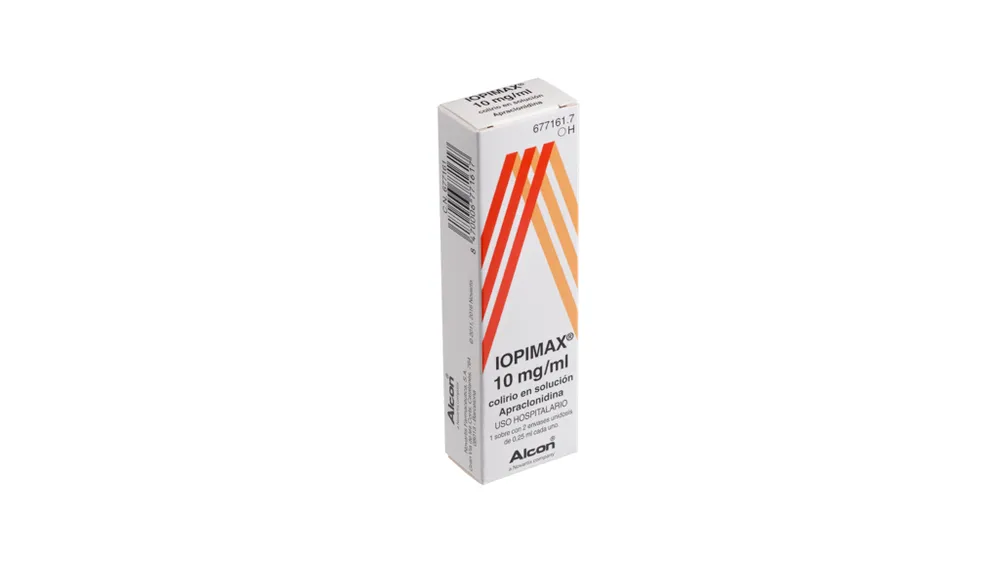
Table of Contents
Package leaflet: Information for the user
Introduction
PACKAGE LEAFLET: INFORMATION FOR THE USER
IOPIMAX 10 mg/ml eye drops solution
Apraclonidine hydrochloride
Read the entire leaflet carefully before you start using this medicine, as it contains important information for you.
- Keep this leaflet as you may need to read it again.
- If you have any questions, ask your doctor or pharmacist.
- If you experience any side effects, talk to your doctor or pharmacist, even if they are not listed in this leaflet. See section 4.
Contents of the leaflet
- What IOPIMAX is and what it is used for
- What you need to know before IOPIMAX is administered to you
- How IOPIMAX is administered
- Possible side effects
- How to store IOPIMAX
- Contents of the pack and other information
Your doctor will administer IOPIMAX eye drops. This leaflet aims to inform you about the medicine.
1. What IOPIMAX is and what it is used for
IOPIMAX eye drops contain apraclonidine, which is used to control or prevent an increase in pressure inside the eye following laser eye surgery.
2. What you need to know before IOPIMAX is administered to you
This medicine may not be suitable for you. It is important that you review all of the following points, as if any of them apply to you, your doctor may decide to prescribe a different medicine:
IOPIMAX must not be administered in the following cases:
- children (this medicine is not indicated for patients under 18 years of age)
- if you are allergic to clonidine, apraclonidine, or to any of the other components of this medicine (listed in section 6)
- if you have a history of any uncontrolled, unstable, or severe heart disease (including chest pain, angina pectoris, heart attacks, or heart failure)
- if you are taking monoamine oxidase inhibitor antidepressants.
If you think any of the above apply to you or if you have any doubts, consult your doctor before receiving this medicine.
Take special care with IOPIMAX. Consult your doctor if:
•you have or are being treated for:
- heart disease (including chest pain, angina pectoris, heart attacks, or heart failure)
- high blood pressure
- circulatory problems (including stroke, Raynaud's disease, or Buerger's disease)
- vasovagal attacks (episodes of fainting)
- reduced liver or kidney function.
If any of these conditions apply to you, you may be at increased risk of effects on your heart or circulatory system, and therefore your blood pressure and heart rate will be closely monitored.
? you suffer from depression, as clonidine and its derivatives may cause depression
? you suffer from diabetes or have low blood sugar levels, as this medicine may mask the signs and symptoms of a sudden drop in blood sugar, such as rapid heartbeat or tremors
? you regularly consume alcohol, as IOPIMAX may enhance its effects
? you have previously had an exaggerated response to other medicines that reduce intraocular pressure, in which case your eye pressure should be closely monitored.
If any of the above apply to you or if you have any doubts, consult your doctor before receiving this medicine.
Other medicines and IOPIMAX
Do not receive IOPIMAX if:
? you are taking monoamine oxidase inhibitors (used to treat depression), e.g. phenelzine, isocarboxazid, tranylcypromine, moclobemide
? you are taking tricyclic antidepressants (commonly used to treat depression), e.g. amitriptyline, imipramine, doxepin, mianserin, trazodone, dosulepin, lofepramine
? you are taking medicines containing sympathomimetics used to treat various conditions such as asthma (e.g. salbutamol, terbutaline, bambuterol), Parkinson's disease, and heart conditions, which may also be present in cough and cold medicines.
Take special care with IOPIMAX if:
? you are using eye drops to treat glaucoma containing sympathomimetics, e.g. phenylephrine, brimonidine, dipivefrin, as your blood pressure may increase
? you are taking medicines for sleep, pain relief, or sedatives, as IOPIMAX may enhance their effects
? you are taking or have taken neuroleptics (very potent tranquilizers used to treat certain mental illnesses, e.g. chlorpromazine, flupenthixol, haloperidol), as your blood pressure may drop too low.
If you are at risk of effects on your blood pressure, it will be closely monitored, along with your heart rate.
Before receiving IOPIMAX, inform your doctor if you are taking, have recently taken, or might need to take any other medicines.
Use of IOPIMAX with food and drinks
IOPIMAX should be used with caution if you have recently consumed alcohol or drink alcohol regularly.
Pregnancy, breastfeeding, and fertility
IOPIMAX must not be used if you are pregnant or think you may become pregnant, or if you are breastfeeding.
Your doctor should have properly informed you about this. If not, consult your doctor before using any medicine.
Driving and use of machines
This type of medicine may cause drowsiness. If this occurs, do not drive or operate tools or machinery.
3. How IOPIMAX is administered
Adults and elderly patients
IOPIMAX is supplied in a specially designed single-use container. Your doctor will administer one drop one hour before laser surgery and another drop immediately after surgery.
After IOPIMAX is administered, you will be instructed to press with your finger on the inner corner of the eye, near the nose. This helps prevent IOPIMAX from passing into the rest of the body.
If you are using other ophthalmic medications, wait at least 5 minutes between the administration of this eye drop and other ophthalmic medications. Ophthalmic ointments should be administered last.
Use in children
This medicine must not be used in children.
4. Possible adverse effects
Like all medicines, this medicine can cause adverse effects, although not everyone experiences them.
When used before and after laser surgery, you may experience some or all of the following adverse effects in your eyes:
Common (may affect up to 1 in 10 people treated)
- redness in one or both eyes
- increased size of a pupil
- inability to close the eye
- eye disorder (whitish appearance of the eye surface)
- unusual or uncomfortable sensation in the eye
- dry eye sensation
Uncommon (may affect up to 1 in 100 people treated)
- bleeding on the surface of the eye (conjunctival haemorrhage)
- eye inflammation (which may include eye pain, burning, redness, or swelling)
- retraction or elevation of the upper eyelid
- extremely low pressure inside the eye (your doctor will notice this during eye checks)
- blurred or reduced vision
- bleeding on the surface of the eye
- blurred vision
- eye allergy
- itchy eye
- eye irritation
You may also experience adverse effects in other parts of the body:
Common (may affect up to 1 in 10 people treated)
- dryness sensation in the nose
- unusual or unpleasant taste
Uncommon (may affect up to 1 in 100 people treated)
- irregular heartbeat
- difficulty sleeping
- altered dreams
- episodes of fainting
- burning or tingling sensations
- decreased libido
- feeling irritable
- slow heartbeat or palpitations
- feeling faint or dizzy when sitting or standing up
- diarrhoea
- nausea or vomiting
- stomach pain or discomfort
- headaches
- tiredness
Rare (may affect up to 1 in 1,000 people treated)
- reduced sensitivity or numbness (tingling sensation)
- difficulty breathing
- runny nose or excess saliva
- dry or burning sensation in the nose
- dry mouth
- increased sweating
- itching of the skin
- pain in arms or legs
- tightness or pain in the chest
- feeling of heat or cold
Frequency not known (cannot be estimated from available data)
- decreased blood pressure
- increased blood pressure
If you experience an allergic reaction, unusual dizziness or delirium, or have irregular heartbeats, inform your doctor immediately.
Reporting of adverse effects
If you experience any adverse effects, consult your doctor or pharmacist, even if they are possible adverse effects not listed in this leaflet. You may also report them directly via the Spanish Pharmacovigilance System for Human Medicines: https://www.notificaRAM.es. By reporting adverse effects, you can help provide more information on the safety of this medicine.
5. IOPIMAX Storage
- Do not use IOPIMAX after the expiry date stated on the outer packaging and container following "EXP". The expiry date refers to the last day of the month indicated.
- Do not store above 25°C. Keep in the original packaging to protect from light.
- Keep out of the reach and sight of children.
- Use immediately after opening.
6. Contents of the container and other information
Composition of IOPIMAX
- The active substance is apraclonidine 10 mg/mL (as hydrochloride).
- The other components are sodium acetate, sodium chloride, and purified water. Occasionally, very small amounts of hydrochloric acid or sodium hydroxide may be added to adjust the eye drops to be more suitable for your eyes.
Appearance of the medicine and contents of the pack
IOPIMAX 10 mg/mL eye drops solution is pale yellow and is supplied in a 0.25 mL container.
Marketing Authorization Holder:
Essential Pharma Limited,
Vision Exchange Building
Triq it-Territorjals, Zone 1,
Central Business District,
Birkirkara, CBD 1070,
Malta
Manufacturer:
Alcon Couvreur N.V.
Rijksweg, 14
B-2870 Puurs, Belgium
Date of the most recent revision of this leaflet: April 2018