Ideos Unidia 1000 mg/880 IU effervescent granules
Spain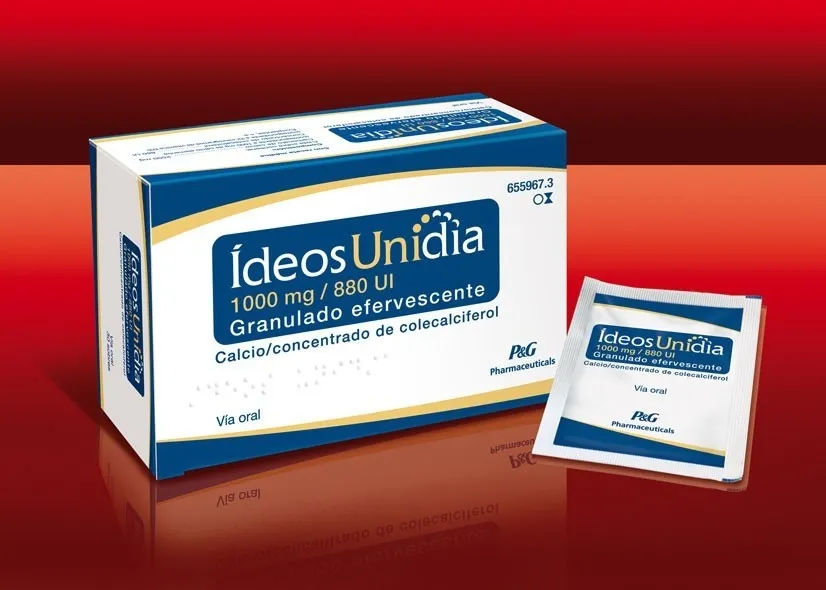
Table of Contents
Package leaflet: Information for the user
Introduction
Package leaflet: information for the user
IDEOS UNIDIA 1000 mg/880 IU effervescent granules
Calcium carbonate/colecalciferol
Read the entire leaflet carefully before you start taking this medicine, because it contains important information for you.
Follow exactly the instructions for administration of the medicine contained in this leaflet or those indicated by your doctor, pharmacist, or nurse.
- Keep this leaflet, as you may need to read it again.
- If you need advice or more information, consult your pharmacist.
- If you experience adverse effects, consult your doctor, pharmacist, or nurse, even if they are adverse effects not listed in this leaflet. See section 4.
- You should consult a doctor if you worsen or do not get better.
Contents of the leaflet
- What Ideos Unidia is and what it is used for
- What you need to know before taking Ideos Unidia
- How to take Ideos Unidia
- Possible adverse effects
- Storage of Ideos Unidia
- Contents of the pack and other information
1. What Ideos Unidia is and what it is used for
Ideos Unidia contains the active substances calcium carbonate and colecalciferol (Vitamin D3).
This medicine is used in elderly patients for the treatment of calcium and vitamin D deficiency. It is also used in combination with treatments for osteoporosis in patients with, or at high risk of, combined deficiencies of vitamin D and calcium.
2. What you need to know before taking Ideos Unidia
Do not take Ideos Unidia:
- if you are allergic to the active substances or to any of the other components of this medicine (listed in section 6),
- if, due to an underlying disease, you have high levels of calcium in your urine (hypercalciuria) or in your blood (hypercalcemia),
- if you have kidney stones,
- if you have excessive levels of vitamin D in your blood (hypervitaminosis D).
Warnings and precautions
Talk to your doctor or pharmacist before taking Ideos Unidia:
- if you have impaired kidney function or are prone to developing kidney stones. Your treatment should be carefully monitored if your kidneys are not functioning properly to ensure that calcium does not accumulate excessively in your blood.
- if you have sarcoidosis (an inflammatory disease of unknown origin characterized by the formation of nodules in various parts of the body).
- if you are an immobilized patient with osteoporosis.
If you are on long-term treatment, your doctor may occasionally wish to monitor your blood calcium levels and take urine samples to assess kidney function. Depending on the results, your doctor may reduce the dose or decide to discontinue treatment.
Children and adolescents
Ideos Unidia is not indicated for use in children.
Taking Ideos Unidia with other medicines
Inform your doctor or pharmacist if you are taking, have recently taken, or might need to take any other medicines.
Consult your doctor if you are taking any of the following medicines:
- heart medications such as digoxin or other cardiac glycosides,
- bisphosphonates or sodium fluoride (medicines used to treat bone disorders),
- thiazide diuretics,
- phenytoin or barbiturates (medicines used in the treatment of epilepsy),
- glucocorticosteroids,
- tetracycline antibiotics,
- other medicines containing vitamin D or calcium.
Calcium salts may reduce the absorption of iron, zinc, and strontium ranelate. Therefore, preparations containing iron, zinc, or strontium ranelate should be taken at least two hours before or after Ideos Unidia.
Taking Ideos Unidia with food, drinks and alcohol
This medicine may interact with certain foods containing oxalic acid (e.g., spinach and rhubarb), phosphates (e.g., bran), or phytic acid (e.g., whole grains), as these may reduce the absorption of calcium contained in Ideos Unidia.
Pregnancy, breast-feeding and fertility
If you are pregnant or breast-feeding, think you may be pregnant or are planning to become pregnant, consult your doctor or pharmacist before using this medicine.
Due to the high dose of vitamin D, this medicine is not indicated during pregnancy and lactation. In pregnant women, overdoses of calcium and vitamin D should be avoided, as persistent hypercalcemia has been associated with adverse effects on fetal development.
Ideos Unidia may be used during lactation, but your doctor should be informed. This should be taken into account when administering additional vitamin D to the infant.
Driving and use of machines
Ideos Unidia is not expected to affect your ability to drive or operate machinery.
Ideos Unidia contains potassium, sodium, sorbitol and sucrose
- This medicine contains 4.2 mmol of potassium (163 mg) per sachet, which should be taken into consideration in the treatment of patients with renal impairment or those on potassium-restricted diets.
- This medicine contains less than 1 mmol of sodium (23 mg) per sachet and is therefore considered essentially “sodium-free”.
- This medicine contains 1.1 mg of sorbitol per sachet.
- If your doctor has diagnosed you with an intolerance to certain sugars, consult with him before taking this medicine. It may cause dental caries.
3. How to take Ideos Unidia
Follow exactly the administration instructions provided in this leaflet or those indicated by your doctor, pharmacist, or nurse. If in doubt, consult your doctor, pharmacist, or nurse.
Adults
Pour the contents of the sachet into a glass, add a large amount of water, stir, and drink the resulting solution immediately after effervescence has stopped. The recommended dose is one sachet per day. Your doctor or pharmacist will tell you how many sachets you need to take each day.
If you take more Ideos Unidia than you should
If you take an excessive dose of this medicine, the following symptoms may occur: nausea, vomiting, intense thirst, increased frequency of urination, and constipation. Inform your doctor immediately if you experience any of these effects and take the necessary measures.
In case of prolonged overdose, calcifications in blood vessels or tissues may occur.
In case of overdose or accidental ingestion, contact the Toxicology Information Service. Telephone: 91 562 04 20.
If you forget to take Ideos Unidia
Do not take a double dose to make up for missed doses.
If you have any further questions about the use of this medicine, ask your doctor, pharmacist, or nurse.
4. Possible adverse effects
Like all medicines, this medicine can cause adverse effects, although not everyone will experience them.
You may have an allergic reaction. If you experience rash, itching, difficulty breathing, or swelling of the face, lips, throat, or tongue, stop taking the medicine immediately and seek urgent medical help.
Uncommon (may affect up to 1 in 100 people):
- high concentration of calcium in the blood (hypercalcaemia). Symptoms include nausea, vomiting, loss of appetite, constipation, stomach pain, bone pain, extreme thirst, needing to urinate more often, muscle weakness, drowsiness, and confusion
- increased calcium content in urine (hypercalciuria)
Rare (may affect up to 1 in 1,000 people):
- constipation, flatulence, nausea, abdominal pain, diarrhoea
- itching, rash, and urticaria
Not known (frequency cannot be estimated from available data):
- milk-alkali syndrome associated with high concentration of calcium in blood (hypercalcaemia), elevated blood pH (alkalosis), and renal failure.
Reporting of adverse effects
If you experience any adverse effect, consult your doctor, pharmacist, or nurse, even if it is a possible adverse effect not listed in this leaflet. You can also report them directly via the Spanish Pharmacovigilance System for Human Medicinal Products: https://www.notificaram.es. By reporting adverse effects, you can help provide more information on the safety of this medicine.
5. Storage of Ideos Unidia
Keep this medicine out of sight and reach of children.
Do not use this medicine after the expiry date stated on the packaging after EXP. The expiry date refers to the last day of the month indicated.
Do not store above 25°C.
Medicines must not be disposed of via wastewater or household waste. Unused medicines and their containers should be handed over to the SIGRE Point at your pharmacy. If you are in doubt, ask your pharmacist how to dispose of unused medicines and their containers properly. This will help protect the environment.
6. Contents of the pack and other information
Composition of Ideos Unidia
The active substances in one 8 g sachet are:
Calcium carbonate 2500 mg
equivalent to elemental calcium 1000 mg or 25 mmol
Concentrate of colecalciferol (in powder) 880 IU
equivalent to colecalciferol (vitamin D3) 22 µg
The other components are citric acid, malic acid, glucono-lactone, maltodextrin, sodium cyclamate, sodium saccharin, lemon flavour (containing sorbitol), rice starch, potassium carbonate, sodium ascorbate, all-rac-alpha-tocopherol, modified starch, sucrose, medium-chain triglycerides and anhydrous colloidal silica.
Presentation of the product and contents of the pack
8 g sachets (paper/aluminium/polyethylene); cartons containing 20, 30, 46, 50 or 100 sachets, sample carton containing 10 sachets, and multi-packs containing 90 (3 packs of 30) sachets.
Only some pack sizes may be marketed.
Marketing Authorisation Holder and Manufacturer
Marketing Authorisation Holder
Theramex Ireland Limited
3rd Floor, Kilmore House,
Park Lane, Spencer Dock,
Dublin 1
D01 YE64
Ireland
Manufacturer:
Hermes Pharma Ges.m.b.H.
Schwimmschulweg 1a
9400 Wolfsberg, Austria
or
MEDA Pharma GmbH & Co. KG
Benzstrasse 1
61352 Bad Homburg
Germany
Local representative:
Theramex Healthcare Spain, S.L.
Calle Martínez Villergas 52, Edificio C, planta 2ª izquierda.
28027 Madrid
Spain
Date of the most recent review of this leaflet: October 2022
Detailed and up-to-date information on this medicinal product is available on the website of the Spanish Agency of Medicines and Health Products (AEMPS) http://www.aemps.gob.es/