Ibis 20 mg orodispersible tablets
Spain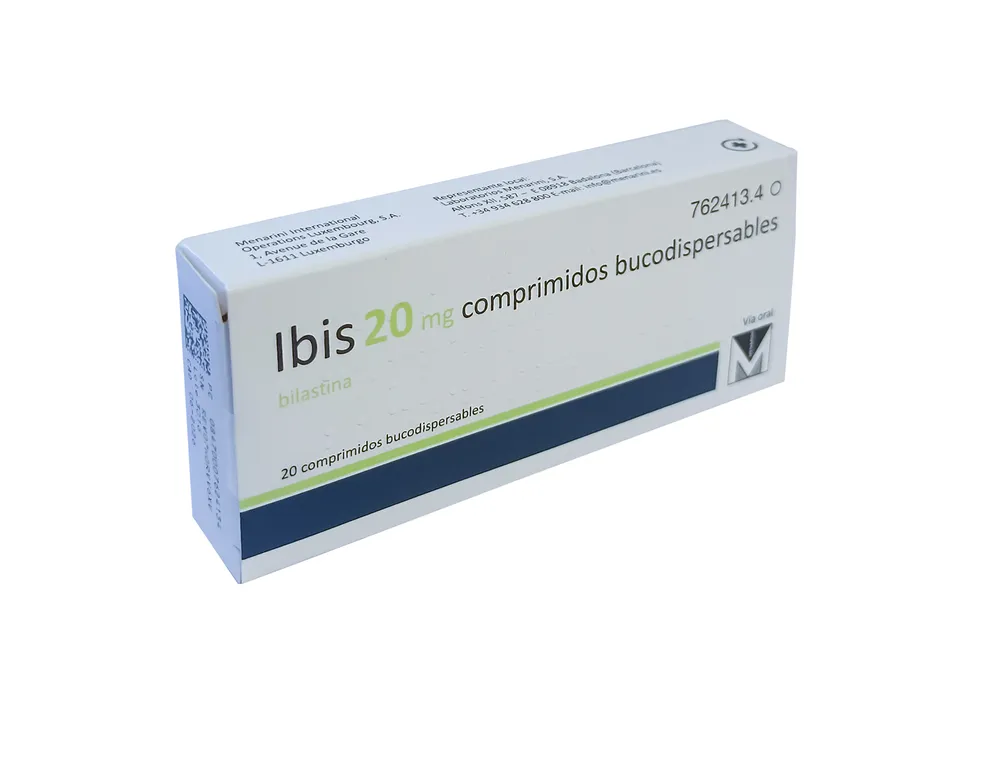
Table of Contents
Package leaflet: Information for the user
Introduction
Package leaflet: information for the patient
Ibis 20 mg orodispersible tablets
bilastine
Read the entire leaflet carefully before you start taking this medicine because it contains important information for you.
- Keep this leaflet as you may need to read it again.
- If you have any questions, ask your doctor or pharmacist.
- This medicine has been prescribed for you only and must not be given to other people, even if they have the same symptoms as you, because it may harm them.
- If you experience any adverse effects, consult your doctor or pharmacist, even if they are adverse effects not listed in this leaflet. See section 4.
Leaflet contents
- What Ibis is and what it is used for
- What you need to know before taking Ibis
- How to take Ibis
- Possible adverse effects
- How to store Ibis
- Contents of the pack and other information
1. What Ibis is and what it is used for
Ibis contains bilastine as the active substance, which is an antihistamine.
Ibis is used to relieve symptoms of allergic rhinoconjunctivitis (sneezing, nasal itching, nasal discharge, nasal congestion, and red, watery eyes) and other forms of allergic rhinitis in adults and adolescents aged 12 years and older. It may also be used to treat itchy skin rashes (hives or urticaria).
2. What you need to know before taking Ibis
Do not take Ibis
If you are allergic to bilastina or to any of the other ingredients of this medicine (listed in section 6).
Warnings and precautions
Consult your doctor or pharmacist before starting to use this medicine if you have moderate or severe renal impairment, low blood levels of potassium, magnesium, or calcium, if you have or have had heart rhythm problems or if your heart rate is very low, if you are taking medicines that may affect heart rhythm, or if you have or have had a specific abnormal heart rhythm pattern (known as QTc interval prolongation on the electrocardiogram) that may occur in certain types of heart disease and are also taking other medicines (see “Use of Ibis with other medicines”).
Children
Do not administer Ibis 20 mg orodispersible tablets to children under 12 years of age. For alternative pharmaceutical forms of bilastina suitable for use in children under 12 years of age, see section 3 “Use in children”.
Do not exceed the recommended dose. If symptoms persist, consult your doctor.
Other medicines and Ibis
Inform your doctor or pharmacist if you are taking, have recently taken, or might need to take any other medicines, including those obtained without a prescription.
In particular, please discuss with your doctor if you are taking any of the following medicines:
- Ketoconazole tablets (used to treat Cushing's syndrome when the body produces an excess of cortisol)
- Erythromycin (an antibiotic)
- Diltiazem (used to treat angina pectoris – chest pain or pressure)
- Cyclosporine (used to reduce the activity of your immune system, thereby preventing transplant rejection or reducing disease activity in autoimmune and allergic disorders such as psoriasis, atopic dermatitis, or rheumatoid arthritis)
- Ritonavir (used to treat HIV)
- Rifampicin (an antibiotic)
Taking Ibis with food, drinks, and alcohol
These orodispersible tablets must not be taken with food or fruit juices, especially grapefruit juice or other fruit juices, as this would reduce the effect of bilastina. To avoid this, you may:
- take the orodispersible tablet and wait one hour before eating or drinking fruit juices, or
- if you have eaten food or drunk fruit juice, wait two hours before taking the orodispersible tablet.
Bilastina, at the recommended dose (20 mg), does not increase drowsiness caused by alcohol.
Pregnancy, breastfeeding, and fertility
There are no data, or data are limited, on the use of bilastina in pregnant women, during breastfeeding, or on effects on fertility.
If you are pregnant or breastfeeding, think you may be pregnant, or plan to become pregnant, consult your doctor or pharmacist before using this medicine.
Consult your doctor or pharmacist before using any medicine.
Driving and using machines
It has been shown that bilastina 20 mg does not affect driving performance in adults. However, individual patient response to the medicine may vary. Therefore, assess how this medicine affects you before driving or operating machinery.
Ibis contains sodium and ethanol
This medicine contains less than 1 mmol of sodium (23 mg) per orodispersible tablet; i.e., essentially “sodium-free”.
This medicine contains 0.0030 mg of alcohol (ethanol) in each orodispersible tablet, equivalent to 1.6 mg/100 g (0.0016% w/w). The amount of alcohol in an 185 mg orodispersible tablet is equivalent to less than 1 ml of beer or 1 ml of wine.
The small amount of alcohol contained in this medicine does not produce any noticeable effect.
3. How to take Ibis
Follow exactly the instructions for using this medicine given by your doctor or pharmacist. If in doubt, consult your doctor or pharmacist again.
The recommended dose in adults, including elderly patients and adolescents aged 12 years and older, is 1 orodispersible tablet (20 mg of bilastine) daily.
- The orodispersible tablet is for oral use.
- Please place the orodispersible tablet in the mouth. It will rapidly disperse in saliva and can then be easily swallowed.
- Alternatively, you may disperse the orodispersible tablet in water before taking it.
- You should use water only for dispersion; do not use grapefruit juice or any other fruit juice.
- The orodispersible tablet should be taken one hour before or two hours after eating any food or fruit juice (see section 2, "Taking Ibis with food, drinks and alcohol").
Duration of treatment
Regarding the duration of treatment, your doctor will determine the type of illness you have and advise you on how long you should take this medicine.
Use in children
For children aged 2 to 11 years with a minimum body weight of 15 kg, other more suitable pharmaceutical forms are available—bilastine 10 mg orodispersible tablets or bilastine 2.5 mg/ml oral solution. Please consult your doctor or pharmacist.
Do not administer bilastine to children under 2 years of age or with a body weight below 15 kg, as sufficient data are not available.
If you take more Ibis than you should
If you, or anyone else, exceed the recommended dose of this medicine, inform your doctor immediately or go to the nearest hospital emergency department. Please remember to bring this medicine package or the package leaflet with you.
In case of overdose or accidental ingestion, contact your doctor or pharmacist immediately or call the Toxicology Information Service at telephone number 91 562 04 20, indicating the medicine and the amount ingested.
If you forget to take Ibis
Do not take a double dose to make up for a missed dose.
If you forget to take your dose, take it as soon as possible, and then return to your regular dosing schedule.
If you have any further questions about the use of this medicine, ask your doctor or pharmacist.
If you stop taking Ibis
Generally, no effects will occur after stopping this treatment.
If you have any further questions about the use of this medicine, ask your doctor or pharmacist.
4. Possible adverse effects
Like all medicines, this medicine may cause adverse effects, although not everyone will experience them.
If you experience allergic reactions whose symptoms may include difficulty breathing, dizziness, collapse or loss of consciousness, swelling of the face, lips, tongue or throat and/or swelling and redness of the skin, stop taking this medicine and seek immediate medical attention.
Other adverse effects that may occur in adults and adolescents are:
Common: may affect up to 1 in 10 people
- headache
- somnolence
Uncommon: may affect up to 1 in 100 people
- changes in electrocardiogram
- blood tests showing changes in liver function
- dizziness
- stomach pain
- fatigue
- increased appetite
- irregular heartbeat
- weight gain
- nausea (feeling sick)
- anxiety
- dry nose or nasal discomfort
- abdominal pain
- diarrhoea
- gastritis (inflammation of the stomach wall)
- vertigo (a sensation of dizziness or instability)
- feeling of weakness
- thirst
- dyspnoea (difficulty breathing)
- dry mouth
- indigestion
- itching
- cold sores
- fever
- tinnitus (ringing in the ears)
- difficulty sleeping
- blood tests showing changes in kidney function
- increased blood fats
Frequency not known: cannot be estimated from available data
- palpitations (awareness of heartbeats)
- tachycardia (rapid heartbeat)
- vomiting
Adverse effects that may occur in children:
Common: may affect up to 1 in 10 people
- allergic conjunctivitis (eye inflammation due to an allergic reaction)
- headache
Uncommon: may affect up to 1 in 100 people
- eye irritation
- dizziness
- loss of consciousness
- diarrhoea
- nausea (feeling sick)
- swelling of the lips
- eczema
- urticaria (hives)
- fatigue
- rhinitis (nasal irritation)
- stomach ache (abdominal pain / upper abdominal pain)
Reporting of adverse effects
If you experience any type of adverse effect, consult your doctor or pharmacist, even if it is a possible adverse effect not listed in this leaflet. You may also report them directly through the Spanish Pharmacovigilance System for Human Medicinal Products: www.notificaRAM.es
By reporting adverse effects, you can help provide more information on the safety of this medicine.
5. Storage of Ibis
Keep this medicine out of sight and reach of children.
Do not use this medicine after the expiry date stated on the packaging and blister after EXP. The expiry date refers to the last day of the month indicated.
This medicine does not require any special storage conditions.
Medicines must not be disposed of via wastewater or household waste. Return unused medicines and their containers to the Sigre Point at your pharmacy. If you are in doubt, ask your pharmacist how to dispose of medicines and containers you no longer need. This will help protect the environment.
6. Contents of the pack and other information
Composition of Ibis
- The active substance is bilastine. Each orodispersible tablet contains 20 mg of bilastine.
- The other components are: mannitol (E421), sodium croscarmellose, sodium stearyl fumarate, sucralose (E955), red grape flavour (main components: gum arabic, ethyl butyrate, triacetin, methyl anthranilate, ethanol, d-limonene, linalool).
See section 2 “Ibis contains sodium and ethanol”.
Nature of the product and contents of the container
Ibis 20 mg orodispersible tablets are round, flat, white tablets, engraved with “20” on one side and 8 mm in diameter.
Ibis 20 mg orodispersible tablets are available in unit-dose pre-perforated blisters containing 10 x 1, 20 x 1, 30 x 1, 40 x 1, 50 x 1 orodispersible tablets.
Only certain pack sizes may be marketed.
Marketing Authorization Holder
Menarini International Operations Luxembourg, S.A.
1, Avenue de la Gare
L-1611 Luxembourg
Local representative:
Laboratorios Menarini, S.A.
Alfons XII, 587 – E 08918 Badalona (Barcelona)
Manufacturer
Faes Farma, S.A.
Maximo Agirre Kalea, 14
48940 Leioa (Bizkaia)
Spain
or
Faes Farma, S.A.
Parque Científico y Tecnológico de Bizkaia
Ibaizabal Bidea, Edificio 901
48160 Derio (Bizkaia)
Spain
This medicinal product is authorized in the European Economic Area member states under the following names:
Germany: Bilaxten 20 mg Schmelztabletten
Austria: Olisir 20 mg Schmelztabletten
Belgium: Bellozal 20 mg orodispersible tablets
Bulgaria: ???????? ?? ???? 20 mg ???????????? ?? ? ?????? ????????
Cyprus: Bilaz 20 mg δισκ?α διασπειρ?μενα στο στ?μα
Croatia: Nixar Alergija 20 mg raspadljive tablete za usta
Slovenia: Bilador 20 mg orodisperzibilne tablete
Spain: Ibis 20 mg comprimidos bucodispersables
Estonia: Opexa
Finland: Revitelle 20 mg tabletti, suussa hajoava
France: Bilaska 20 mg comprimé orodispersible
Greece: Bilaz 20 mg δισκ?α διασπειρ?μενα στο στ?μα
Hungary: Lendin Neo 20 mg szájban diszpergálódó tabletta
Italy: Bysabel 20 mg compressa orodispersibile
Ireland: Drynol 20 mg orodispersible tablets
Latvia: Opexa 20 mg mute dispergejamas tabletes
Lithuania: Opexa 20 mg burnoje disperguojamos tabletes
Luxembourg: Bellozal 20 mg orodispersible tablets
Malta: Gosall 20 mg orodispersible tablets
Poland: Clatra
Portugal: Lergonix 20 mg comprimido orodispersível
Czech Republic: Xados
Slovakia: Omarit 20 mg orodispergovatelné tablety
Romania: Borenar 20 mg comprimate orodispersabile
Date of the most recent review of this leaflet: February 2026
Other sources of information
Detailed information on this medicinal product is available on the website of the Spanish Agency of Medicines and Health Products (AEMPS) (http://www.aemps.gob.es/)