Hydroxyl B1-B6-B12 film-coated tablets
Spain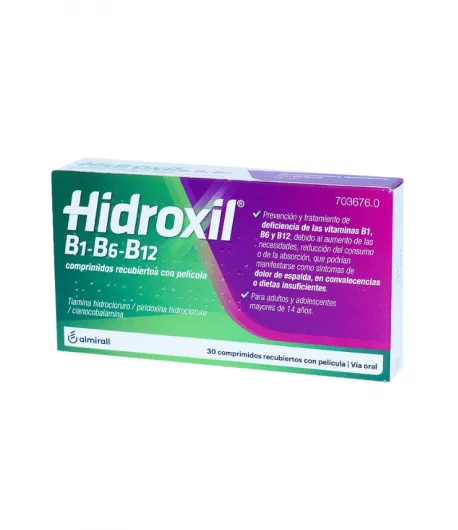
Table of Contents
Package leaflet: Information for the user
Introduction
Package leaflet: information for the user
Hidroxil B1-B6-B12 film-coated tablets
thiamine hydrochloride / pyridoxine hydrochloride / cyanocobalamin
Read the entire leaflet carefully before you start taking this medicine, because it contains important information for you.
Follow exactly the instructions for use provided in this leaflet or as directed by your doctor or pharmacist.
- Keep this leaflet, as you may need to read it again.
- If you need advice or more information, consult your pharmacist.
- If you experience any adverse effects, consult your doctor or pharmacist, even if they are adverse effects not listed in this leaflet. See section 4.
- You should consult a doctor if you worsen or do not improve within 7 days.
Contents of the leaflet
-
What Hidroxil is and what it is used for.
-
What you need to know before taking Hidroxil.
-
How to take Hidroxil.
-
Possible adverse effects.
-
How to store Hidroxil.
-
Contents of the pack and other information.
1. What Hidroxil is and what it is used for
The active ingredients of Hidroxil are the water-soluble vitamins B1 (thiamine), B6 (pyridoxine), and B12 (cyanocobalamin), which are involved in numerous processes of human metabolism.
Hidroxil is indicated for: Prevention and treatment of deficiency of vitamins B1, B6, and B12 due to increased requirements, reduced intake, or impaired absorption, which may manifest as symptoms of back pain, during convalescence, or as a result of inadequate diets.
Hidroxil B1-B6-B12 tablets are indicated in adults and adolescents over 14 years of age.
2. What you need to know before taking Hidroxil
Do not take Hidroxil:
- If you are allergic to vitamin B1, B6, or various forms of vitamin B12, cobalt, or any of the other components of this medicine (listed in section 6).
- If you are being treated with levodopa (a medicine for Parkinson's disease).
- If you have Leber's disease (hereditary optic atrophy) or tobacco amblyopia (reduced visual acuity that may occur in people who abuse tobacco), as these conditions could worsen.
Due to the doses it contains, do not take this medicine:
- If you have kidney or liver disease.
- If you are pregnant or breastfeeding.
- Children under 14 years of age.
Warnings and precautions
Talk to your doctor or pharmacist before taking Hidroxil.
- Do not take a higher dose than recommended or for longer than recommended.
- If you have any blood disorders, such as anemia, your doctor should determine the cause before you take vitamin B12.
- Cases of dependence and withdrawal have been reported after taking monthly doses of pyridoxine (vitamin B6), even at doses lower than those contained in this medicine.
- You should avoid exposure to sunlight due to a possible risk of photosensitivity (with skin lesions such as rash or blisters).
- If you have previously had an allergy to vitamin B1 due to skin contact (contact dermatitis) for occupational reasons, you may experience a relapse when taking this medicine.
Interference with laboratory tests
If you are scheduled to undergo any diagnostic tests (including blood and urine tests, skin tests using allergens, etc.), inform your doctor that you are taking this medicine, as it may alter test results. False results may occur in certain determinations of urobilinogen, theophylline, uric acid, or antibodies against intrinsic factor (IF).
Children
This medicine is contraindicated in children under 14 years of age.
Other medicines and Hidroxil
Inform your doctor or pharmacist if you are using, have recently used, or might need to use any other medicines.
This medicine may interact with the following medicines:
- Levodopa (used to treat Parkinson's disease).
- Phenobarbital, phenytoin (used to treat epilepsy).
- Altretamine (used to treat cancer).
- Amiodarone (for heart conditions).
- Neuromuscular blocking agents (used in anesthesia for surgery).
- 5-Fluorouracil (used for certain types of cancer).
- Various medicines may interfere with pyridoxine (vitamin B6) and reduce its levels, including: antibiotics for tuberculosis (isoniazid, cycloserine, ethionamide, and pyrazinamide), penicillamine (for rheumatic diseases), hydralazine (for high blood pressure), immunosuppressants such as corticosteroids, cyclosporine (used in organ transplantation and other conditions).
- Various medicines may reduce the absorption of vitamin B12 or diminish its effect, such as: high-dose ascorbic acid, antibiotics such as neomycin and chloramphenicol, colchicine (for gout), H2 antagonists (medicines for acidity or stomach ulcers), aminosalicylic acid in long-term treatments (for intestinal diseases), omeprazole (for stomach ulcers), antiepileptic medicines, metformin (for diabetes), high-dose folic acid.
- Oral contraceptives may reduce levels of vitamins B6 and B12.
Taking Hidroxil with alcohol
Excessive alcohol intake reduces the absorption of vitamins.
Pregnancy, breastfeeding, and fertility
If you are pregnant or breastfeeding, think you may be pregnant, or are planning to become pregnant, consult your doctor or pharmacist before using this medicine.
Due to the doses of vitamins B it contains, which are much higher than those recommended during pregnancy and breastfeeding, this medicine is contraindicated during pregnancy and breastfeeding.
Hidroxil is not recommended for women of childbearing age who are not using an effective contraceptive method.
Driving and using machines
The effect of Hidroxil on the ability to drive and use machines is none or negligible. This medicine may cause drowsiness in a few patients, who should therefore not drive and/or operate dangerous machinery during treatment.
Hidroxil contains sodium
This medicine contains less than 23 mg of sodium (1 mmol) per tablet; hence, it is essentially "sodium-free".
3. How to take Hidroxil
Follow exactly the instructions for use provided in this leaflet or those given by your doctor or pharmacist. If in doubt, consult your doctor or pharmacist.
The recommended dose is:
Adults and adolescents over 14 years of age
1 tablet per day
In general, treatment should not exceed 15 days, although your doctor may recommend administration for a longer period.
If your condition worsens or does not improve after 7 days of treatment, you should consult your doctor.
Oral use
It is preferable to swallow the tablets whole, with sufficient water.
Patients with hepatic or renal insufficiency
These patients must not take Hidroxil (see section 2).
Use in children
This medicine is contraindicated in children under 14 years of age (see section 2).
If you take more Hidroxil than you should
If you have taken more Hidroxil than you should, you may experience symptoms such as gastrointestinal discomfort (diarrhea, nausea, vomiting), and headache. Due to the pyridoxine content, you may suffer nervous system disorders such as altered or reduced sensitivity, tingling, numbness in hands and feet, unsteady gait, etc. You may also develop photosensitivity with skin rashes; drowsiness, lethargy, breathing difficulties, among other effects, depending on the dose, increased serum concentrations of AST (SGOT) (a transaminase), and decreased serum folic acid concentrations. Rarely, a severe allergic reaction (anaphylactic shock) may occur.
In children, accidental ingestion of very high doses of vitamin B6 may additionally cause profound sedation, weakness, and breathing difficulties.
In case of overdose or accidental ingestion, contact your doctor or pharmacist immediately, go to a medical center, or call the Toxicology Information Service at telephone number: 915 62 04 20, indicating the medicine and the amount taken.
If you forget to take Hidroxil
Do not take a double dose to make up for missed doses.
If you have any further questions about the use of this medicine, ask your doctor or pharmacist.
4. Possible adverse effects
Like all medicines, this medicine may cause adverse effects, although not everyone will experience them.
The assessment of possible adverse effects is based on the following frequency categories: very common (may affect more than 1 in 10 people), common (may affect up to 1 in 10 people), uncommon (may affect up to 1 in 100 people), rare (may affect up to 1 in 1,000 people), and very rare (may affect up to 1 in 10,000 people).
Uncommonly reported effects include: nausea, vomiting, headache, drowsiness, paresthesia (tingling sensation in arms and legs), and skin rash (redness or swelling). Hypersensitivity reactions (allergic reactions) to vitamins B1, B6, and B12 have also been reported.
Other adverse effects reported, with frequency not known exactly, include: gastrointestinal discomfort, diarrhea, loss of appetite (with high doses), photosensitivity with skin lesions such as blisters; very occasionally, reduction in platelet count (thrombocytopenia); dizziness, restlessness, insomnia; neurological disturbances with reduced sensation and tingling, among other symptoms, which generally decrease upon discontinuation of treatment; changes in urine color; occasionally, anaphylactic reaction with itching and breathing difficulty; vitamin B1 may rarely cause delayed hypersensitivity.
If an allergic reaction occurs, treatment must be discontinued and medical advice should be sought immediately to initiate appropriate treatment.
Reporting of adverse effects
If you experience any type of adverse effect, consult your doctor or pharmacist, even if it is a possible adverse effect not listed in this leaflet. You may also report them directly through the Spanish Pharmacovigilance System for Human Medicines: https://www.notificaram.es. By reporting adverse effects, you can help provide more information on the safety of this medicine.
5. Storage of Hidroxil
Store below 25 °C.
Keep this medicine out of the sight and reach of children.
Do not use this medicine after the expiry date stated on the packaging after EXP. The expiry date refers to the last day of the month indicated.
Medicines should not be disposed of via wastewater or household waste. Dispose of unused medicines and their packaging at the SIGRE collection point at your pharmacy. If you are in doubt, ask your pharmacist how to dispose of medicines and packaging you no longer need. This will help protect the environment.
6. Contents of the pack and other information
Composition of Hidroxil B1-B6-B12 film-coated tablets
- The active substances are thiamine hydrochloride (vitamin B1), pyridoxine hydrochloride (vitamin B6) and cyanocobalamin (vitamin B12).
Each tablet contains 250 mg of thiamine hydrochloride, 250 mg of pyridoxine hydrochloride and 500 micrograms of cyanocobalamin.
- The other components (excipients) are: copovidone, sodium carboxymethyl starch (from potato), sodium stearyl fumarate, modified corn starch, citric acid, trisodium citrate, silicon dioxide, hypromellose, titanium dioxide (E-171), natural wax, glycerol, medium-chain triglycerides and carmine acid (E-120).
Appearance of the product and contents of the pack
This medicine is presented as pink, biconvex, elliptical film-coated tablets.
Packs containing 15 and 30 tablets.
Marketing Authorization Holder and Manufacturer
Marketing Authorization Holder
Almirall, S.A.
General Mitre, 151
08022 – Barcelona (Spain)
Manufacturer
Industrias Farmacéuticas Almirall, S.A.
Ctra. de Martorell, 41-61
08740 - Sant Andreu de la Barca (Barcelona) (Spain)
Date of the most recent revision of this leaflet: January 2022.
Detailed information on this medicine is available on the website of the Spanish Agency for Medicines and Health Products (AEMPS) (http://www.aemps.gob.es/)