Hurricane Spray 200 mg/ml solution for oral spray
Spain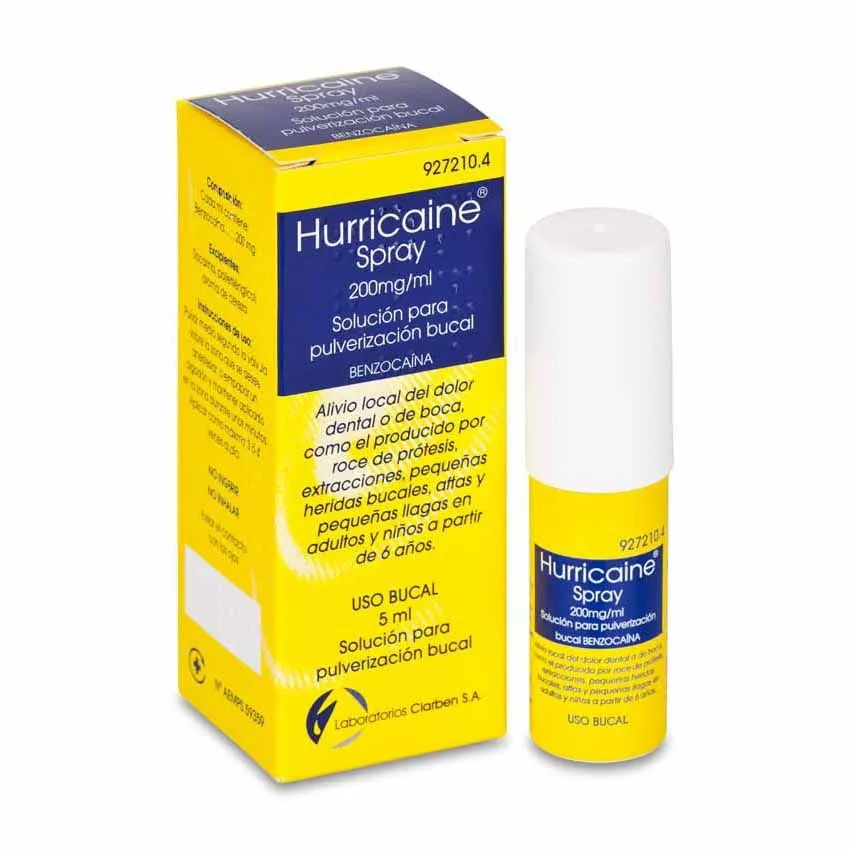
Table of Contents
Package leaflet: Information for the user
Introduction
Package leaflet: information for the user
Hurricaine spray 200 mg/ml solution for oral spray
Benzocaine
Read the entire leaflet carefully before you start using this medicine, because it contains important information for you.
Follow exactly the instructions for administration of the medicine contained in this leaflet or those indicated by your doctor or pharmacist.
- Keep this leaflet, as you may need to read it again.
- If you need advice or more information, consult your pharmacist.
- If you experience adverse effects, consult your doctor, pharmacist, or nurse, even if they are adverse effects not listed in this leaflet. See section 4.
- You should consult a doctor if you worsen or do not improve<after 2 days.
Contents of the leaflet
- What Hurricaine spray is and what it is used for
- What you need to know before using Hurricaine spray
- How to use Hurricaine spray
- Possible adverse effects
- How to store Hurricaine spray
- Contents of the pack and other information
1. What Hurricaine spray is and what it is used for
It is a topical anesthetic that works by suppressing pain when applied externally to the area of the mouth to be treated.
It is indicated for the local relief of dental or oral pain, such as that caused by dentures rubbing, tooth extractions, minor mouth injuries, canker sores, and small mouth ulcers in adults and children aged 6 years and older.
You should consult a doctor if symptoms worsen or do not improve after 2 days of treatment.
2. What you need to know before using Hurricaine spray
Do not use Hurricaine spray
- If you are allergic to benzocaine, to other local anaesthetics derived from p-aminobenzoic acid, or to any of the ingredients of this medicine (listed in section 6).
Warnings and precautions
Consult your doctor, pharmacist, or nurse before starting to use Hurricaine spray
- If you are intolerant to other local anaesthetics such as para-aminobenzoic acid (PABA), parabens, or paraphenylenediamine (a component of hair dyes).
- If you have a severe or extensive injury in the mouth.
- Do not exceed the recommended dose indicated in section 3 (How to use Hurricaine spray).
- If you have asthma, bronchitis, or emphysema.
- Stop taking the medicine and consult your doctor immediately if you experience: headache, dizziness, shallow breathing, nausea, fatigue, or tachycardia.
- Elderly or debilitated individuals should consult their doctor before taking this medicine, as they may be more sensitive to potential adverse reactions.
- Do not swallow, do not inhale.
- Avoid contact with and/or spraying into the eyes.
- Do not eat or drink while numbness in the mouth persists, due to the risk of biting the tongue or oral mucosa and choking.
Use of Hurricaine spray with other medicines
Inform your doctor or pharmacist if you are taking, have recently taken, or might need to take any other medicines.
This medicine may interact with:
- Sulfonamides (medicines used to treat infections): should not be used at the same time as benzocaine, as it may reduce the antibacterial effect of sulfonamides.
- Medicines containing hyaluronidase: should not be used concomitantly with benzocaine, as it may increase benzocaine's adverse effects.
- Medicines containing cholinesterase, used to treat conditions such as Alzheimer's disease, myasthenia gravis, or glaucoma, because their simultaneous use inhibits the metabolism of benzocaine.
- Other local anaesthetics.
- In individuals sensitive to benzocaine, hair dyes containing paraphenylenediamine may cause severe contact dermatitis.
Use of Hurricaine spray with food and drinks
Do not use this medicine before meals or before drinking (see section Warnings and precautions).
Pregnancy and breastfeeding
If you are pregnant or breastfeeding, think you may be pregnant, or are planning to become pregnant, consult your doctor or pharmacist before using this medicine.
You should not use benzocaine during pregnancy.
It is unknown whether benzocaine is excreted in breast milk; therefore, women who are breastfeeding should not use this medicine.
Use in people aged 65 years and older
People aged 65 years and older and debilitated patients may be more sensitive to the adverse effects of benzocaine and should consult their doctor.
Driving and using machines
This medicine has no effect on driving or operating machinery.
3. How to use Hurricaine spray
Follow exactly the instructions for administration provided in this leaflet or those given by your doctor or pharmacist. If in doubt, ask your doctor or pharmacist.
This medicine is for application in the mouth. It must not be swallowed.
Recommended dose:
Adults and adolescents:
Press the valve for half a second directly onto the area to be anaesthetized, or soak a piece of cotton wool and hold it on the area for several minutes. Apply a maximum of 3 or 4 times a day.
Children aged 6–12 years: only under adult supervision, as described above.
Children aged 2–6 years: under medical supervision.
Children under 2 years: As this is a spray, its use is not recommended.
Remove the cap from the bottle and apply to the area to be anaesthetized by pressing the valve for half a second, or by soaking a piece of cotton wool with several actuations and holding it on the area for several minutes.
Do not apply this medicine more than 3 or 4 times a day.
If symptoms worsen or pain persists after 2 days of treatment, consult your doctor.
Wash your hands after applying the medicine.
If you use more Hurricaine spray than you should
Signs of overdose may include: bluish discoloration of the skin, slurred speech, numbness, unsteady gait, blurred or double vision, dizziness, excitement or seizures, ringing in the ears, and increased sweating. Blood pressure may also decrease.
In case of overdose or accidental ingestion, seek immediate medical advice or go to a medical center, or call the Toxicology Information Service (telephone 91 562 04 20), stating the medicine and the amount ingested.
4. Possible adverse effects
Like all medicines, Hurricaine spray may cause adverse effects, although not everyone experiences them.
During the period of benzocaine use, the following adverse effects have been reported, although their frequency cannot be precisely determined:
Urticaria, edema, anaphylactoid reaction (contact dermatitis). Cross-reactions with other ester-type local anesthetics. Photosensitivity, bad taste in the mouth, mucosal dehydration, and difficulty swallowing.
Sensation of oral burning.
Methemoglobinemia, whose symptoms include: headache, dizziness, shortness of breath, nausea, fatigue, or tachycardia.
Prolonged contact of benzocaine with mucous membranes may cause epithelial dehydration and hardening of the mucosa.
Reporting of adverse effects
If you experience any type of adverse effect, consult your doctor or pharmacist, even if it is a possible adverse effect not listed in this leaflet. You may also report them directly via the Spanish Pharmacovigilance System for Human Medicinal Products website: www.notificaram.es.
By reporting adverse effects, you can help provide more information on the safety of this medicine.
5. Storage of Hurricaine spray
Keep this medicine out of sight and reach of children.
Do not use this medicine after the expiry date stated on the packaging after EXP. The expiry date refers to the last day of the month indicated.
Do not store above 30 °C.
Medicines must not be disposed of via wastewater or household waste. Dispose of containers and unused medicines at the SIGRE collection point at your pharmacy. If in doubt, ask your pharmacist how to dispose of containers and medicines you no longer need. This will help protect the environment.
6. Contents of the pack and other information
Composition of Hurricaine spray
- The active substance is: Benzocaine.
- The other components are: Polyethylene glycol, Sodium saccharin, Cherry flavor.
Nature and contents of the product and pack size
Hurricaine spray is a cinnamon-colored oral spray solution with a cherry odor and taste.
It is available in 5 ml and 60 ml aluminum bottles.
Marketing Authorization Holder
Laboratorios Clarben S.A.
Av. Valdelaparra 27
28108 Alcobendas, Spain.
Manufacturer
Laboratorios Clarben S.A.
C/ Asura 111 local 1 and 4
28043 Madrid, Spain.
This leaflet was approved in
November 2013
Detailed and up-to-date information on this medicinal product is available on the website of the Spanish Agency for Medicines and Health Products (AEMPS): http://www.aemps.gob.es/.