Hirudoid 3 mg/g ointment
Spain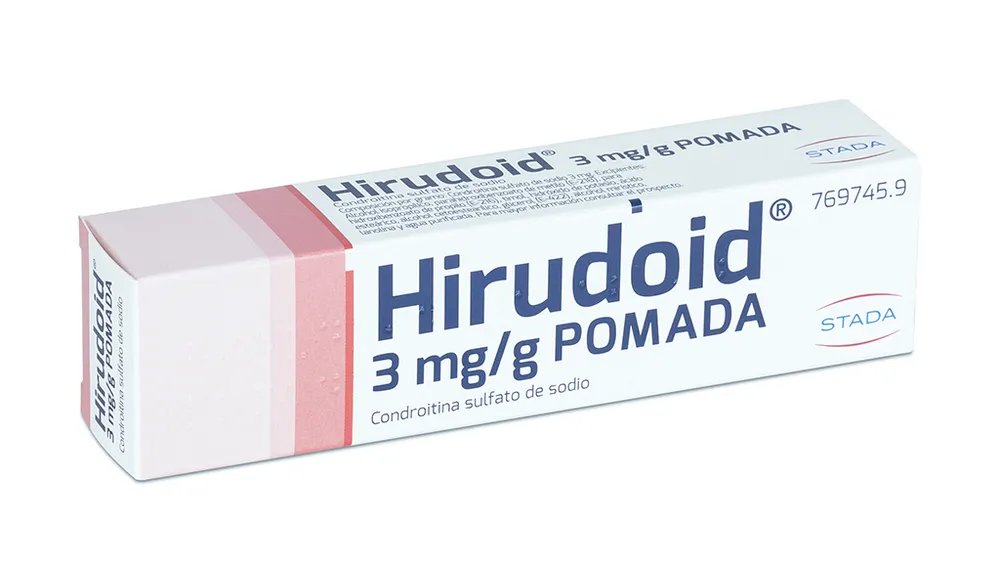
Table of Contents
Patient Information Leaflet
Introduction
PACKAGE LEAFLET: INFORMATION FOR THE USER
Hirudoid 3 mg/g ointment
Sodium chondroitin sulfate
Read this entire leaflet carefully before you start using this medicine, as it contains important information for you.
Follow exactly the instructions for use provided in this leaflet or those given by your doctor or pharmacist.
-
Keep this leaflet, as you may need to refer to it again.
-
If you need advice or more information, consult your pharmacist.
-
If you experience any adverse effects, consult your doctor or pharmacist, even if they are adverse effects not listed in this leaflet.
-
You should consult a doctor if your condition worsens or if you do not improve after 5 days.
Leaflet contents:
-
What Hirudoid is and what it is used for
-
What you need to know before using Hirudoid
-
How to use Hirudoid
-
Possible adverse effects
-
How to store Hirudoid
-
Contents of the pack and other information
1. What Hirudoid is and what it is used for
Hirudoid is a medicine containing sodium chondroitin sulfate as the active substance, and has properties that promote blood flow.
This medicine is indicated for:
the local symptomatic relief of superficial venous disorders such as heaviness and tightness in the legs with varicose veins in adults
the local symptomatic relief of superficial bruises caused by blows in adults and children over 1 year of age.
You should consult a doctor if your condition worsens or does not improve after 5 days.
2. What you need to know before using Hirudoid
Do not use Hirudoid
-
If you are allergic to sodium chondroitin sulfate or to any of the other ingredients of this medicine (listed in section 6).
-
If you have significant coagulation disorders.
-
On mucous membranes, ulcers, or open or infected wounds.
Warnings and precautions
Consult your doctor or pharmacist before starting to use Hirudoid.
-
Should be used only on intact skin.
-
Contact with the eyes should be avoided.
In cases of venous problems caused by blood clots (such as thromboembolism, obstruction of a blood vessel impairing blood flow), it is recommended to apply the product gently and without massage.
- Should not be used for prolonged periods or over large areas of skin.
Using Hirudoid with other medicines
Inform your doctor or pharmacist if you are taking, have recently taken, or might need to take any other medicines.
It is not recommended to apply other topical preparations to the same area without consulting your doctor.
Pregnancy, breastfeeding, and fertility
If you are pregnant or breastfeeding, think you may be pregnant, or are planning to become pregnant, consult your doctor or pharmacist before using this medicine.
Do not use Hirudoid during pregnancy or breastfeeding unless your doctor specifically advises you to do so.
Driving and using machines
No effects on the ability to drive vehicles or operate machinery have been reported.
Hirudoid contains propyl parahydroxybenzoate (E-216), methyl parahydroxybenzoate (E-218), cetostearyl alcohol, and lanolin
This medicine may cause allergic reactions (possibly delayed) because it contains propyl parahydroxybenzoate (E-216) and methyl parahydroxybenzoate (E-218), and local skin reactions (such as contact dermatitis) because it contains cetostearyl alcohol and lanolin.
3. How to use Hirudoid
Follow exactly the instructions for medication administration provided in this leaflet or as directed by your physician or pharmacist. If in doubt, consult your physician or pharmacist.
This medicine is for topical use (on the skin only). The recommended dose is:
Superficial venous disorders
Adults: apply a thin layer of gel or ointment to the affected area 2 to 3 times daily, spreading it with gentle massage to facilitate penetration.
Wash your hands after each application to avoid inadvertent contact with eyes and mucous membranes.
The average duration of treatment is usually 1 to 2 weeks. If symptoms worsen or persist after 5 days of treatment, consult your doctor.
Children under 18 years: do not use without medical supervision.
Bruises (contusions):
Adults and children over 1 year of age: apply a thin layer of gel or ointment to the affected area 2 to 3 times daily, spreading it with gentle massage to facilitate penetration.
Wash your hands after each application to avoid inadvertent contact with eyes and mucous membranes. The average duration of treatment for bruises is usually less than 10 days. If symptoms worsen or persist after 5 days of treatment, consult your doctor.
Children under 1 year: do not use without medical supervision.
If you use more Hirudoid than you should
If you have used more Hirudoid than recommended or in case of accidental ingestion, contact the Toxicology Information Service at telephone number 91 562 04 20, indicating the medication and the amount ingested.
Accidental ingestion of large amounts of Hirudoid gel, due to its content of isopropyl alcohol, may cause symptoms of acute alcohol intoxication.
In case of suspected alcohol intoxication, specific therapeutic measures should be initiated immediately.
If you forget to use Hirudoid
Do not apply a double dose to make up for missed doses.
Continue treatment as usual without taking any special action.
If you have any further questions about the use of this medicine, consult your doctor or pharmacist.
4. Possible adverse effects
Like all medicines, Hirudoid can cause adverse effects, although not everyone will experience them.
Very rarely (affects less than 1 in 10,000 patients), allergic-type reactions at the site of application have been observed, which may manifest as itching and irritation, and which disappear upon discontinuation of treatment.
If you experience any adverse effects, consult your doctor or pharmacist, even if they are adverse effects not listed in this leaflet.
5. Storage of Hirudoid
Keep this medicine out of the sight and reach of children.
Do not use this medicine after the expiry date stated on the packaging after EXP. The expiry date refers to the last day of the month indicated.
This medicine does not require any special storage conditions.
Dispose of the tube 12 months after first opening. Write the date of opening in the space provided on the carton.
Medicines must not be disposed of via wastewater or household waste. Instead, return any unused medicines and their packaging to the SIGRE point at your pharmacy. If you are in doubt, please ask your pharmacist how to dispose of medicines and packaging you no longer need. This will help protect the environment.
6. Contents of the pack and other information
Composition of Hirudoid
-
The active substance is sodium chondroitin sulfate. Each gram of ointment contains 3 milligrams of sodium chondroitin sulfate.
-
The other components (excipients) are isopropyl alcohol, methyl parahydroxybenzoate (E-218), propyl parahydroxybenzoate (E-216), thymol, potassium hydroxide, stearic acid, cetostearyl alcohol, glycerol (E-422), myristyl alcohol, lanolin, and purified water.
Appearance of the product and contents of the pack
Hirudoid is available in lacquered aluminum tubes containing 40 grams of ointment.
Marketing Authorization Holder
Laboratorio STADA S.L. Frederic Mompou, 5
08960 Sant Just Desvern (Spain) [email protected]
Manufacturer
STADA Arzneimittel AG Stadastrasse 2-18
61118 - Bad Vilbel
Germany
or
Wagener & Co. GmbH
Lohesch 60
49525 Lengerich
Germany
Date of the most recent review of this leaflet: March 2012
"Detailed and up-to-date information on this medicinal product is available on the website of the Spanish Agency for Medicines and Health Products (AEMPS) http://www.aemps.gob.es/"