Hibitane 5 mg/5 mg lemon-flavored lozenges for sucking
Spain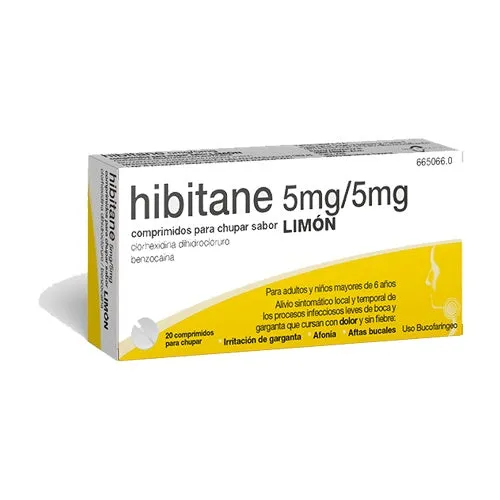
Table of Contents
Package leaflet: Information for the user
Introduction
Package leaflet: information for the user
HIBITANE 5mg/5mg Sucking tablets lemon flavour
chlorhexidine dihydrochloride / benzocaine
Read the entire leaflet carefully before you start taking this medicine because it contains important information for you.
- Keep this leaflet as you may need to read it again.
- If you need advice or more information, consult your pharmacist.
- If you experience any adverse effects, consult your doctor or pharmacist, even if they are adverse effects not listed in this leaflet. See section 4.
- You should consult your doctor if you worsen or do not improve after 2 days.
Leaflet contents:
- What Hibitane is and what it is used for
- What you need to know before taking Hibitane
- How to take Hibitane
- Possible adverse effects
- How to store Hibitane
- Contents of the pack and other information
1. What Hibitane is and what it is used for
The active ingredients in this medicine combine the antiseptic and disinfectant action of chlorhexidine with the local anesthetic action of benzocaine.
This medicine is used for the temporary relief of local symptoms of mild throat infections that occur without fever, such as sore throat, irritation, and hoarseness.
2. What you need to know before starting to take Hibitane
Do not take Hibitane
- If you are allergic (hypersensitive) to chlorhexidine, benzocaine, or any of the other components of this medicine (listed in section 6).
Warnings and precautions
Consult your doctor or pharmacist before starting to take Hibitane:
- If you are intolerant to other local anesthetics such as para-aminobenzoic acid (PABA), parabens, or paraphenylenediamine (a component of hair dyes).
- If you have a severe or extensive injury in the mouth.
- If you suffer from periodontitis (gum disease), as chlorhexidine may increase supragingival calculus formation.
- Do not take doses higher than those recommended in section 3 (How to take Hibitane).
Maintaining proper oral hygiene is recommended to reduce tartar buildup and possible tooth discoloration that chlorhexidine may cause.
Other medicines and Hibitane
Inform your doctor or pharmacist if you are currently using, have recently used, or might need to take any other medicines.
Although no interactions have been reported under recommended conditions of use, this medicine should not be used together with other oral or throat medications without consulting your doctor or pharmacist.
Drug interactions may be particularly important with:
- Other antiseptics for mouth or throat.
- Cholinesterase inhibitor medicines (used for Alzheimer's disease).
- Sulfonamides (used for infections).
Anionic compounds and suspending agents, commonly found in toothpastes, reduce the effectiveness of chlorhexidine; therefore, the mouth should be thoroughly rinsed after using toothpaste.
Interference with diagnostic tests
This medicine may interfere with the pancreatic function test using bentiromide. Do not take this medicine at least three days before the test and inform your doctor.
Pregnancy and breastfeeding
Consult your doctor or pharmacist before using any medicine.
Important for women
If you are pregnant, breastfeeding, think you might be pregnant, or are planning to become pregnant, consult your doctor before taking this medicine.
Use in people aged 65 years and older
Elderly individuals and debilitated patients may be more sensitive to benzocaine.
Use in children
This medicine must not be given to children under 6 years of age without first consulting a doctor.
Children may be more sensitive to benzocaine, similar to elderly individuals and debilitated patients.
Driving and operating machinery
No cases have been reported in which this medicine affects the ability to drive or operate machinery.
Hibitane contains:
- Sodium: this medicine contains less than 23 mg of sodium (1 mmol) per lozenge, which means it is essentially “sodium-free”.
- Sulfur dioxide (E-220): this medicine may cause severe allergic reactions and bronchospasm (sudden sensation of suffocation) because it contains sulfur dioxide (as part of the flavors).
- Sucrose: this medicine contains sucrose. If your doctor has informed you that you have an intolerance to certain sugars, consult him before taking this medicine.
- Butylated hydroxyanisole (E-320): this medicine may cause local skin reactions (such as contact dermatitis) or irritation of the eyes and mucous membranes because it contains butylated hydroxyanisole.
This medicine contains fragrances with citral, citronellol, D-limonene, geraniol, and linalool.
Citral, citronellol, D-limonene, geraniol, and linalool may cause allergic reactions.
3. How to take Hibitane
Follow exactly the instructions for use provided in this leaflet or those given by your doctor or pharmacist. If in doubt, ask your doctor or pharmacist.
If you feel that the effect of Hibitane is too strong or too weak, inform your doctor or pharmacist.
This medicine is intended for oropharyngeal use; therefore, the lozenges must be slowly dissolved in the mouth without chewing or swallowing, as its action is local and only becomes effective when the product is in direct contact with the affected area.
The usual dose is as follows:
Adults and children over 6 years of age:
1 lozenge every 2 or 3 hours, slowly dissolved in the mouth.
Do not exceed 8 lozenges in 24 hours (1 day).
Slowly dissolve the lozenge in the mouth without chewing or swallowing.
Always use the lowest effective dose.
If you notice that symptoms worsen or persist for more than 2 days after starting treatment, or if fever, headache, nausea, or vomiting occur, you should consult your doctor as soon as possible.
If you take more Hibitane than you should:
If you have taken more than the recommended amount, consult your doctor or pharmacist immediately, or call the Toxicology Information Service at telephone number 915 62 04 20, indicating the medicine and the quantity taken.
The main symptoms of overdose are: slurred speech, numbness, unsteady gait, blurred or double vision, dizziness, excitement or convulsions, ringing in the ears, and increased sweating. A decrease in blood pressure may also occur.
4. Possible adverse effects
Like all medicines, this medicine may cause adverse effects, although not everyone will experience them.
The following adverse effects have been observed during the use of medicines containing chlorhexidine and benzocaine, although their frequency cannot be precisely determined.
Tooth discoloration may occur. This staining or discoloration may be more pronounced in individuals who have dental tartar deposits. This change in tooth color is not permanent and can be removed by means of a dental cleaning. The color of dental fillings may also be altered; in such cases, this staining may be permanent.
A change in taste perception may occur.
In some cases, this medicine may cause irritation in the mouth or irritation at the tip of the tongue, which are usually temporary, as well as allergic reactions to chlorhexidine or benzocaine.
Reporting of adverse effects
If you experience any type of adverse effect, consult your doctor or pharmacist, even if it is a possible adverse effect not listed in this leaflet. You may also report them directly through the Spanish Pharmacovigilance System for Human Medicines: https://www.notificaram.es. By reporting adverse effects, you can help provide more information on the safety of this medicine.
5. Storage of Hibitane
Keep this medicine out of the sight and reach of children.
Do not store above 25 °C.
Do not use this medicine after the expiry date stated on the container after EXP. The expiry date refers to the last day of the month indicated.
Medicines must not be disposed of via wastewater or household waste. Dispose of unused containers and medicines at the SIGRE collection point located at your pharmacy. If you are unsure, ask your pharmacist how to properly dispose of containers and unused medicines. This will help protect the environment.
6. Additional Information
Composition of Hibitane
Each lozenge contains:
- Active substances: Chlorhexidine dihydrochloride 5 mg and benzocaine 5 mg.
- Other components (excipients): mannitol (E-421), microcrystalline cellulose (E-460), povidone, magnesium stearate, sodium cyclamate, sodium saccharin (E-954), menthol flavour (containing citronellol, d-limonene, sodium and sulfur dioxide (E-220)) and lime-lemon flavour (containing citral, citronellol, d-limonene, geraniol, linalool, sodium, sulfur dioxide (E-220), sucrose and butylated hydroxyanisole (E-320)).
Appearance of the medicinal product and contents of the pack
These are lemon-flavoured lozenges. This medicine is available in packs of 20 lozenges.
Marketing Authorization Holder and Manufacturer:
Marketing Authorization Holder:
IONFARMA s.l.u.
Perú, 228
08020 Barcelona, Spain
Manufacturer:
Laboratorios Alcalá-Farma, S.L.
Avenida de Madrid, 82
28802 Alcalá de Henares
Madrid, Spain
Date of the most recent review of this leaflet: September 2021
Detailed and up-to-date information on this medicine is available on the website of the Spanish Agency of Medicines and Medical Devices (AEMPS) http://www.aemps.es/