Glucose Fresenius Kabi 50% solution for infusion
Spain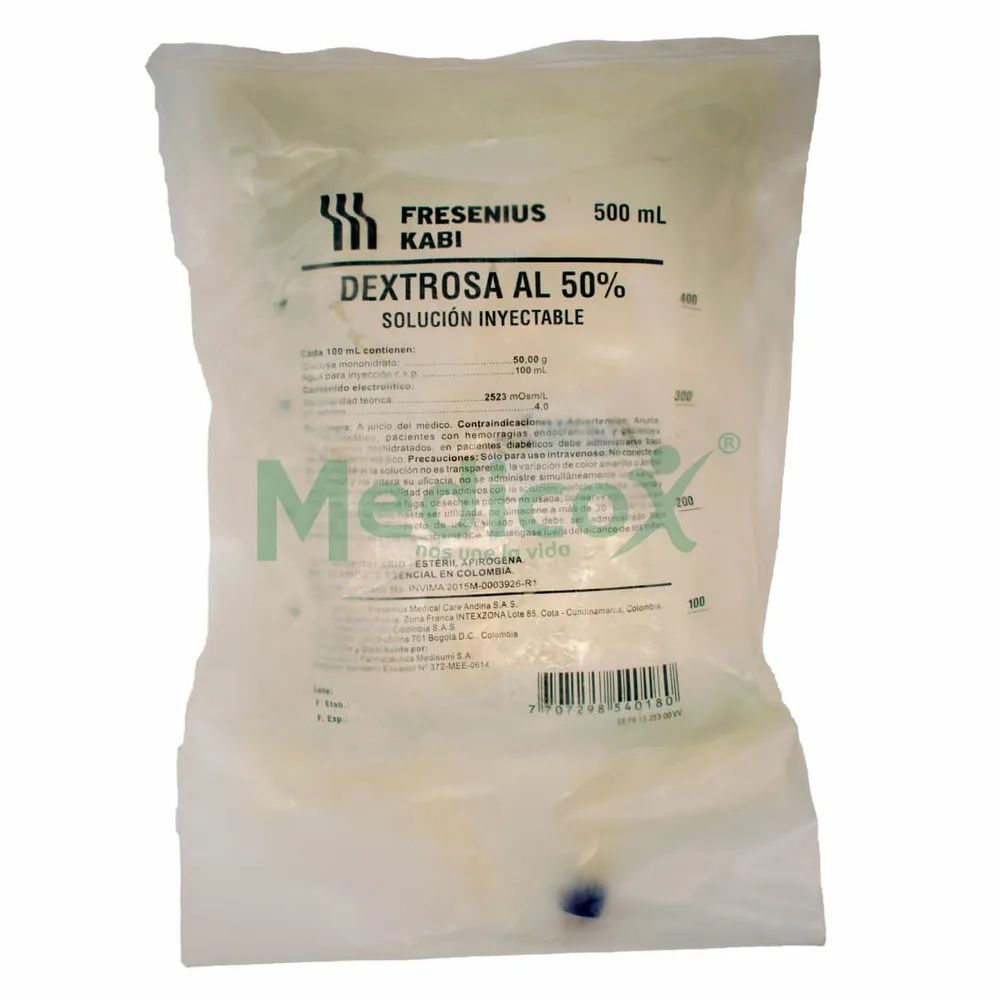
Table of Contents
Patient Information Leaflet
Introduction
PACKAGE LEAFLET: INFORMATION FOR THE USERDextrosa Fresenius Kabi 50% solution for infusion
Glucose
Read the entire leaflet carefully before you start using this medicine.
they have the same symptoms as you, since it may harm them.
not mentioned in this leaflet, inform your doctor or pharmacist. |
Package leaflet contents:
- What Dextrosa Fresenius Kabi 50% is and what it is used for
- Before using Dextrosa Fresenius Kabi 50%
- How to use Dextrosa Fresenius Kabi 50%
- Possible side effects
- How to store Dextrosa Fresenius Kabi 50%
- Further information
1. What DEXTROSE FRESENIUS KABI 50% is and what it is used for
Dextrose Fresenius Kabi 50% is an infusion solution supplied in 100 ml and 500 ml glass bottles.
Dextrose Fresenius Kabi 50% belongs to the group of intravenous solutions for parenteral nutrition – carbohydrates, and is indicated for:
- Treatment of hypertonic dehydration caused by vomiting, diarrhea, profuse sweating, etc.
- Disorders of carbohydrate metabolism: hypoglycemia (decreased blood glucose levels), insulin coma, acetonemic vomiting.
- Parenteral nutrition with volume restriction.
2. BEFORE USING DEXTROSE FRESENIUS KABI 50%
Do not use Dextrose Fresenius Kabi 50%:
- If you are allergic (hypersensitive) to the active substance or to any of the other components of Dextrose Fresenius Kabi 50%.
- If you have excess glucose, diabetes mellitus, or sugar intolerance.
- If you have hypotonic dehydration (loss of water together with electrolytes), electrolyte imbalance, and
in patients with intracranial or intraspinal hemorrhage, or in cases of delirium tremens associated with dehydration.
- In patients with anuria (suppression of urine formation) and in diabetic coma, hepatic coma.
- In patients with ischemic cerebrovascular accidents (deficient blood supply, and therefore oxygen, to an area of the brain), as excess glucose worsens ischemia and recovery.
Warnings and precautions
Take special care with Dextrose Fresenius Kabi 50%
It is especially important to frequently monitor fluid and electrolyte balance (particularly potassium and sodium) and blood glucose levels. If necessary, insulin will be administered: one unit per 10 g of glucose. It is also advisable to monitor for possible decreases in blood potassium (hypokalemia) and sodium (hyponatremia) levels.
In patients with sodium deficit, administration of sodium-free solutions may cause peripheral circulatory collapse and oliguria (reduced urine output).
Too rapid administration of highly concentrated glucose solutions may cause an increase in blood glucose levels and hyperosmolar syndrome. Monitoring of glucosuria is recommended. Likewise, patients should be monitored for signs of mental confusion and loss of consciousness, particularly those with chronic uremia or carbohydrate intolerance.
Your doctor will pay special attention if you are elderly.
Prolonged intravenous glucose therapy may reduce insulin production, so your doctor will assess the need for insulin administration.
When discontinuing the infusion of concentrated glucose solutions, administration of 5–10% glucose may be advisable to prevent rebound hypoglycemia.
For hypoglycemic states (low blood glucose levels) in neonates or young children, less concentrated solutions (10–25%) are recommended.
The compatibility of this solution with any additive must be verified before use.
These solutions must not be administered using the same infusion sets used or intended for blood transfusion, as there is a risk of agglutination.
If you suffer from critical conditions, pain, postoperative stress, infections, burns, or central nervous system disorders
If you have any type of heart, liver, or kidney disease and are being treated with a medication that enhances the effect of vasopressin (a hormone regulating water retention in the body), your risk of developing hospital-acquired low blood sodium levels (hyponatremia) may increase. (See section "Other medicines and Dextrose Fresenius Kabi 50%")
All patients must be closely monitored. In cases where normal regulation of blood water content is disrupted due to increased secretion of vasopressin, also known as Antidiuretic Hormone (ADH), infusion of fluids with low sodium chloride concentration (hypotonic fluids) may result in low blood sodium levels (hyponatremia). This can cause headache, nausea, seizures, lethargy, coma, brain swelling (cerebral edema), and death; therefore, these symptoms (acute symptomatic hyponatremic encephalopathy) are considered a medical emergency. (See section 4. Possible side effects)
Children, women of childbearing age, and patients with brain disorders such as meningitis, cerebral hemorrhage, cerebral contusion, and cerebral edema are at special risk of developing severe and potentially fatal brain swelling due to acute hyponatremia.
Use of Dextrose Fresenius Kabi 50% with other medicines
Inform your doctor or pharmacist if you are using or have recently used any other medicines, including those obtained without a prescription, as it may be necessary to interrupt treatment or adjust the dose of one or more of them.
Concomitant use of Dextrose Fresenius Kabi 50% with other medicines may alter the effectiveness of both treatments.
Administration of glucocorticoids, diuretics, phenytoin, and chlorpromazine increases blood glucose levels.
Intravenous glucose administration in patients treated with insulin or oral antidiabetics (biguanides, sulfonylureas) may reduce the therapeutic efficacy of these agents. If glucose is administered together with digitalis glycosides (digoxin), increased digitalis activity may occur, with a risk of developing toxicity from these medications.
Your doctor will check the compatibility of this solution with any additive before use. These solutions must not be administered using the same infusion sets used or intended for blood transfusion, as there is a risk of agglutination.
Medicines that increase the effect of vasopressin (see section "Warnings and precautions"), for example:
- Medicines that stimulate vasopressin release (e.g., antipsychotics, narcotics)
- Medicines that potentiate the action of vasopressin (e.g., non-steroidal anti-inflammatory drugs)
- Medicines that act like vasopressin, known as vasopressin analogs
Other medicines that increase the risk of hyponatremia, including diuretics in general and antiepileptic drugs.
Pregnancy and breastfeeding
Consult your doctor or pharmacist before using any medicine.
This medicine should be administered with special caution in pregnant women during labor, especially if administered in combination with oxytocin (a hormone that may be given to induce labor and control bleeding) due to the risk of hyponatremia.
Glucose crosses the placenta while insulin does not, so the fetus itself is responsible for insulin synthesis. For this reason, it should be administered with caution in pregnant women. Infusions exceeding 10 g/hour cause increases in fetal insulin.
The use of large amounts of glucose solution during labor, especially in complicated deliveries, may lead to hyperglycemia (high blood glucose), hyperinsulinemia (high insulin levels), and fetal acidosis, and therefore may be harmful to the newborn. Thus, it should be used cautiously during pregnancy.
It is also recommended to use with caution during breastfeeding.
Driving and use of machines
Not applicable due to the characteristics of its use.
3. HOW TO USE DEXTROSE FRESENIUS KABI 50%
Follow exactly the administration instructions for Dextrose Fresenius Kabi 50% given by your doctor. Consult your doctor or pharmacist if you have any doubts.
Dextrose Fresenius Kabi 50% will be administered by healthcare personnel only, via intravenous infusion (directly into a vein), under standard aseptic conditions for injectable solutions.
The dose and infusion rate depend on the patient's weight, requirements, and clinical condition. In most cases, the recommended dose is 1.5–3.0 g/kg/day or 0.5 g/kg/h.
The duration and rate of administration will be controlled by a healthcare professional.
If you use more Dextrose Fresenius Kabi 50% than you should
Symptoms of glucose overdose include:
- excessive urination, which may lead to severe dehydration
- disturbances in blood electrolyte balance (plasma hyperosmolarity) leading to altered consciousness, seizures, and coma.
If you are not hospitalized, go immediately to the nearest hospital or contact the Toxicology Information Service. Telephone: 91 562 04 20.
4. Possible adverse effects
Like all medicines, Dextrosa Fresenius Kabi 50% can cause adverse effects, although not everyone will experience them.
Intravenous administration of glucose solutions may cause disturbances in fluid and electrolyte balance, including edema (swelling), decreased levels of potassium, calcium, magnesium, and phosphate. Elevated glucose concentrations due to decreased potassium levels may also occur. In these cases, blood glucose levels normalize upon administration of potassium, without the need for insulin.
Direct intravenous administration of concentrated glucose solutions may cause pain, venous irritation, and thrombophlebitis (inflammation of the veins with a clot).
If doses mentioned above are exceeded, blood levels of bilirubin and lactate may reach abnormally high values.
Headache, nausea, seizures, lethargy. These may be caused by low sodium levels in the blood. When blood sodium levels drop significantly, water enters the brain cells causing them to swell. This results in increased intracranial pressure and leads to hyponatremic encephalopathy.
If you consider any of the adverse effects you experience to be severe, or if you notice any adverse effects not listed in this leaflet, inform your doctor or pharmacist.
5. STORAGE OF DEXTROSE FRESENIUS KABI 50%
Keep out of the reach and sight of children.
No special storage conditions are required.
6. ADDITIONAL INFORMATION
Composition of Dextrosa Fresenius Kabi 50%
The active substance is glucose. Each 100 ml of solution contains 50 g of glucose (as monohydrate 55 g).
The other components are: water for injections.
Theoretical osmolarity: 2775 mosm/l
pH: 3.5–6.5
Theoretical calories: 2000 kcal/l
Appearance of the product and contents of the container
Dextrosa Fresenius Kabi 50% is a clear solution free from suspended particles. It is supplied in 100 ml and 500 ml bottles.
Marketing Authorization Holder and Manufacturer
Marketing Authorization Holder:
Fresenius Kabi España S.A.
C/ Marina 16-18
08005-Barcelona (Spain)
Manufacturer:
Fresenius Kabi Italia S.r.l.
Via Camagre, 41/43
37063 Isola della Scala – Verona
Italy
This leaflet was last reviewed in
August 2018
This information is intended for healthcare professionals only:
Handle under normal aseptic conditions used for intravenous infusion solutions.
After opening the container, discard any unused portion of the solution. The contents of each Dextrosa Fresenius Kabi 50% container are intended for single use only.
When administering the solution, ensure proper placement of the needle within the vein, as extravasation may cause significant tissue irritation due to the hypertonic nature of the solution.
When administered undiluted, this solution must be given via a central vein. When diluted to a concentration of 10% or lower, it may be administered through a peripheral vein.
The solution must be clear and free from precipitates. Do not administer if otherwise.
Before adding medications to the solution or administering concomitantly with other drugs, compatibility must be verified.
General advice
Monitoring of fluid balance, serum glucose, serum sodium, and other electrolytes may be required before and during administration, particularly in patients with increased non-osmotic release of vasopressin (syndrome of inappropriate antidiuretic hormone secretion, SIADH) and in patients receiving concomitant treatment with vasopressin agonists, due to the risk of hyponatremia.
Monitoring of serum sodium is especially important with products having a lower sodium concentration compared to serum sodium levels. Following infusion of Dextrosa Fresenius Kabi 50%, rapid and active glucose transport into body cells occurs. This condition promotes an effect equivalent to the administration of free water and may lead to severe hyponatremia.