Glucose Fresenius Kabi 20% solution for infusion
Spain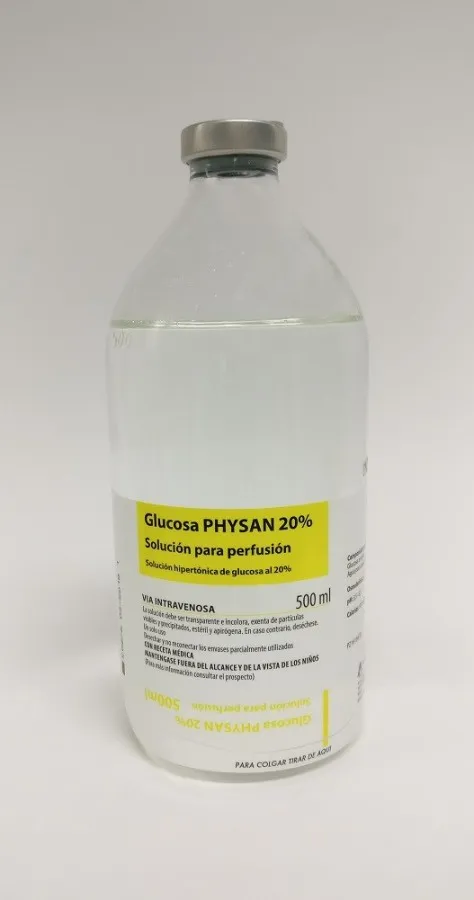
Table of Contents
- Package leaflet: Information for the user
- Introduction
- 1. What Glucosa Fresenius Kabi 20% is and what it is used for
- 2. What you need to know before using Glucosa Fresenius Kabi 20%
- 3. How to use Glucosa Fresenius Kabi 20%
- 4. Possible adverse effects
- 5. Storage of Glucose Fresenius Kabi 20%
- 6. Contents of the container and other information
Package leaflet: Information for the user
Introduction
PACKAGE LEAFLET: INFORMATION FOR THE USER
Glucosa Fresenius Kabi 20% solution for infusion
Glucose
Read the entire leaflet carefully before you start using this medicine, because it contains important information for you.
- Keep this leaflet as you may need to read it again.
- If you have any questions, consult your doctor or pharmacist.
- This medicine has been prescribed for you only, and you must not give it to other people, even if they have the same symptoms, as it may harm them.
- If you experience any adverse effects, consult your doctor or pharmacist, even if they are effects not listed in this leaflet. See section 4.
Leaflet contents:
- What Glucosa Fresenius Kabi 20% is and what it is used for
- What you need to know before using Glucosa Fresenius Kabi 20%
- How to use Glucosa Fresenius Kabi 20%
- Possible side effects
- How to store Glucosa Fresenius Kabi 20%
Pack contents and other information
1. What Glucosa Fresenius Kabi 20% is and what it is used for
Glucosa Fresenius Kabi 20% is a clear infusion solution belonging to the group of intravenous solutions for parenteral nutrition, intended to provide water and energy.
Glucosa Fresenius Kabi 20% is indicated for:
- Parenteral nutrition (as an energy source), when oral intake of food is limited.
- Hypertonic dehydration states (without significant loss of electrolytes) or in cases where correction of ionic imbalances due to excess is required.
Disorders of carbohydrate metabolism.
2. What you need to know before using Glucosa Fresenius Kabi 20%
Do not use Glucosa Fresenius Kabi 20%
- If you are allergic to the active substance or to any of the other components of this medicine (listed in section 6).
- In conditions of hyperglycemia (high blood glucose levels).
- In conditions of hyperhydration (excess body water) or edema due to fluid accumulation in tissues.
- If you have severe renal failure (severe kidney dysfunction) or anuria (absence of urine production).
- In case of electrolyte depletion (loss of salts).
- If you have hyperlactatemia (presence of lactic acid in blood).
- If you suffer from significant disturbances in glucose tolerance, including hyperosmolar states.
- In cases of hypotonic dehydration (with salt loss), unless electrolytes are simultaneously administered.
- If you have untreated diabetes.
- During the first 24 hours following head trauma.
Warnings and precautions
Consult your doctor or pharmacist before starting to use Glucosa Fresenius Kabi 20%.
-
Blood glucose concentration must be carefully monitored during episodes of intracranial hypertension.
-
If you have suffered acute ischemic events (reduced or absent blood flow in arteries), as hyperglycemia has been associated with increased cerebral ischemic damage and impaired recovery.
-
In cases of shock or disturbances in acid-base balance, electrolytes should be administered according to individual requirements before initiating glucose solution infusion. In case of sodium deficit, administration of sodium-free solutions may lead to peripheral circulatory collapse and reduced urine output.
-
Regular monitoring of serum electrolytes and fluid balance is recommended, as frequent and large-volume parenteral glucose infusions may cause significant ionic depletions. In such cases, electrolyte supplementation may be necessary.
-
To prevent hypokalemia (low blood potassium) associated with prolonged parenteral glucose feeding, potassium may be added to the glucose solution as a precautionary measure.
-
The risk of hyperhydration can be avoided by maintaining a complete balance of fluid intake and loss.
-
Regular monitoring of blood glucose levels (glycemia) is recommended, especially if you are diabetic. In such cases, insulin requirements may need to be adjusted. Furthermore, these solutions should be used with caution if you have Addison's disease or carbohydrate intolerance.
-
If you have malnutrition, as you may have a deficiency in vitamin B1 (thiamine). This vitamin is essential for glucose metabolism; therefore, such deficiency should be corrected first if necessary.
-
If the 20% glucose solution is administered via peripheral vein, continuous infusion at the same injection site should be avoided due to the risk of thrombophlebitis (vein inflammation associated with clot formation).
-
Special care should be taken when used in elderly patients, as they may have impaired liver and/or kidney function.
-
In prolonged treatments, insulin production may be reduced.
-
If you suffer from critical conditions, pain, postoperative stress, infections, burns, or central nervous system disorders.
-
If you have any heart, liver, or kidney disease and are being treated with a medication that enhances the effect of vasopressin (a hormone regulating water retention in the body), because this may increase the risk of hospital-acquired low blood sodium levels (hyponatremia). (See section "Other medicines and Glucosa Fresenius Kabi 20%").
All patients must be closely monitored. In situations where normal regulation of blood water content is disturbed due to increased secretion of vasopressin, also known as Antidiuretic Hormone (ADH), infusion of fluids with low sodium chloride concentration (hypotonic fluids) may result in low blood sodium levels (hyponatremia). This can cause headache, nausea, seizures, lethargy, coma, brain swelling (cerebral edema), and death; therefore, these symptoms (acute symptomatic hyponatremic encephalopathy) are considered a medical emergency. (See section 4. Possible side effects)
Children, women of childbearing age, and patients with brain disorders such as meningitis, cerebral hemorrhage, cerebral contusion, and cerebral edema are at special risk of developing severe and potentially fatal brain swelling caused by acute hyponatremia.
Other medicines and Glucosa Fresenius Kabi 20%
Use of Glucosa Fresenius Kabi 20% with other medicines. Inform your doctor or pharmacist if you are using, have recently used, or might need to use any other medicines.
Certain medicines may interact with Glucosa Fresenius Kabi 20%. In such cases, it may be necessary to adjust the dose or discontinue treatment with one of the medicines.
It is important that you inform your doctor if you are taking any of the following medicines:
-
Insulin or oral antidiabetics (biguanides, sulfonylureas), as intravenous glucose administration in patients treated with these medicines may reduce their therapeutic efficacy (antagonistic action).
-
Corticosteroids: Intravenous glucose administration in patients receiving systemic corticosteroids with glucocorticoid activity (e.g., cortisol) may lead to a significant increase in plasma glucose levels due to the hyperglycemic effect of these agents. As for corticosteroids with mineralocorticoid activity, they should be used with caution due to their capacity to retain water and sodium.
-
Digitalis glycosides (digoxin), as intravenous glucose administration concomitant with therapy using these medicines may increase digitalis activity, increasing the risk of toxicity. This is due to hypokalemia that may result from glucose administration if potassium is not added to the solution.
Electrolyte-free glucose solutions must not be administered using the same infusion set, simultaneously, before, or after blood transfusion, due to the risk of pseudoagglutination.
Medicines that enhance the effect of vasopressin
The following medicines increase the effect of vasopressin, thereby reducing renal excretion of electrolyte-free water and increasing the risk of hospital-acquired hyponatremia following inadequately balanced intravenous infusion therapy:
- Medicines that stimulate vasopressin release; e.g.:
chlorpropamide, clofibrate, carbamazepine, vincristine, selective serotonin reuptake inhibitors, 3,4-methylenedioxy-N-methamphetamine (MDMA), ifosfamide, antipsychotics, narcotics
- Medicines that potentiate vasopressin action; e.g.:
chlorpropamide, NSAIDs, cyclophosphamide
- Vasopressin analogues; e.g.:
desmopressin, oxytocin, vasopressin, terlipressin
Other medicines known to increase the risk of hyponatremia include diuretics in general and antiepileptic drugs such as oxcarbazepine.
Pregnancy, breastfeeding, and fertility
If you are pregnant or breastfeeding, think you may be pregnant, or are planning to become pregnant, consult your doctor or pharmacist before using this medicine.
Glucosa Fresenius Kabi 20% should be administered with special caution in pregnant women during labor, especially if administered in combination with oxytocin, due to the risk of hyponatremia (see section 4).
During pregnancy, your doctor will decide whether administration of 20% glucose solution is appropriate, as it should be used with caution in this situation.
Excessive glucose administration during pregnancy may lead to hyperglycemia (high blood glucose), hyperinsulinemia (high blood insulin), and fetal acidosis (increased blood acidity in the fetus), which may be harmful to the newborn.
There is no evidence suggesting that Glucosa Fresenius Kabi 20% solution may cause adverse effects in the neonate during breastfeeding. Nevertheless, caution is recommended during this period.
Driving and use of machines
There is no indication that Glucosa Fresenius Kabi 20% solution may affect the ability to drive or operate machinery.
3. How to use Glucosa Fresenius Kabi 20%
Follow exactly the administration instructions for this medicine as given by your doctor or pharmacist. If in doubt, consult your doctor or pharmacist again.
Glucosa Fresenius Kabi 20% is supplied as a solution and will be administered in hospital by the appropriate healthcare personnel.
Glucosa Fresenius Kabi 20% is administered intravenously by infusion.
Your doctor will determine the duration of your treatment with Glucosa Fresenius Kabi 20%.
The dose may be adjusted at the physician's discretion depending on age, body weight, clinical condition, fluid balance, electrolyte status, and acid-base balance of the patient.
Unless otherwise directed by the physician, the recommended dosage is as follows:
Maximum daily dose
Adults
Maximum daily dose of 10 ml/kg body weight/day (equivalent to 2.0 g glucose/kg body weight/day), which should only be exceeded in exceptional cases up to 6.0 g/kg body weight/day.
Maximum infusion rate
1.25 ml/kg body weight/hour (equivalent to 0.25 g glucose/kg body weight/hour).
Due to the body's maximum metabolic oxidation rate, carbohydrate supply should be restricted to 300–400 g/day under normal metabolic conditions.
In cases of metabolic insufficiency, for example, during post-stress metabolism, hypoxic conditions (lack of oxygen), or organ failure, the daily dose should be reduced to 200–300 g of glucose (equivalent to 3 g/kg body weight per day) to avoid elevated blood sugar levels (hyperglycemia), insulin resistance, and increased morbidity. Adequate monitoring is required for personalized dose adjustment.
Use in children
Newborns and premature neonates
The maximum glucose dose in premature neonates should be 11.5 g per kg body weight on the first day of life. From the second day of life onward, the maximum daily glucose dose should not exceed 17.3 g per kg body weight. In full-term newborns, the maximum glucose dose should be 7.2 g per kg body weight on the first day of life. From the second day of life onward, the maximum daily glucose dose should not exceed 17.3 g per kg body weight.
Infants and children
The maximum glucose dose depends on the body weight of the infant/child and the phase of critical illness, which can be divided into acute, stable, and recovery phases. The acute phase is defined as the resuscitation phase when the patient requires organ life support (sedation, mechanical ventilation, vasopressors, fluid resuscitation). The stable phase is defined as a stable or independent patient. The recovery phase is defined as a patient who is mobilizing. The recommended maximum daily glucose doses in grams per kg body weight per day are listed in the following table according to the phase of illness:
Recommended maximum daily glucose dose
Body weight | Acute phase | Stable phase | Recovery phase |
Up to 10 kg | 5.8 g/kg body weight/day | 8.6 g/kg body weight/day | 14 g/kg body weight/day |
11-30 kg | 3.6 g/kg body weight/day | 5.8 g/kg body weight/day | 8.6 g/kg body weight/day |
31-45 kg | 2.2 g/kg body weight/day | 4.3 g/kg body weight/day | 5.8 g/kg body weight/day |
Over 45 kg | 1.4 g/kg body weight/day | 2.9 g/kg body weight/day | 4.3 g/kg body weight/day |
Monitoring of blood sugar levels is recommended during the administration of carbohydrate solutions.
To prevent overdose, the use of infusion pumps is recommended, especially for the infusion of glucose solutions with higher concentrations.
Method of administration
Infusion preferably via central intravenous route (administration through a large vein).
If you use more Glucosa Fresenius Kabi 20% than you should
Given the nature of the product, if its indication and administration are correct and controlled, there is no risk of intoxication.
If the solution is not administered correctly and under control, one of the following signs of overdose may occur: hyperglycemia, glucosuria, fatty liver, hyperhydration, or electrolyte disturbances. In such cases, administration should be discontinued and symptomatic treatment initiated. In the event of elevated blood glucose, insulin should be administered.
If capillary blood glucose values exceed 200 mg/dL, insulin administration should be initiated. Likewise, in cases where glucose administration is used as a non-protein energy source in parenteral nutrition, the composition of the nutritional mixture should be adjusted (increasing lipid supply and reducing glucose supply).
In case of overdose or accidental ingestion, contact the Toxicology Information Service. Telephone: 915 620 420.
If you have any further questions about the use of this product, consult your doctor or pharmacist.
4. Possible adverse effects
Like all medicines, Glucosa Fresenius Kabi 20% may produce adverse effects, although not everyone will experience them.
If the solution is administered correctly and under control, possible complications are those related to the intravenous administration technique.
If administration is performed via a central vein, the main complications will be due to catheter placement and maintenance, or complications arising from infections.
If administration is performed via a peripheral vein, there is a risk of developing thrombophlebitis (inflammation of a vein associated with clot formation), especially when administration is prolonged. In these cases, it is recommended to periodically change the catheter insertion site (every 24–48 hours).
Hyperglycemia, glycosuria (glucose in urine), or disturbances in fluid or electrolyte balance may occur if the solution is administered too rapidly, if the fluid volume is excessive, or in cases of metabolic insufficiency.
Hyperglycemia resulting from rapid infusion or excessive volume must be especially monitored in severe cases of diabetes mellitus and can be avoided by reducing the dose and infusion rate or by administering insulin.
The following adverse reactions have been reported:
Metabolism and nutrition disorders:
-
Hyperglycemia
-
Electrolyte imbalance
-
Fluid imbalance
General disorders and administration site conditions:
-
Edema at infusion site
-
Pyrexia
-
Extravasation at injection site
-
Infection at injection site
-
Reaction at injection site
-
Pain at injection site
Renal and urinary disorders:
- Glycosuria
Vascular disorders:
- Thrombophlebitis
Hyponatremia:
Headache, nausea, seizures, lethargy. This may be caused by low sodium levels in the blood. When blood sodium levels drop significantly, water enters the brain cells, causing them to swell. This results in increased intracranial pressure and leads to hyponatremic encephalopathy.
Reporting of adverse effects
If you experience any type of adverse effect, consult your doctor or pharmacist, even if it is a possible adverse effect not listed in this leaflet. You may also report them directly through the Spanish Pharmacovigilance System for Human Medicines: www.notificaRAM.es. By reporting adverse effects, you can help provide more information on the safety of this medicine.
5. Storage of Glucose Fresenius Kabi 20%
Keep this medicine out of the sight and reach of children.
Do not use this medicine after the expiry date stated on the container after EXP. The expiry date refers to the last day of the month indicated.
Medicines must not be disposed of via wastewater or household waste. Ask your pharmacist how to dispose of containers and medicines that you no longer require. This will help protect the environment.
Store below 25°C.
6. Contents of the container and other information
Composition of Glucose Fresenius Kabi 20%
- The active substance is glucose. Each 100 ml of solution contains 20 g of anhydrous glucose (equivalent to 22 g of glucose monohydrate).
- The other components are water for injections and hydrochloric acid and sodium hydroxide (for pH adjustment).
Appearance of the product and contents of the container
Glucose Fresenius Kabi 20% is a clear solution packed in a closed glass bottle. It is available in container sizes of 250 ml and 500 ml.
Clinical pack presentations are also available:
12 bottles containing 250 ml
12 bottles containing 500 ml
Not all container sizes may be marketed.
Marketing Authorization Holder and Manufacturer
Marketing Authorization Holder
Fresenius Kabi España S.A.U.
Torre Mapfre-Vila Olímpica
C/ Marina 16-18
08005-Barcelona (Spain)
Manufacturer
Fresenius Kabi Italia, S.r.l.
Via Camagre, 41/43
37063 Isola Della Scala – Verona
Italy
Date of the most recent revision of this summary: January 2020.
Detailed and up-to-date information on this medicinal product is available on the website of the Spanish Agency of Medicines and Health Products (AEMPS) http://www.aemps.gob.es/
This information is intended for healthcare professionals only
Glucose Fresenius Kabi 20% is to be administered by infusion, preferably via a central vein.
Healthcare personnel must ensure proper placement of the needle within the vein, as tissue irritation due to extravasation can be severe, owing to the hypertonic nature of this solution.
The contents of each bottle of Glucose Fresenius Kabi 20% are intended for single use only.
Once the container has been opened, the solution should be administered immediately. Any unused portion must be discarded.
The solution should be clear and free from precipitates. Do not administer if this is not the case.
When administering the solution, and particularly when preparing mixtures or adding medications, strict aseptic technique must be maintained.
Within the context of parenteral nutrition, Glucose Fresenius Kabi 20% may be administered together with other nutritional preparations in a single bag or separately.
However, prior to preparing mixtures for parenteral nutrition, adding medications to the solution, or administering concomitantly with other drugs, compatibility must be verified.
Incompatibility has been reported in various studies between 20% glucose solutions and the following: sodium ampicillin, disodium edetate, α-erythropoietin, erythromycin lactobionate, sodium heparin, imipenem-cilastatin sodium, sodium indomethacin, meropenem, and sodium thiopental.
Nevertheless, some of these drugs may be compatible with this infusion solution depending on various factors such as the pH of the solution (e.g., sodium heparin and erythromycin lactobionate), the drug concentration in the solution (e.g., sodium heparin), or the time interval between reconstitution and administration (e.g., imipenem-cilastatin sodium, meropenem).
In addition, incompatibility has been observed when certain drugs are diluted in glucose-containing solutions, including: amrinone lactate, cisplatin, interferon alfa-2b, procainamide hydrochloride, amoxicillin sodium/clavulanic acid, teicoplanin, bleomycin sulfate, cladribine, melphalan hydrochloride, mechloroethamine hydrochloride, mitomycin, amoxicillin sodium, rifampicin, and trimethoprim-sulfamethoxazole. However, it should be noted that some of these drugs, such as amrinone lactate or amoxicillin sodium/clavulanic acid, may be directly injected at the injection site while these infusion solutions are being administered.
Glucose solutions free of electrolytes must not be administered through the same infusion set, simultaneously, before, or after blood transfusion, due to the risk of pseudoagglutination.
General advice
Monitoring of fluid balance, serum glucose, serum sodium, and other electrolytes may be required before and during administration, particularly in patients with increased non-osmotic release of vasopressin (syndrome of inappropriate antidiuretic hormone secretion, SIADH) and in patients receiving concomitant treatment with vasopressin agonists, due to the risk of hyponatremia.
Monitoring of serum sodium is particularly important when physiologically hypotonic solutions are administered. Glucose Fresenius Kabi 20% may become extremely hypotonic after administration due to glucose metabolism in the body (see sections 2 and 4).