Glucagen Hypokit 1 mg powder and solvent for solution for injection
Spain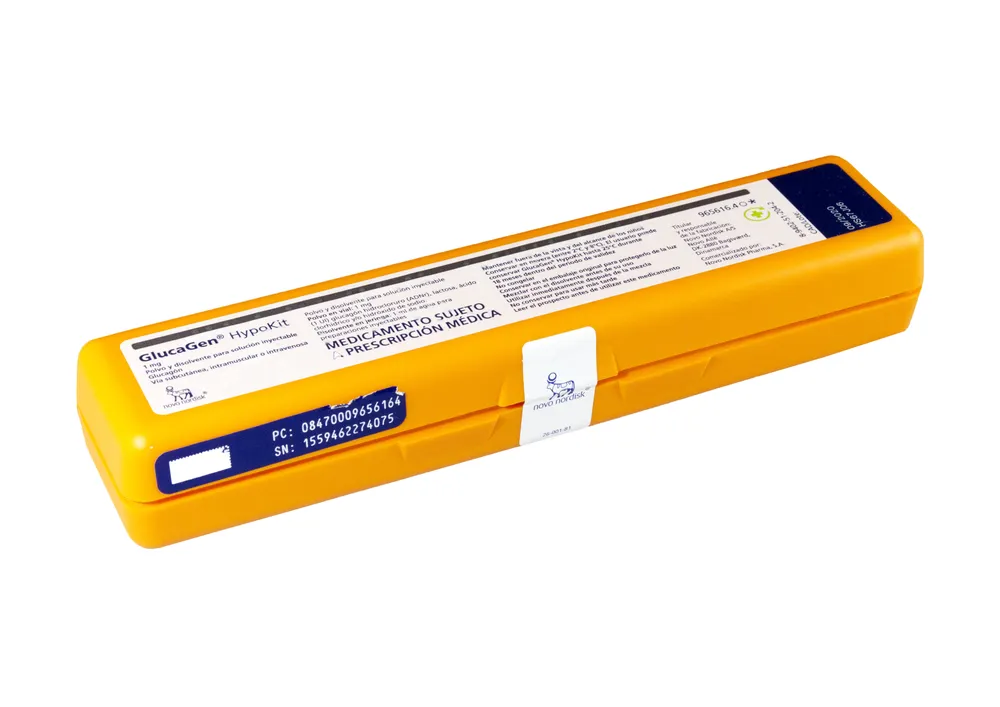
Table of Contents
Patient Information Leaflet
Introduction
Patient Information Leaflet
GlucaGen HypoKit 1 mg
Powder and solvent for injectable solution
glucagon
Read this entire leaflet carefully before you start using this medicine, because it contains important information for you.
- Keep this leaflet, as you may need to read it again.
- If you have any questions, ask your doctor, pharmacist, or nurse.
- This medicine has been prescribed for you personally. Do not give it to others, even if they have the same symptoms as you, because it could harm them.
- If you experience any side effects, consult your doctor, even if the side effects are not listed in this leaflet. See section 4.
Contents of this leaflet
- What GlucaGen HypoKit is and what it is used for
- What you need to know before using GlucaGen HypoKit
- How to use GlucaGen HypoKit
- Possible side effects
- How to store GlucaGen HypoKit
- Contents of the pack and other information
- Additional information for healthcare professionals
1. What GlucaGen HypoKit is and what it is used for
GlucaGen HypoKit contains the active substance "glucagon".
GlucaGen HypoKit is used immediately in emergency situations in children and adults with diabetes who use insulin. It is used when they have fainted (are unconscious) due to very low blood sugar levels. This is called "severe hypoglycemia". GlucaGen HypoKit is used when they are unable to take sugar orally.
Glucagon is a natural hormone that has the opposite effect of insulin in the human body. It helps the liver convert a substance called "glycogen" into glucose (sugar). The glucose is then released into the bloodstream, causing blood sugar levels to rise.
For healthcare professionals: see section 7.
2. What you need to know before using GlucaGen HypoKit
Important information
-
Make sure that family members, coworkers, or close friends are aware of GlucaGen HypoKit. Inform them that if you faint (become unconscious), they must use GlucaGen HypoKit immediately.
-
Show family members and others where you keep the kit and how to use it. They must act quickly—prolonged unconsciousness can be harmful. It is important that they are trained and know how to use GlucaGen HypoKit before it is needed.
-
The syringe does not contain GlucaGen. The water in the syringe must be mixed with the compressed GlucaGen powder in the vial before injection. Instruct family members and others to follow the instructions in section 3: How to use GlucaGen HypoKit.
-
Any unused mixture of GlucaGen must be discarded.
-
After using GlucaGen HypoKit, you or someone else must contact your doctor or a healthcare professional. You need to determine why your blood sugar dropped and how to prevent it from happening again.
Do not use GlucaGen HypoKit if
- you are allergic to glucagon or any of the other ingredients of this medicine (listed in section 6).
- you have a tumor of the adrenal gland.
If either of these applies to you, do not use GlucaGen HypoKit.
Warnings and precautions
Talk to your doctor, pharmacist, or nurse before using GlucaGen HypoKit.
GlucaGen may not work properly if:
- you have been fasting for a prolonged period
- you have low adrenaline levels
- your low blood sugar is due to excessive alcohol consumption
- you have a tumor that releases glucagon or insulin
If any of these apply to you, consult your doctor or nurse.
Use of GlucaGen with other medicines
The following medicines may affect the performance of GlucaGen HypoKit:
- insulin – used to treat diabetes
- indomethacin – used to treat joint pain and stiffness
The following medicines may be affected by GlucaGen HypoKit:
- warfarin – used to prevent blood clots. GlucaGen may increase the anticoagulant effect of warfarin.
- beta-blockers – used to treat high blood pressure and irregular heartbeat. GlucaGen HypoKit may increase blood pressure and pulse, although this effect lasts only briefly.
If any of these apply to you (or if you are unsure), consult your doctor or pharmacist before using GlucaGen HypoKit.
Tell your doctor or pharmacist if you are using, have recently used, or might need to use any other medicines.
Pregnancy and breastfeeding
If you experience low blood sugar while pregnant or breastfeeding, think you might be pregnant, or plan to become pregnant, you may use GlucaGen HypoKit.
Consult your doctor or pharmacist before using any medicine if you are pregnant.
Driving and using machines
Wait until the effects of low blood sugar have passed before driving or operating tools or machinery.
GlucaGen contains sodium
GlucaGen contains less than 23 mg of sodium (1 mmol) per maximum dose (2 ml), which is essentially “sodium-free”.
3. How to use GlucaGen HypoKit
Follow exactly the instructions for administering the medicine provided in this leaflet or as directed by your doctor. If in doubt, consult your doctor.
Preparation and administration of the injection
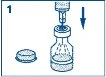
- Remove the plastic cap from the vial. Remove the needle cover from the syringe. Do not remove the safety plastic from the syringe. Insert the needle into the rubber stopper (within the marked circle) of the vial containing GlucaGen and inject all the liquid from the syringe into the vial.
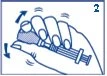
- Without removing the needle from the vial, gently shake the vial until GlucaGen is completely dissolved and the solution is clear.
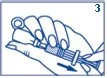
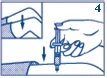
- Make sure the plunger is fully depressed. While keeping the needle in the liquid, slowly withdraw all the solution into the syringe. Ensure the plunger does not come out of the syringe. It is important to remove any air bubbles from the syringe:
- With the needle pointing upwards, gently tap the syringe with your fingers.
- Slightly press the plunger to expel any air bubbles that may have collected at the top of the syringe.
Continue pressing the plunger until the correct dose for injection is reached. A small amount of liquid will be expelled from the tip of the needle when doing this.
See below Dose to be injected.
-
Inject the dose under the skin or into the muscle.
-
Place the unconscious person on their side to prevent choking.
-
Give the person a sugary snack such as candy, biscuits, or fruit juice as soon as they regain consciousness and are able to swallow. The sugary snack will help prevent another episode of low blood sugar.
After using GlucaGen HypoKit, you or another person must contact your doctor or a healthcare professional. You need to determine why the low blood sugar occurred and how to prevent it from happening again.
Dose to be injected
The recommended dose is:
- Adults: inject the entire medication (1 ml) – this is marked as “1” on the syringe.
- Children under 8 years of age or children over 8 years of age weighing less than 25 kg: inject half of the medication (0.5 ml) – this is marked as “0.5” on the syringe.
- Children over 8 years of age or children under 8 years of age weighing more than 25 kg: inject the entire medication (1 ml) – this is marked as “1” on the syringe.
If you are given more GlucaGen than you should
An overdose of GlucaGen may cause nausea and vomiting. Specific treatment is generally not required.
In case of overdose or accidental ingestion, contact your doctor or pharmacist immediately, or call the Toxicology Information Service at telephone number (91) 562.04.20, indicating the medicine and the amount ingested.
4. Possible adverse effects
Like all medicines, this medicine can cause adverse effects, although not everyone will experience them.
The following adverse effects may occur with this medicine:
Contact your doctor immediately if you experience any of the following serious adverse effects:
Very rare: may affect up to 1 in 10,000 people
- Allergic reaction – symptoms may include difficulty breathing, sweating, rapid heartbeat (tachycardia), skin rash, facial swelling, and collapse.
?Contact your doctor immediately if you experience any of the serious adverse effects listed above.
Other adverse effects
Common: may affect up to 1 in 10 people
- Feeling of dizziness (nausea)
Uncommon: may affect up to 1 in 100 people
- Vomiting
Rare: may affect up to 1 in 1,000 people
- Stomach (abdominal) pain
Frequency not known: frequency cannot be estimated from the available data
- Reactions at the injection site.
? If you experience any adverse effect listed above, consult your doctor, even if it is a possible adverse effect not listed in this leaflet.
Reporting of adverse effects
If you experience any adverse effect, consult your doctor, even if it is a possible adverse effect not listed in this leaflet. You may also report them directly via the Spanish Pharmacovigilance System for Human Medicines: www.notificaRAM.es. By reporting adverse effects, you can help provide more information on the safety of this medicine.
5. Storage of GlucaGen Hypokit
-
Keep this medicine out of the sight and reach of children.
-
Store properly:
- in a refrigerator (between 2°C and 8°C), or
- outside the refrigerator, below 25°C for up to 18 months, within the expiry period.
-
Keep in the original packaging to protect from light.
-
Do not freeze, to prevent damage to the product.
-
Use immediately after mixing. Do not store for later use.
-
Do not use this medicine after the expiry date stated on the label. The expiry date refers to the last day of the month indicated.
-
Do not use if the mixed solution has a gel-like appearance or if part of the powder has not dissolved properly.
-
Do not use if the plastic cap is missing or loose when you receive the product. In this case, return the product to your pharmacy.
-
Medicines must not be disposed of via wastewater or household waste. Dispose of unused containers and medicines at the SIGRE point in your pharmacy. If in doubt, ask your pharmacist how to dispose of unused medicines and packaging. This will help protect the environment.
6. Contents of the pack and other information
Composition of GlucaGen
- The active substance is glucagon 1 mg as hydrochloride, produced in yeast using recombinant DNA technology.
- The other components are: monohydrate lactose, water for injections, hydrochloric acid and/or sodium hydroxide (for pH adjustment).
Appearance of the product and contents of the pack
GlucaGen is supplied as a vial containing glucagon, a white sterile powder, with a disposable syringe containing the solvent. The powder is compacted. After mixing, the reconstituted solution contains glucagon 1 mg/mL.
Marketing Authorization Holder and Manufacturer
Novo Nordisk A/S
Novo Allé
DK-2880 Bagsværd, Denmark
This medicinal product is authorized in the European Economic Area and the United Kingdom (Northern Ireland) under the following names:
Germany, Austria, Belgium, Bulgaria, Cyprus, Croatia, Denmark, Slovakia, Slovenia, Spain, Estonia, Finland, France, Greece, Hungary, Ireland, Iceland, Italy, Latvia, Lithuania, Luxembourg, Malta, the Netherlands, Portugal, the United Kingdom (Northern Ireland), Czech Republic: GlucaGen
Norway and Sweden: Glucagon Novo Nordisk
7. Additional information for healthcare professionals
Healthcare professionals should read all previous sections before reviewing this additional information.
Due to the instability of GlucaGen in solution, the product must be administered immediately after reconstitution and must not be administered as an intravenous infusion.
Do not attempt to recap the needle of the used syringe. Place the used syringe into the orange case and dispose of the used needle in a sharps container when possible.
Treatment of severe hypoglycemia
Administer as subcutaneous or intramuscular injection. If the patient does not respond within 10 minutes, intravenous glucose should be administered. Once the patient has responded to treatment, oral carbohydrates should be given to restore liver glycogen and prevent recurrence of hypoglycemia.
Diagnostic procedures
Oral carbohydrates should be administered once the procedure is completed, if compatible with the diagnostic method used. Remember that GlucaGen has the opposite effect of insulin. Extra caution is required when administering GlucaGen to diabetic patients or individuals with heart problems during endoscopic or radiographic procedures.
For diagnostic procedures, the use of a syringe with a finer needle and more precise graduation may be more appropriate.
Gastrointestinal tract examination:
Doses range from 0.2 – 2 mg depending on the diagnostic technique and route of administration. The diagnostic dose to achieve relaxation of the stomach, duodenal bulb, duodenum, and small intestine is 0.2 – 0.5 mg administered intravenously or 1 mg administered intramuscularly. The dose to relax the colon is 0.5 – 0.75 mg intravenously or 1 – 2 mg intramuscularly. Onset of effect after intravenous injection of 0.2 – 0.5 mg occurs within one minute, with duration of effect lasting 5 – 20 minutes. Onset of effect after intramuscular injection of 1 – 2 mg occurs after 5 – 15 minutes and lasts approximately 10 – 40 minutes.
Additional adverse reactions following use in diagnostic procedures
Changes in blood pressure, rapid heartbeat, hypoglycemia, and hypoglycemic coma.
Date of latest review of this leaflet: 12/2022
Other sources of information
Detailed and up-to-date information on this medicinal product is available on the website of the Spanish Agency of Medicines and Health Products (AEMPS) http://www.aemps.gob.es/