Gaviscon Forte oral suspension in sachets
Spain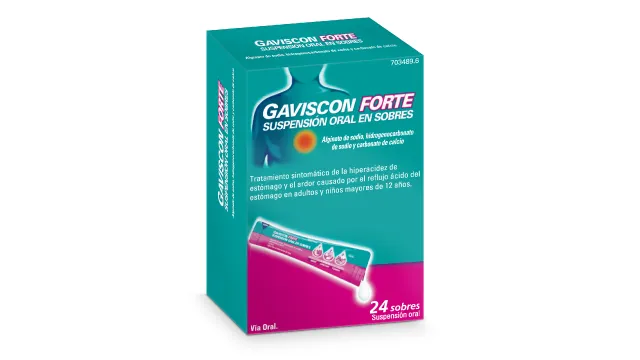
Table of Contents
Patient Information Leaflet
Introduction
Patient Information Leaflet
Gaviscon Forte Oral Suspension in Sachets
Sodium alginate, sodium hydrogen carbonate (bicarbonate), and calcium carbonate
Read the entire leaflet carefully before you start taking this medicine, as it contains important information for you. Always follow exactly the instructions for taking this medicine as described in this leaflet or as given by your doctor or pharmacist.
|
Package leaflet contents:
- What Gaviscon Forte is and what it is used for
- What you need to know before taking Gaviscon Forte
- How to take Gaviscon Forte
- Possible side effects
- Storage of Gaviscon Forte
- Contents of the pack and other information
1. What Gaviscon Forte is and what it is used for
It belongs to the group of medicines known as other agents for peptic ulcer and gastroesophageal reflux.
It works in two different ways:
- Sodium alginate together with sodium hydrogen carbonate (bicarbonate) and calcium carbonate form a protective barrier in the stomach to prevent gastric reflux, relieving heartburn.
- Sodium hydrogen carbonate (bicarbonate) and calcium carbonate additionally neutralize excess acid in the stomach.
Gaviscon Forte is indicated for the symptomatic treatment of stomach hyperacidity and heartburn caused by acid reflux from the stomach in adults and adolescents over 12 years of age.
You should consult a doctor if symptoms worsen or do not improve after 7 days.
2. What you need to know before taking Gaviscon Forte
Do not take Gaviscon Forte:
- If you are allergic to calcium carbonate, sodium hydrogen carbonate (bicarbonate), sodium alginate, or any of the other ingredients of this medicine (listed in section 6).
- If you have severe kidney insufficiency or suffer from kidney stones.
- If you have high levels of calcium in your blood or low levels of phosphate in your blood.
- If you have high levels of calcium in your urine.
Warnings and Precautions
Consult your doctor or pharmacist before taking this medicine if: you have mild or moderate kidney problems, you have been diagnosed with sarcoidosis (an inflammatory condition that can affect multiple organs in the body), if you suffer from constipation or haemorrhoids, or if you experience symptoms of stomach or intestinal disorders, appendicitis, or oedema.
If you are taking or need to take other medicines, you should separate their administration by 1 to 2 hours (see "Other medicines and Gaviscon Forte").
Avoid prolonged use, as it may lead to kidney stones. Similarly, high doses over a long period may not only cause kidney stones but also lead to elevated calcium levels in blood or urine, kidney failure, or worsening of pre-existing kidney problems.
This medicine should not be taken with milk or dairy products.
If symptoms persist after 7 days of treatment, consult your doctor.
Children and adolescents
Gaviscon Forte is not recommended for children under 12 years of age.
Interference with diagnostic tests
If you are scheduled to undergo any laboratory tests (including blood and urine tests, skin tests using allergens, etc.), inform your doctor that you are taking this medicine, as it may alter test results.
Other medicines and Gaviscon Forte
Inform your doctor or pharmacist if you are taking, have recently taken, or might need to take any other medicines.
Before taking this medicine, inform your doctor if you are taking antibiotics (tetracyclines, quinolones), heart medications such as cardiac glycosides (digoxin, digitoxin), or other medicines such as fluorides, phosphates, iron salts, ketoconazole, neuroleptics, thyroid hormones, penicillamine, glucocorticoids, chloroquine, bisphosphonates, beta-blockers (atenolol, metoprolol, propranolol), or estramustine, as this medicine may affect their effectiveness.
Since Gaviscon Forte may interfere with certain medicines, you should wait 2 hours after taking it before taking any other oral medicine. If you have taken another medicine, wait 1 to 2 hours before taking Gaviscon Forte to ensure maximum benefit from the other treatment.
Taking Gaviscon Forte with food and drinks
Like all calcium-containing antacids, this medicine should not be taken with large amounts of milk or dairy products, as this may lead to increased calcium levels in the blood and milk-alkali syndrome (Burnett's syndrome).
Fertility, pregnancy and breastfeeding
If you are pregnant or breastfeeding, think you may be pregnant, or are planning to become pregnant, consult your doctor or pharmacist before using this medicine.
This medicine may be used during pregnancy and breastfeeding if taken according to these recommendations and not for prolonged periods.
As this medicine provides a significant amount of calcium in addition to the daily intake of pregnant or breastfeeding women, such women must not exceed the doses indicated in section 3. How to take Gaviscon Forte, and should not simultaneously consume large amounts of dairy products and milk (1 litre of milk contains 1.2 grams of elemental calcium).
Driving and using machines
This medicine does not affect the ability to drive or operate machinery.
Gaviscon Forte contains sodium, methyl parahydroxybenzoate, and propyl parahydroxybenzoate.
This medicine contains 255.76 mg of sodium (a main component of table/cooking salt) in each 2 sachets (20 ml). This corresponds to 12.8% of the maximum daily intake of sodium recommended for an adult.
Consult your doctor if you need to take 3 or more sachets daily for a prolonged period, especially if you have been advised to follow a low-salt (low-sodium) diet.
It may cause allergic reactions (possibly delayed), as it contains methyl parahydroxybenzoate (E-218) and propyl parahydroxybenzoate (E-216).
3. How to take Gaviscon Forte
Follow exactly the instructions for use provided in this leaflet or as directed by your doctor or pharmacist. If in doubt, consult your doctor or pharmacist.
The recommended dose for adults, including elderly people and adolescents over 12 years of age, is 1 to 2 sachets as needed, taken 1 hour after meals and before going to bed. The maximum dose is 8 sachets per day.
Renal insufficiency: caution is required in patients on low-salt diets (see section 2).
How to take:
This medicine is taken orally.
Open the sachet and take the contents directly from the sachet.
If symptoms persist after 7 days of continuous treatment, consult your doctor to rule out more serious conditions.
If you take more Gaviscon Forte than you should
Symptoms of overdose include nausea and vomiting, constipation, fatigue, increased urine production, thirst, dehydration, and abnormal muscle weakness.
Drink plenty of water and consult your doctor or pharmacist.
In case of overdose or accidental ingestion, consult your doctor or pharmacist, go to a medical center, or call the Toxicology Information Service at telephone number: 91 562 04 20, indicating the medicine and the amount ingested.
If you forget to take Gaviscon Forte
Do not take a double dose to make up for missed doses.
When needed, resume taking it as indicated in section 3. How to take Gaviscon. If you have any further questions about the use of this medicine, ask your doctor or pharmacist.
4. Possible adverse effects
Like all medicines, this medicine can cause adverse effects, although not everyone experiences them.
During the use of the combination of sodium alginate, sodium hydrogen carbonate (bicarbonate), and calcium carbonate, the following adverse effects have been observed with the frequencies listed below:
Frequency not known (frequency cannot be estimated from available data):
- Allergic reactions, such as skin rash and itching, difficulty breathing, swelling of the face, mouth or throat, and anaphylactic shock.
- Increased levels of calcium in the blood, especially in people with impaired kidney function (with prolonged use and high doses).
- Constipation, nausea, vomiting, fatigue, confusion, increased urine production, thirst, and dehydration (alkalosis) (with prolonged use and high doses).
- Milk-alkali syndrome (Burnett's syndrome), which may lead to elevated calcium levels in the blood (with prolonged use and high doses).
Reporting of adverse effects
If you experience any type of adverse effect, consult your doctor or pharmacist, even if it is a possible adverse effect not listed in this leaflet. You may also report them directly via the Spanish Pharmacovigilance System for Human Medicinal Products (www.notificaram.es). By reporting adverse effects, you can help provide more information on the safety of this medicine.
5. Storage of Gaviscon Forte
Keep this medicine out of the sight and reach of children.
Do not use this medicine after the expiry date stated on the carton after EXP. The expiry date refers to the last day of the month indicated.
Do not store above 30°C. Do not refrigerate or freeze.
Medicines should not be disposed of via wastewater or household waste.
Dispose of unused containers and medicines at the SIGRE collection point at your pharmacy. Ask your pharmacist how to dispose of containers and medicines you no longer need. This helps protect the environment.
6. Contents of the pack and other information
Composition of Gaviscon
The active substances are 500 mg of sodium alginate, 213 mg of sodium hydrogen carbonate (bicarbonate), and 325 mg of calcium carbonate.
The other components (excipients) are carbomer, methylparaben (E-218), propylparaben (E-216), sodium saccharin, mint flavouring no. 2, sodium hydroxide, and purified water.
Nature of the product and pack contents
Gaviscon is a white, opaque suspension with a mint odour and flavour.
It is available in cardboard packs containing 2, 12, 24, or 30 sachets, each sachet containing 10 ml.
Only certain pack sizes may be marketed.
Marketing Authorisation Holder and Manufacturer
Reckitt Benckiser Healthcare, S.A.
Paseo de Gracia, 9, 08007, Barcelona, Spain
RB NL Brands B.V.
Schiphol Blvd 207, 1118 BH Schiphol, The Netherlands
Date of the most recent revision of this leaflet: August 2020.
Detailed and up-to-date information on this medicine is available on the website of the Spanish Agency of Medicines and Medical Devices (AEMPS): http://www.aemps.gob.es/