Fungowas 10 mg/g cream
Spain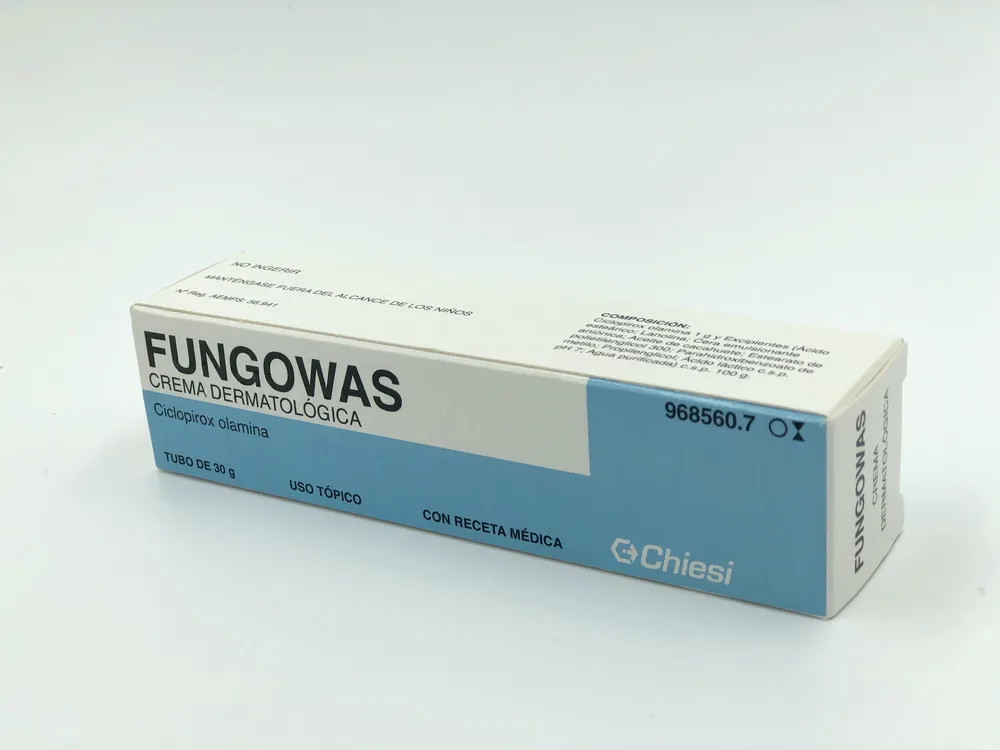
Table of Contents
Package leaflet: Information for the user
Introduction
Package leaflet: information for the user
Fungowas 10 mg/g cream
ciclopirox olamine
Read the entire leaflet carefully before you start using this medicine, because it contains important information for you.
- Keep this leaflet, as you may need to read it again.
- If you have any questions, ask your doctor or pharmacist.
- This medicine has been prescribed for you only and must not be given to other people, even if they have the same symptoms as you, because it could harm them.
- If you experience any adverse effects, consult your doctor or pharmacist, even if they are adverse effects not listed in this leaflet. See section 4.
Contents of the leaflet
- What Fungowas is and what it is used for
- What you need to know before using Fungowas
- How to use Fungowas
- Possible side effects
- How to store Fungowas
- Contents of the pack and other information
1. What Fungowas is and what it is used for
Fungowas belongs to the group of antifungal medicines known as topical antifungals, which are used to treat fungal skin infections.
It is indicated for topical treatment of:
- athlete's foot (tinea pedis), tinea corporis (ringworm of the body)
- cutaneous candidiasis (skin infections caused by the fungus Candida sp.)
- pityriasis versicolor (a skin condition caused by a fungus, characterized by round patches of brown, pink, or white discoloration, mainly appearing on the trunk and arms)
- candidal balanitis (inflammation of the glans penis caused by a fungal infection)
- as complementary treatment for the male partners of women with local genital fungal infection (vaginitis and vulvovaginitis caused by the fungus Candida sp.)
- erythrasma
2. What you need to know before using Fungowas 10 mg/g cream
Do not use Fungowas
- If you are allergic to ciclopirox olamine or to any of the other ingredients of this medicine (listed in section 6).
- This medicine contains peanut oil (arachis oil). It should not be used if you are allergic to peanuts or soya.
Warnings and precautions
- Avoid contact with the eyes. If contact occurs, rinse thoroughly with plenty of water.
- Do not apply this medicine to open wounds.
Consult your doctor or pharmacist before starting to use Fungowas.
Other medicines and Fungowas
Inform your doctor or pharmacist if you are taking, have recently taken, or might need to take any other medicines, including those obtained without a prescription.
Pregnancy and breastfeeding
The safety of this medicine during pregnancy and breastfeeding has not been established. As a precautionary measure, the use of this medicine is not recommended in pregnant or breastfeeding women, unless otherwise directed by your doctor.
Consult your doctor or pharmacist before using any medicine.
Driving and using machines
The effect of Fungowas on the ability to drive and use machinery is negligible or none.
Fungowas contains propylene glycol, lanolin, methyl parahydroxybenzoate and peanut oil
This medicine contains 18 mg of propylene glycol per gram of cream.
It may cause local skin reactions (such as contact dermatitis) because it contains lanolin.
It may cause allergic reactions (possibly delayed) because it contains methyl parahydroxybenzoate.
This medicine contains arachis oil (peanut oil). Do not use this medicine if you are allergic to peanuts or soya.
3. How to use Fungowas
Follow exactly the administration instructions for Fungowas provided by your doctor. If in doubt, consult your doctor or pharmacist again.
Dosage
Use in adults
Apply Fungowas to the affected area of skin twice daily (once in the morning and once at night).
Although improvement of lesions usually occurs during the first week, treatment should be continued for 1–2 weeks after the lesions have disappeared in order to prevent relapses and resistance to treatment.
If lesions have not disappeared after 4 weeks of treatment, you should consult your doctor again.
Use in children
The use of Fungowas in children is not recommended.
Method of administration
This medicine is for cutaneous use only.
Wash your hands before and after use.
Apply the cream to the affected area of skin with gentle massage.
In cases of candidal balanitis or to prevent reinfection in male partners of women with gynecological infection, the cream should be applied to the glans (tip of the penis) and the inner surface of the foreskin (the skin covering the tip of the penis).
If you use more Fungowas than you should
Due to the route of administration of this medicine, intoxication is unlikely.
In case of overdose or accidental ingestion, contact your doctor or pharmacist immediately, or call the Toxicology Information Service at telephone number 91 562 04 20, indicating the medicine and the amount used/ingested.
If you forget to use Fungowas
Do not apply a double dose to make up for missed doses.
If you have any further questions about the use of this medicine, ask your doctor or pharmacist.
4. Possible adverse effects
Like all medicines, this medicine can cause adverse effects, although not everyone experiences them.
Adverse effects are more common during the first days of treatment and very rarely lead to discontinuation of treatment.
Common adverse effects (may affect up to 1 in 10 people)
The most frequently reported adverse effects during initial applications are transient signs of worsening at the application site (burning sensation, redness, itching); these effects are brief and treatment should not be interrupted.
Uncommon adverse effects (may affect up to 1 in 100 people)
Uncommon adverse effects include local reactions such as blisters and general allergic reactions. If any of these effects occur, treatment must be immediately discontinued and you should consult your doctor as soon as possible.
Frequency not known (frequency cannot be estimated from available data)
Contact dermatitis (skin rash such as eczema).
If undergoing long-term treatment over a large area, on wounded skin, on a mucous membrane, or under occlusive dressing, the risks related to the medicine passing into the bloodstream should be considered, even if systemic effects have not been reported.
If you consider any of the adverse effects you experience to be severe, or if you notice any adverse effect not listed in this leaflet, inform your doctor or pharmacist.
Reporting of adverse effects
If you experience any type of adverse effect, consult your doctor or pharmacist, even if it is a possible adverse effect not listed in this leaflet. You may also report them directly via the Spanish Pharmacovigilance System for Human Medicines: https://www.notificaram.es
By reporting adverse effects, you can help provide more information on the safety of this medicine.
5. Storage of Fungowas
This medicine does not require any special storage conditions.
Keep out of the sight and reach of children.
Do not use Fungowas after the expiry date stated on the packaging after EXP. The expiry date refers to the last day of the month indicated.
Medicines must not be disposed of via wastewater or household waste. Dispose of unused medicines and their containers at the SIGRE Point at your pharmacy. Ask your pharmacist how to dispose of medicines and containers you no longer need. This will help protect the environment.
6.
Composition of Fungowas
- The active substance is ciclopirox olamine. Each gram of cream contains 10 mg of ciclopirox olamine.
- The other components are stearic acid, lanolin, anionic emulsifying wax, peanut oil, ethylene glycol palmitostearate/polyethylene glycol, methyl parahydroxybenzoate, propylene glycol, lactic acid (for pH adjustment), purified water.
Appearance of the medicinal product and contents of the pack
Fungowas is presented as a white, creamy, odorless cream in containers containing 1 aluminum tube with 30 g of cream.
Marketing Authorization Holder and Manufacturer
Marketing Authorization Holder
CHIESI ESPAÑA, S.A.U.
Plaça d’Europa, 41-43, Planta 10
08908 L'Hospitalet de Llobregat
Barcelona (Spain)
Manufacturer
- BRAUN MEDICAL, S.A.
Huelma, 5
Polígono Industrial Los Olivares
23009 Jaén (Spain)
Date of the most recent revision of this leaflet: December 2024.
Detailed information on this medicinal product is available on the website of the Spanish Agency of Medicines and Health Products (AEMPS) (http://www.aemps.gob.es).
PR 03_02a