Fosrenol 750 mg oral powder
Spain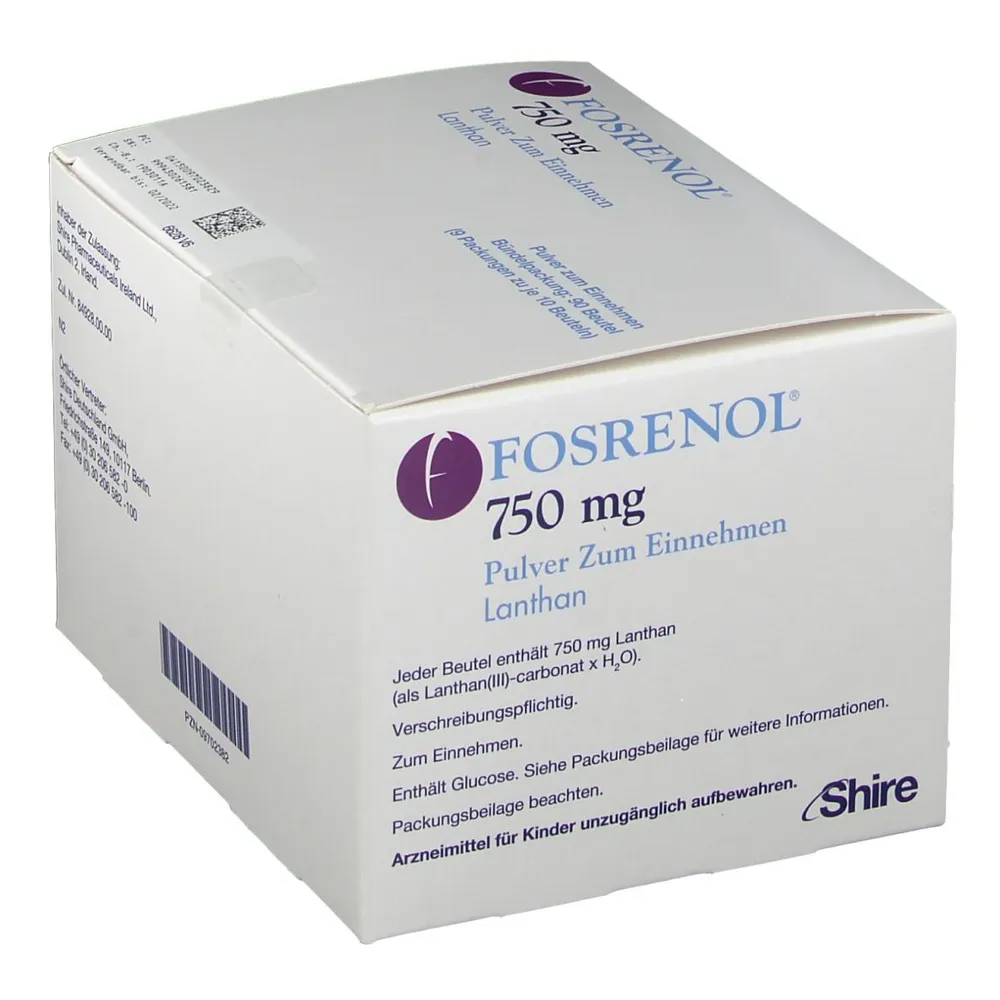
Table of Contents
Package leaflet: Information for the user
Introduction
Package leaflet: information for the patient
FOSRENOL 750 mg oral powder
FOSRENOL 1000 mg oral powder
lanthanum
Read the entire leaflet carefully before you start taking this medicine, because it contains important information for you.
- Keep this leaflet. You may need to read it again.
- If you have any questions, ask your doctor or pharmacist.
- This medicine has been prescribed for you only, and you should not give it to others, even if they have the same symptoms as you, because it could harm them.
- If you experience any adverse effects, consult your doctor or pharmacist, even if they are adverse effects not listed in this leaflet. See section 4.
Contents of the leaflet:
- What Fosrenol is and what it is used for
- What you need to know before taking Fosrenol
- How to take Fosrenol
- Possible adverse effects
- How to store Fosrenol
- Contents of the pack and other information
1. What Fosrenol is and what it is used for
Fosrenol is used to reduce blood phosphorus levels in adult patients with chronic renal failure.
Patients whose kidneys do not function properly are unable to control the concentration of phosphorus in the blood. As a result, the amount of phosphorus in the blood increases (your doctor may refer to this condition as hyperphosphatemia).
Fosrenol is a medicine that reduces the body's absorption of phosphorus from food by binding to it in the digestive tract. Phosphorus bound to Fosrenol cannot be absorbed through the intestinal wall.
2. What you need to know before taking Fosrenol
Do not take Fosrenol
? if you are allergic to lanthanum carbonate hydrate or any of the other ingredients of this medicine (listed in section 6)
? if you have low levels of phosphate in your blood (hypophosphataemia)
? if you have intestinal obstruction.
Warnings and precautions
Talk to your doctor or pharmacist before taking Fosrenol if you know you have or have had any of the following conditions:
- stomach or intestinal cancer
- inflammatory bowel disease including ulcerative colitis or Crohn’s disease
- abdominal surgery or infection or inflammation of the abdomen/intestine (peritonitis)
- gastric or intestinal ulcers
- intestinal obstruction or slow intestinal transit (e.g., constipation and stomach complications due to diabetes)
- reduced liver or kidney function
If your kidney function is reduced, your doctor may decide to monitor your blood calcium levels periodically. If your calcium levels are too low, you may be given additional calcium.
If you are due to have an X-ray, inform your doctor that you are taking Fosrenol, as it may affect the results.
If you are due to have a gastrointestinal endoscopy, inform your doctor that you are taking Fosrenol (lanthanum), as the endoscopist may detect lanthanum deposits in the gastrointestinal tract.
Taking Fosrenol with other medicines
Tell your doctor or pharmacist if you are taking, have recently taken, or might need to take any other medicines.
Fosrenol may affect how certain medicines are absorbed in the gastrointestinal tract. If you are taking chloroquine (for rheumatism and malaria), ketoconazole (for fungal infections), or antibiotics of the tetracycline or doxycycline group, you must not take these drugs within 2 hours before or after taking Fosrenol.
It is not recommended to take oral fluoroquinolone antibiotics (including ciprofloxacin) within 2 hours before or 4 hours after taking Fosrenol.
If you are taking levothyroxine (for underactive thyroid), you must not take this medicine within 2 hours before or after taking Fosrenol. Your doctor may wish to monitor your blood levels of thyroid-stimulating hormone (TSH) more closely.
Taking Fosrenol with food and drink
Fosrenol should be taken with or immediately after meals. See section 3 for instructions on how to take Fosrenol.
Pregnancy and breastfeeding
Fosrenol must not be used during pregnancy. If you are pregnant or breastfeeding, think you may be pregnant, or are planning to become pregnant, consult your doctor or pharmacist before using this medicine.
Since it is unknown whether the medicine passes into breast milk, you must not continue breastfeeding while taking Fosrenol. If you are breastfeeding, consult your doctor or pharmacist before using any medicine.
Driving and using machines
Dizziness and vertigo (a sensation of dizziness or spinning) are uncommon adverse reactions that have been reported in patients treated with Fosrenol. If you experience these symptoms, they may affect your ability to drive or operate machinery.
Fosrenol contains glucose
If your doctor has informed you that you have an intolerance to certain sugars, consult with him before taking this medicine.
3. How to take Fosrenol
Follow exactly the instructions for administration of this medicine given by your doctor or pharmacist. If in doubt, consult your doctor or pharmacist again.
You should take Fosrenol together with or immediately after eating food. Adverse effects such as nausea and vomiting are more likely if you take Fosrenol before a meal.
Fosrenol oral powder must be mixed with a soft food (for example, apple sauce or a similar food) and then swallowed. There is no need to take additional liquid.
Do not open the sachet until you are ready to use it. Mix the entire contents of the sachet into 1–2 tablespoons of soft food, making sure that the entire dose is mixed with the food. Be sure to ingest the mixture of oral powder and food immediately (within 15 minutes). Do not save any portion of the oral powder and food mixture for later use.
Your doctor will tell you how many sachets of oral powder to take with each meal (your daily dose will be divided among your meals). The number of sachets you take will depend on:
• Your diet (the amount of phosphate in the food you eat)
• Your blood phosphorus level.
Before starting Fosrenol oral powder, your doctor may have used Fosrenol chewable tablets to determine the correct dose. Fosrenol chewable tablets are available in various strengths, allowing for smaller dose increases. The initial dose of chewable tablets is usually 250 mg three times daily with meals. Your likely oral powder dose will be 750 or 1000 mg three times daily with meals. Every 2–3 weeks, your doctor will monitor your blood phosphorus level and may increase your dose until your blood phosphorus level becomes acceptable, and then regularly thereafter.
Fosrenol works by binding to dietary phosphorus in your intestine. It is very important to take Fosrenol with every meal. If you change your diet, inform your doctor, as you may need additional Fosrenol. Your doctor will advise you what to do in this case.
If you take more Fosrenol than you should
If you take an excessive amount of Fosrenol, contact your doctor to assess the risk and receive advice. Symptoms of overdose may include nausea and headache.
If you have taken more Fosrenol than you should, contact your doctor, pharmacist, or call the Toxicology Information Service immediately at telephone: 91-562-04-20, indicating the medicine and the amount taken.
It is recommended to bring the medicine packaging and leaflet to the healthcare professional.
If you forget to take Fosrenol
It is important to take Fosrenol with every meal.
If you forget to take Fosrenol, take the next dose with your next meal. Do not take a double dose to make up for forgotten doses.
4. Possible adverse effects
Like all medicines, this medicine can cause adverse effects, although not everyone experiences them.
Some adverse effects could be serious. If you experience any of the following, contact your doctor immediately:
- Rupture of the intestinal wall (signs include: severe stomach pain, chills, fever, nausea, vomiting, or abdominal tenderness on palpation). This adverse effect is rare (may affect up to 1 in 1,000 people).
- Intestinal obstruction (signs include: severe bloating, pain, swelling or cramps in the abdomen, severe constipation). This adverse effect is uncommon (may affect up to 1 in 100 people).
- Contact your doctor if you experience a new or severe episode of constipation, as it may be an early sign of intestinal obstruction. Constipation is a common adverse effect (may affect 1 in 10 people).
Other less serious adverse effects include the following:
.
Very common adverse effects (may affect more than 1 in 10 people):
? Nausea, vomiting, diarrhoea, stomach pain, headache, itching, skin rash.
Common adverse effects (may affect up to 1 in 10 people):
? Heartburn and flatulence.
? Hypocalcaemia (abnormally low calcium levels in the blood) is also a common adverse effect; symptoms may include tingling in hands and feet, muscle and abdominal cramps, or spasms of facial and foot muscles.
Uncommon adverse effects (may affect up to 1 in 100 people):
? Fatigue; feeling unwell; chest pain; weakness; swelling of hands and feet; body pain; dizziness; vertigo; burping; inflammation of the stomach and intestines (gastroenteritis); indigestion; irritable bowel syndrome; dry mouth; dental disorders; inflammation of the oesophagus or mouth; soft stools; increases in certain liver enzymes, parathyroid hormone; aluminium, calcium and blood glucose levels; increase or decrease in blood phosphate levels; thirst; weight loss; joint pain; muscle pain; weakness and loss of bone mass (osteoporosis); loss of appetite and increased appetite; laryngitis; hair loss; increased sweating; taste disturbances and increased white blood cell count.
Not known (frequency cannot be estimated from available data):
- Presence of product residue in the gastrointestinal tract.
Reporting of adverse effects
If you experience any type of adverse effect, consult your doctor or pharmacist, even if it is a possible adverse effect not listed in this leaflet.
You can also report them directly via the Spanish Pharmacovigilance System for Human Medicinal Products: www.notificaRAM.es.
By reporting adverse effects, you can help provide more information on the safety of this medicine.
5. Storage of Fosrenol
Keep this medicine out of the sight and reach of children.
This medicine does not require any special storage conditions.
Do not use this medicine after the expiry date which is stated on the packaging and on the label of the bottle after EXP. The expiry date refers to the last day of the month indicated.
Medicines should not be disposed of via wastewater or household waste. Dispose of unused medicines and their containers at the SIGRE Point  at your pharmacy. Ask your pharmacist how to dispose of medicines and containers you no longer need. This will help protect the environment.
6. Contents of the pack and other information
Composition of Fosrenol
- The active substance is lanthanum (as lanthanum carbonate hydrate). Each sachet contains lanthanum carbonate hydrate corresponding to 750 mg or 1000 mg of lanthanum.
- The other components are dextrates (hydrated), anhydrous colloidal silica, and magnesium stearate.
Appearance of the product and contents of the pack
Fosrenol is presented as a white to off-white oral powder in a sachet.
The sachets are supplied in a box of 90 units. (The outer carton contains 9 boxes of 10 sachets each.)
Marketing Authorization Holder and Manufacturer
The Marketing Authorization Holder is:
Takeda Pharmaceuticals International AG Ireland Branch
Block 2 Miesian Plaza, 50-58 Baggot Street Lower,
Dublin 2, D02 HW68, Ireland
E-mail: [email protected]
The manufacturer is:
Catalent Germany Schorndorf GmbH
Steinbeisstr. 1 und 2
Schorndorf, Baden-Wuerttemberg, 73614
Germany.
Further information about this medicinal product is available upon request by contacting the local representative of the Marketing Authorization Holder:
Local representative:
Takeda Farmacéutica España S.A.
Calle Albacete, 5, planta 9ª,
Edificio Los Cubos
28027 Madrid
Spain
Tel: +34 91 790 42 22
This medicinal product is authorized in the Member States of the European Economic Area and in the United Kingdom (Northern Ireland) under the following names:
Austria, Belgium, Denmark, Estonia, Finland, France, Germany, Iceland, Latvia, Lithuania, Luxembourg, Netherlands, Norway, Slovenia, Spain, Sweden, United Kingdom (Northern Ireland) | Fosrenol |
Ireland, Italy | Foznol |
Date of the most recent review of this leaflet: 04/2025.
Detailed information on this medicinal product is available on the website of the Spanish Agency for Medicines and Health Products (AEMPS) (http://www.aemps.gob.es/)