Fosavance 70 mg/5.600 UI tablets
Spain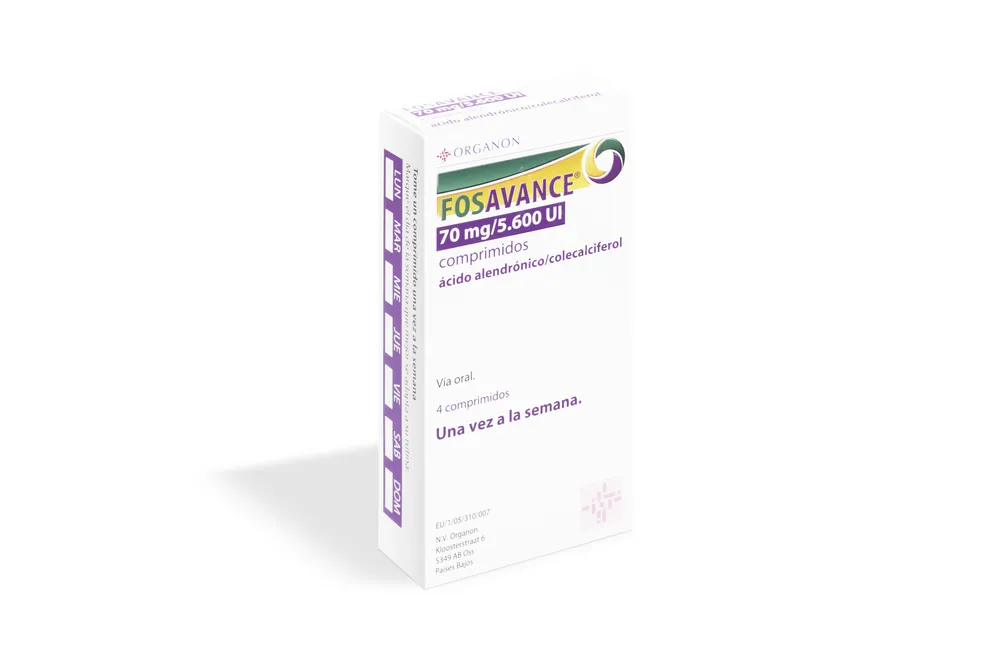
Table of Contents
Patient Information Leaflet
Introduction
Patient Information Leaflet
FOSAVANCE 70mg/2,800IU tablets
FOSAVANCE 70mg/5,600IU tablets
alendronic acid/colecalciferol
Read the entire leaflet carefully before you start taking this medicine, as it contains important information for you.
- Keep this leaflet as you may need to read it again.
- If you have any questions, ask your doctor or pharmacist.
- This medicine has been prescribed for you only. Do not pass it on to other people, even if they have the same symptoms as you, because it may harm them.
- If you experience any side effects, talk to your doctor or pharmacist, even if they are side effects not listed in this leaflet. See section 4.
- It is especially important that you understand the information in section 3 before taking this medicine.
Leaflet Contents
- What FOSAVANCE is and what it is used for
- What you need to know before taking FOSAVANCE
- How to take FOSAVANCE
- Possible side effects
- How to store FOSAVANCE
- Contents of the pack and other information
1. What FOSAVANCE is and what it is used for
What is FOSAVANCE?
FOSAVANCE is a tablet containing two active substances: alendronic acid (commonly known as alendronate) and colecalciferol, also known as vitamin D3.
What is alendronate?
Alendronate belongs to a group of non-hormonal medicines called bisphosphonates. Alendronate prevents bone loss that occurs in women after menopause and helps rebuild bone. It reduces the risk of spinal and hip fractures.
What is vitamin D?
Vitamin D is an essential nutrient required for calcium absorption and for maintaining healthy bones. The body can only properly absorb calcium from food if sufficient vitamin D is present, which is found in very few foods. The main source of vitamin D is production in the skin through exposure to sunlight. As we age, our skin produces less vitamin D. Vitamin D deficiency can lead to bone loss and osteoporosis, and in severe cases may cause muscle weakness, increasing the risk of falls and fractures.
What is FOSAVANCE used for?
Your doctor has prescribed FOSAVANCE to treat your osteoporosis and because you are at risk of vitamin D deficiency. It reduces the risk of spinal and hip fractures in postmenopausal women.
What is osteoporosis?
Osteoporosis causes bones to become thin and fragile. It is common in women after menopause. During menopause, the ovaries stop producing certain female hormones called estrogens, which help maintain a healthy skeleton. As a result, bone loss occurs and bones become more fragile. The earlier a woman reaches menopause, the greater her risk of developing osteoporosis.
Initially, osteoporosis has no symptoms. However, if left untreated, it can lead to bone fractures. Although these are usually painful, spinal fractures may go unnoticed until they cause loss of height. Weakened bones may break during normal daily activities, such as standing up, or from minor injuries that would not normally break a healthy bone. Bone fractures typically occur in the hip, spine, or wrist, and can cause not only pain but also significant problems such as stooped posture ("dowager's hump") and loss of mobility.
How can osteoporosis be treated?
In addition to your treatment with FOSAVANCE, your doctor may recommend lifestyle changes to help slow the progression of your disease, such as:
Quitting smoking
Smoking appears to increase the rate of bone loss and therefore may increase your risk of bone fractures.
Exercise
Like muscles, bones need exercise to stay strong and healthy. Consult your doctor before starting any exercise program.
Eating a balanced diet
Your doctor may advise you about your diet or whether you should take any dietary supplements.
2. What you need to know before taking FOSAVANCE
Do not take FOSAVANCE
- if you are allergic to alendronic acid, cholecalciferol, or any of the other ingredients of this medicine (listed in section 6),
- if you have certain problems with your throat (oesophagus – the tube connecting your mouth to your stomach), such as narrowing or difficulty swallowing,
- if you cannot remain upright (standing or sitting) for at least 30 minutes,
- if your doctor has told you that you have low levels of calcium in your blood.
If you think any of these apply to you, do not take the tablets. Consult your doctor first and follow their advice.
Warnings and precautions
Talk to your doctor or pharmacist before starting FOSAVANCE if:
- you have kidney problems,
- you have, or have recently had, problems with swallowing or digestive issues,
- your doctor has told you that you have Barrett’s oesophagus (a condition associated with changes in the cells lining the lower part of the oesophagus),
- you have been told you have difficulty absorbing minerals in your stomach or intestines (malabsorption syndrome),
- you have poor dental hygiene, gum disease, an upcoming dental extraction, or do not receive regular dental care,
- you have cancer,
- you are receiving chemotherapy or radiotherapy,
- you are receiving treatment with angiogenesis inhibitors (such as bevacizumab or thalidomide) used in cancer treatment,
- you are taking corticosteroids (such as prednisone or dexamethasone) used to treat conditions like asthma, rheumatoid arthritis, or severe allergies,
- you are or have been a smoker (as this may increase the risk of dental problems).
You may be advised to have a dental examination before starting treatment with FOSAVANCE.
It is important to maintain good oral hygiene while taking FOSAVANCE. You should have regular dental check-ups during treatment and contact your doctor or dentist if you experience any problems in your mouth or teeth, such as tooth loss, pain, or swelling.
Irritation, inflammation, or ulceration of the throat (oesophagus – the tube connecting your mouth to your stomach) may occur, often with symptoms such as chest pain, heartburn, or difficulty or pain when swallowing, especially if patients do not drink a full glass of water and/or lie down within 30 minutes after taking FOSAVANCE. These adverse effects may worsen if patients continue taking FOSAVANCE after developing such symptoms.
Girls and adolescents
FOSAVANCE must not be given to girls and adolescents under 18 years of age.
Other medicines and FOSAVANCE
Tell your doctor or pharmacist if you are taking, have recently taken, or might need to take any other medicines.
Calcium supplements, antacids, and certain oral medications may interfere with the absorption of FOSAVANCE if taken at the same time. Therefore, it is important to follow the instructions given in section 3 and wait at least 30 minutes before taking any other medication or supplement.
Certain medicines used for rheumatism or long-term pain called NSAIDs (for example, acetylsalicylic acid or ibuprofen) may cause gastrointestinal problems. Therefore, caution should be taken if these medicines are used together with FOSAVANCE.
Certain medicines or food additives may prevent the absorption of vitamin D from FOSAVANCE, including artificial fat substitutes, mineral oils, the weight-loss medicine orlistat, and cholesterol-lowering medicines such as cholestyramine and colestipol. Medicines for epileptic seizures (convulsions) (such as phenytoin or phenobarbital) may reduce the effectiveness of vitamin D. Individually, the need for additional vitamin D supplementation may be considered.
Taking FOSAVANCE with food and drink
Food and drinks (including mineral water) may reduce the effectiveness of FOSAVANCE if taken at the same time. Therefore, it is important to follow the advice given in section 3. You must wait at least 30 minutes before consuming any food or drinks other than water.
Pregnancy and breast-feeding
FOSAVANCE is intended for use only in postmenopausal women. You must not take FOSAVANCE if you are pregnant or think you may be pregnant, or if you are breast-feeding.
Driving and using machines
Adverse effects with FOSAVANCE (such as blurred vision, dizziness, and severe bone, muscle, or joint pain) have been reported, which may affect your ability to drive or operate machinery (see section 4). If you experience any of these adverse effects, you should not drive until you feel better.
FOSAVANCE contains lactose and sucrose.
If your doctor has informed you of an intolerance to certain sugars, consult with them before taking this medicine.
FOSAVANCE contains sodium.
This medicine contains less than 1 mmol of sodium (23 mg) per tablet; that is, essentially “sodium-free”.
3. How to take FOSAVANCE
Follow exactly the administration instructions for FOSAVANCE given to you by your doctor or pharmacist. If in doubt, consult your doctor or pharmacist again.
Take one FOSAVANCE tablet once a week.
Follow these instructions carefully.
- Choose the day of the week that best fits your routine. Each week, take one FOSAVANCE tablet on the day you have chosen.
It is very important that you follow instructions 2), 3), 4), and 5) to help ensure the FOSAVANCE tablet reaches your stomach quickly and to help reduce the risk of irritation in your throat (oesophagus – the tube connecting your mouth to your stomach).
- After getting up in the morning and before taking any food, drink, or other medicine, swallow the FOSAVANCE tablet whole with a full glass of water (not mineral water) (no less than 200 ml), so that FOSAVANCE is properly absorbed.
- Do not take it with mineral water (still or sparkling).
- Do not take it with coffee or tea.
- Do not take it with juice or milk.
Do not crush, chew, or allow the tablet to dissolve in your mouth, due to the risk of developing mouth ulcers.
-
Do not lie down – remain upright (sitting, standing, or walking) – for at least 30 minutes after swallowing the tablet. Do not lie down until after your first meal of the day.
-
Do not take FOSAVANCE at bedtime or before getting up in the morning.
-
If you have difficulty or pain when swallowing, chest pain, or new or worsening heartburn, stop taking FOSAVANCE and contact your doctor.
-
After swallowing a FOSAVANCE tablet, wait at least 30 minutes before taking your first meal, drink, or other medicine of the day, including antacids, calcium supplements, and vitamins. FOSAVANCE is only effective when taken on an empty stomach.
If you take more FOSAVANCE than you should
If you take too many tablets by mistake, drink a full glass of milk and contact your doctor immediately. Do not induce vomiting and do not lie down.
If you forget to take FOSAVANCE
If you miss a dose, take one tablet the morning after you remember. Do not take two tablets on the same day. Then resume taking one tablet once a week on your originally chosen day.
If you stop taking FOSAVANCE
It is important that you continue taking FOSAVANCE for as long as your doctor prescribes it. Since it is not known how long you should take FOSAVANCE, you should periodically discuss with your doctor whether continuing treatment with this medicine is still appropriate for you.
An Instruction Card is included in the FOSAVANCE pack. It contains important information to help you remember how to take FOSAVANCE correctly.
If you have any further questions about the use of this medicine, ask your doctor or pharmacist.
4. Possible adverse effects
Like all medicines, this medicine may cause adverse effects, although not everyone experiences them.
Consult your doctor immediately if you experience any of the following adverse effects, which may be serious and for which you may need urgent medical treatment:
Frequent (may affect up to 1 in 10 people):
- burning sensation; difficulty swallowing; pain when swallowing; ulcer in the throat (esophagus – the tube connecting your mouth to your stomach) which may cause chest pain, burning, or difficulty or pain when swallowing.
Rare (may affect up to 1 in 1,000 people):
- allergic reactions such as hives; swelling of the face, lips, tongue and/or throat, which may cause difficulty breathing or swallowing; severe skin reactions,
- pain in the mouth and/or jaw, swelling or sores inside the mouth, numbness or a feeling of heaviness in the jaw, or tooth loss. These may be signs of bone damage in the jaw (osteonecrosis), usually associated with delayed healing and infection, often following a dental extraction. Contact your doctor and dentist if you experience these symptoms,
- atypical femoral fractures (thigh bone) which may rarely occur, particularly in patients on long-term treatment for osteoporosis. Inform your doctor if you notice pain, weakness, or discomfort in the thigh, hip, or groin, as these may be early symptoms indicating a possible femoral fracture,
- severe bone, muscle, and/or joint pain.
Frequency not known (cannot be estimated from available data):
- atypical fractures at sites other than the femur (thigh bone).
Other adverse effects include
Very frequent (may affect more than 1 in 10 people):
- bone, muscle, and/or joint pain, sometimes severe.
Frequent (may affect up to 1 in 10 people):
- joint swelling,
- abdominal pain; stomach discomfort or burping after eating; constipation; feeling of fullness or bloating in the stomach; diarrhea; flatulence,
- hair loss; itching,
- headache; dizziness,
- fatigue; swelling of the hands or legs.
Uncommon (may affect up to 1 in 100 people):
- nausea; vomiting,
- irritation or inflammation of the throat (esophagus – the tube connecting your mouth to your stomach) or stomach,
- black or tarry stools,
- blurred vision; eye pain or redness,
- skin rash; redness of the skin,
- transient flu-like symptoms such as muscle pain, general malaise, and sometimes fever, which usually occur at the beginning of treatment,
- taste disturbances.
Rare (may affect up to 1 in 1,000 people):
- symptoms of low calcium levels in the blood, including muscle cramps or spasms and/or tingling sensation in the fingers or around the mouth,
- stomach ulcers or peptic ulcers (sometimes severe or with bleeding),
- narrowing of the throat (esophagus – the tube connecting your mouth to your stomach),
- skin rash that worsens with sunlight,
- mouth ulcers.
Very rare (may affect up to 1 in 10,000 people):
- consult your doctor if you have ear pain, discharge from the ear, or an ear infection. These could be symptoms of bone damage in the ear.
Reporting of adverse effects
If you experience any type of adverse effect, talk to your doctor or pharmacist, even if it is a possible adverse effect not listed in this leaflet. You can also report them directly through the national reporting system listed in Appendix V. By reporting adverse effects, you can help provide more information on the safety of this medicine.
5. Storage of FOSAVANCE
Keep this medicine out of the sight and reach of children.
Do not use this medicine after the expiry date stated on the carton and blister after EXP. The expiry date refers to the last day of the month indicated.
Store in the original blister to protect it from moisture and light.
Medicines must not be disposed of via wastewater or household waste. Ask your pharmacist how to dispose of any unused medicine and its packaging. This will help protect the environment.
6. Contents of the pack and other information
Composition of FOSAVANCE
The active substances are alendronic acid and colecalciferol (vitamin D3). Each FOSAVANCE 70 mg/2,800 IU tablet contains 70 mg alendronic acid (as sodium salt trihydrate) and 70 micrograms (2,800 IU) of colecalciferol (vitamin D3). Each FOSAVANCE 70 mg/5,600 IU tablet contains 70 mg alendronic acid (as sodium salt trihydrate) and 140 micrograms (5,600 IU) of colecalciferol (vitamin D3).
The other components are microcrystalline cellulose (E-460), anhydrous lactose (see section 2), medium-chain triglycerides, gelatin, sodium croscarmellose, sucrose (see section 2), colloidal silicon dioxide, magnesium stearate (E-572), butylhydroxytoluene (E-321), modified starch (corn) and sodium aluminosilicate (E-554).
Appearance of the product and contents of the pack
FOSAVANCE 70 mg/2,800 IU tablets are white to off-white, modified capsule-shaped, and marked with a bone silhouette on one side and “710” on the other. FOSAVANCE 70 mg/2,800 IU tablets are available in packs containing 2, 4, 6 or 12 tablets.
FOSAVANCE 70 mg/5,600 IU tablets are white to off-white, modified rectangular-shaped, and marked with a bone silhouette on one side and “270” on the other. FOSAVANCE 70 mg/5,600 IU tablets are available in packs containing 2, 4 or 12 tablets.
Only certain pack sizes may be marketed.
Marketing Authorization Holder N.V. Organon | Manufacturer Merck Sharp & Dohme B.V. Organon Heist bv Industriepark 30 2220 Heist-op-den-Berg Belgium |
You can request further information about this medicinal product by contacting the local representative of the marketing authorization holder:
Belgium/Belgium/Belgium Organon Belgium Tel/Tel: 0080066550123 (+32 2 2418100) | Lithuania Organon Pharma B.V. Lithuania branch Tel.: +370 52041693 |
Bulgaria Organon (B.V.) Ltd. - Bulgarian Branch Tel.: +359 2 806 3030 | Luxembourg/Luxembourg Organon Belgium Tél/Tel: 0080066550123 (+32 2 2418100) |
Czech Republic Organon Czech Republic s.r.o. Tel: +420 233 010 300 | Hungary Organon Hungary Kft. Tel.: +36 1 766 1963 |
Denmark Organon Denmark ApS Tlf: +45 4484 6800 | Malta Organon Pharma B.V., Cyprus branch Tel: +356 2277 8116 |
Germany Organon Healthcare GmbH Tel: 0800 3384 726 (+49(0) 89 2040022 10) | Netherlands N.V. Organon Tel.: 00800 66550123 (+32 2 2418100) |
Estonia Organon Pharma B.V. Estonian RO Tel: +372 66 61 300 | Norway Organon Norway AS Tlf: +47 24 14 56 60 |
Greece BIANEΞ Α.Ε. Tel: +30 210 80091 11 | Austria Organon Healthcare GmbH Tel: +49 (0) 89 2040022 10 |
Spain Organon Salud, S.L. Tel: +34 91 591 12 79 | Poland Organon Polska Sp. z o.o. Tel.: +48 22 105 50 01 |
France Organon France Tél: +33 (0) 1 57 77 32 00 | Portugal Organon Portugal, Sociedade Unipessoal Lda. Tel: +351 218705500 |
Croatia Organon Pharma d.o.o. Tel: +385 1 638 4530 | Romania Organon Biosciences S.R.L. Tel: +40 21 527 29 90 |
Ireland Organon Pharma (Ireland) Limited Tel: +353 15828260 | Slovenia Organon Pharma B.V., Oss, Ljubljana branch Tel: +386 1 300 10 80 |
Iceland Vistor hf. Tel: +354 535 7000 | Slovakia Organon Slovakia s. r. o. Tel: +421 2 44 88 98 88 |
Italy Organon Italia S.r.l. Tel: +39 06 90259059 | Finland/Finland Organon Finland Oy Tel/Tel: +358 (0) 29 170 3520 |
Cyprus Organon Pharma B.V., Cyprus branch Tel: +357 22866730 | Sweden Organon Sweden AB Tel: +46 8 502 597 00 |
Latvia Commercial representative office of “Organon Pharma B.V.” in Latvia Tel: +371 66968876 | United Kingdom (Northern Ireland) Organon Pharma (UK) Limited Tel: +44 (0) 208 159 3593 |
Date of the most recent review of this leaflet: <{MM/YYYY}>
Detailed information about this medicine is available on the website of the European Medicines Agency: https://www.ema.euopa.eu.