Eylea 114.3 mg/ml solution for injection
Spain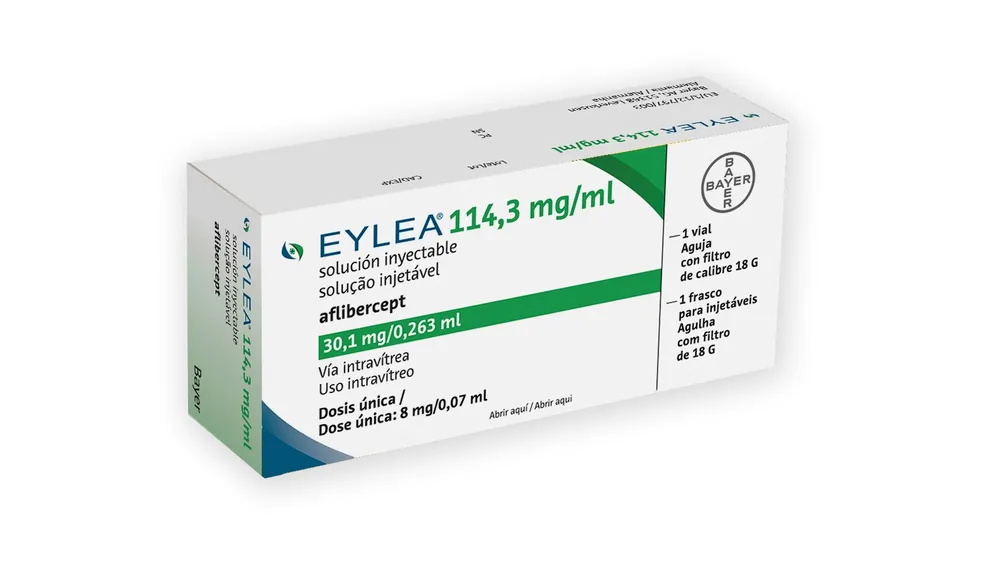
Table of Contents
Patient Information Leaflet
Introduction
Patient Information Leaflet
Eylea 114.3 mg/ml solution for injection
aflibercept
Read the entire leaflet carefully before you are administered this medicine, as it contains important information for you.
- Keep this leaflet, as you may need to read it again.
- If you have any questions, consult your doctor.
- If you experience any side effects, consult your doctor, even if they are side effects not listed in this leaflet. See section 4.
Leaflet Contents
- What Eylea is and what it is used for
- What you need to know before being administered Eylea
- How Eylea is administered
- Possible side effects
- How to store Eylea
- Contents of the pack and other information
1. What Eylea is and what it is used for
What Eylea is
Eylea contains the active substance aflibercept. It belongs to a group of medicines called anti-angiogenic agents.
Your doctor will inject Eylea into your eye to treat certain eye disorders in adult patients, known as:
- wet age-related macular degeneration (wet AMD)
- vision impairment due to diabetic macular edema (DME)
- vision impairment due to macular edema secondary to retinal vein occlusion (branch, central, and hemi-retinal vein occlusion).
These disorders affect the macula. The macula is the central part of the light-sensitive layer at the back of the eye. It is responsible for sharp, central vision.
Wet AMD occurs when abnormal blood vessels form and grow beneath the macula. These abnormal blood vessels may leak fluid or blood into the eye. Leaking blood vessels that cause swelling of the macula lead to DME. In patients with retinal vein occlusion (RVO), one or more blood vessels carrying blood away from the retina are blocked. As a result, levels of VEGF (vascular endothelial growth factor) rise, causing fluid to leak into the retina and leading to swelling of the macula (the part of the retina responsible for fine vision). This swelling is called macular edema. When the macula swells with fluid, central vision becomes blurred.
These disorders can affect your vision.
How Eylea works
Eylea stops the growth of abnormal new blood vessels in the eye. Eylea can help stabilize, and in many cases, improve vision.
2. What you need to know before Eylea is administered to you
You will not be given Eylea if
- you are allergic to aflibercept or to any of the other components of this medicine (listed in section 6)
- you have an infection in or around your eye
- you have eye pain or redness (a severe eye inflammation).
Warnings and precautions
Talk to your doctor before you are given Eylea if:
- you have glaucoma, an eye disease caused by high pressure in the eye
- you have a history of seeing flashes of light or dark floating spots, or if their size or number increases suddenly
- you have had eye surgery within the last 4 weeks or have eye surgery scheduled within the next 4 weeks.
Tell your doctor immediately if you experience:
- redness of the eye
- eye pain
- increased eye discomfort
- blurred or reduced vision
- increased sensitivity to light
These may be symptoms of inflammation or infection, and your doctor may discontinue treatment with Eylea.
Additionally, it is important for you to know that:
- the safety and efficacy of Eylea when administered in both eyes simultaneously have not been studied, and such use may increase the risk of adverse effects.
- Eylea injections may cause an increase in eye pressure in some patients within 60 minutes following injection. Your doctor will monitor you after each injection.
- your doctor will assess other risk factors that could increase the likelihood of a tear or detachment of the back layers of the eye. In such cases, your doctor will administer Eylea with caution.
- women of childbearing potential must use effective contraceptive methods during treatment and for at least 4 months after the last Eylea injection.
The use of substances similar to those in Eylea is potentially associated with the risk of blood vessel blockage due to blood clots, which could lead to myocardial infarction or stroke. Theoretically, this could also occur after an intraocular injection of Eylea. If you have had a stroke, transient ischemic attack, or myocardial infarction within the past 6 months, your doctor will administer Eylea with caution.
Children and adolescents
The use of Eylea has not been studied in children and adolescents under 18 years of age, as the conditions treated occur primarily in adults. Therefore, its use is not recommended in this age group.
Other medicines and Eylea
Tell your doctor if you are taking, have recently taken, or might need to take any other medicines.
Pregnancy and breastfeeding
- Women who may become pregnant must use effective methods of contraception during treatment and for at least 4 months after the last Eylea injection.
- Experience with Eylea use in pregnant women is limited. Women should not receive Eylea during pregnancy unless the potential benefit to the woman outweighs the potential risk to the fetus.
- Small amounts of Eylea may pass into breast milk. The effect on newborns or breastfed infants is unknown. Use of Eylea during breastfeeding is not recommended.
Therefore, if you are pregnant or breastfeeding, think you may be pregnant, or plan to become pregnant, consult your doctor before receiving this medicine.
Driving and use of machines
After receiving an Eylea injection, you may experience temporary visual disturbances. Do not drive or operate machinery while these symptoms persist.
Eylea contains polysorbate 20
This medicine contains 0.021 mg of polysorbate 20 in each 0.07 ml dose, equivalent to 0.3 mg/ml.
Polysorbates may cause allergic reactions. Inform your doctor if you have any known allergies.
3. How Eylea will be administered
The recommended dose is 8 mg of aflibercept per injection.
Exudative AMD and DME
- You will receive 1 injection every month for the first 3 months.
- After this, you may receive injections up to every 6 months. Your doctor will decide the frequency based on the condition of your eye.
- If your doctor switches your treatment to Eylea 114.3 mg/ml, your doctor will decide the frequency after the first injection.
Macular edema secondary to RVO
- You will receive 1 injection every month for the first 3 months.
- After this, your doctor will decide the frequency based on the condition of your eye.
- If your doctor switches your treatment to Eylea 114.3 mg/ml, your doctor will decide the frequency after the first injection.
Method of administration
Your doctor will inject Eylea into the inside of your eye (intravitreal injection).
Before the injection, your doctor will use a disinfectant eye rinse to carefully clean your eye to prevent infection. Your doctor will administer eye drops (local anesthetic) to numb the eye in order to reduce or prevent injection pain.
If a dose of Eylea has not been administered
Make a new appointment with your doctor as soon as possible.
Before stopping treatment with Eylea
Talk to your doctor before stopping treatment. Stopping treatment may increase the risk of vision loss and your vision may worsen.
If you have any further questions about the use of this medicine, ask your doctor.
4. Possible adverse effects
Like all medicines, this medicine can cause adverse effects, although not everyone experiences them.
The adverse effects of Eylea injection are due to either the medicine itself or the injection procedure, and most affect the eye.
Some adverse effects may be serious
Contact your doctor immediately if you experience any of the following:
- Common adverse effect, which may affect up to 1 in 10 people
- clouding of the lens (cataract)
- increased pressure inside the eye
- bleeding at the back of the eye (retinal haemorrhage)
- bleeding inside the eye (vitreous haemorrhage)
- Uncommon adverse effect, which may affect up to 1 in 100 people
- certain forms of lens clouding (subcapsular/nuclear cataract)
- detachment, tear, or bleeding of the light-sensitive layer at the back of the eye, causing flashes of light and floating spots, which may sometimes progress to vision loss (retinal tear or detachment)
Other possible adverse effects
Common (may affect up to 1 in 10 people):
- allergic reactions
- spots in vision (floaters in the vitreous humour)
- detachment of the gel-like substance inside the eye (vitreous detachment)
- decreased visual acuity
- eye pain
- bleeding inside the eye (conjunctival haemorrhage)
- damage to the transparent layer in front of the iris (punctate keratitis, corneal abrasion)
Uncommon (may affect up to 1 in 100 people):
- detachment or tear of one of the layers at the back of the eye, causing flashes of light and floating spots, which may sometimes progress to vision loss (retinal pigment epithelial detachment/tear)
- inflammation of the iris, other parts of the eye, or the gel-like substance inside the eye (uveitis, iritis, iridocyclitis, vitritis)
- certain forms of lens clouding (cortical cataract)
- damage to the surface of the eyeball (corneal erosion)
- blurred vision
- pain at the injection site
- sensation of having something in the eye
- increased tear production
- bleeding at the injection site
- redness of the eye
- clouding of the lens (lenticular opacity)
- eyelid swelling
- redness of the eye (ocular hyperaemia)
- irritation at the injection site
- degeneration of the light-sensitive membrane at the back of the eye (retinal degeneration)
- swelling of the surface layer of the eyeball (corneal oedema)
Rare (may affect up to 1 in 1,000 people):
- blindness
- severe inflammation or infection inside the eye (endophthalmitis)
- eyelid irritation
Frequency not known (cannot be estimated from available data):
- inflammation of the white part of the eye associated with redness and pain (scleritis)
In addition to those previously mentioned, the following adverse effects may occur:
- abnormal sensation in the eye
- damage to the surface of the transparent front part of the eye (corneal epithelial defect)
- inflammation in other parts of the eye (cells floating in the anterior chamber)
- clouding of the lens due to injury (traumatic cataract)
- pus in the eye (hypopyon)
- severe allergic reactions
Reporting of adverse effects
If you experience any adverse effect, consult your doctor, even if it is a possible adverse effect not listed in this leaflet. You can also report them directly through the national reporting system detailed in Appendix V. By reporting adverse effects, you can help provide more information on the safety of this medicine.
5. Storage of Eylea
- Keep this medicine out of the sight and reach of children.
- Do not use this medicine after the expiry date stated on the carton and label after “CAD/EXP”. The expiry date refers to the last day of the month indicated.
- Store in a refrigerator (between 2 °C and 8 °C). Do not freeze.
- The unopened vial may be stored outside the refrigerator at temperatures below 25 °C for a maximum of 24 hours.
- Keep the vial in the outer packaging to protect it from light.
6. Contents of the pack and other information
Composition of Eylea
- The active substance is aflibercept. 1 ml of solution contains 114.3 mg of aflibercept. Each vial contains 0.263 ml. This provides a usable amount to administer a single dose of 0.07 ml containing 8 mg of aflibercept.
- The other components are: sucrose, arginine hydrochloride, monohydrate histidine hydrochloride, histidine, polysorbate 20, water for injections.
See “Eylea contains polysorbate 20” in section 2 for more information.
Appearance of Eylea and contents of the pack
Eylea is an injectable solution (injection). The solution is colourless to pale yellow.
Pack: 1 vial + 1 filter needle.
Marketing Authorisation Holder
Bayer AG
51368 Leverkusen
Germany
Manufacturer
Bayer AG
Müllerstraße 178
13353 Berlin
Germany
Further information on this medicinal product is available upon request by contacting the local representative of the Marketing Authorisation Holder:
Belgium/Belgium/Belgium Bayer SA-NV Tel/Tel: +32-(0)2-535 63 11 | Lithuania UAB Bayer Tel. +37 05 23 36 868 |
| Luxembourg/Luxembourg Bayer SA-NV Tel/Tel: +32-(0)2-535 63 11 |
Czech Republic Bayer s.r.o. Tel: +420 266 101 111 | Hungary Bayer Hungária KFT Tel:+36 14 87-41 00 |
Denmark Bayer A/S Tlf: +45 45 23 50 00 | Malta Alfred Gera and Sons Ltd. Tel: +35 621 44 62 05 |
Germany Bayer Vital GmbH Tel: +49 (0)214-30 513 48 | Netherlands Bayer B.V. Tel: +31-23 – 799 1000 |
Estonia Bayer OÜ Tel: +372 655 8565 | Norway Bayer AS Tlf: +47 23 13 05 00 |
Greece Bayer Ελλάς ΑΒΕΕ Tel: +30-210-61 87 500 | Austria Bayer Austria Ges.m.b.H. Tel: +43-(0)1-711 46-0 |
Spain Bayer Hispania S.L. Tel: +34-93-495 65 00 | Poland Bayer Sp. z o.o. Tel: +48 22 572 35 00 |
France Bayer HealthCare Tél (Toll-free): +33-(0)800 87 54 54 | Portugal Bayer Portugal, Lda. Tel: +351 21 416 42 00 |
Croatia Bayer d.o.o. Tel: +385-(0)1-6599 900 | Romania SC Bayer SRL Tel: +40 21 529 59 00 |
Ireland Bayer Limited Tel: +353 1 216 3300 | Slovenia Bayer d. o. o. Tel: +386 (0)1 58 14 400 |
Iceland Icepharma hf. Sími: +354 540 8000 | Slovakia Bayer spol. s r.o. Tel. +421 2 59 21 31 11 |
Italy Bayer S.p.A. Tel: +39 02 397 8 1 | Finland/Finland Bayer Oy Puh/Tel: +358- 20 785 21 |
Cyprus NOVAGEM Limited Tel: +357 22 48 38 58 | Sweden Bayer AB Tel: +46 (0) 8 580 223 00 |
Latvia SIA Bayer Tel: +371 67 84 55 63 |
Date of the most recent revision of this leaflet:
Other sources of information
Detailed information on this medicine is available on the European Medicines Agency website: https://www.ema.euopa.eu.
For local information, scan here to access the website https://www.pi.bayer.com/eylea3.
A QR code with a link to the package leaflet is included.
This information is intended for healthcare professionals only:
The vial is for single use in one eye only. Withdrawing multiple doses from a single vial may increase the risk of contamination and subsequent infection.
Do not use if the packaging or its components are expired, damaged, or have been tampered with. Check the vial label to ensure you have the Eylea dose intended for use. The 8 mg dose requires the use of the Eylea 114.3 mg/ml vial.
Intravitreal injection must be performed using a 30 G × ½ inch (1.27 cm) injection needle (not included).
Using a smaller needle (higher gauge) than the recommended 30 G × ½ inch (1.27 cm) injection needle may result in increased injection force.
1. | Before administration, visually inspect the injectable solution. Do not use the vial if particles, cloudiness, or discoloration are observed. | |
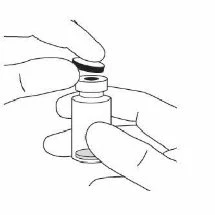
2. | Remove the plastic closure cap and disinfect the outer surface of the vial rubber stopper. |
|
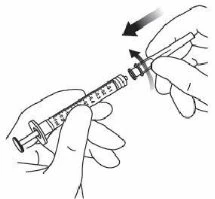
3. | Use an aseptic technique when performing steps 3 to 10. Attach the filter needle supplied in the pack to a sterile 1 ml syringe with Luer Lock adapter. |
|
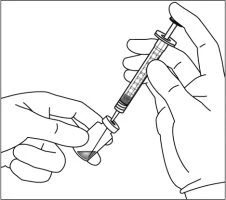
4. | Push the filter needle through the center of the vial stopper until the needle is fully inserted into the vial and its tip reaches the bottom or lower inner edge of the vial. | |
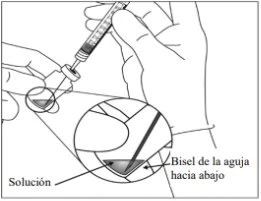
5. | Transfer the entire contents of the Eylea vial into the syringe, keeping the vial in an upright, slightly tilted position to facilitate complete withdrawal. To avoid introducing air, ensure the bevel of the filter needle remains submerged in the solution. Continue tilting the vial during withdrawal, keeping the bevel of the filter needle submerged in the solution.
| |
6. | Ensure the plunger rod is sufficiently retracted when emptying the vial to fully evacuate the filter needle. After injection, any unused portion of the product must be discarded. | |
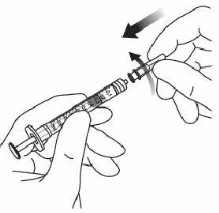
7. | Remove the filter needle and dispose of it appropriately. Note: the filter needle must not be used for intravitreal injection. | |
8. | Firmly attach the 30 G × ½ inch (1.27 cm) injection needle to the syringe tip with Luer Lock by rotating it. |
|
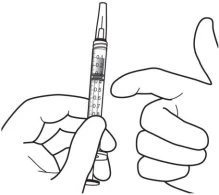
9. | Hold the syringe with the needle pointing upward and check for air bubbles. If present, gently tap the syringe with a finger until the bubbles rise to the top. |
|
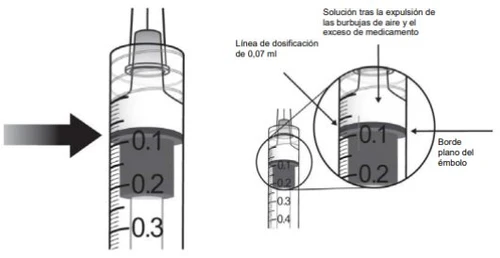
10. | To remove all air bubbles and expel excess medication, slowly push the plunger so that the flat edge of the plunger aligns with the mark indicating 0.07 ml on the syringe.
|
Disposal of unused medication and all materials that have come into contact with it must be carried out in accordance with local regulations.