Espikur 50 mg tablets
SpainTable of Contents
Package leaflet: Information for the user
Introduction
Package leaflet: information for the user
Espikur 50 mg tablets
13C-Urea
Read the entire leaflet carefully before you start taking this medicine because it contains important information for you.
- Keep this leaflet. You may need to read it again.
- If you have any questions, ask your doctor or pharmacist.
- This medicine has been prescribed for you only, and you must not give it to other people, even if they have the same symptoms as you, because it could harm them.
- If you experience any adverse effects, consult your doctor or pharmacist, even if they are effects not listed in this leaflet. See section 4.
Leaflet contents
- What Espikur is and what it is used for
- What you need to know before taking Espikur
- How to take Espikur
- Possible side effects
- How to store Espikur
- Contents of the pack and other information
1. What Espikur is and what it is used for
This medicine is for diagnostic use only.
Espikur is a breath test. After you have taken the tablet, the breath test will show whether your stomach is infected with the bacterium Helicobacter pylori.
Why do you need to undergo the Espikur test? You may have a gastric infection caused by a bacterium called Helicobacter pylori. Your doctor has prescribed this test for one of the following reasons:
-
Your doctor wants to confirm whether you have a Helicobacter pylori infection.
-
It has already been determined that you are infected with Helicobacter pylori, and you have been taking medication to treat the infection. Your doctor will now check whether the treatment has been successful.
2. What you need to know before taking Espikur
Do not take Espikur:
- if you are allergic to 13C-urea or to any of the other components of this medicine (listed in section 6).
- if you have or suspect you have a stomach infection, as this may lead to false results.
- if you have inflammation of the stomach lining (atrophic gastritis), as this may lead to false results.
Warnings and precautions
Consult your doctor or pharmacist before taking Espikur if you have had all or part of your stomach surgically removed.
Taking Espikur with other medicines
Inform your doctor or pharmacist if you are taking, have recently taken, or might need to take any other medicines.
The test should not be performed within at least:
- 4 weeks after taking medications against a bacterial infection
- 2 weeks after the last dose of a medication to reduce gastric acid secretion.
Both groups of medicines could influence the test results. This is especially important after treatment against the bacterium Helicobacter pylori.
Pregnancy and breastfeeding
It is not expected that performing the breath test during pregnancy or breastfeeding will have harmful effects. Espikur may be used during pregnancy and breastfeeding.
Driving and using machines
Espikur has no known effects on the ability to drive or operate machinery.
3. How to take Espikur
Follow exactly the instructions for administration of this medicine as given by your doctor. If you are unsure, consult your doctor or pharmacist again.
You must remain fasting for at least 6 hours before undergoing the breath test. You may drink some water until the time the test is performed.
Some medicines may affect the test result. Please refer to section “Taking Espikur with other medicines”.
The procedure lasts approximately 10 minutes.
The recommended dose is one tablet as a single dose. The tablet should be swallowed whole with a glass of water. If the tablet is chewed, the test must be repeated, as this increases the risk of obtaining a false result.
A new test may be performed as soon as the following day.
This medicine should not be administered to children under 18 years of age due to lack of data.
If in doubt, ask your doctor or pharmacist.
If you take more Espikur than you should
Since only 1 tablet is provided, overdose is not expected. If you are unsure, contact your doctor.
4. Possible adverse effects
Like all medicines, this medicine can cause adverse effects, although not everyone will experience them.
Very rare (may affect up to 1 in 10,000 people)
- stomach pain
- fatigue
- alteration of the sense of smell (parosmia)
Inform your doctor or pharmacist if any of the adverse effects become severe.
Reporting of adverse effects
If you experience any type of adverse effect, consult your doctor, pharmacist, or nurse, even if it is a possible adverse effect not listed in this leaflet. You can also report them directly through the Spanish Pharmacovigilance System for Human Medicines: www.notificaRAM.es
By reporting adverse effects, you can help provide more information on the safety of this medicine.
5. Storage of Espikur
Keep this medicine out of the sight and reach of children.
Do not use this medicine after the expiry date stated on the label and packaging following “EXP”. The expiry date is the last day of the month indicated.
Store in the original packaging to protect from light.
Do not store above 25 ºC.
Medicines must not be disposed of via wastewater or household waste. Dispose of unused medicines and their containers at the SIGRE collection point at your pharmacy. If you are unsure, ask your doctor or pharmacist how to dispose of medicines and containers you no longer need. This will help protect the environment.
6. Contents of the package and other information
Composition of Espikur
- The active substance is 13C-urea. Each tablet contains 50 mg of 13C-urea.
- The other components are: anhydrous citric acid, anhydrous colloidal silica, sodium croscarmellose, microcrystalline cellulose, magnesium stearate and talc.
Nature of the product and contents of the pack
Espikur is a white, round, convex tablet, 12 mm in diameter.
Pack sizes:
1 tablet (kit) in an aluminum blister (with sample tubes and disposable straw).
10 x 1 tablets in an aluminum blister (without sample tubes and disposable straw).
Breath bags are supplied separately.
Component | 1 tablet (kit) | 10 x 1 tablet |
Tablet in an aluminum blister | 1 | 10 |
Sample tubes for the 00-minute breath sample (blue cap) | 2 | |
Sample tubes for the 10-minute breath sample (red cap) | 2 | |
Disposable straw | 1 | |
Package leaflet | 1 | 1 |
Barcode labels for sample tubes | 4 | - |
Additional barcode labels | 2 |
Marketing Authorization Holder and Manufacturing Responsible Party
Marketing Authorization Holder:
Laboratoires Mayoly Spindler
3 Place Renault
92500 Rueil Malmaison,
France
Manufacturing Responsible Party:
Laboratoires MAYOLY SPINDLER
6 avenue de l’Europe
78400 Chatou
France
Or
Laboratoires Galeniques Vernin
20 Rue Louis Charles Vernin
Dammarie Les Lys, 77190
France
This medicinal product has been authorized in the Member States of the European Economic Area under the following names:
Belgium, Luxembourg, Portugal, Spain, Sweden, Netherlands: Espikur 50 mg
Italy: Helidiag 50 mg
Date of the most recent review of this leaflet:
Detailed information on this medicinal product is available on the website of the Spanish Agency of Medicines and Health Products (AEMPS) (http://www.aemps.gob.es/).
This information is intended for healthcare professionals only:
It is recommended that the test be performed with the patient in a resting position.
If the test is to be performed in the morning, the patient should fast overnight and not eat breakfast. If the test is carried out later in the day, or if fasting could cause problems for the patient, a light breakfast may be allowed, e.g., tea and toast. Additionally, if the patient has eaten a heavy meal, they must fast for six hours before the test.
Breath samples may be collected using breath tubes or breath bags.
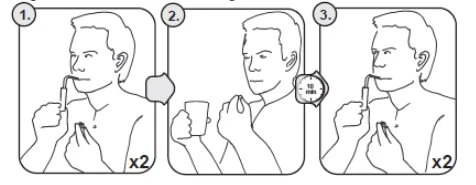
Test procedure using sample tubes (see Figure 1).
To perform the test, use 4 sample tubes with caps and 1 straw.
Keep one of the additional barcode labels as a reference label for the patient’s medical record.
-
The patient should begin the procedure with the two 00-MINUTE sample tubes with blue caps.
- Unscrew the cap.
- Place the straw to the bottom of the sample tube.
- Take a deep breath and slowly exhale into the tube.
- Remove the straw from the tube and immediately close the tube with the cap.
- Check that the cap is securely closed.
- Repeat the procedure with the second 00-MINUTE sample tube.
-
Swallow the tablet with a glass of water. Wait 10 minutes in an upright position (standing or sitting).
-
Exhale into the two 10-MINUTE tubes with red caps in the same manner described above.
After sample collection, label all 4 tubes as shown in the following image, applying one barcode label along the length of each tube.
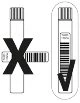
Send the four labeled sample tubes to the local diagnostic laboratory for analysis.
Handle the sample tubes carefully and avoid any damage that could cause leakage.
Figure 1. How to perform the test using sample tubes.
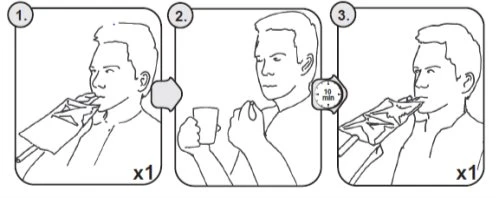
Test procedure using breath bags (see Figure 2).
To perform the test, use 2 individual breath bags or 1 double breath bag and 1 mouthpiece.
-
Remove the screw cap from the flexible tube of the breath bag and attach the mouthpiece to the flexible tube. Exhale through the mouthpiece to obtain the initial (00-MINUTE) breath bag sample. Remove the mouthpiece from the breath bag and close the breath bag with the screw cap.
-
Swallow the tablet with a glass of water. Wait 10 minutes in an upright position (standing or sitting).
-
Exhale into the unused side of the double breath bag or into another individual breath bag to obtain the test (10-MINUTE) breath bag sample, as described above.
Label the breath bags to identify the different samples (e.g., “zero test” and “10-min test”).
Handle the breath bags containing the samples carefully and avoid any damage that could cause leakage.