Entecavir Teva 1 mg film-coated tablets EFG
Spain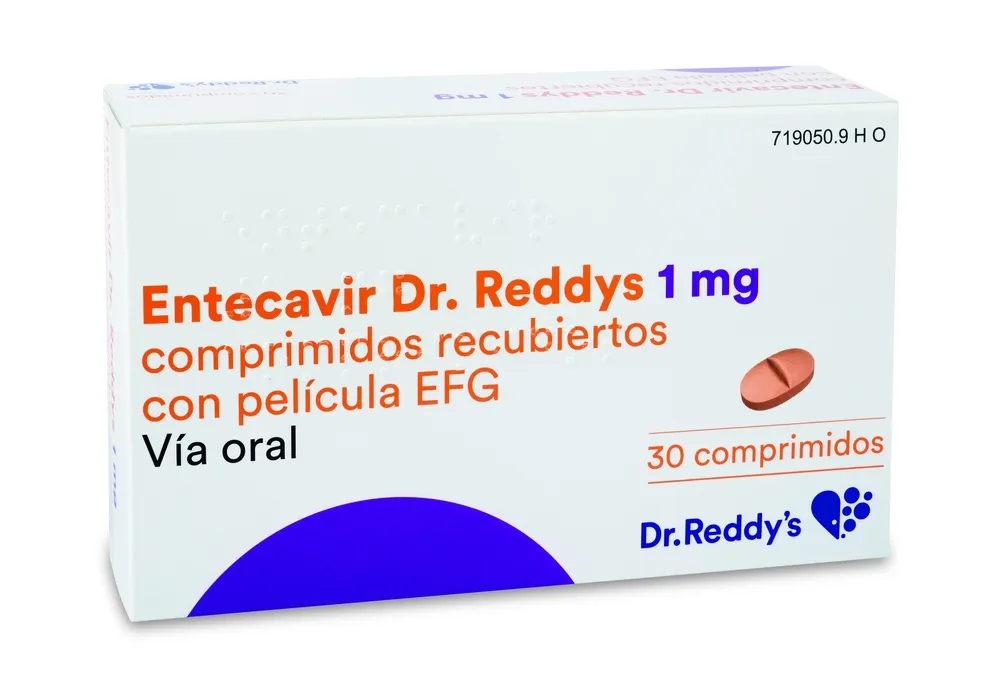
Table of Contents
Package leaflet: Information for the user
Introduction
Package leaflet: information for the user
ENTECAVIR TEVA 1 MG FILM-COATED TABLETS EFG
Read the entire leaflet carefully before you start taking this medicine, because it contains important information for you.
- Keep this leaflet, as you may need to read it again.
- If you have any questions, ask your doctor or pharmacist.
- This medicine has been prescribed for you only, and you should not give it to other people, even if they have the same symptoms as you, because it could harm them.
- If you experience any adverse reactions, consult your doctor or pharmacist, even if they are adverse reactions not listed in this leaflet. See section 4.
Leaflet contents
- What Entecavir Teva is and what it is used for
- What you need to know before taking Entecavir Teva
- How to take Entecavir Teva
- Possible side effects
- How to store Entecavir Teva
- Contents of the pack and other information
1. What Entecavir Teva is and what it is used for
Entecavir is an antiviral medicine used to treat chronic (long-term) infection with the hepatitis B virus (HBV) in adults.
Entecavir may be used in patients whose liver is damaged but still functions adequately (compensated liver disease) and in patients whose liver is damaged and does not function properly (decompensated liver disease).
Entecavir is also used to treat chronic (long-term) HBV infection in children and adolescents from 2 to less than 18 years of age.
Entecavir may be used in children whose liver is damaged but still functions adequately (compensated liver disease).
Hepatitis B virus infection can damage the liver. Entecavir reduces the amount of virus in the body and improves the condition of the liver.
2. What you need to know before taking Entecavir Teva
Do not take Entecavir Teva
- if you are allergic to entecavir or to any of the other ingredients of this medicine (listed in section 6).
Warnings and precautions
Talk to your doctor or pharmacist before starting entecavir
-
if you have ever had kidney problems, inform your doctor. This is important because entecavir is eliminated from the body through the kidneys, and your dose or treatment schedule may need to be adjusted.
-
do not stop taking entecavir without consulting your doctor, as your hepatitis may worsen if treatment is interrupted. When entecavir treatment is stopped, your doctor will continue to monitor you and perform blood tests for several months.
-
ask your doctor whether your liver is functioning properly, and if not, about the possible effects your treatment with entecavir might have.
-
if you are also infected with HIV (human immunodeficiency virus), make sure to inform your doctor. You should not take entecavir for the treatment of hepatitis B infection unless you are also taking medications for the treatment of HIV infection, because otherwise the effectiveness of future HIV treatments could be reduced. Entecavir will not control your HIV infection.
-
taking Entecavir will not prevent you from transmitting the hepatitis B virus (HBV) to other people through sexual contact or bodily fluids (including blood contamination). Therefore, it is important that you take appropriate precautions to prevent others from becoming infected with HBV. A vaccine is available to protect people at risk of HBV infection.
-
Entecavir belongs to a class of medicines that can cause lactic acidosis (excess lactic acid in your blood) and enlargement of the liver. Symptoms such as nausea, vomiting, and stomach pain could indicate the development of lactic acidosis. Occasionally, this rare but serious side effect has been fatal. Lactic acidosis occurs more frequently in women, especially those who are overweight. Your doctor will monitor you periodically while you are taking this medicine.
-
if you have previously received treatment for chronic hepatitis B, please inform your doctor.
Children and adolescents
Entecavir must not be used in children under 2 years of age or weighing less than 32.6 kg.
Taking Entecavir Teva with other medicines
Inform your doctor or pharmacist if you are taking, have recently taken, or might need to take any other medicines.
Taking Entecavir Teva with food and drinks
In most cases, you can take entecavir with or without food. However, if you have previously been treated with another medicine containing lamivudine as the active ingredient, the following should be considered. If you have switched to entecavir because lamivudine treatment was not successful, you must take entecavir on an empty stomach, once daily. If your liver disease is very advanced, your doctor will also instruct you to take entecavir on an empty stomach.
An empty stomach means at least 2 hours after and 2 hours before the next meal.
Children and adolescents (from 2 to under 18 years of age) may take entecavir with or without food.
Pregnancy, breastfeeding and fertility
Inform your doctor if you are pregnant or planning to become pregnant. The use of entecavir during pregnancy has not been shown to be safe. Entecavir should not be used during pregnancy unless clearly necessary, as determined by your doctor. It is important that women of childbearing potential who are being treated with entecavir use an effective method of contraception to prevent pregnancy.
You must not breastfeed during treatment with entecavir. If you are breastfeeding, inform your doctor. It is unknown whether entecavir, the active substance of this medicine, is excreted in human breast milk.
Driving and using machines
Dizziness, tiredness (fatigue), and numbness (somnolence) are common adverse reactions that could affect your ability to drive and use machines. If you have any doubts, consult your doctor.
3. How to take Entecavir Teva
Not all patients need the same dose of Entecavir.
Always follow exactly the instructions given by your doctor for taking this medicine. If in doubt, consult your doctor or pharmacist again.
For adults, the recommended dose is 0.5 mg or 1 mg once daily (orally).
Your dose will depend on:
- whether you have previously been treated for HBV infection, and which medication you received.
- whether you have kidney problems. Your doctor may prescribe a lower dose or advise you to take it less frequently than once daily.
- the condition of your liver.
For children and adolescents (aged 2 to less than 18 years) who weigh at least 32.6 kg and require a 0.5 mg dose (half of a 1 mg tablet), entecavir 0.5 mg film-coated tablets are also available. All doses should be taken once daily by mouth.
For children and adolescents weighing less than 32.6 kg and for doses below 0.5 mg, an oral solution of entecavir may be available.
Your paediatrician will determine the correct dose based on the child's weight.
Your doctor will advise you on the appropriate dose for you. Always take the dose recommended by your doctor to ensure the medicine is fully effective and to reduce the risk of developing treatment resistance. Take entecavir for as long as your doctor has instructed. Your doctor will tell you when to stop treatment.
Some patients must take this medicine on an empty stomach (see Entecavir tablets with food and drink in Section 2). If your doctor tells you to take this medicine on an empty stomach, this means at least 2 hours after a meal and 2 hours before the next meal.
If you take more Entecavir Teva than you should
If you have taken more entecavir than you should, contact your doctor, pharmacist, or call the Toxicology Information Service immediately at: 91 562 04 20, indicating the medicine and the amount taken.
If you forget to take Entecavir Teva
It is important not to miss any doses. If you forget a dose of Entecavir, take it as soon as possible and then take the next scheduled dose at the usual time. If it is almost time for your next dose, do not take the missed dose. Wait and take the next dose at the usual time. Do not take a double dose to make up for a missed dose.
Do not stop treatment with Entecavir Teva without consulting your doctor
Some people develop very severe hepatitis symptoms when they stop taking entecavir. Inform your doctor immediately of any changes in symptoms you notice after stopping treatment.
If you have any further questions about using this medicine, ask your doctor or pharmacist.
4. Possible adverse effects
Like all medicines, this medicine may cause adverse effects, although not everyone experiences them.
The following adverse effects have been reported in patients treated with entecavir:
Common (may affect up to 1 in 10 people):
- headache
- inability to sleep (insomnia)
- extreme tiredness (fatigue)
- dizziness
- numbness (somnolence)
- vomiting
- diarrhoea
- nausea
- indigestion (dyspepsia)
- increased levels of liver enzymes in the blood
Uncommon (may affect up to 1 in 100 people):
- skin rash
- hair loss
Rare (may affect up to 1 in 1,000 people):
- severe allergic reaction
Children and adolescents
Adverse effects experienced in children and adolescents are similar to those experienced in adults as described above, with the following difference:
Very common (may affect more than 1 in 10 people): low levels of neutrophils (a type of white blood cell important in fighting infection).
Reporting of adverse effects
If you experience any type of adverse effect, consult your doctor or pharmacist, even if it is a possible adverse effect not listed in this leaflet. You may also report them directly via the Spanish Pharmacovigilance System for Human Medicines: https://www.notificaram.es. By reporting adverse effects, you can help provide more information on the safety of this medicine.
5. Storage of Entecavir Teva
Keep this medicine out of the sight and reach of children.
Do not use this medicine after the expiry date stated on the bottle, blister pack, or packaging following EXP. The expiry date refers to the last day of the month indicated.
This medicine does not require any special storage conditions.
Medicines must not be disposed of via wastewater or household waste. Dispose of containers and unused medicines at the SIGRE collection point at your pharmacy. If you are unsure, please ask your pharmacist how to dispose of containers and medicines you no longer need. This will help protect the environment.
6. Contents of the pack and other information
Composition of Entecavir Teva
- The active substance is entecavir.
- Each film-coated tablet contains 1 mg of entecavir.
- The other components are:
Tablet core: mannitol (E421), microcrystalline cellulose (E460), pregelatinized corn starch, crospovidone type A (E1202), magnesium stearate.
Film coating: partially hydrolysed polyvinyl alcohol (E1203), titanium dioxide (E171), macrogol 3350 (polyethylene glycol), talc (E553b), red iron oxide (E172).
Nature of the product and contents of the container
Round, light pink to pink film-coated tablet with a score line, marked with “1” on one side and “E/E” on the other, with a diameter of approximately 8.42 – 8.86 mm.
The film-coated tablet can be divided into two equal halves.
Film-coated tablets are supplied in:
- PVC/PVdC – Aluminium blisters in packs containing 10, 30, 60 or 90 tablets.
- PVC/PVdC – Aluminium unit dose blisters in packs containing 30x1, 60x1 or 90x1 tablets.
- Aluminium/OPA/PVC – Aluminium blisters in packs containing 10, 30, 60 or 90 tablets.
- Aluminium/OPA/PVC – Aluminium unit dose blisters in packs containing 30x1, 60x1 or 90x1 tablets.
- HDPE bottles with child-resistant polypropylene closure in packs containing 30 or 100 tablets.
- HDPE bottles with child-resistant polypropylene closure and silica gel desiccant in packs containing 30 or 100 tablets.
Only some pack sizes may be marketed.
Marketing Authorization Holder and Manufacturer
Marketing Authorization Holder
Teva Pharma, S.L.U.
C/ Anabel Segura, 11. Edificio Albatros B, 1st floor.
28108 Alcobendas, Madrid
Spain
Manufacturer
Teva Operations Poland Sp. z.o.o
ul. Mogilska 80
31-546 Kraków
Poland
or
Merckle GmbH
Ludwig-Merckle-Strasse 3, Blaubeuren
89143 Baden-Wuerttemberg
Germany
or
PLIVA Croatia Ltd.
Prilaz baruna Filipovica 25
10000 Zagreb
Croatia
This medicinal product is authorized in the European Economic Area member states under the following names:
Austria Entecavir ratiopharm 1 mg Filmtabletten
Denmark Entecavir Teva
Spain Entecavir Teva 1 mg film-coated tablets EFG
France Entecavir Teva 1mg, comprimé pelliculé
Croatia Entekavir Pliva 1 mg filmom obložene tablete
Netherlands Entecavir Teva 1 mg, filmomhulde tabletten
Norway Entecavir Teva
Poland Entecavir Teva
Portugal Entecavir Teva
Sweden Entecavir Teva
Slovenia Entekavir Teva 1 mg filmsko obložene tablete
Date of the most recent review of this leaflet: June 2022
Detailed information on this medicinal product is available on the website of the Spanish Agency of Medicines and Health Products (AEMPS) (http://www.aemps.gob.es/)