Enandol 12.5 mg/g gel
Spain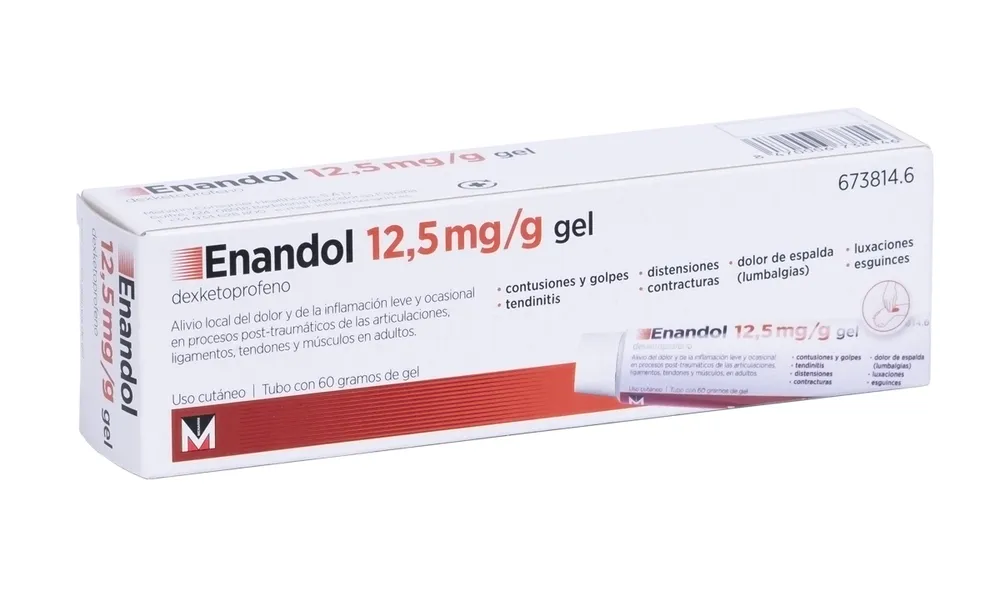
Table of Contents
Package leaflet: Information for the user
Introduction
Package leaflet: information for the user
Enandol 12.5 mg/g gel
dexketoprofen
Read the entire leaflet carefully before you start using this medicine because it contains important information for you.
Always follow exactly the instructions for use of this medicine as described in this leaflet or as given by your doctor or pharmacist.
-
Keep this leaflet, as you may need to read it again.
-
If you need advice or more information, consult your pharmacist.
-
If you experience any adverse reactions, consult your doctor or pharmacist, even if they are adverse reactions not listed in this leaflet. See section 4.
-
You should consult a doctor if you worsen or do not improve within 7 days.
Contents of the leaflet
- What Enandol is and what it is used for
- What you need to know before using Enandol
- How to use Enandol
- Possible adverse effects
- Storage of Enandol
- Contents of the pack and other information
1. What Enandol is and what it is used for
This medicine contains dexketoprofen, an active substance belonging to the group of non-steroidal anti-inflammatory drugs.
It is used in adults for the local relief of mild and occasional pain and inflammation of traumatic origin affecting joints, tendons, ligaments, and muscles, such as bruises and injuries, tendinitis, sprains, muscle spasms, back pain (lumbago), dislocations, and strains.
2. What you need to know before using Enandol
Do not use Enandol
- If you are allergic to dexketoprofen or to any of the other components of this medicine (listed in section 6).
- If you have previously experienced allergic reactions to dexketoprofen, ketoprofen, fenofibrate, tiaprofenic acid, acetylsalicylic acid (e.g. aspirin), or to any other non-steroidal anti-inflammatory drug (symptoms include difficulty breathing, nasal mucosa swelling, or hives).
- If you have a history of skin reactions in areas exposed to sunlight (even on cloudy days) or to ultraviolet (UVA) lamps (photosensitivity reactions).
- If you have a history of skin allergy to dexketoprofen, ketoprofen, tiaprofenic acid, fenofibrate, UV blockers, or perfumes.
- Do not apply to eyes, mucous membranes (mouth, nose, genitals), infected skin, open wounds, or other lesions that compromise the integrity of the skin in the area to be treated.
- Stop using this medicine immediately if you experience any skin reaction, including skin reactions after simultaneous use of products containing octocrylene (octocrylene is one of the excipients found in various cosmetic and hygiene products such as shampoo, after-shave lotion, bath and shower gel, skin creams, lipsticks, anti-aging creams, makeup removers, hair sprays, used to delay photodegradation).
- Do not expose treated areas to sunlight or ultraviolet (UVA) lamps during treatment and for 2 weeks after stopping treatment.
- If you are in the last 3 months of pregnancy.
Warnings and precautions
Consult your doctor or pharmacist before starting to use Enandol.
To prevent possible allergic reactions upon exposure to sunlight during treatment with this medicine:
-
Treatment should be discontinued if any skin reaction occurs after applying Enandol.
-
Exposure to sunlight (even on cloudy days) or to ultraviolet (UVA) lamps on areas that have been in contact with the product may cause skin reactions (photosensitization), potentially severe. Therefore, it is necessary to:
-
Cover treated areas with clothing to protect them during treatment and for two weeks after stopping treatment, to avoid any risk of photosensitization.
- Wash your hands thoroughly after each application of the medicine.
-
After applying the gel, do not wear tight clothing or occlusive dressings.
-
Cross-reactions may occur with certain sunscreens, fenofibrate, and other products containing benzophenone in their chemical structure.
Children and adolescents
The safety and efficacy of Enandol have not been established in children and adolescents.
Other medicines and Enandol
Inform your doctor or pharmacist if you are taking, have recently taken, or might need to take any other medicines.
Interaction with other medicines is unlikely due to the direct application of Enandol on the skin.
Pregnancy, breastfeeding and fertility
Consult your doctor or pharmacist before using any medicine.
Administration of this medicine should be avoided during pregnancy, as its safety during this period has not been established.
There are insufficient data on the excretion of dexketoprofen in human breast milk; therefore, its use is not recommended during breastfeeding.
Oral forms (e.g. tablets) of dexketoprofen may cause adverse effects on the fetus. It is unknown whether the same risk applies when dexketoprofen is used topically on the skin.
If you are pregnant or breastfeeding, think you may be pregnant, or plan to become pregnant, consult your doctor or pharmacist before using this medicine. Do not use dexketoprofen during the last 3 months of pregnancy. Dexketoprofen should not be used during the first 6 months of pregnancy unless clearly necessary and specifically recommended by your doctor. If treatment is required during this period, the lowest effective dose should be used for the shortest possible duration.
Driving and use of machines
No effects on the ability to drive or operate machinery have been reported.
Enandol contains alcohol (ethanol) and lavender essence
This medicine contains 0.33 g of alcohol (ethanol) in each gram of gel. Ethanol may cause a burning sensation on damaged skin.
This medicine contains lavender essence with benzyl alcohol, amyl cinnamaldehyde, citral, eugenol, hydroxycitronellal, coumarin, geraniol, farnesol, linalool, benzyl benzoate, citronellol, and d-limonene, which may cause allergic reactions.
3. How to use Enandol
Follow exactly the administration instructions for this medicine provided in this leaflet or those indicated by your doctor or pharmacist. If in doubt, consult your doctor or pharmacist.
The usual dose is two or three applications per day, one application every 12 or 8 hours. The amount of gel will depend on the area to be treated, and it should be applied with a gentle massage to promote absorption.
Use the smallest amount necessary for the shortest time required.
The total daily dose must not exceed 7.5 g per day, equivalent to 14 cm of gel.
Continuous treatment with this medicine should be limited to a maximum of 7 days. If pain or swelling worsens or persists after 7 days of treatment, consult your doctor.
If you use more Enandol than you should
As this is a topical preparation, the possibility of overdose is remote.
In case of overdose or accidental ingestion, contact the Toxicology Information Service. Telephone: 91 562 04 20.
If accidental ingestion of the tube contents occurs, healthcare professionals should perform gastric lavage and initiate symptomatic treatment.
4. Possible adverse effects
Like all medicines, this medicine may produce adverse effects, although not everyone experiences them.
Uncommon (may affect up to 1 in 100 people):
- Dermatitis (redness, itching, swelling of the skin, burning sensation), including allergic skin reactions.
Rare (may affect up to 1 in 1,000 patients):
- Severe reactions such as blister-like lesions resembling burns (bullous or flictenular eczema) that may spread or become generalized.
Very rare (may affect up to 1 in 10,000 patients):
- Allergic reaction that may manifest as whitish or reddish itchy skin welts (urticaria) and/or difficulty breathing (bronchospasm).
Frequency not known (cannot be estimated from available data):
- Skin reactions at the application site upon exposure to sunlight (photosensitivity), presenting as redness and inflammation of the skin, and in some cases mild blistering.
Reporting of adverse effects
If you experience any type of adverse effect, consult your doctor or pharmacist, even if it is an adverse effect not listed in this leaflet. You may also report them directly via the Spanish Pharmacovigilance System for Human Medicinal Products: www.notificaram.es. By reporting adverse effects, you can help provide more information on the safety of this medicine.
5. Storage of Enandol
Keep this medicine out of the sight and reach of children.
No special storage conditions are required. However, it is recommended not to expose the product to heat for prolonged periods, as it could deteriorate.
Do not use this medicine after the expiry date stated on the packaging after EXP. The expiry date refers to the last day of the month indicated.
Medicines must not be disposed of via wastewater or household waste. Unused medicines and their containers should be handed over to the SIGRE Point at your pharmacy. If you have any doubts, ask your pharmacist how to properly dispose of unused medicines and their packaging. This will help protect the environment.
6. Contents of the pack and other information
Composition of Enandol
The active substance is dexketoprofen. Each gram of gel contains 12.5 mg dexketoprofen.
The other components are: carbomer, 96% ethanol, lavender essence, tromethamine, and purified water.
Appearance of Enandol and contents of the pack
Colorless, almost transparent gel, supplied in flexible aluminum tubes with pack sizes of 60 g.
Marketing Authorization Holder
MENARINI CONSUMER HEALTHCARE, S.A.U.
Guifré, 724 - 08918 Badalona (Barcelona)
Spain
Manufacturer
LABORATORIOS MENARINI, S.A.
Alfons XII, 587. Badalona (Barcelona) Spain
Date of the most recent revision of this leaflet: October 2025.
Other sources of information
Detailed and up-to-date information on this medicinal product is available on the website of the Spanish Agency of Medicines and Medical Devices (AEMPS) http://www.aemps.gob.es/