Elucirem 0.5 mmol/ml solution for injection
Spain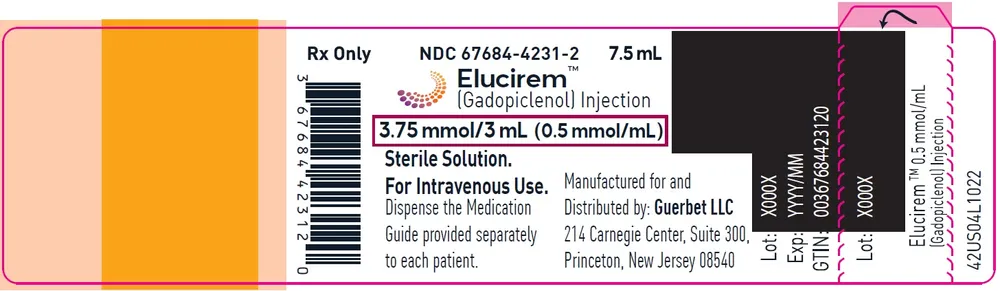
Table of Contents
- Package leaflet: Information for the user
- Introduction
- 1. What Elucirem is and what it is used for
- 2. What you need to know before Elucirem is administered
- 3. How Elucirem will be administered to you
- 4. Possible adverse effects
- 5. Storage of Elucirem
- 6. Contents of the container and other information
Package leaflet: Information for the user
Introduction
Package leaflet: information for the patient
Elucirem 0.5 mmol/ml solution for injection
gadopiclenol
This medicinal product is subject to additional monitoring, which will allow rapid identification of new safety information. You can help by reporting any side effects you may experience. Information on how to report side effects is included at the end of section 4.
Read this entire leaflet carefully before this medicine is administered to you, as it contains important information for you.
- Keep this leaflet, as you may need to read it again.
- If you have any questions, consult your doctor, radiologist, or pharmacist.
- If you experience any side effects, consult your doctor or radiologist, even if they are not listed in this leaflet. See section 4.
Contents of this leaflet
- What Elucirem is and what it is used for
- What you need to know before being given Elucirem
- How Elucirem will be administered
- Possible side effects
- How to store Elucirem
- Contents of the pack and other information
1. What Elucirem is and what it is used for
Elucirem is a contrast agent that enhances the contrast of images obtained during magnetic resonance (MR) scans. Elucirem contains the active substance gadopiclenol.
It improves the visualization and delineation of abnormal structures or lesions in certain parts of the body and helps to differentiate between healthy and diseased tissue.
It is used in adults and children (from 2 years of age).
It is administered as an intravenous injection. This medicinal product is for diagnostic use only and will only be administered by healthcare professionals experienced in the clinical practice of magnetic resonance imaging.
2. What you need to know before Elucirem is administered
Elucirem must not be administered
if you are allergic to the active substance or to any of the other components of this medicine (listed in section 6).
Warnings and precautions
Talk to your doctor, radiologist, or pharmacist before Elucirem is administered if:
- you have previously had a reaction to any contrast agent,
- you have asthma,
- you have a history of allergies (such as hay fever, hives),
- your kidneys are not functioning properly,
- you have had seizures or are being treated for epilepsy,
- you have any heart or blood vessel disease.
In all these cases, your doctor will decide whether the planned examination can proceed. If Elucirem is administered, your doctor or radiologist must take the necessary precautions and administer it under close supervision.
Your doctor or radiologist may decide to perform a blood test to check your kidney function before deciding to use Elucirem, especially if you are 65 years of age or older.
Other medicines and Elucirem
Tell your doctor, radiologist, or pharmacist if you are taking, have recently taken, or might need to take any other medicines.
In particular, inform your doctor, radiologist, or pharmacist if you are receiving or have recently received medications to treat heart conditions or high blood pressure such as β-blockers, vasoactive substances, angiotensin-converting enzyme (ACE) inhibitors, or angiotensin II receptor antagonists.
Pregnancy and breastfeeding
Pregnancy
Consult your doctor or radiologist if you are pregnant or think you might be pregnant, as Elucirem should not be used during pregnancy unless strictly necessary.
Breastfeeding
Consult your doctor or radiologist if you are breastfeeding.
Your doctor will assess whether you should continue breastfeeding or interrupt it for 24 hours after receiving Elucirem.
Driving and using machines
Elucirem has no or negligible effect on the ability to drive and use machines. However, if you feel unwell after the examination, you should not drive or operate machinery.
Elucirem contains sodium
This medicine contains less than 1 mmol of sodium (23 mg) per 15 ml vial; therefore, it is essentially "sodium-free".
3. How Elucirem will be administered to you
A qualified healthcare professional will inject Elucirem into your vein using a small needle. Elucirem may be injected manually or with an automatic injector.
Your doctor or radiologist will determine the dose you should receive and will supervise the injection.
The usual dose of 0.1 ml/kg body weight is the same for both adults and children aged 2 years and older.
In children, your doctor or radiologist will use Elucirem in vials with a single-use syringe to ensure greater accuracy of the injected volume.
After the injection, you will remain under supervision for at least 30 minutes. This is the period during which adverse reactions (such as allergic reactions) are most likely to occur. However, in rare cases, reactions may occur hours or even days later.
Use in patients with severe kidney problems
Elucirem is not recommended for use in patients with severe kidney problems. However, if its use is required, only a single dose should be administered during the examination, and a second injection should not be given until at least 7 days have passed.
Use in elderly patients
If you are 65 years of age or older, dose adjustment is not necessary, but you may be given a blood test to check that your kidneys are functioning properly.
If you receive more Elucirem than you should
It is highly unlikely that you will receive an overdose of Elucirem, as it will be administered by a qualified healthcare professional. If an overdose does occur, Elucirem can be removed from the body by haemodialysis (blood cleansing).
If you have any further questions about the use of this medicine, ask your doctor, radiologist, or pharmacist.
4. Possible adverse effects
Like all medicines, this medicine may cause adverse effects, although not everyone will experience them.
After administration of Elucirem, you will remain under observation. Most adverse effects occur within minutes. There is a small risk of having an allergic reaction to Elucirem. These reactions may occur immediately or up to seven days after injection. These reactions can be severe and lead to shock (a case of allergic reaction that may be life-threatening).
Immediately inform your doctor, radiologist, or healthcare professional if you experience any of the following adverse effects, as they may be the first signs of shock:
- swelling of the face, lips, tongue, or throat
- dizziness (low blood pressure)
- breathing difficulty
- skin rash
- cough, sneezing, or runny nose
The possible side effects observed during clinical trials with Elucirem are listed below according to their likelihood:
Frequency | Possible adverse effects |
Common (may affect up to 1 in 10 people) | Reaction at injection site* Headache |
Uncommon (may affect up to 1 in 100 people) | Allergic reaction** Diarrhea Nausea (feeling unwell) Fatigue (tiredness) Abdominal pain Unusual taste in mouth Sensation of warmth Vomiting (feeling sick) |
*Reaction at the injection site may include pain, swelling, sensation of cold or heat, bruising, and redness.
**Allergic reactions may include: skin inflammation, skin redness, difficulty breathing, voice changes, throat tightness, throat irritation, abnormal sensation in the mouth, transient facial flushing (early reactions), and swollen eyes, swelling, rash, and itching (late reactions).
Cases of nephrogenic systemic fibrosis (NSF) (which causes hardening of the skin and may also affect soft tissues and internal organs) have been reported with other gadolinium-containing contrast agents; however, no cases of NSF have been reported with Elucirem during clinical trials.
Reporting of adverse reactions
If you experience any type of adverse reaction, consult your doctor or pharmacist, even if it is a possible adverse reaction not listed in this leaflet. You may also report them directly through the national reporting system detailed in Appendix V.
By reporting adverse reactions, you can help provide more information on the safety of this medicine.
5. Storage of Elucirem
Keep this medicine out of the sight and reach of children.
Do not use this medicine after the expiry date which is stated on the label of the vial or pre-filled syringe and on the outer carton after "EXP" or "CAD". The expiry date refers to the last day of that month.
This medicine is a clear, colourless to pale yellow solution.
Do not use this medicine if the solution is not clear or if it contains visible particles.
For vials: This medicine does not require any special storage conditions.
Chemical and physical stability has been demonstrated for 24 hours at a temperature of up to 25 °C.
From a microbiological standpoint, the product should be used immediately after opening.
For pre-filled syringes: Do not freeze.
Medicines should not be disposed of via wastewater or household waste. Ask your pharmacist how to dispose of medicines and packaging that you no longer need. This will help protect the environment.
6. Contents of the container and other information
Composition of Elucirem
- The active substance is gadopiclenol. Each ml of solution contains 485.1 mg of gadopiclenol (equivalent to 0.5 mmol of gadopiclenol and 78.6 mg of gadolinium).
- The other components are tetraxetan, trometamol, hydrochloric acid (to adjust pH), sodium hydroxide (to adjust pH), and water for injections. See section 2 “Elucirem contains sodium”.
Appearance of Elucirem and contents of the container
It is a clear, colourless to pale yellow injectable solution.
It is available in containers containing:
- 1 vial with 3, 7.5, 10, 15, 30, 50 or 100 ml of injectable solution.
- 25 vials with 7.5, 10 or 15 ml of injectable solution.
- 1 or 10 (10 x 1) pre-filled syringes with 7.5, 10 or 15 ml of injectable solution.
- 1 pre-filled syringe with 7.5, 10 or 15 ml of injectable solution with administration kit for manual injection (one extension line and one catheter).
- 1 pre-filled syringe with 7.5, 10 or 15 ml of injectable solution with administration kit for Optistar Elite injector (one extension line, one catheter, and one 60 ml plastic empty syringe).
- 1 pre-filled syringe with 7.5, 10 or 15 ml of injectable solution with administration kit for Medrad Spectris Solaris EP injector (one extension line, one catheter, and one 115 ml plastic empty syringe).
Only certain pack sizes may be marketed.
Marketing Authorisation Holder
Guerbet
15 rue des Vanesses
93420 Villepinte
France
Manufacturer
Guerbet
16 rue Jean Chaptal
93600 Aulnay-sous-Bois
France
BIPSO GmbH
Robert-Gerwig-Strasse 4
Singen (Hohentwiel)
78224
Germany
Date of the most recent revision of this package leaflet
Other sources of information
Detailed information on this medicinal product is available on the European Medicines Agency website: http://www.ema.europa.eu.
< ------------------------------------------------------------------------------------------------------------------------ >
This information is intended for healthcare professionals only:
For further details on how to use the medicinal product, please refer to section 6.6 Special precautions for disposal and other handling instructions in the Summary of Product Characteristics of this medicinal product.